
We are just a month into the new year and so much (and what all!) has already happened on the global political landscape. I’ve been keeping a close eye on developments from a gender lens, and in this edition I bring you updates from Bangladesh, Benin, Burkina Faso, Honduras, Italy, Japan, the USA and more. In case you missed last month’s edition, you can find it here.
Think more people should know about these updates? Help spread the word by sharing this on your social media!
Tracking women among candidates and winners
🇯🇵 JAPAN: Come February 08 and Japan will be heading to polls thanks to an early election called by PM Sanae Takaichi. Takaichi dissolved the lower house of the Japanese Parliament on January 23, a move being seen as an attempt to capitalise on her popularity and assert her authority and strengthen her party’s position. When the nation had last held the polls to the lower chamber in 2024, women had comprised 23.4 percent of all candidates and only 15.7 percent of the elected MPs, data from the Inter Parliamentary Union (IPU) shows. A similar share of female candidates (24 percent) are expected to contest the snap polls.
🇧🇯 BENIN: In parliamentary elections held in early January, 28 women were elected in Benin, comprising 25.7 percent of all MPs, the same number and share as in the previous election, as per IPU data.
🇧🇩 BANGLADESH: The South Asian nation is set to hold its next parliamentary election on February 12, the first since the 2024 protests that forced former PM Sheikh Hasina to step down and flee the country. Only four percent of the candidates for the polls are women, even though the National Charter 2025, formulated by the National Consensus Commission, requires all political parties to ensure that women comprise a minimum of five percent of candidates. (Imagine the target being five percent and even that not being met!). Several parties did not field a single female candidate. One of these is the Jamaat-e-Islami, whose leader Shafiqur Rahman even went on to claim that women cannot lead the party. To say that in a country that has had a woman at its helm for the majority of its existence is truly a remarkable thing!
Updates about women leading countries, states and movements
The internet was witness to some rare optics when Italian PM Giorgia Meloni met her Japanese counterpart Sanae Takaichi in January. Meloni was on an official visit to the East Asian nation. In contrast to the usuals from such meetings, there was some happy birthday singing, cake, Studio Ghibli-art-style selfies, and of course, the hugs.
Since it was Meloni’s birthday a day before she landed in Japan, Takaichi and other Japanese officials sang Happy Birthday to her in Italian. She also received some presents, and also a package from the Hello Kitty maker Sanrio for her daughter. Videos and pictures from the meeting were shared from both sides, including a Studio Ghibli-inspired selfie from the Italian leader. The leaders also upgraded their bilateral relationship to a "special strategic partnership".
The meeting of two women leading nations is quite the rare sight in international politics (and of two women leading G7 nations even rarer) – often dominated by bro-codes and bromance - and their bonding was apparent to observers, who were quick to note the similarities in the politics and leadership journeys of the two women. (Previously, when two female leaders – former New Zealand PM Jacinda Ardern and her Finnish counterpart Sanna Marin - had met, a reporter had wondered if they were meeting because of their age and gender!)
“Sanae and I also share the fact that we are among the women who have opened new paths in our countries,” Meloni observed during her remarks.
“ Sanae and I haven’t known each other for very long, but our relationship immediately began with a special affinity and I believe it is quickly becoming a solid friendship, also on a personal level,” Meloni added.
Spotlighting women’s experiences in political office
January saw a a series of disturbing events involving women politicians from around the world.
Viviane Compaoré, a former minister, MP and governor from Burkina Faso, was found murdered in her home earlier in January. Compaoré was an influential figure during the presidency of Blaise Compaoré whose government was overthrown by popular protests in 2014. The country’s public prosecutor has launched a high-level inquiry into her death.
In Honduras, amidst a tense political environment over a disputed election result, Gladis Aurora López, an MP, was injured after being hit by an explosive device outside the Parliament. The device was thrown from a street outside at the Parliament where members of her party, the National Party, were holding a news briefing.
In the USA, a man sprayed an unknown substance on Congresswoman Ilhan Omar at an event she was hosting. The man was immediately pinned down and arrested, and Omar seems to have escaped unhurt. At the event Omar was calling for the abolition of Immigration and Customs Enforcement (ICE), which is currently under intense scrutiny and criticism for its tactics.
Examining the space for women’s participation within political parties
Some change is brewing in the Netherlands’ political landscape. The Staatkundig Gereformeerde Partij (the SGP), a conservative Christian political party, will be nominating 46 women in upcoming local elections on March 18, the highest ever in its history, NL Times reported. This is the same party whose candidates had “overwhelmingly rejected a motion to enshrine in the party’s core statutes that women are welcome to hold political or leadership positions” at its congress last May.
The party’s founding regulations state that women in politics are acting “in conflict with their calling”. Following court orders, the party had to amend its statutes in 2013 to allow women to run for political office (they were previously barred from doing so). The following year, women ran for two municipalities and Lilian Janse became the first woman to hold office for the party when she joined her local city council. In 2018, at least seven municipalities followed. Twenty female candidates ran in 2022. This year’s total more than doubles that figure.
The more one learns, there’s only more to learn
“Gender politics: why young women are going Green”: The Week
“Tanzania’s president raised hopes for women’s political representation – the 2025 elections show much remains to be done”: The Conversation
“What it’s like to be a female MP in Jordan”: Middle East Uncovered
“Seats without sway: women in Indonesia’s parliament”: Fulcrum
“Italy’s Prime Minister is still the story, not the statecraft”: Women’s Media Center
‘Every vote counts’: What women leaders know about fixing broken political systems, from Iceland to Washington”: Ms.
A quick round-up from the community working at the intersection of gender x politics
What are political parties doing in response to the growing threat of technology-facilitated gender-based violence (TF-GBV), and what can they do better? Two new research reports from ODI Global’s initiative, ALIGN (short for Advancing Learning and Innovation on Gender Norms), try to answer.
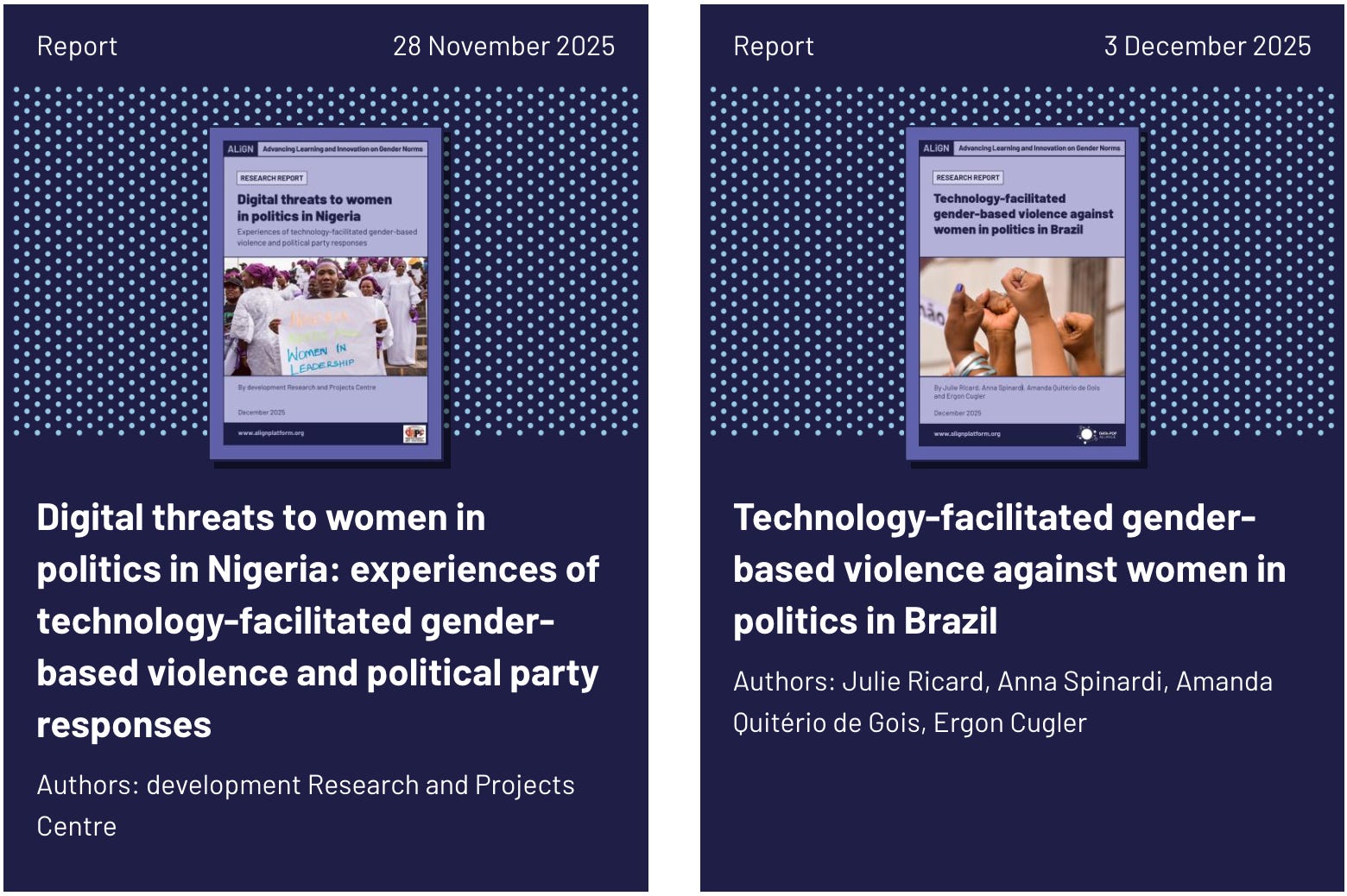
For the reports, ALIGN partnered with Data-Pop Alliance in Brazil and the development Research and Projects Centre in Nigeria. Researchers analysed hundreds of Telegram and X messages, reviewed party policies across both countries, and interviewed dozens of women politicians and party leaders to understand how TF-GBV operates, its impacts, and what effective party responses could look like.
That’s a wrap for this edition! If you liked this compilation, please press the ❤️ button and show us some love! And please, please do share this with a friend or on your social media accounts. There’s frankly nothing quite like reader love and endorsement, so please keep it coming! Thank you!
Disclaimer: #WomenLead is a non-partisan newsletter produced in a personal capacity, and does not reflect any institutional affiliation/opinion. In case of any questions, please drop in a message at womenlead.project@gmail.com.
Comments
Nothing yet. Say the first thing.
Sign in to join the conversation.