
As the midterm elections rapidly approach, and the number of donation requests you receive from Democratic candidates rapidly increases, those of us with limited donation budgets would benefit from paying more attention to which Democratic candidates in key races are overperforming, and which ones are underperforming. To put it a slightly different way, you should try to learn more about which Democratic candidates are doing better or worse than how an average Democrat would be doing in that same campaign, and thus which Democratic campaigns would be trustworthy stewards of your limited donation dollars.
In this regard, there is a somewhat crude but quite useful way to determine how an average Democratic nominee for Senate should be doing against an average Republican nominee for Senate in 2026. Allow me to explain.
(Note: For the purposes of this article, I will be looking at Senate races that are widely expected to competitive in 2026, feature a Democrat vs. a Republican at the top of the ticket, and for which we have a decent amount of recent polling data. I am aware that other races may end up being competitive, and I will look at those later when more data becomes available.)
State partisan leans
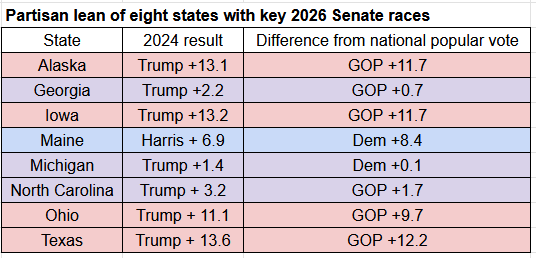
The first step is to measure the partisan lean of every state where there is a key Senate race. This can be done by comparing how a state voted in the 2024 presidential election to the national popular vote for president that year. Given that Trump won the national popular vote by 1.47 points, here is the partisan lean of the eight states that are the focus of this article:
Source: Dave Leip’s Atlas of US Elections
The difference between the national popular vote for president in a given state and how that state voted for president provides you a useful estimate of how much a state would be expected to lean toward one party or the other in the event of a precisely even national environment. So, for example, if the current national electoral environment was 50-50, we would expect a Republican candidate in Alaska to lead by about 12 points, and a Democratic candidate in Maine to lead by about eight points.
Which way does the national political environment lean?
Importantly, we are not currently in an even national political environment where the two major parties are roughly equal. All major trackers of the generic congressional ballot, which provides you the best current estimate of the partisan lean of the national electoral environment, show a clear Democratic advantage. This includes, as of this writing, Nate Silver (Dems +6.6), Decision Desk HQ (Dems + 6.8), Fifty Plus One (Dems +6.5) and Real Clear Politics (Dems + 7.0). These four trackers produce an average result of Dems +6.7.
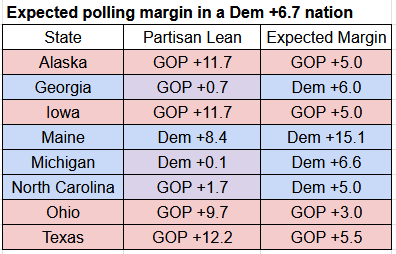
Given the partisan lean of the eight states listed above, and a national electoral environment of Democrats +6.7 points, here is what we would expect the current margins to be if both the Democratic and Republican nominees were average performers compared to the other members of their parties:
The overperformers and the underperformers
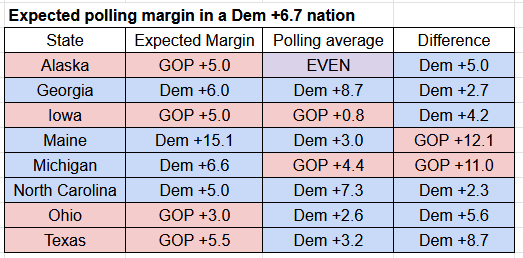
Now, looking at the current polling averages for these eight states on 270toWin, we can compare the expected margin in each state to the current polling averages in those states to get a sense of how the candidates in key Senate races are performing compared to expectations:
And, here are those results sorted by Democratic overperformance, from highest to lowest:
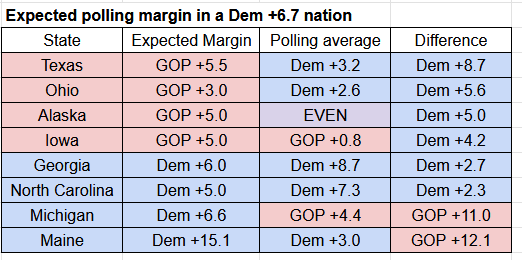
We can see that Democrats are heavily underperforming their expected numbers in Maine and Michigan, while they are outperforming expectations in the other six races—especially in Texas.
However, before we go finger-pointing or backslapping, there is one more factor we need to consider.
General elections are two-player games
One important assumption of these expected margins is that both major parties will nominate an entirely average candidate, someone who performs no better or worse than the median member of that party. However, it basically never works out that way. One or both candidates is usually a little better, or worse, than average.
General elections are two-player games, so it can be difficult to tell which of the candidates—or both—are underperforming or overperforming. One way to solve this problem is to look at the past electoral performance of the candidates on the ballot, and see how they performed compared to expectations in earlier years.
As I wrote in my recent article “Look for the Overperformers,” Sherrod Brown, Mary Peltola, and Josh Turek, who are the Democratic nominees in for U.S. Senate in Ohio, Alaska, and Iowa respectively, have a history of significantly outperforming what an average Democratic candidate would achieve. As such, that all three are once again outperforming expectations this year is not at all surprising.
In North Carolina, former Gov. Roy Cooper is the Democratic nominee. Cooper twice won elections for governor, in 2016 and 2020. In both years, the Democratic nominee for president, Hillary Clinton and Joe Biden respectively, narrowly lost North Carolina to Donald Trump despite winning the national popular vote. So, Cooper clearly has a history of overperforming what an average Democrat would accomplish, and it is not surprising to see him doing so again.
In Georgia, Sen. Jon Ossoff is, somewhat surprisingly, outperforming his expected poll standing. In 2020, Ossoff underperformed, at least in the November general election, scoring 47.95% percent of the vote in a state where Biden won 49.47% of the vote. However, Ossoff’s opponent, Rep. Mike Collins, has also put in a slightly below average performance in his races for Congress, according to Split Ticket. So, it is possible that Ossoff has improved as a politician since 2020, that the below-average Collins is giving Ossoff a boost, or simply that the polls are slightly skewed in Ossoff’s direction right now.
In Texas, while I believe that Democratic nominee James Talarico is a talented and charismatic candidate, I am inclined to think that a lot of Talarico’s extreme overperformance comes from his Republican opponent, Ken Paxton, being terrible. Paxton has a list of scandals a mile long, little cash on hand, and no outside Republican donors willing to help him so far. In fact, Paxton’s opponent in the Republican primary, John Cornyn, ran huge amounts of negative advertising against him, which has likely provided a real benefit to Talarico by driving Paxton’s numbers down further.
In Maine, I don’t think the big Republican overperformance is entirely the fault of Democratic nominee Troy Jackson or the way former Democratic nominee Graham Platner’s campaign imploded. Susan Collins has just always been an extremely overperforming Republican—in fact, she is the top in the nation at that by some measures. I doubt there is a single Democrat who would meet, much less outperform, expectations against her. I know it might sound kind of ridiculous to say this, but Collins is kind of like LeBron James or Shohei Ohtani. She’s just the best at outperforming her own party, and everyone will look bad when they run against her.
In Michigan, while I recognize writing this will make some people unhappy with me, the extreme Democratic underperformance is likely due to Abdul El-Sayed himself underperforming. El-Sayed’s opponent, Rep. Mike Rogers, lost the Michigan U.S. Senate race to Sen. Elissa Slotkin by 0.34% in 2024, even though Donald Trump won Michigan by 1.41%. That is a clear underperformance that took place less than two years ago, making Rogers a highly unlikely candidate to be crushing expectations right now. Perhaps the polling will move more in El-Sayed’s direction as November approaches, but honestly with very high overperforming Democrats such as Gov. Gretchen Whitmer and Rep. Kristen McDonald Rivet available in Michigan, this did not have to be a difficult race for Team Blue in 2026.
Bang for your buck donation suggestion for the small donor with a limited budget
All of this data is, I think, quite relevant for those of you on limited budgets who want to maximize the impact you can make to help Democrats retake the Senate in 2026.
Looking at it all together, there are two races that really stand out: Mary Peltola in Alaska and Josh Turek in Iowa. Here’s why:
According to the current polling averages, Alaska and Iowa are the two tipping point states that would determine which party controls the U.S. Senate.
Additionally, both Alaska and Iowa are smallish states (at least in terms of population), where running a campaign is nowhere near as expensive as it will be in larger states like Michigan, North Carolina, Georgia, Ohio, or Texas.
The two Democratic candidates, Mary Peltola and Josh Turek, both have a history of outperforming the average Democrat—by a lot—in multiple elections. They also do not appear to be up against particularly challenging Republican opponents, unlike Troy Jackson in Maine.
So, if you are looking for a highly impactful way to give just $10, $20 or $40, right now I recommend donating to Mary Peltola and Josh Turek.
Comments
Nothing yet. Say the first thing.
Sign in to join the conversation.