
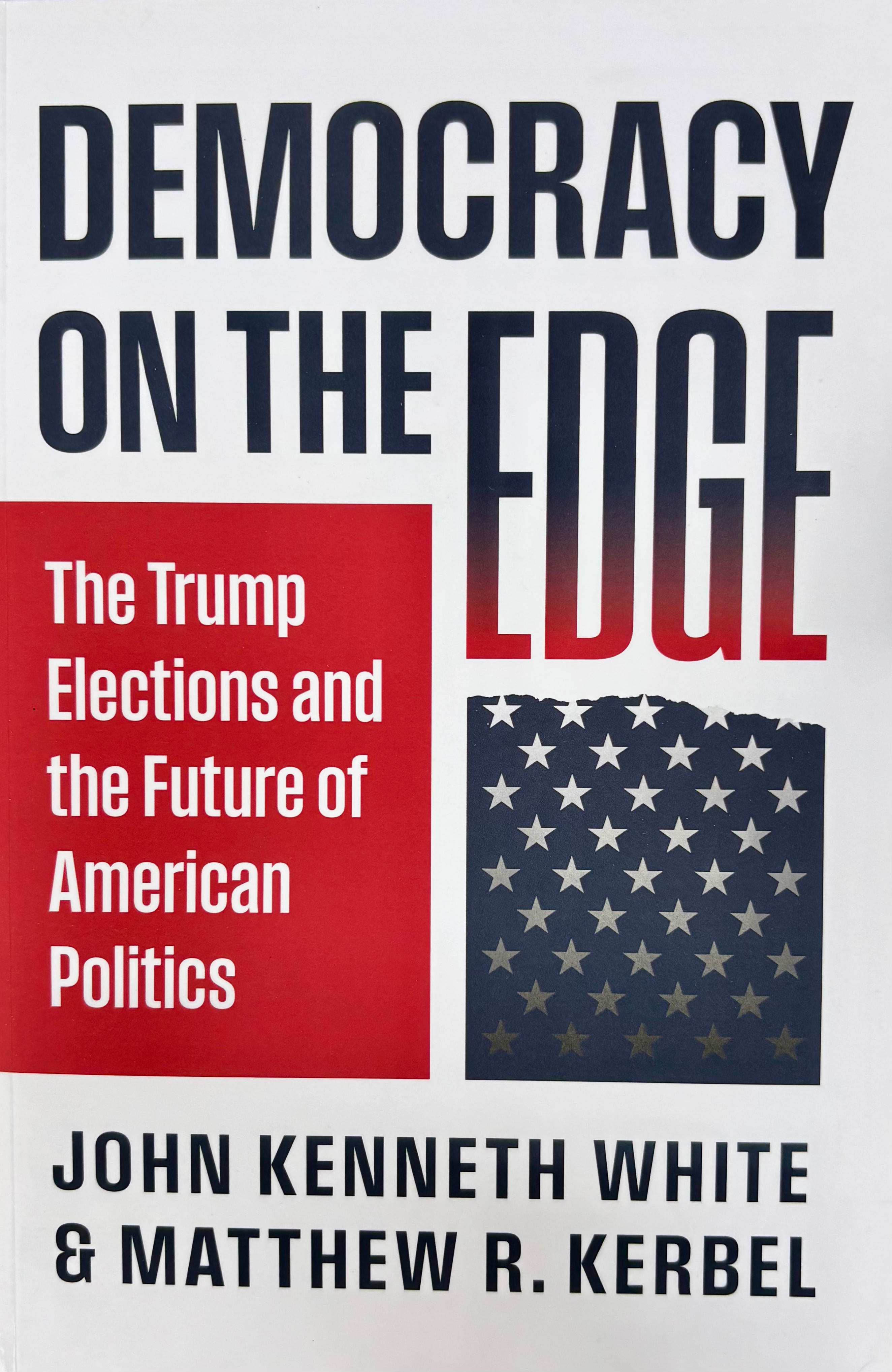
Last Friday, I published an excerpt from my new book, Democracy on the Edge, about why young voters have not become Democrats even though their interests align more closely with Democrats than Republicans.
Today, I’d like to share an excerpt that addresses how Republicans have been able to maneuver and manipulate the political system to govern for years as a minority party.
We can distinguish minority rights from minority rule. The former refers to procedures that give the minority a chance to influence the majority’s agenda. The latter is a perversion of democracy that gives minorities the power to impose their way on the rest of the country. Minority rule is by definition undemocratic and stands in stark contrast to protecting the rights of minorities to be heard in the political process.
The passage below shows how the anti-democratic impulse in today’s Republican party has been building for a long time, and how it has worked to frustrate Democrats from delivering on their promises even when they have had the support of electoral majorities. These disparities will need to be addressed by the next Democratic president.
Until August 31, you can receive a 30% discount when you order Democracy on the Edge from the University Press of Kansas. Just type the discount code 24ONTHEEDGE at checkout.
A Minority Party with Outsized Power
Whenever a political party loses an election, it not only accommodates itself to its unhappy present but also argues that its alternative programs deserve both a hearing and a vote. … After Lyndon Johnson’s 1964 landslide victory, House Minority Leader Gerald Ford declared that Republicans should “oppose those proposals of the President and the majority which for one reason or another are unsound or do not get at the problem in the best way.” Ford added that the “minority’s task is to offer good alternatives, so the Congress and the people have a real choice.”
But after consistently winning the presidency starting with Eisenhower’s victory in 1952, Republicans refused to accept the role of loyal opposition to an emerging center-left Democratic party. Consequently, they rejected moderation and selectivity during the Clinton, Obama, and Biden years in favor of being a party of resistance, with consequences for themselves and for the body politic. The conservative scholar Bruce Bartlett writes that, “when a political party abandons ideas, demonizes intellectuals, degrades politics, and simply pursues power for the sake of power,” the result is an inherent inconsistency and an incessant pursuit of power for power’s sake. Republicans became reflexively opposed to whatever Democrats proposed in an attempt to prevent them from any substantive legislative accomplishments that could help them win the next election. With Republicans about to seize control of Congress in 2010, Mitch McConnell bluntly stated, “The single most important thing we want to achieve is for President Obama to be a one-term president.” While a unified opposition party didn’t accomplish McConnell’s ultimate objective, it did stymie any further legislative victories for the Democratic president. Thus after the sudden death of the archconservative Supreme Court Justice Antonin Scalia in 2016, McConnell led the Senate in refusing to consider Barack Obama’s nomination of Merrick Garland to the Court. McConnell recalled: “One of my proudest moments was when I looked Barack Obama in the eye and I said, ‘Mr. President, you will not fill the Supreme Court vacancy.’” And with Joe Biden in the White House, Republicans, acting on the orders of Donald Trump, killed an immigration deal that would have added more border patrol agents, devoted more resources to the illegal importation of fentanyl, expedited the asylum process, and allowed the president to close the border should illegal immigration reach a critical level. Mitt Romney said of Trump’s opposition: “The fact that he would communicate to Republican senators and congresspeople that he doesn’t want us to solve the border problem because he wants to blame Biden for it is really appalling.”
This is far different from the way Republicans behaved during the Lyndon Johnson/Gerald Ford era, when they saw their role as offering “good alternatives” to the Democratic majority. Today, the Trump-dominated Republican Party thwarts any diminishment of power by relying on constitutional mechanisms like the Electoral College and the two-senators-per-state constitutional arrangement to have an outsized voice in government. Both the creaky and outdated provisions of the Constitution have created a type of tyranny that its framers hardly envisioned. While grasping the possibility that disproportionate state populations could allow for minority rule, the framers discounted its potential for trouble. …
Things have not worked out that way. Over the years, the disproportionate numbers between rural and more heavily populated states have grown. Back in 1790, a voter in Delaware had approximately thirteen times more influence in the Senate than a voter in Virginia.[1] Today, California has sixty-eight times the population of Wyoming, yet each state has two senators. The numbers are so out of whack that only in 2002, 2010, and 2014 did Republicans control the Senate after winning a majority of the votes cast in all Senate races.[2] Undoubtedly, given their warnings about the potential for minority rule, the framers would be aghast at today’s disparities. And they would no doubt recognize the danger to democracy with that rule being exercised by an anti-democratic, Trump-controlled Republican Party.
The filibuster is another device Republicans have used to exercise outsized power. The filibuster was not used in the first Congresses until 1806 when the Senate, acting on the suggestion of Aaron Burr, ruled that any motion to end debate and move to a final vote was an unnecessary duplication, thereby creating the conditions under which filibusters could occur. Filibuster rules have been modified several times since, but a reform-minded Congress in 1975 added a provision that put the burden of ending a filibuster on the majority. This allowed the filibuster to be automatically deployed on nearly every vote. Thus every contested measure needs to clear a herculean threshold of sixty votes to pass. Consequently, Republicans have been disincentivized from taking positions that can be embraced by a majority of voters because the filibuster gives them power whether or not they hold a Senate majority. …
The rickety Electoral College compounds this problem. In this century, Republicans have twice lost the popular vote (2000 and 2016) yet won the presidency. In 2000, Al Gore outpaced George W. Bush by more than 500,000 votes but Bush garnered 271 electoral votes. Sixteen years later, Hillary Clinton won nearly three million more votes than Donald Trump but lost the Electoral College by 304 votes to 227.[3] Had just 40,000 votes in three states flipped from Biden to Trump in 2020, Trump would have held the presidency despite having lost to Joe Biden by seven million votes. The Electoral College has twice permitted Republicans to govern despite being popular vote runners-up. Although designed as a lowercase r republican mechanism to give some control over presidential elections to the states, the effect was literally to establish minority rule.
Finally, the United States Supreme Court has given Republicans extraordinary opportunities to exercise undue power. Beginning in the 1980s, Republicans elevated judges who promised to be “strict constructionists” and would interpret the constitution in ways that restrict the power of the federal government. An organized effort to identify such jurists was undertaken by the right-wing Federalist Society, which eventually supplanted the neutral American Bar Association as the arbiter of Republicans’ Supreme Court nominees. For Trump, the imprimatur of the Federalist Society was necessary to reassure conservatives he would faithfully execute their desires. In 2016, Trump took the unusual step of releasing a list of names of those he would appoint as federal judges should he become president. He kept that promise, elevating three Federalist Society-approved candidates to the Supreme Court.[4] Before him, George W. Bush did likewise, appointing two justices.[5] Together, these presidents—each one initially elected without a popular vote majority— built a durable conservative Court majority.
The imposition of a creeping counter-majoritarianism has been buttressed by the Republican Party’s very successful efforts at using the gerrymander to redraw House districts. During the Obama years, Republicans used every means at their disposal to ensure House majorities for the remainder of the 2010s and into the next decade. Thus in 2016 Republicans won 48 percent of the popular vote for the House yet controlled 55 percent of the seats. The conservative Supreme Court helped by ruling that partisan gerrymandering claims were beyond the reach of the federal courts, leaving in place most lines drawn by Republicans.
And to make sure they do not lose power, Republican-controlled state legislatures have limited early voting days, enacted new restrictions on absentee voting, and required voters to produce identification as Republican lawyers and poll watchers challenged results without merit and intimidated poll workers. According to Steven Levitsky and Daniel Ziblatt, this was a new form of “lawfare,” that is, “legislation that was ostensibly aimed at combating fraud but in reality was designed to dampen turnout among lower-income, minority, and younger voters.”[6] The former Republican strategist Stuart Stevens likens such measures to the Democrats’ use of the poll tax and literacy tests after the Civil War to prevent newly enfranchised African Americans from entering the voting booths.[7]
If you’re interested in reading more about Democracy on the Edge, you can click here to access the book’s home page on the University Press of Kansas website. And if you order a copy before August 31, you can receive 30% off the list price by typing the discount code 24ONTHEEDGE at checkout.
[1] Steven Levitsky and Daniel Ziblatt, Tyranny of the Minority: Why American Democracy Reached the Breaking Point (New York: Crown, 2024), 169.
[2] Levitsky and Ziblatt, Tyranny of the Minority, 175.
[3] There were five electoral college write-in votes that year.
[4] Neil Gorsuch, Brett Kavanaugh, and Amy Coney Barrett.
[5] John Roberts and Samuel Alito.
[6] Levitsky and Ziblatt, Tyranny of the Minority, 111.
[7] Levitsky and Ziblatt, Tyranny of the Minority, 111.
Comments
Nothing yet. Say the first thing.
Sign in to join the conversation.