
This is the third installment in a short narrative sub-series for Fallen Continent. Click here to read the previous chapter, if you haven’t already.
US Highway 2, Montana. The Fort Peck Military Administration.
“Couldn’t they have just flown us here?” groaned a young man’s voice, which was normally heard singing or cracking jokes by those in its vicinity. “I know this town has an airport. No Dollar General, but an airport.”
“Use your brain, Melchior,” snapped Sir Fulk, sitting in the shotgun seat ahead of his impatient subordinate. “You can’t transport cement in a bush plane.”
Sitting beside Sir Fulk in the driver’s seat was Joe Hopkins, the outlaw-come-squire who was now driving a troop transporter for the Knights Templar. The drive from the Templar outpost of Malta to the remote hamlet of Glasgow was only seventy miles, but the poor condition of U.S. Route 2 had stretched the length of the trip to several hours. Their cargo really should have been transported by rail, but the old Amtrak line was in even worse condition than its asphalt counterpart. It may have even been easier to travel down the Milk River by flatboat, but the Commander insisted they keep their vehicles in active use, lest they dwindle and rust in the garage.
It had been a long and eventful summer since Joe joined the Templars. The contentious election of Grand Master Baldwin ushered in a flurry of reforms. Rival Commander Bohemond’s misgivings towards the new Grand Master sparked concerns of civil war, but the tension soon dissipated. A new scare arose in the north, when the “State of Alberta” in Cardston threatened to join the United States in Bozeman. When Bohemond was placed in command of a special task force meant to harry the Albertan border, it dispelled the Bohemond faction’s fears that Baldwin was some sort of Bozeman sympathizer. The Alberta Crisis passed into memory, and Bohemond was next sent to garrison the dam town of Fort Peck and hasten its incorporation into the Templars.
“It’s a smart move, on Baldwin’s part,” Joe remembered Fulk telling him when the news broke. “Gives the old fox something productive to do, instead of plotting and scheming in his compound at Fort Benton. And it keeps him far, far away from Bozeman, where he might do something stupid.”
Indeed it was far; Joe once heard that Glasgow was the most isolated city in the entire mainland United States, although he found it hard to believe. When the hamlet hove into view, Joe knew that the company had nearly reached the end of its voyage. One southward swing, and they would be right in Fort Peck. Their job was simple: deliver supplies to the Army Engineers that maintained the dam, rotate out the troops under Commander Bohemond with a fresh garrison, and return to Malta with the retiring knights. Behind them was a small wagon train of sutlers and camp followers who intended to trade with the locals and any visiting Lakota Indians. First among them, in Joe’s reckoning, was Anna, a sutler-woman with whom he had become closely acquainted since joining the Knights Templar. He was, by now, quite certain of his feelings for her, and was waiting only to improve his station in life before advancing with a marriage proposal.
Glasgow, a town bifurcated by the inactive railroad and overshadowed by the colossal airport that once housed B-52 Stratofortress bombers in the 20th Century, was eerily quiet. Extremely remote as it was, it was still the largest settlement of northeastern Montana, making it the economic hub of an otherwise lawless and uncivilized wasteland. This made it attractive for Badlands raiders, which in turn necessitated a sizable military presence to ward off a potential threat. The palisade which encircled the city, ordinarily bristling with guns, stood as bare as the felled logs from which it was fashioned. Only a skeleton crew of Templars manned the gates, who silently raised the red-and-white crossing bar and waved the arriving host through the checkpoint. Topping off their gas tanks at a filling station, the company pontificated the situation.
“With all of Bohemond’s ravings about raiders,” Fulk assessed, “You’d think he would keep a tighter watch on this town.”
“That’s why we’re here, aren’t we?” countered Sir Hugh, an argumentative and self-important knight who had a habit of contradicting Fulk at every opportunity. Fulk couldn’t stand his presence, but Hugh was a known associate of Commander Bohemond, who had specifically requested him for the mission. “If anyone’s fighting raiders around here, it’ll have to be us.”
Fulk scanned his surroundings. An uneasy expression grew on his face. “That’s the problem. I haven’t seen a single Army Engineer since we arrived. There’s barely any Templars here as is. Even after we rotate the garrison at Fort Peck, that still leaves Glasgow half-abandoned.”
“Then they must be out chasing raiders,” Hugh dismissed. “I’m sure we’ll get a good explanation from Bohemond when we get there.”
With their fuel replenished, the Templars boarded their vehicles once more and departed. The sentries at the southeastern gate bid them go with icy gazes and pursed lips.
The cement trucks trundled behind the infantry vehicles in good order, although some of the sutlers and stragglers encountered difficulty at the last checkpoint. Joe watched in suspense through his side-view mirror as Anna’s truck was halted by a helmeted guardsman and inspected for contraband.
“Don’t worry about your girlfriend, Joe,” Fulk reassured him. “They’re just doing their due diligence.”
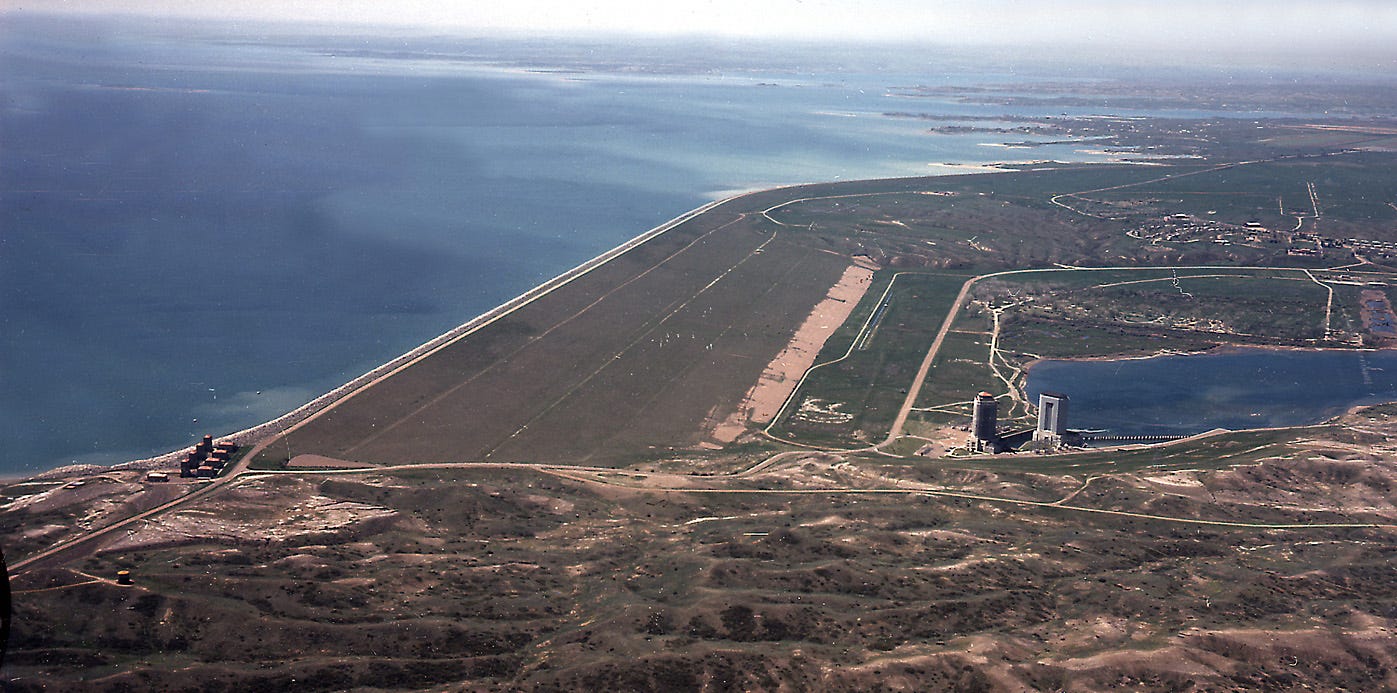
The settlement of Fort Peck was a different matter from Glasgow entirely. Its civilian population before the Great War was miniscule compared to Glasgow, but its vital infrastructure necessitated a permanent habitation of handymen and the everyday laborers who supported them, in addition to the standard amenities of a military town. And a military town it was, teeming with Templar soldiers, armed to the teeth and sporting the distinguishing Templar armband over their khaki fatigues and hunters’ camo. Glasgow hosted only the tiniest knightly garrison; here in Fort Peck, they were crawling all over the place. Curiously, for every Templar present, there stood in serried ranks an equally-heavily armed Indian, with Lakota, Dakota, and Assiniboia tribal banners fluttering in the breeze. Yet not a single standard of the U.S. Army Corps of Engineers flew beside it, nor did any uniform present bear the familiar shoulder patch of a golden castle on a red shield.
Fulk scratched his head, observing the unnerving scene. “Just what the hell is going on here?” he exclaimed.
“We’re going to war, Fulk,” brayed the harsh voice of Commander Bohemond, striding out of an SUV that pulled up beside the arriving Templars. “It’s a good thing you arrived when you did.”
The knight’s eyes bulged. “Is Macklin finally coming south?” Fulk asked.
“Unload your cargo, bring your men inside. We’ll talk about it over dinner.”
Joe and his friends sat on a long bench in the central mess hall, at the end nearest the elevated table where the knights dined. It was laid out much in the same manner as a medieval lord’s great hall, only with modern brick-and-mortar construction instead of Dark Age masonry. Their supper left something to be desired; coarse bread and lumpy mashed potatoes filled their stomachs and left them bloating, but unsatisfied. Hugh and Fulk ate little better, even though they enjoyed the privilege of conversing with the Commander throughout their meal.
“We’re really going to war with the Manlist?” asked Fulk, pushing around his mashed potatoes with his fork. “How has the news not reached Havre yet?”
“News travels slowly here, and across vast distances,” Bohemond explained. “This is a very recent development. Wherever Macklin leads his army, he sends the smaller warlords fleeing ahead of him. Just yesterday, we repulsed the band of the so-called Army of the Dead, some 50-odd screaming, fanatical berserkers. Macklin discharged them from their stomping grounds in Medicine Lake, and they felt the only place to go was here.”
“And that’s why you’ve recruited the Indians?” said Fulk.
Bohemond lifted a finger as he swallowed his food and washed it down with a swig of ale. “No,” he replied, clearing his throat. “That was a different matter. The Fire Force white-nats are moving up the Yellowstone River and have their sights set on their racial enemies, the red people. I extended my hand in friendship to the Fort Peck Indians, and they’ve accepted. They’ll recognize the authority of the Knights Templar, and I’ll help them take as many skinhead scalps as they wish. Now that they’re here, they might as well help us take down the Manlist.”
The nonchalance in Bohemond’s face stood in stark contrast to the panic growing on Fulk’s. “The Indians are a great help, but that’s hardly enough to stop Roland Macklin! He’s the Canadian Genghis Khan! We have to get word back to Havre!”
Bohemond shook his head. “There’s no time. We need to strike now. He’s still solidifying his grip on the northeast counties. If we ride fast, we can raze his unguarded strongholds in Saskatchewan. He’ll have no choice but to pull back, at which point we’ll be halfway back to Malta carrying a cornucopia of loot.”
“A sound plan, Lord Commander,” Hugh lauded.
All throughout the exchange, Joe craned his neck in his commander’s direction and strained his ear to eavesdrop on their conversation. He relayed what fragments he could make out to his friends, who carefully scrutinized every detail.
“His story doesn’t add up,” surmised Melisende, the banner’s quartermaster and one of the few women to take up arms as a Templar auxiliary. “Fire Force 14 isn’t strong enough to pose a serious threat to the Fort Peck Reservation. Certainly not enough for them to reach out to Bohemond for help.”
“I dunno, I got a dislocated shoulder from a white-nat at Tancred’s Tavern,” said Melchior.
“I’m pretty sure those were Canadians,” Joe replied. “Fire Force is only like 60 guys, Great White North’s a lot bigger.”
“That doesn’t matter!” said an irritated Melisende in a sharp whisper. “What matters is that Bohemond has hundreds of troops that have no good reason to be here, and the Army Engineers are still nowhere to be found. He’s planning something!”
“Then what should we do?” asked Julian, the biggest and quietest member of Joe’s circle. “We’re not really in a position to stop him.”
“We’ll think of something,” said Joe. “Or Mel will, anyhow. We can at least wait until dinner to express our concerns to Fulk.”
After clearing his plate and wiping his face clean, Bohemond delivered his ultimatum. “I only need your troops. All of them, right now, no questions asked.” Fulk hesitated. “You can go up the chain of command and wait for a reply while Macklin bears down on us with the best troops north of the 49th parallel. But if you don’t want him to drink from your skull in a week’s time, you can do as I command.”
Sir Fulk trembled. Agonizing moments passed as he considered the Commander’s offer, then he made his reply. “Very well, Lord Commander. My men are yours.”
The Commander steepled his hands curtly on the table. “Thank you. You’ve done your duty, and now it’s time I do mine.” He briskly rose from the table, chair legs screeching on the hardwood floor. Hugh rose in unison and drew a pistol from his holster. Fulk scarcely had time to look his rival in the eye before Hugh pulled the trigger.
Click here to read the master post of the series, with links at the bottom of the page to all other Fallen Continent entries.
Previous Entry: The Bahamas
Next Entry: The Man of the Hour
No posts
Comments
Nothing yet. Say the first thing.
Sign in to join the conversation.