
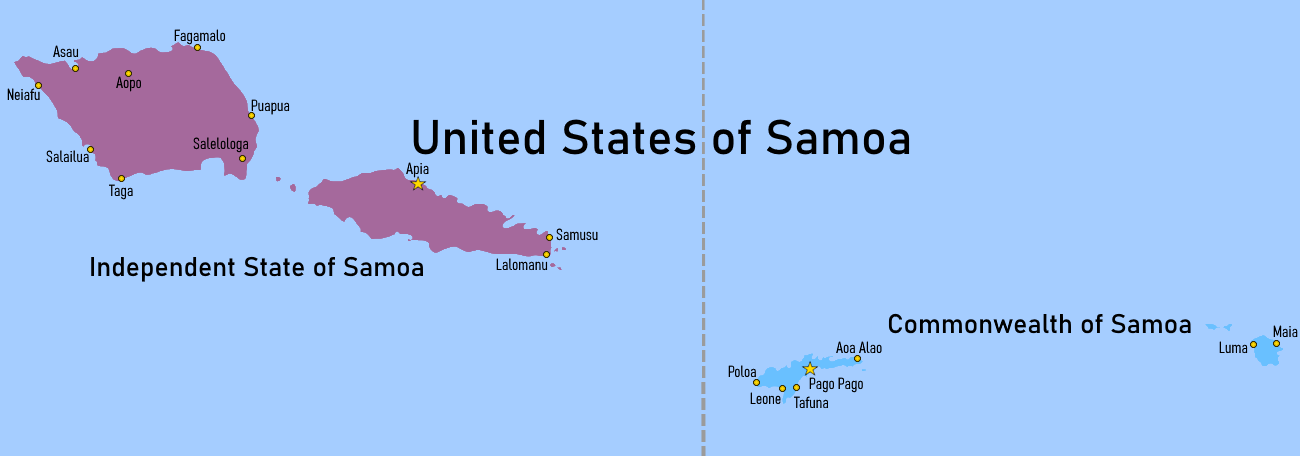
Samoa (Combined)
Population: 190,000
Largest City: Apia
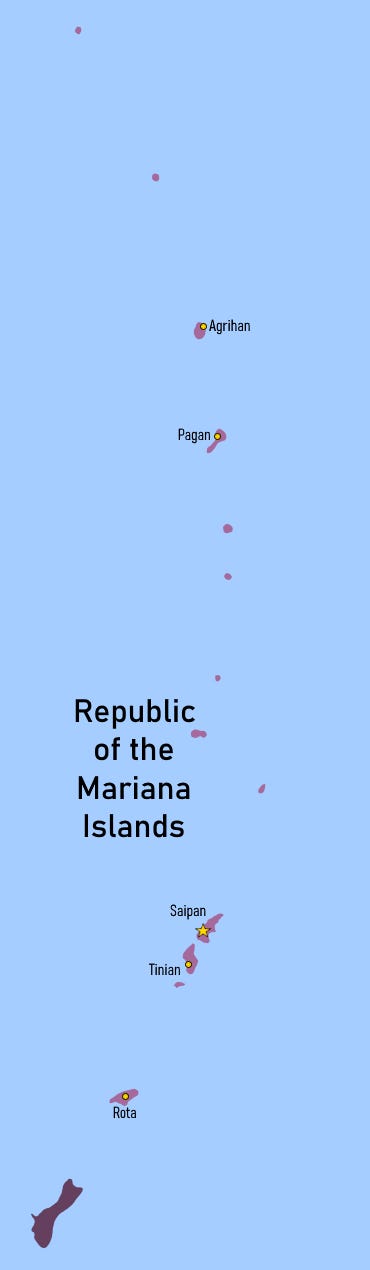
The Mariana Islands (Guam uninhabited)
Population: 60,000
Largest City: Garapan, Saipan
Long considered the playground of the American empire, the United States spent the better part of two centuries acquiring and ruling over the Pacific islands. Some were tethered to the United States as colonies, others were admitted as an integral part of the Union, others were relinquished to their previous owners or newly independent countries, and many others are unable to support human habitation. The post-nuclear age has brought great change to the American Pacific, as the former American territories take control of their own destinies.
Capitals: Apia, Samoa; Pago Pago, American Samoa
Classification: Special Case (Transnational confederation)
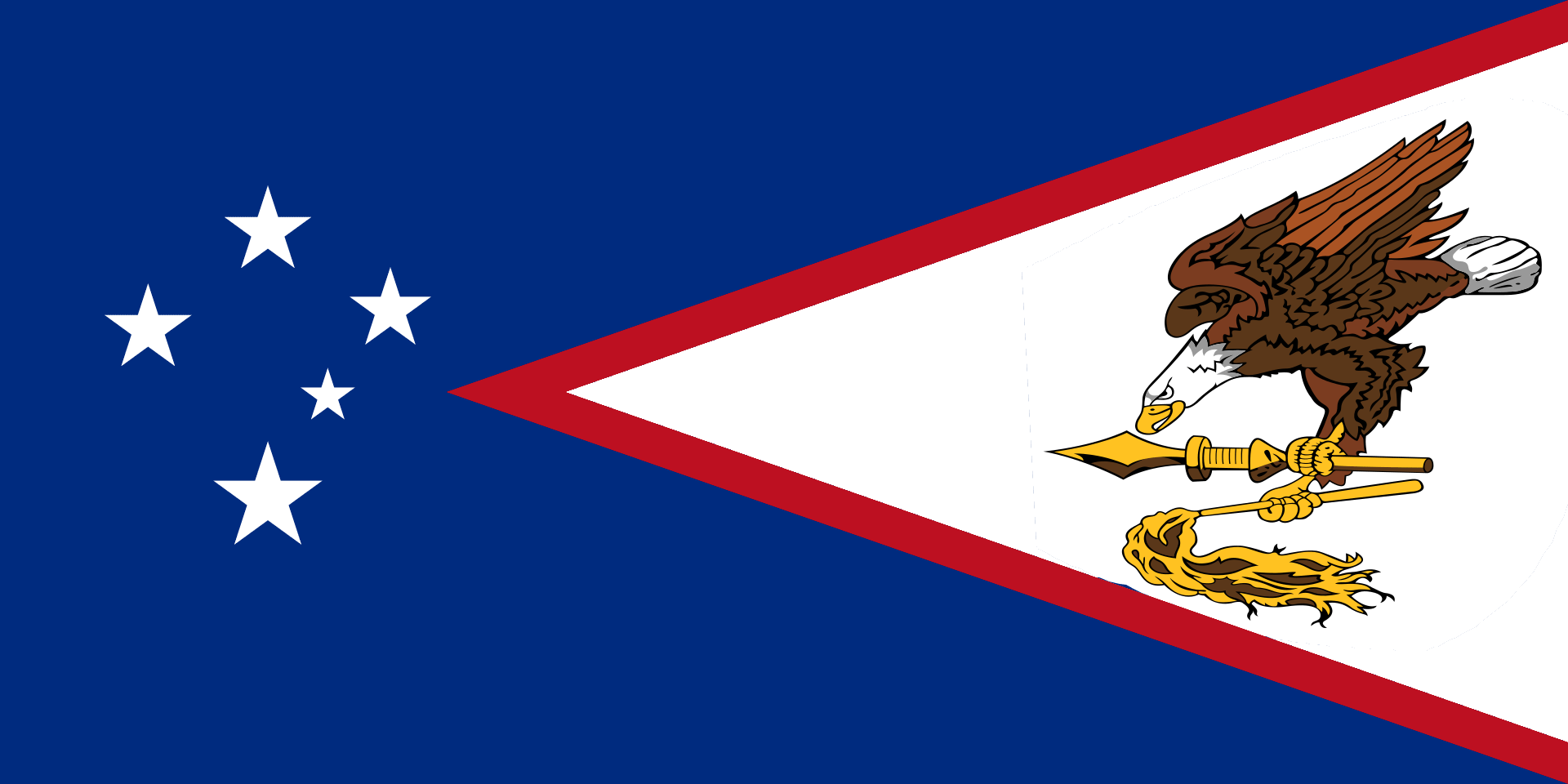
Following the Tripartite Convention of 1899, the Samoan Islands were split between east and west. The western half became a German colony, while the United States annexed the east. German Samoa became a trust territory of New Zealand, which became an independent country in 1962. In 1992, the Independent State of Western Samoa dropped the “Western” from its name, provoking controversy on the other side of the International Date Line.
American Samoa, meanwhile, spent the 20th century gradually regaining autonomy from Washington. Despite remaining an unorganized, unincorporated territory, it elected its own legislature, the Fono, and the Navy-appointed governors were replaced by a locally-elected executive. The upper house of the Fono consists of matai, indigenous chieftains who hold inherited titles. The matai of western Samoa also retain a role in government, holding all the elected seats of parliament. This parliament elects one of the four highest matai, the paramount chieftains of the tama’aiga, as the O le Ao o le Malo, or ceremonial head of state of Samoa, who also serves as a kind of quasi-monarchical figure. American Samoa had no serious intention of admission to the Union prior to the Great War. The Fono voted unanimously against bestowing U.S. birthright citizenship upon American Samoans, and preferred the preservation of their traditional culture over assimilation into the United States.
The Great War, of course, cut American Samoa adrift from its parent country. Although theoretically subject to the Department of the Interior, the Acting Secretary in Twin Falls paid Samoa no mind during his brief, ill-fated term. The longer-lived Amarillo government achieved limited contact with Pago Pago, even if “you’re on your own” was the extent of their communications. The naval regime in Kahului, Hawaii was the last American government to concern itself with the Pacific territories, but by that point Pago Pago sought to distance itself from the United States entirely.
The tidal wave of refugees from North America, Australia, and East Asia fundamentally changed the political, economic, and demographic landscape of Oceania. Known as “the Pacific Continent,” the millions of island-bound boat people (most of whom perished from disease, starvation, and violence) swarmed the isolated and hard-pressed states of the Pacific Ocean. Some nations rode the storm; others were toppled and had to accommodate their new neighbors. Some new countries arose outright from the chaos, other islands degenerated into warlord fiefdoms or anarchic maritime bartertowns.
American Samoa saw what happened to French Polynesia and feared a repeat of the chaos that upended the archipelago. Unfortunately, they lacked the resources to weather the storm on their own. One third of their antebellum economy belonged to the public sector and thus relied on U.S. government funding; another third was solely provided by the StarKist tuna cannery, which turned a profit by exporting to the U.S. mainland. The economy also heavily depended on military service and veterans’ benefits, as a disproportionate share of the population served in the United States military. Moreover, the war itself decimated the American Samoan population, as thousands of soldiers were slain or stranded in distant theaters of combat. Unable to provide or defend for themselves, American Samoa was faced with the choice of refugee conquest, Hawaiian military rule, or union with a foreign power.
Given the other options, the choice was clear. Rather than submit to Kahului, American Samoa approached the Independent State of Samoa and proposed an alliance. Independent Samoa, just as wary of Pacific Continent filibusters as their estranged brothers, was eager to accept. Both Samoas sought the patronage of a foreign power to prop up their economies and aid them in case of invasion, and they found an answer in New Zealand.
Having lost Auckland, Wellington, and Christchurch, New Zealand moved its capital to Dunedin, on the southeast coast of South Island, where it maintained continuity of government. The Dunedin government quashed civil unrest, maintained its grip over both North and South Island, and restored its democratic processes far earlier than most countries. It also projected considerable influence onto the internationally-recognized Australian government in Tasmania, which had effectively become an appendage of its trans-Tasman neighbor. Dunedin didn’t stand a chance against rogue nuclear submarines, but it had the means and the will to bail out the Samoan economy and deter piratical filibusters.
Dunedin fostered deeper cooperation between the two Samoas and helped facilitate their removal from the American Pacific sphere. After years of de facto independence, American Samoa seceded from the United States as the Commonwealth of Samoa. Now fully independent, the Commonwealth formally joined with the Independent State of Samoa to create a new, confederal union: the United States of Samoa.
This new United States binds the two Samoas together in matters of defense, commerce, and foreign diplomacy, but domestic affairs are left to the devolved governments. Additionally, the western Samoan O le Ao o le Malo now serves as the ceremonial president of the entire union, who can now be chosen from among the faʻasuaga, the eastern Samoan paramount chiefs, as well as the western tama’aiga. He still retains some ceremonial power in western Samoa, such as the ability to dissolve parliament or grant pardons, but his status in the east is purely celebrity. After joining the union, the Commonwealth of Samoa changed its time zone to match the Independent State of Samoa, bringing Pago Pago forward by 23 hours and pushing the International Date Line back to the Cook Islands.
Following the Hawaiian Spring, relations between Kahului and the Samoas finally thawed. New Zealand and Australia-Tasmania were quick to establish relations with the newly-proclaimed Republic of Hawaii. The United States of Samoa lagged behind, still skeptical of the old filibuster wave, but are warming up to the idea of renewed diplomatic and commercial ties. There are still Samoan Americans living in Hawaii, among other places, as well as American citizens (as opposed to American nationals) living in Samoa. The most eager proponents of Samoan-Hawaiian relations even desire the USS’ entry into the Compact of Free Association, aping the example of the other American Pacific territory, the Northern Mariana Islands.
Capital: Saipan
Classification: Special Case (Liberalized military government)
Allegiance: Republic of Hawaii (by Compact of Free Association)
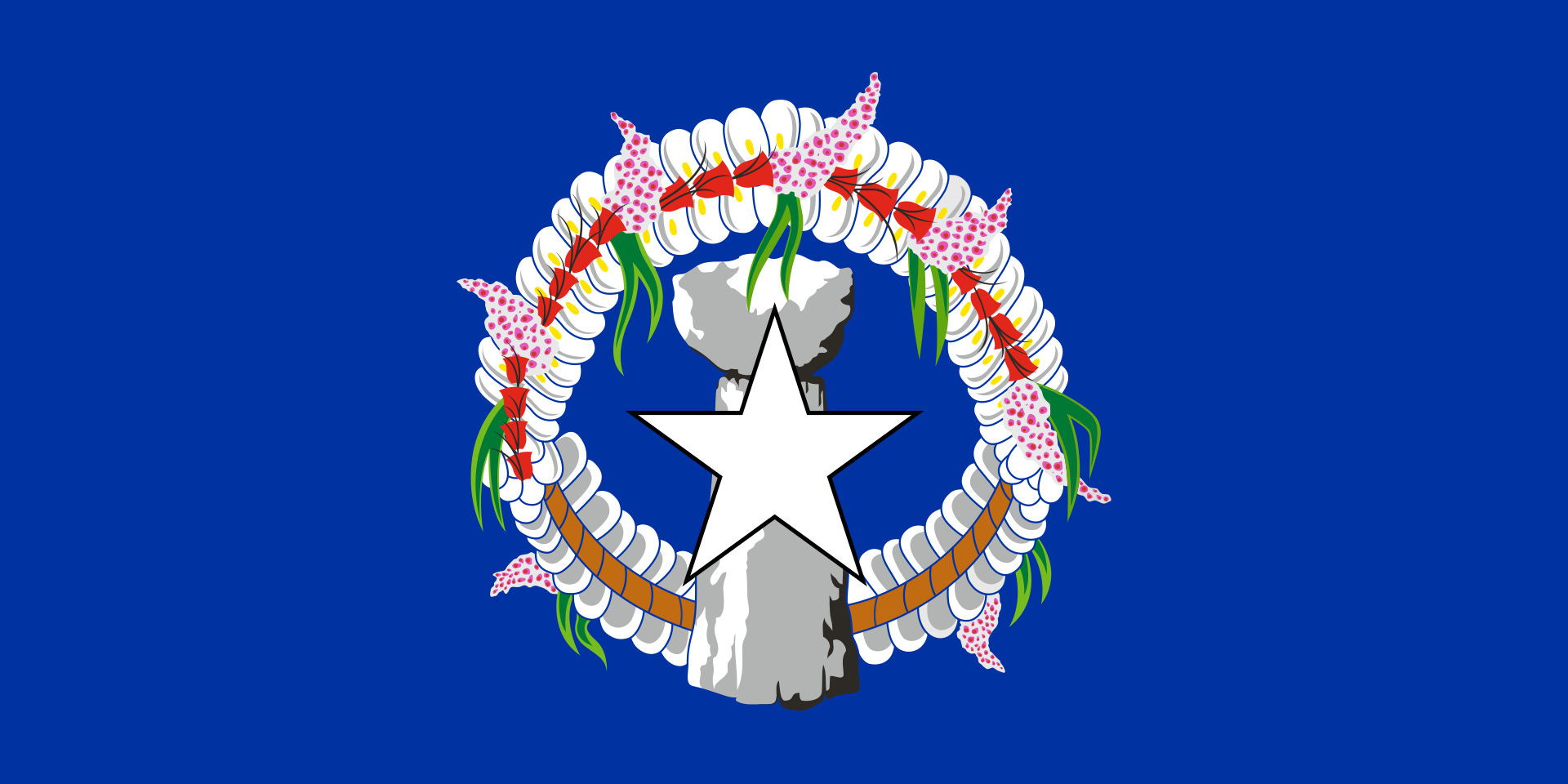
The Mariana Islands once belonged to the Spanish Empire, until Guam was ceded to the United States in 1898 and the Northern Marianas sold to Germany in 1899. After half a century of German and then Japanese colonial rule, the northern islands became a United Nations Trust Territory administered by the United States. The Northern Marianas sought to unite with their southern neighbors, but Guam rejected their request for integration, and the Northern Marianas became their own Commonwealth within the United States.
Guam’s military facilities were struck during the Great War, and the drifting fallout rendered the entire island uninhabitable. Both military personnel and Guamanian civilians were forced to evacuate the island, and the Northern Marianas were the best and nearest option. After beating back the better part of the Chinese PLA Navy, the remnants of the United States Seventh Fleet widely dispersed throughout the western Pacific to evade secondary strikes. Seventh Fleet Task Force 75 had already relocated its headquarters from Guam to Saipan, making them an attractive rallying point as the threat of secondary strikes subsided and ships found themselves free to congregate again. They were joined by U.S. aircraft escaping from East Asia, landing on Saipan and Tinian’s airports before continuing east. Most of the Seventh Fleet eventually relocated to Hawaii and joined the naval government there, but Task Force 75 remained in Saipan with a complement of ships that made up the new task force, including the nuclear submarine U.S.S. Key West and the tag-along Australian frigate H.M.A.S. Perth.
Although the Commonwealth’s civilian government was untouched by the nuclear exchange, Saipan found itself sidelined by Task Force 75. Already saddled with a reputation for nepotism and self-indulgent crony politics, the Commonwealth of the Northern Mariana Islands decayed into an instrument for its members’ protection and enrichment, much like the isolationist state governments of South Dakota and Illinois, until it was eventually dissolved outright by the Navy and replaced with a permanent military administration. The Military Government of the Mariana Islands also included the defunct Guam territory, finally uniting the two Mariana territories into one polity.
The Northern Marianas never suffered any secondary strikes. The only serious challenge from the outside came from Chinese Type 39 conventional attack submarines raiding its shipping. After sinking one submarine out of the three-ship task force, the Key West drove off the other two subs. The greater challenge came from the inside. Ethnic strife between the native Chamorros, Filipino immigrants, Guamanian refugees, American diaspora and military personnel, various Pacific Continent refugees, and the especially-hated Chinese minority provided no shortage of civil unrest for the MGMI to suppress. Although unpopular before the War, the dissolved Commonwealth government was sorely missed by the new democratic opposition, who resented Task Force 75’s imposition of military rule. Residents from all backgrounds felt that the Marianas had been shackled to the Kahului government as a colonial outpost and a first line of defense to absorb Chinese attack.
During the age of military rule, the Navy considered turning the abandoned, volcanically-active island of Pagan into a test range for live-fire training. The descendants of the native Paganians protested the plan, wishing to return to their ancestral home, and Pacific Continent refugees also wished to move off of overcrowded Saipan. The MGMI caved to popular demand, although dreams of employing refugees in a proposed coconut plantation were dashed by a volcanic eruption that covered most of Pagan’s arable land. The principle economic facet of the revived Pagan settlement is a profitable tuna fishery, although the threat of continued interruptions (projected to last for thousands to millions of years) prevents further economic investment.
The even further-north island of Agrihan, similarly evacuated in the 20th Century over fears of volcanic eruption, was also resettled by a Navy-sponsored program, who wished to get troublesome Chomorro dissidents and Pacific Continent refugees out of their hair and doing something useful far away from Saipan. Unlike Pagan, no eruptions have occurred on Agrihan, and the desired coconut plantations that Pagan couldn’t harbor are the economic mainstay of Agrihan. Other, smaller settlements have been established on the tinier islands in between Pagan and Saipan, such as Guguan and Alamagan.
After the naval government in Kahului fell during the Hawaiian Spring, the Acting Commander-in-Chief issued a directive for all his subordinate military administrations to follow his lead by holding democratic elections and dissolving military rule. Most of his remote supporters, who tended to recognize Kahului because A) they liked the idea of a straight-forward, no-nonsense military government to sort out the chaos of the post-nuclear age, or B) wanted to recognize someone very far away who couldn’t possibly interfere with their domestic business, refused to follow his dictates and simply shifted their allegiance elsewhere. Things developed differently in the Marianas, and exactly to Kahului’s wishes. Stretched threadbare after decades of unpopular, heavy-handed government, the democratic wave brought on by the Hawaiian Spring crashed onto Saipan and toppled the government before it even had a chance to consider Kahului’s instructions. Following Hawaii’s lead, Task Force 75 disbanded the MGMI, supervised local democratic elections, and seceded from the United States as the Republic of the Mariana Islands.
Although an improvement over the old, politics in the new republic didn’t quite pan out to the wide-eyed protestors’ wishes. Instead of the old, extended family cliques of the territorial Commonwealth, the new Republic is characterized by populistic demagogues and ethnocultural identity politics. As in Hawaii, the military still retains an influential backseat role in Mariana politics, and the American diaspora who lead the majority coalition government are loosely affiliated with them.
During the period of military rule, the island municipalities of Guam were abolished in favor of military districts. With the return of civilian government, the municipalities have returned, including the Northern Islands Municipality. Although Pagan has the largest population of the NIM islands, the local government is based in the less volcanically-active Agrihan. The tiny island of Agujian was also settled after the Great War and now hosts a sugar cane plantation, but the lack of natural harbors has kept its population small, and it is administered as a part of the Tinian municipality.
Guam remains officially uninhabited, and it is the duty of the small Marianan navy to round up and evict the seasonal population of poachers, scavengers, fishers, and various criminals that attempts to set up camp there. Northern Guam won’t be habitable for quite some time, but cleanup and resettlement in the southeast is projected to be commercially viable within the next fifteen years. Guam is currently administered as its own municipality-in-exile, and the Guamanian refugees and their descendants still vote for the exile government, which will be reinstated and broken up into several new municipalities once the island is recolonized.
Having attained independence and a more or less functioning democracy, the Marianas’ principal complaints regarding their relationship with Hawaii were resolved, and the islands were free to renew their relationship with Kahului on fonder terms. They are now members of the Hawaiian Compact of Free Association, the successor to the old US Compact. Along with the Republic of Hawaii, this alliance includes the Republic of Palau, the Republic of the Marshall Islands, and the Federated States of Micronesia. This loosely ties their economic and military structure to those of Hawaii, as Compact members can all enlist in the Hawaiian military and earn Hawaiian citizenship, and many of their governmental services and disaster programs are run by Kahului.
The Compact belongs to a wider, more informal web of Pacific commerce and diplomacy, loosely oriented around New Zealand, the United States of Samoa, the reformed government of Papua New Guinea, and the Australian rump government in Tasmania. Compact members, also known as Freely Associated States, have all earned the recognition of Japan for their denunciation of the rogue military regime that occupies Okinawa. The possible next addition to the Compact is controversial, and its potential inclusion bodes a startling change in democratic Hawaii’s attitude towards rogue military polities: the Republic of Jackson.
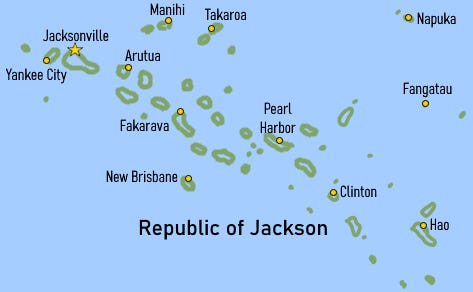
Tuamotu Islands
Population: 25,000
Largest City: Jacksonville (Rangiroa)
Capital: Jacksonville (Rangiroa), Tuamotu Islands, French Polynesia
Classification: Military Faction (Nuclear submarine state)
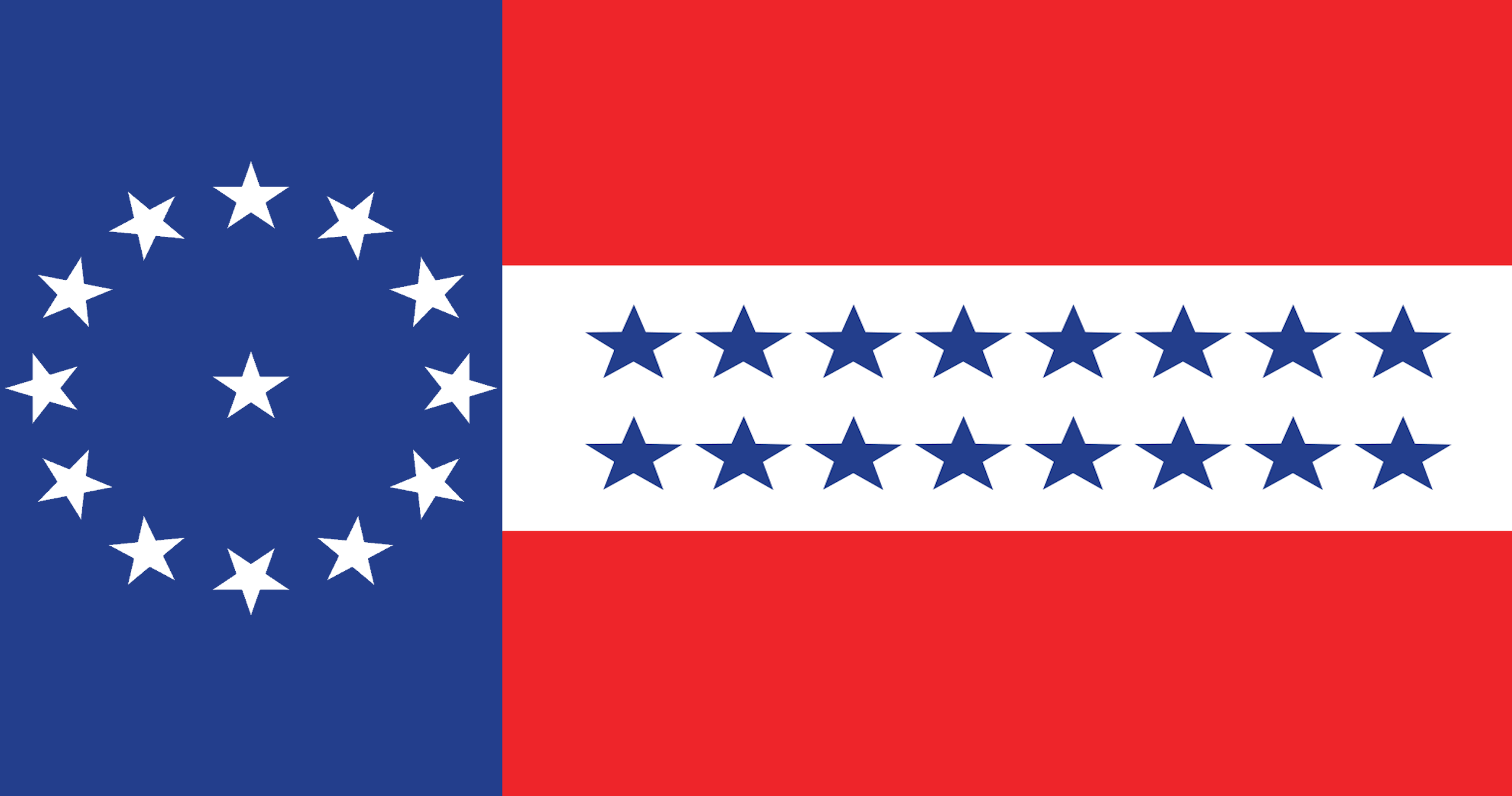
The Republic of Jackson is the quintessential submarine state. After gallivanting around the South Pacific for two years, battling rogue Chinese submarines and dodging nuclear missiles, the rogue Ohio-class nuclear submarine U.S.S. Henry M. Jackson put in at Rangiroa harbor in French Polynesia. Unwilling to submit to the Acting Commander-in-Chief’s authority and unable to carry on the war in Asia or return to their old homes, the Henry M. Jackson instead sought to make a new home somewhere else, acting in the long tradition of Manifest Destiny.
Disregarding the integrity of their French allies, the submariners sailed into the lagoon and proclaimed their sovereignty over all the Tuamotu and Gambier Islands. They backed up their claims in the usual carrot-and-stick fashion of rogue submarine states: free nuclear power and protection to their supporters, the threat of atomic annihilation to their enemies. While such a brazen action might have provoked opposition in the South Atlantic, where the international community was strong enough to work against them (and indeed this happened to Britain’s H.M.S. Dreadnought when it attempted to conquer Namibia), the only power in the Pacific that could have stopped the Jacksonians was the U.S. government in Kahului. At the time, Kahului’s policy was one of ignorance and deflection, refusing to condemn or support rogue elements and hoping they eventually come to their senses and rejoin the United States. And if the USA gets a 51st State in French Polynesia or Okinawa, why pass the opportunity up?
The rest of the Pacific did not look upon Jackson with such benign neglect. Despite the numerous economic sanctions and diplomatic condemnations, Jackson had nukes and electricity, and this was enough for English-speaking refugees from across the Pacific Continent to move there. Wholly undemocratic and brazenly prejudiced against nonwhite settlers and locals, Jackson earned the undying support of its preferred demographic, who upturned these downtrodden refugees into tropical aristocrats. The military dictatorship evolved into an oligarchic republic, as the Captain stepped down to hold presidential elections, in which the small, armed, land-holding electorate voted him right back into power.
The Republic of Jackson hasn’t evolved much since its inception. It is a politically uncomplicated state: a colonial filibuster realm backed up by economic momentum (however exploitative) and a nuclear arsenal. Yet their plantations, fisheries, and cottage industries reap a tidy profit, and their influential settler base serves as an important nexus for American and Australian diaspora throughout the Pacific Continent, who tend to look after their own now that there is no United States to defend them.
Time has passed, and the Pacific increasingly sees Jackson not as an aberration, but as a fact of life. Having failed to break its economy through sanctions, foreign states withdrew their sanctions and opened up trade with the new republic. The first states to officially recognize Jackson were fellow upstarts, like the tourist-kingdom of Bora Bora. Next came the more legitimate states who were nonetheless altered by the Pacific Continent phenomenon, like Papua New Guinea and New Caledonia. Finally, opinion is warming up enough for the “mainstream” Pacific states to potentially recognize the filibuster republic. Membership in the Compact of Free Association is even on the table, reflecting a recent resurgence in Hawaiian conservatism after the naval old guard’s nadir in the Hawaiian Spring. Hawaii is less ashamed of its role in American Pacific imperialism than it once was, and either a surge of Jacksonian liberalism or Hawaiian conservatism might be enough to land Jackson as the sixth Freely Associated State.
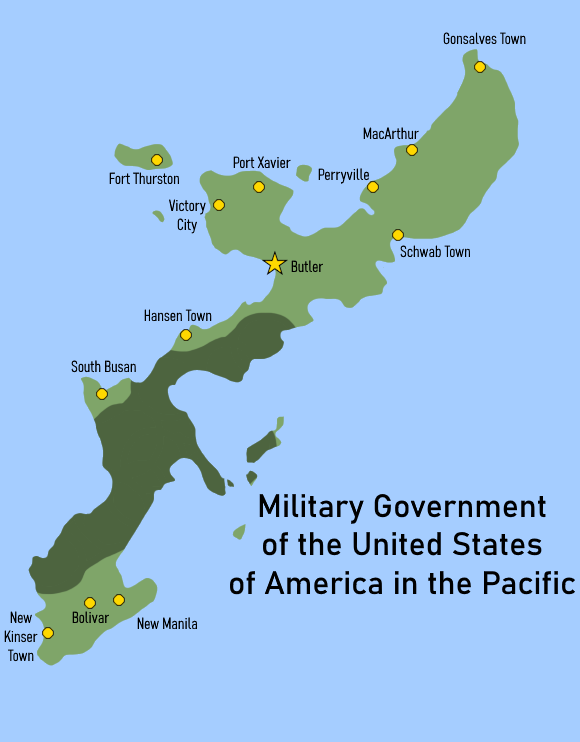
Okinawa
Population: 200,000
Largest City: Butler (Nago)
Capital: Butler (Nago), Okinawa, Japan
Classification: Military Faction (Rogue military unit)
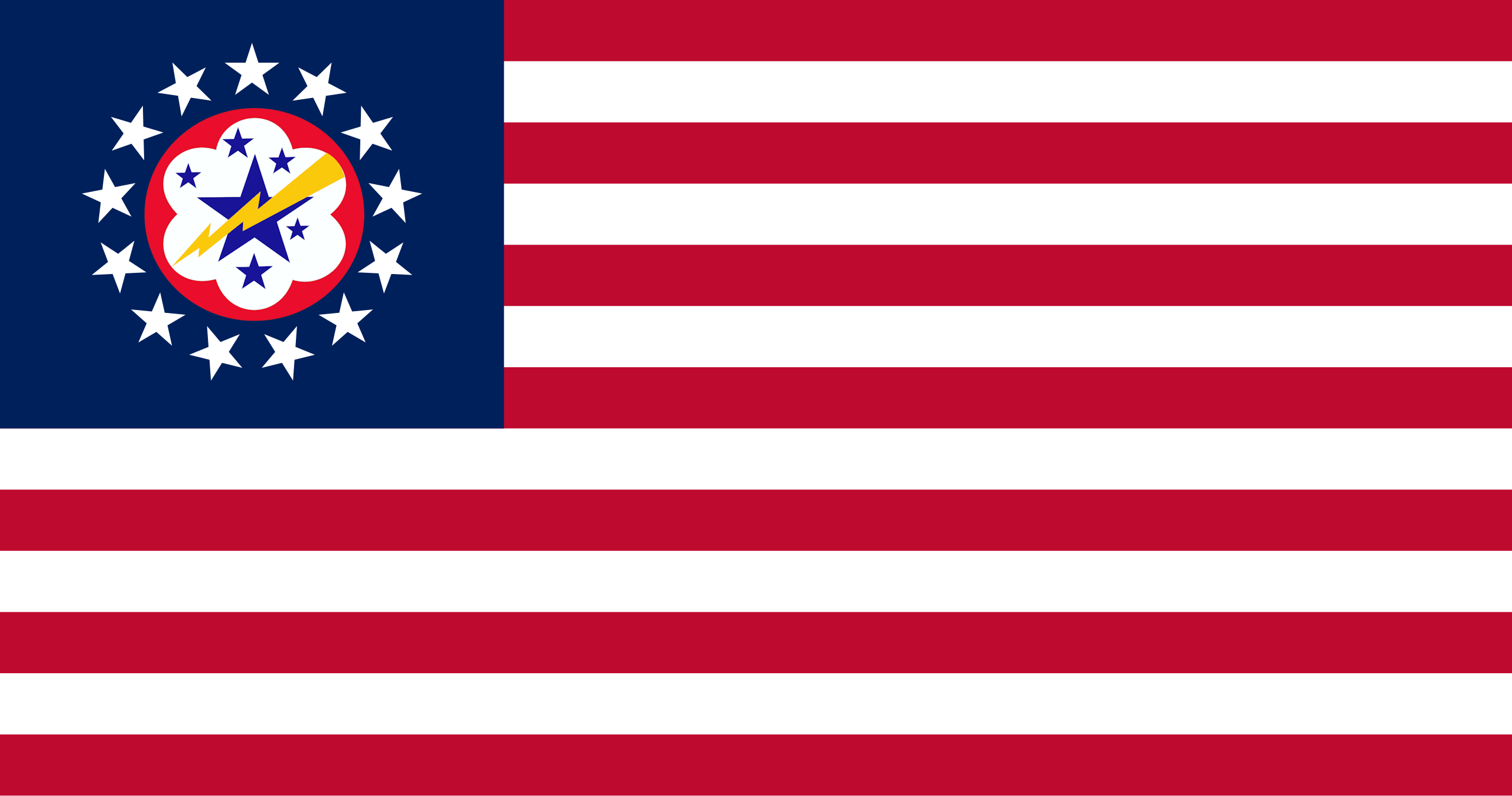
While Hawaii and the Marianas liberalized and the Tuamotus thawed into a state of tepid oligarchy, the US military remnants in Okinawa remain in a state of perpetual Great War fervor. Here are the last true Americans, still in the fight after thirty years of struggle.
The United States Forces Japan have been heavily concentrated on Okinawa ever since the invasion of 1945. The Ryukyuan archipelago was once a territory of the United States, ruled by a military government before its transition to a civil administration and eventual return to Japan. Despite the renewal of Japanese sovereignty over Okinawa, the substantial military presence was impossible to shake, and locals resented their perpetual occupiers. This resentment was made manifest in Okinawa’s historic association with the Japanese Communist Party, Okinawa Social Mass Party, and other left-wing groups.
The Japanese never achieved their goal of evicting the U.S. Armed Forces from Okinawa, or anywhere else in Japan for that matter. The islands were badly hit by nuclear attack during the Great War, and Japan itself suffered a pitifully low survival rate of 2%.1 Okinawa was especially heavily targeted for its many military bases; as several of these bases hosted U.S. nuclear weapons, some of which had yet to be deployed, the fallout was especially dangerous here. Yet many of the U.S. Marines stationed on the island survived. Camp Gonsalves, the mountainous northernmost complex of Marine Corps Base Camp Smedley D. Butler, was widely-spread throughout the northern tip of the island and did not present a viable nuclear target. The Marines dispersed themselves across the peninsula and evaded nuclear destruction, and later rallied in the defense of the island from a Chinese follow-up invasion.
The Camp Gonsalves Marines secured their hold over northern Okinawa, inviting scattered elements of the US military in East Asia to join them, along with odds and ends from South Korea and Taiwan. The Chinese invasion was unwieldy and half-hearted; the East Sea Fleet launched it after the nuclear exchange, partly as a show of force to prove their strength, legitimacy, and patriotism in the unfolding Chinese warlord free-for-all, and partly to deport their dissidents and troublemakers and make them someone else’s problem. The USFJ saw the invasion differently, and fought it as an existential, life-or-death struggle that fundamentally changed their mindset. The Okinawa Marines became ardent anti-communist, ultramilitarist fanatics. The survivors of the Okinawa campaign developed a posthumous cult of personality surrounding the late Marine Corps Major General Clay Thurston, who died in the defense of the island; the city of Ie was later renamed Fort Thurston in his honor.
After grinding the Chinese occupiers to dust in central Okinawa, the Marines turned their attention to the fifth column that they feared was in their midst. Very few Okinawan communists had actually taken up arms in support of the Chinese invaders, yet the Marines confused the populace’s widespread anti-American sentiment for pro-Chinese communist sympathy. The result was a draconian campaign of persecution, repression, and effectively genocide against the local population.
The Marines began with a call for American expatriates throughout East Asia to resettle in Okinawa. With nowhere else to go, this was achieved easily enough, and the U.S. Seventh Fleet helped facilitate the relocation. There were still not enough Americans to provide the USFJ with a sufficiently large and loyal power base, so they went further. They invited refugees from South Korea and Taiwan into Okinawa, and then a tidal wave of Filipino immigrants. They heavily prioritized the newcomers with housing and rations, while locals starved and languished in homelessness and poverty. If anti-American sentiment was only imagined before, the Marines had provoked it into reality. Okinawan gangs roamed the hills and woodlands and poached refugee resettlement camps before retreating into the NEZs. Marine patrols doubled and redoubled after servicemen were ambushed by patriotic bandits. Okinawan trade was strangled by Japanese pirates, with the rest of the archipelago providing safe haven for commerce raiders.
The ethnic struggle worsened as the Marines upped the ante. Racial intermarriage was mandated for the Japanese population, and those who demonstrated insufficient loyalty were deported to Amami and Kyushu. Open dissidents were liquidated, and the NEZ gangs were eradicated in a brutal, years-long urban warfare campaign. The intermarriage decree was extended to the entire population in a surreal imitation of 19th century Paraguay, in the hopes of creating a new caste of Americanized Asians whose loyalty was to the United States Forces Japan alone. The Japanese language was eventually banned, and all Japanese place names were replaced with foreign-language alternatives—mostly the names of American military officers.
Like the rest of the US military factions, the US Forces Japan recognized the naval government in Kahului for several years. While Kahului tried to distance itself from the atrocities committed in its name across the ocean, the USFJ grew to resent Kahului for not appreciating what they saw as great pains undertaken for the sake of their country. The Seventh Fleet had long since evacuated from the west Pacific, leaving the Okinawa Marines to their own isolated existence.
Relations were more or less nonexistent by the time of the Hawaiian Spring, but the USFJ still reacted poorly to Kahului’s orders to hold elections and stand down. Not only did the Marines refuse to democratize, they went a step further and claimed the succession of the military government for themselves. Thus began the Military Government of the United States of America in the Pacific, which coincided with the formal annexation of Okinawa as an organized U.S. territory. Politically, not much changed, although it did make Okinawa an even greater pariah than it already was. Their sole tie with the outside world is the Philippines, whose hard-pressed rump government loves the Okinawa Marines, even if the Tuguegarao government is hesitant to actually recognize them. Most diplomacy between Butler and the outside world is conducted through the Philippine consulate.
With the recent thaw in relations between Hawaii and the Republic of Jackson, some wonder if an eventual rapprochement with Okinawa might follow. Such an outcome is unlikely, given that Japanese-Hawaiian relations now rest entirely on Kahului’s denunciation of the USFJ and affirmed Japanese sovereignty over the islands. A generation has grown up under Butler’s grotesque racial program, and although the intermarriage decree has since been rescinded, the demographic transition is already underway. This generation has grown up under a lifetime of fanatical militarist propaganda, yet its youth are less connected with their American heritage than ever before. Whether the MGUSAP can break out of is isolated shell, or indeed whether it can survive another generation as its Great War veterans enter old age, remains to be seen.
Click here to read the master post of the series, with links at the bottom of the page to all other Fallen Continent entries.
Previous Entry: The Man of the Hour
Next Entry: The Pretender States
The State of Japan retained continuity of government following the Great War and up to the present day. To perpetuate the 2700-year old Japanese monarchy, the rump Diet amended the Imperial Household Law and had the late Prince Hisahito—who had never taken the throne and died alongside his father, reigning uncle, and abdicated grandfather—posthumously adopt an extremely distant member of the Higashuni-no-miya imperial cadet branch, allowing the newly-princed Masahiko Higashikuni to take the Chrysanthemum throne. Hisahito and Masahiko’s last common male ancestor died in 1456.
No posts
Comments
Nothing yet. Say the first thing.
Sign in to join the conversation.