
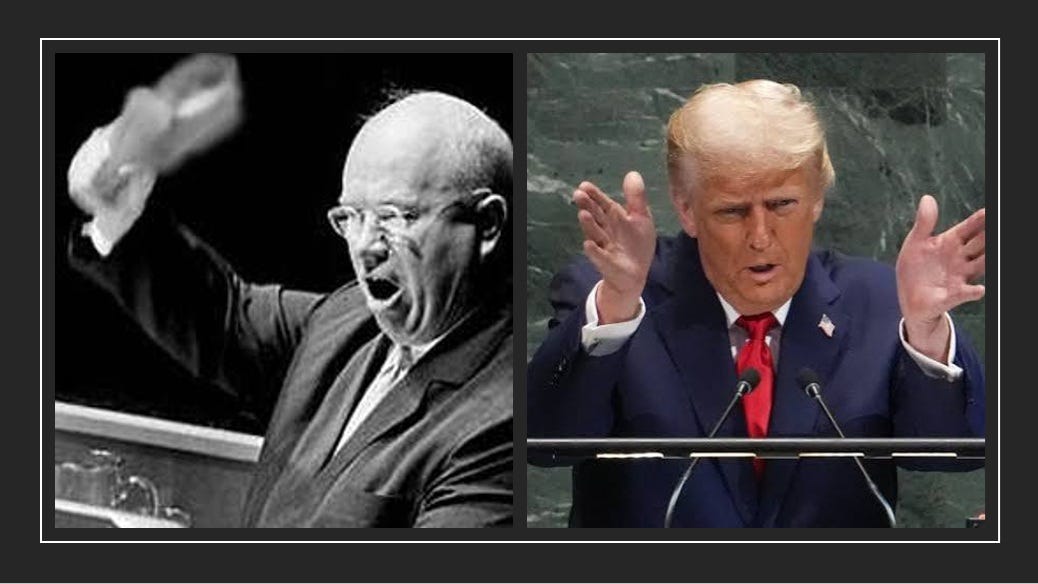
What would have been considered unthinkable a decade ago has now manifested itself itself during the two terms of Donald Trump. The United States has shifted its voting pattern in the United Nations General Assembly and major UN Specialized Agencies to the anti-Western bloc of nations that includes such pariahs as Russia, Belarus. North Korea, Israel, and other decidedly fascist-oriented undemocratic nations. Wayne Madsen Report has conducted a survey of voting patterns and alignments in the General Assembly and those of major UN agencies over the period 1946 to 2026. What we have discovered is a 25 percent shift in votes by the United States, placing its current voting alignment firmly within the anti-Western bloc of member states.
We analyzed seven post-World War II time periods. They include the early Cold War period of 1946 to 1955; the Bandung non-aligned era of 1955 to 1965; the decolonization era of 1965 to 1979; the late Cold War period of 1979 to 1989; the post-Soviet transition time frame of 1990 to 1999; the globalization era of 2000 to 2010; and the multipolar era of 2011 to 2026. The major re-alignment of the United States with the anti-democratic bloc occurred during the two Trump terms (2017 to 2021 and 2025 to the present.
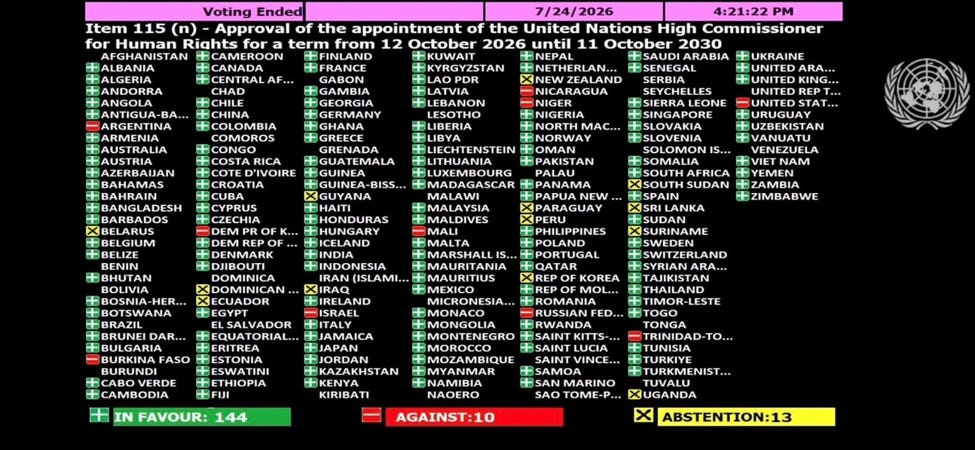
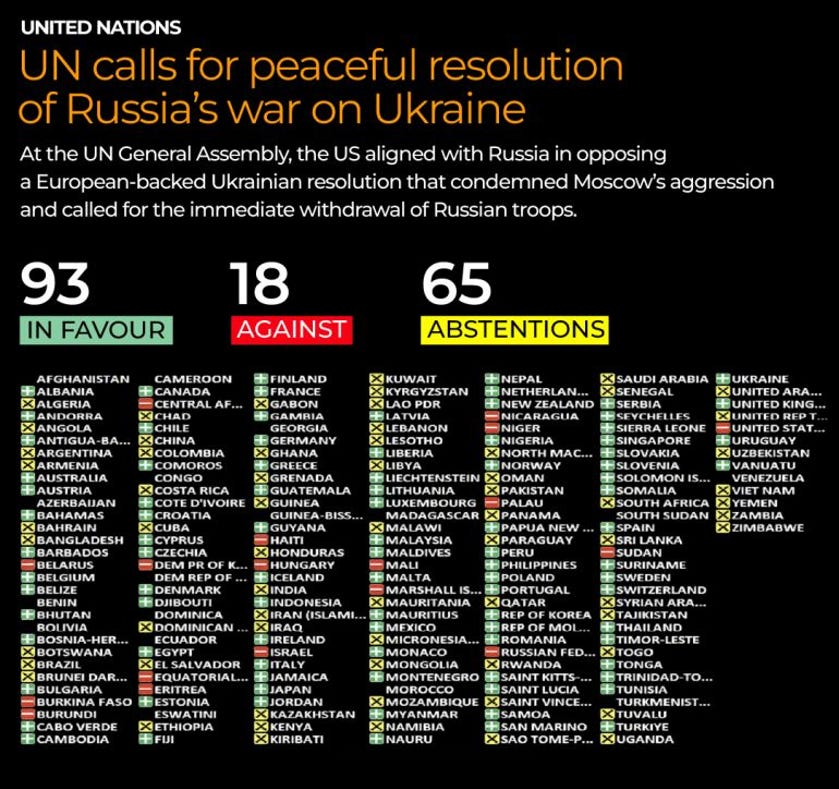
The shift of the United States to the totalitarian and fascist bloc is exemplified by the July 27, 2026 General Assembly vote on the appointment of the UN High Commissioner for Human Rights to a four-year term and a vote on a European resolution calling for Russia to withdraw its troops from Ukraine. In what has become standard policy, the United States was one of ten anti-democratic nations to vote against the Human Rights Commissioner appointment, which was approved by 144 member states. Along with the United States, the “red bloc” on the Human Rights Commissioner included Argentina, Burkina Faso, Democratic Republic of Korea (North Korea), Israel, Mali, Nicaragua, Niger, Russian Federation, and Trinidad and Tobago (which has become a pariah among the Caribbean Community countries). Abstainers and absentees included nations that have previously voted with the “red bloc.” They include Belarus, Bolivia, Burundi, Dominican Republic, Ecuador, El Salvador, Guyana, Iran, Iraq, Paraguay, Peru, Serbia, South Sudan, Suriname, Uganda, and Venezuela. On the European resolution on Russian troops in Ukraine, the U.S, was joined by 17 countries in opposing the call for Russian withdrawal from Ukraine. Other votes in the General Assembly on climate change, Cuba, and multilateral institutions have seen the United States among a minority of pariah nations opposing resolutions supported by a majority of the world’s democratic nations.
The following represents the anti-Western voting blocs in the General Assembly and the plenary bodies of Specialized Agencies like the World Health Organization, UN Educational, Scientific, and Cultural Organization (UNESCO), International Labor Organization (ILO), and others.
The early Cold War period of 1946-1955
Soviet Bloc: Byelorussian SSR, Bulgaria, Czechoslovakia, Hungary, Poland, Romania, Ukrainian SSR, and USSR.
Non-aligned/Neutral Bloc (often voted with Soviet Bloc): Egypt (after 1952), Yugoslavia
The Bandung non-aligned era of 1955-1965
Soviet Bloc: Albania, Byelorussian SSR, Bulgaria, Cuba (after 1959), Czechoslovakia, Hungary, Mongolia, Poland, Romania, Ukrainian SSR, and USSR.
Non-aligned/Neutral Bloc (often voted with Soviet Bloc): Afghanistan, Algeria, Cambodia, Egypt (1952-58), United Arab Republic (Egypt and Syria) (1958-61), Ghana, Indonesia, Tanganyika (until 1964), United Republic of Tanzania (Tanganyika and Zanzibar) after 1964), Yugoslavia, and Zanzibar (1964-64).
The decolonization era of 1965-1979
Soviet Bloc: Afghanistan, Albania, Angola, Byelorussian SSR, Bulgaria, China (People’s Republic after 1971), Cuba, Czechoslovakia, Ethiopia (after 1974), German Democratic Republic (East Germany), Hungary, Laos (after 1975), Libya (after 1970), Mongolia, Mozambique, Poland, South Yemen, Ukrainian SSR, USSR, and Vietnam (after 1977).
Non-aligned/Neutral Bloc (often voted with Soviet Bloc): Algeria, Bangladesh, Dahomey (Benin in 1975), Ceylon (Sri Lanka after 1972), Comoros, Congo (Brazzaville), Egypt (after 1971), Equatorial Guinea, Guinea, Guinea-Bissau, Guyana, India, Iraq, Jamaica, Mali, Peru, United Arab Republic (Egypt) (1961-71), Romania, São Tomé and Principe, Somalia (after 1969), Sudan, Syrian Arab Republic, Yugoslavia, and Zambia.
The late Cold War period of 1979-1989
Soviet Bloc: Afghanistan, Albania, Angola, Byelorussian SSR, Bulgaria, Burma, China, Cuba, Czechoslovakia, Ethiopia, German Democratic Republic (East Germany), Grenada (1979-83), Hungary, Laos, Libya, Mongolia, Mozambique, Nicaragua, Poland, Romania, South Yemen, Ukrainian SSR, USSR, and Vietnam.
Non-aligned/Neutral Bloc (often voted with Soviet Bloc): Algeria, Bangladesh, Benin, Cape Verde, Comoros, Congo (Brazzaville), Democratic Kampuchea, Equatorial Guinea, Guinea-Bissau, Guyana, India, Iran (Islamic Republic of), Iraq, São Tomé and Principe, Seychelles, Sri Lanka, Suriname, Syrian Arab Republic, Uganda, Upper Volta (Burkina Faso in 1984), Yugoslavia, Zambia, and Zimbabwe.
The post-Soviet transition time frame of 1990-1999
Authoritarian/anti-West: Armenia, Azerbaijan, Belarus, China, Cuba, Kazakhstan, Democratic People’s Republic of Korea (North Korea), Laos, Nicaragua, Tajikistan, Turkmenistan, and Uzbekistan.
Non-aligned (often voted authoritarian/anti-West): Algeria, Angola, Burkina Faso, Equatorial Guinea, Georgia, Kyrgyzstan, Libya, Moldova, Russian Federation, Ukraine, Yugoslavia (Federal Republic of), Vietnam, Yemen Arab Republic, and Zimbabwe.
The globalization era of 2000 to 2010
Authoritarian/anti-West: Afghanistan (UN seat contested), Belarus, Democratic People’s Republic of Korea (North Korea), Laos, Nicaragua, Russian Federation, Serbia and Montenegro (2003-2006), Syrian Arab Republic, and Yemen Arab Republic.
Non-aligned (often voted authoritarian/anti-West): Algeria, Armenia, Azerbaijan, Bolivia, Burkina Faso, Cuba, Eritrea, Libya, Myanmar, and Zimbabwe.
The multipolar era of 2011-2026
Authoritarian/anti-West/pro-Russia: Afghanistan, Belarus, Burkina Faso, Central African Republic, Georgia, Iran, Libya, Mali, Nicaragua, Niger, Russian Federation, Sudan, and Syrian Arab Republic.
Authoritarian/anti-democracy/neo-fascist policies: Argentina, Bolivia, Costa Rica, Ecuador, El Salvador, Honduras, India, Israel, Panama, Paraguay, Peru, United States, and Venezuela.
Non-aligned (often votes authoritarian/anti-West): Algeria, Benin, Burundi, Congo, Democratic Republic of Congo, Equatorial Guinea, Eritrea, Ethiopia, Madagascar, Mauritania, South Sudan, Togo, Yemen, Zambia, and Zimbabwe.
Checkbook diplomacy minions of the United States, Russia, and/or Israel: Eswatini, Guyana, Haiti, Kiribati, Lesotho, Marshall Islands, Micronesia, Palau, Suriname, Trinidad and Tobago, and Tuvalu.
Comments
Nothing yet. Say the first thing.
Sign in to join the conversation.