
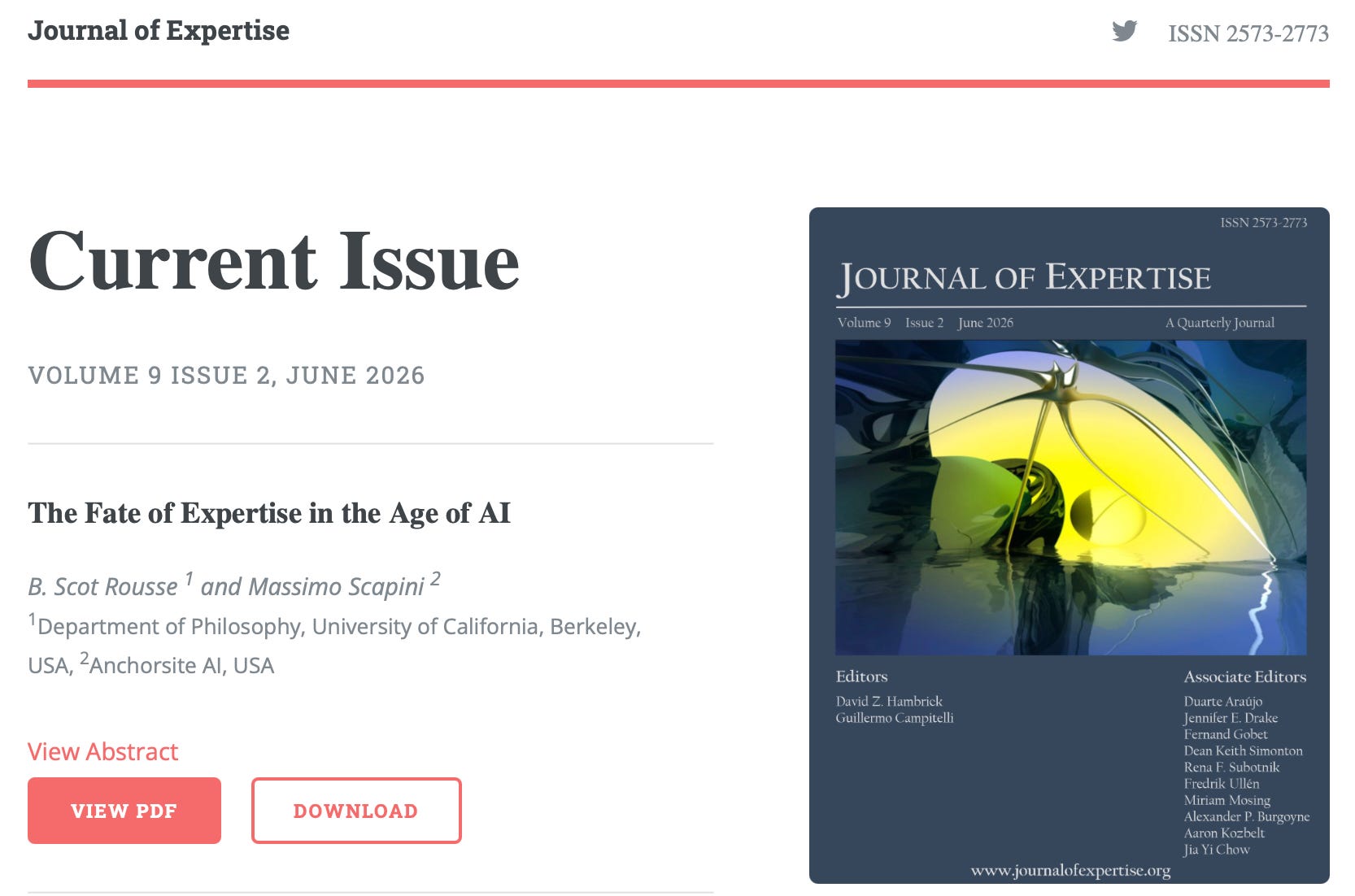
I am happy to report that a new paper that I spent a preposterous number of hours maniacally tweaking and refining has finally been published. “The Fate of Expertise in the Age of AI” — co-authored with Massimo Scapini of Anchorsite AI — appeared earlier this week in Journal of Expertise.
Here is direct link to the pdf of the article, via Journal of Expertise. It is open access.
In this post below I summarize the paper, link to some important background pieces, and then share the concluding section of the paper. The concluding section is called: “Responsibility and the Fate of Expertise.” Please scroll down below to check that out!
In the paper, Massimo and I develop an account of a metamorphosis of expertise now underway as more so-called “cognitive work” becomes mediated by AI.
We argue that the human role is evolving into one of orchestration: guiding machine capabilities that often exceed one’s own, while supplying the intuition needed to frame projects, know what matters, discern quality and breakdown, and remain answerable for the commitments and consequences the work sets in motion.
This paper provides a philosophical grounding for and elaboration of the important recent piece by Arvind Narayanan and Sayash Kapoor on “Why AI hasn’t replaced software engineers, and won’t,” specifically their notion of the “decide-execute-deliver” sandwich that is typical of human work.
The paper draws upon and extends the Dreyfus Model of Skill Acquisition (see below for more on this) and Terry Winograd & Fernando Flores’s foundations of human-computer-interaction (as presented in Understanding Computers and Cognition) in order to develop an account of how human intuition and responsibility will continue to play a role, especially in the “deciding” and “delivering” dimensions of human work.
Massimo and I worked together with Fernando Flores and his family at Pluralistic Networks, a consulting and coaching company based in Oakland. Our approach to these issues draws as much upon this practical experience as it does the theoretical sources just mentioned.
We also confront a vexing developmental conundrum: the same systems that make orchestration necessary may erode the apprenticeships and learning experiences through which the intuition required to orchestrate them is formed. In other words, if AI is really set to displace entry level positions, how are people supposed to develop the taste, expertise, and intuition needed to make sure these systems are doing good work?
Our proposal here is AI-calibrated apprenticeship, in which AI is folded into novice formation under human mentorship so that beginners learn to test, judge, and take progressively greater responsibility for work they may not be able to produce themselves.
The concluding section (which I share below) turns up the human drama by turning from how expert intuition can be formed to what expertise is ultimately for. AI can be a tremendous boon for learners: a patient teacher capable of multiplying examples, simulating scenarios, and accelerating practice. Yet it cannot teach us which projects deserve our commitment, how to care about the results, or how to cultivate and sustain responsibility for what machines do on our behalf.
Responsibility means more than having played some causal role in producing an output. It means standing behind what one, or one’s AI, delivers as a promise; tending the conversations and relationships it sets in motion; repairing breakdowns; and rebuilding trust when things go wrong.
These capacities will atrophy, however, if we give in to the pressure to automate ever more human work. The AI orchestrator will survive only if we take a stand and deliberately design organizations that preserve the embodied and relational practices through which people learn to attune to concerns, declare worthwhile projects, and remain answerable to one another.
Otherwise, orchestration expertise may prove to be only a brief transitional role on the way to human enfeeblement: the ladder of expertise left in ruins while human beings become increasingly passive passengers in a world run by indifferent machines.
This paper stared out as a short manifesto of sorts that Massimo and I co-wrote together in the fall of last year. We shared early versions of the picture we developed in a post here on substack and on LinkedIn. Our original intention was to publish this short and punchy version of it to a wider audience. I sent it to Journal of Expertise, where I had a published a short piece co-authored with Stuart Dreyfus a few years ago.
We intended it as a short position piece or manifesto of sorts. But the editors at Journal of Expertise ended up making some critiques and suggestions that took the paper on a whole broader journey and turned it into a much more substantial piece of scholarship with a rather massive scholarly apparatus and list of citations.
I am proud of how the paper turned out, but at the same time I recognize that the scholarly version might involves some detours and details that likely are not relevant to all potential interested readers. At my friend Don Norman’s urging, I am determined to prepare a more accessible non-scholarly but still rigorous version of the paper in the next few months.
Linked here just below is the original blogpost version that Massimo originally put out there:
An important background to the paper is the Dreyfus Model of Skill Acquisition, which was developed originally by Hubert and Stuart Dreyfus in 1980, and most recently rearticuated in an article by myself and Stuart Dreyfus from 2021 called “Revisiting the Six Stages of Skill Acquisition.”
I summarize and contextualize the Skill Model, and also describe how I came to take over the Wikipedia entry on the Skill Model as its main author and protector in this post. Check it out! This was actually one of my earliest posts on Without Why, and I would love for more people to have had their eyes on it:
What follows here is the final, concluding section of our paper:
Today’s LLM-based AI tools can multiply examples, simulate scenarios, stage practice, offer guidance, and expose a learner to multifarious failure modes. But AI systems cannot teach what tasks and projects are worth undertaking, or how to care about results, how to take responsibility for mistakes, or how to preserve and rebuild the trust that enables cooperative human endeavor.
Here the developmental account we have drawn from the Dreyfus Skill Model meets the second, social dimension of expertise brought into focus by Winograd and Flores and reconstructed recently as part of the larger phenomenological tradition in the philosophy of work (Rousse, 2026b). An apprenticeship adequate to expertise in the age of AI should cultivate not only the intuition to recognize and validate good work, but this social and conversational dimension of expertise as well.
Cultivating a skill is usually not a private endeavor. To exercise a skill is to participate in a domain of practice in which the relevant skilled actions have their place (Wrathall, 2017). Further, to participate in a domain of practice is to be subject to pre-existing standards one has not oneself authored, e.g., standards for what count as a good performance, or a legitimate move in the relevant game (MacIntyre, 2007).
A chess player cannot decide for herself what counts as a legal move or a strong position. The accountant dedicated to her practice holds the standards of sound accounting as binding, treating breaches as demanding honest repair rather than glossing them over or letting them slide (Haugeland, 1998).
Participating in a domain of practice also means participating in the networks of relationships and conversations that enable the people carrying on the practice to conduct its characteristic cooperative activities, both informal (e.g., meeting a friend or bandmate for practice) and formal (competing in an official tournament or competition).
Coordinating these activities involves a structured “dance” of recurrent conversations: requests, offers, promises, declarations, and assertions (Winograd & Flores, 1986, p. 64; Flores, 2012). In this picture, communication is not merely a transmission of information; communication is the coordination of commitments generated by the relevant speech acts.
For example, a promise is a commitment personally to make something happen such as creating a software app in order to take care of someone else’s concern. Delivering on a promise requires the fulfillment and coordination of commitments by both promisor and promisee. An engineer’s commitment to deliver a software application can only be fulfilled if the client has implemented the required computational infrastructure to properly host the app.
One benefit of this account of the conversational coordination required to exercise skills is that it gives definite content to all of the above talk about “responsibility.” We have emphasized over and over again that AI-orchestrators must assume responsibility for the quality of the AI-generated output they usher into the world.
When we say the orchestrators are responsible, we mean much more than that they played a causal role in generating the output by prompting the AI.
We are pointing out that the delivery of the software amounts to a promise they are making to the one receiving the software: it is a promise that the software will take care of the concern it was designed to address and that it will work in the agreed upon way; it is, moreover, a promise to stand behind what was delivered, to facilitate support and repair if it does not work; it is a promise to engage in the requisite follow-up conversations to better understand the underlying animating concerns in order to improve delivery of subsequent iterations; and it is a promise to listen, make amends, and offer appropriate recompense in order to rebuild trust if the project fails through the engineer’s fault (cf. Flores, 2012).
Whether future AI systems will eventually be able to exhibit such a degree of normative competence in human relations is ultimately an empirical question (Rousse, 2026a), but until this social and conversational responsibility at the core of skill and expertise can also be handled by a machine, all predictions about AI systems soon taking over all human work, or even all human knowledge work, are just speculation or hype.
However, no matter how AI capabilities evolve, responsibility of this kind cannot be completely delegated to any AI system, that is, unless we, for some reason, aspire to take human beings out of the conversational “loops” in which our very concerns are being interpreted and addressed. But if we tried to do so, we would be creating for ourselves an AI-powered intensification of the bureaucracy described by Hannah Arendt in the last century: “In a fully developed bureaucracy there is nobody left with whom one can argue, to whom one can present grievances” (Arendt, 1970, p. 81).
In a word, what participation in the above-described conversational networks asks of a practitioner is care. In the sense at stake here, care is not just a feeling of affection (Denning & Rousse, 2024); it becomes real in how well one tends the conversations, commitments, and relationships through which a skill is concretely carried out, preserved, evolved, and then passed on to the next generation. The fate of expertise in the age of AI and the viability of the expert as AI orchestrator, then, are inseparable from the fate of the skills through which human beings exhibit the conversational care and responsibility discussed here.
People can obviously be better or worse at listening to each other’s concerns and taking care of these concerns in conversation (e.g., making and delivering on an offer or request in a timely way). But this is not a fixed given; as Winograd and Flores explicitly argue, these conversational skills can be cultivated, refined, or allowed to deteriorate.
By extension, again as Winograd and Flores argued, computer and AI systems integrated into organizations can be better or worse both at facilitating the conversations that cooperative work requires and at supporting the development of people’s own “communicative competence” and attunement to commitment (Winograd & Flores, 1986, p. 163). This attunement should be a central concern for the design and deployment of today’s AI systems.
The AI orchestrator, then, is not simply a more efficient user of powerful tools. The orchestrator is a practitioner who has been formed in a domain deeply enough to know what matters, to recognize when a machine-generated result is adequate or deficient, and to stand behind the commitments that those results put into circulation.
Orchestration expertise exists only where institutions preserve and redesign the practices through which people become answerable: setting the goals and purposes, mentoring, review, correction, repair, respect for shared standards, and participation in communities where the consequences of one’s work matter to others. Such a figure cannot be produced by access to AI alone.
Ultimately, whether the expert as AI orchestrator proves a lasting figure or a transitional one is not a technical question. The orchestrator could turn out to be a mere placeholder on the way to a future in which more and more skilled, coordinated human activity is given over to AI, the ladder of expertise is left in ruins, and we become, in Stuart Russell’s words, enfeebled “passengers in a cruise ship run by machines” (2019, p. 255).
How things turn out will depend on whether we take a stand, in our society, in our organizations, and in our own lives, to preserve the impassioned, embodied, and relational practices through which skilled work, judgment, responsibility, and care are formed. That means continuing to mentor newcomers in entry-level roles redesigned around AI, continuing to help them learn, honor, and evolve the standards of our domains of practice even where AI performs much of the work.
Human intuition, formed through care and experience, is also what lets us sense which tasks are worth undertaking, which projects deserve our commitment, and which possibilities should be allowed to matter in the first place. The fate of expertise remains in our hands.
We thank Guillermo Campitelli and Charles Spinosa for valuable detailed feedback and suggestions on earlier drafts. We would like to thank Stuart Dreyfus, Fernando Flores, and Terry Winograd for many conversations that shaped our thinking and this essay. Massimo is grateful to his daughter P. S., who served as the principal collaborator in the family AI experiments out of which much of his thinking here originally grew.
Arendt, H. (1970). On violence. Harcourt, Brace & World.
Denning, P. J., & Rousse, B. S. (2024). Can machines be in language? Communications of the ACM, 67(3), 32–35. https://doi.org/10.1145/3637629
Flores, F. (2012). Conversations for action and collected essays: Instilling a culture of commitment in working relationships (M. F. Letelier, Ed.). CreateSpace Independent Publishing Platform.
Haugeland, J. (1998). Truth and rule-following. In Having thought: Essays in the metaphysics of mind (pp. 305–361). Harvard University Press.
MacIntyre, A. (2007). After virtue: A study in moral theory (3rd ed.). University of Notre Dame Press.
Rousse, B. S. (2026a). Toward criteria for artificial self-consciousness: Unity, normativity, and agency. Proceedings of the AAAI Symposium Series, 8(1), 335–344. https://doi.org/10.1609/aaaiss.v8i1.42563
Rousse, B. S. (2026b). Heidegger and phenomenological approaches to work. In J. D. Jonker & G. Rozeboom (Eds.), The Oxford handbook of the philosophy of work. Oxford University Press.
Russell, S. (2019). Human compatible: Artificial intelligence and the problem of control. Viking.
Winograd, T., & Flores, F. (1986). Understanding computers and cognition: A new foundation for design. Ablex Publishing Corporation.
Wrathall, M. (2017). Introduction: Background practices and understandings of being. In H. L. Dreyfus, Background practices: Essays on the understanding of being (M. A. Wrathall, Ed., pp. 1–18). Oxford University Press.
Comments
Nothing yet. Say the first thing.
Sign in to join the conversation.