
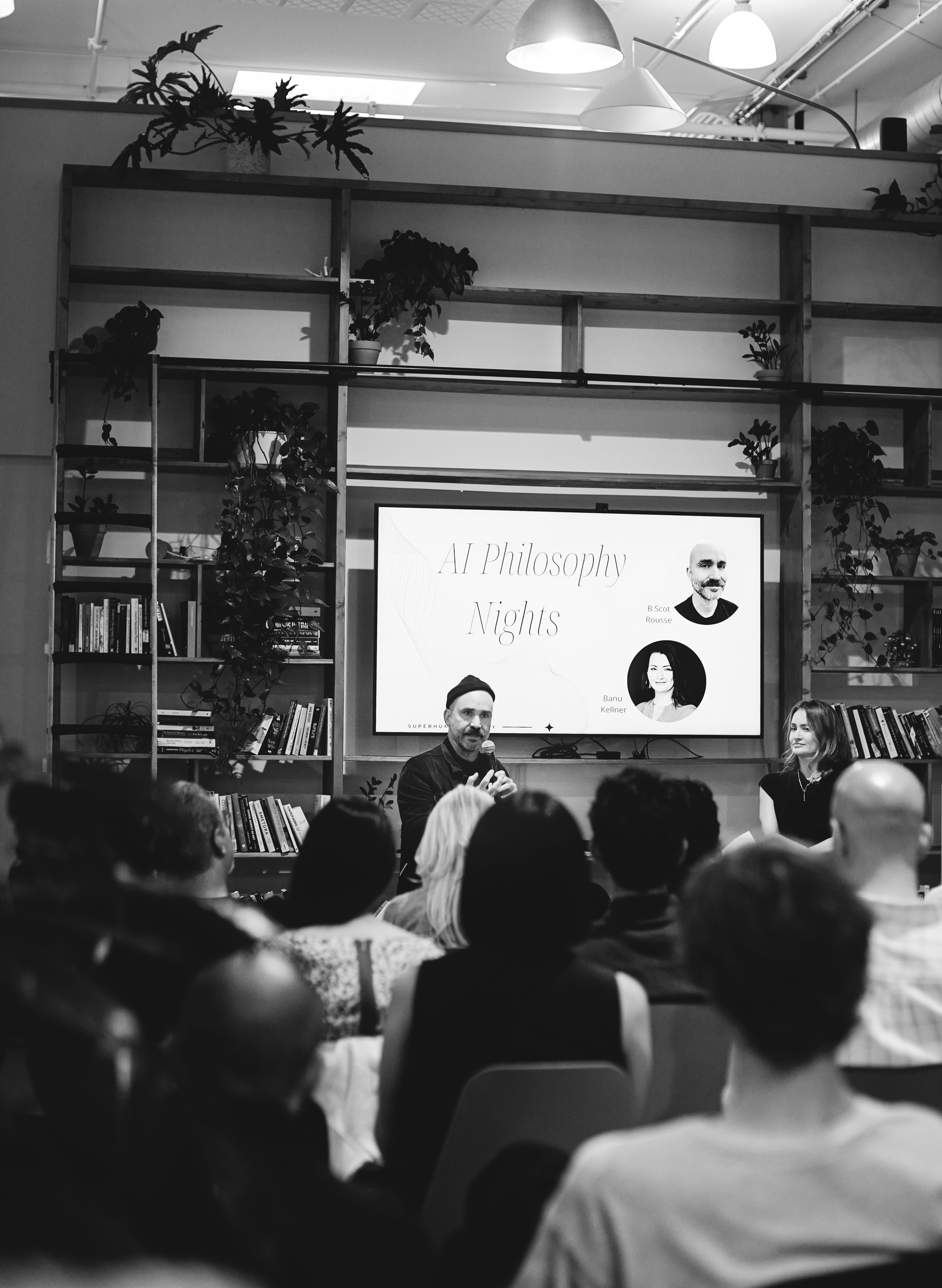
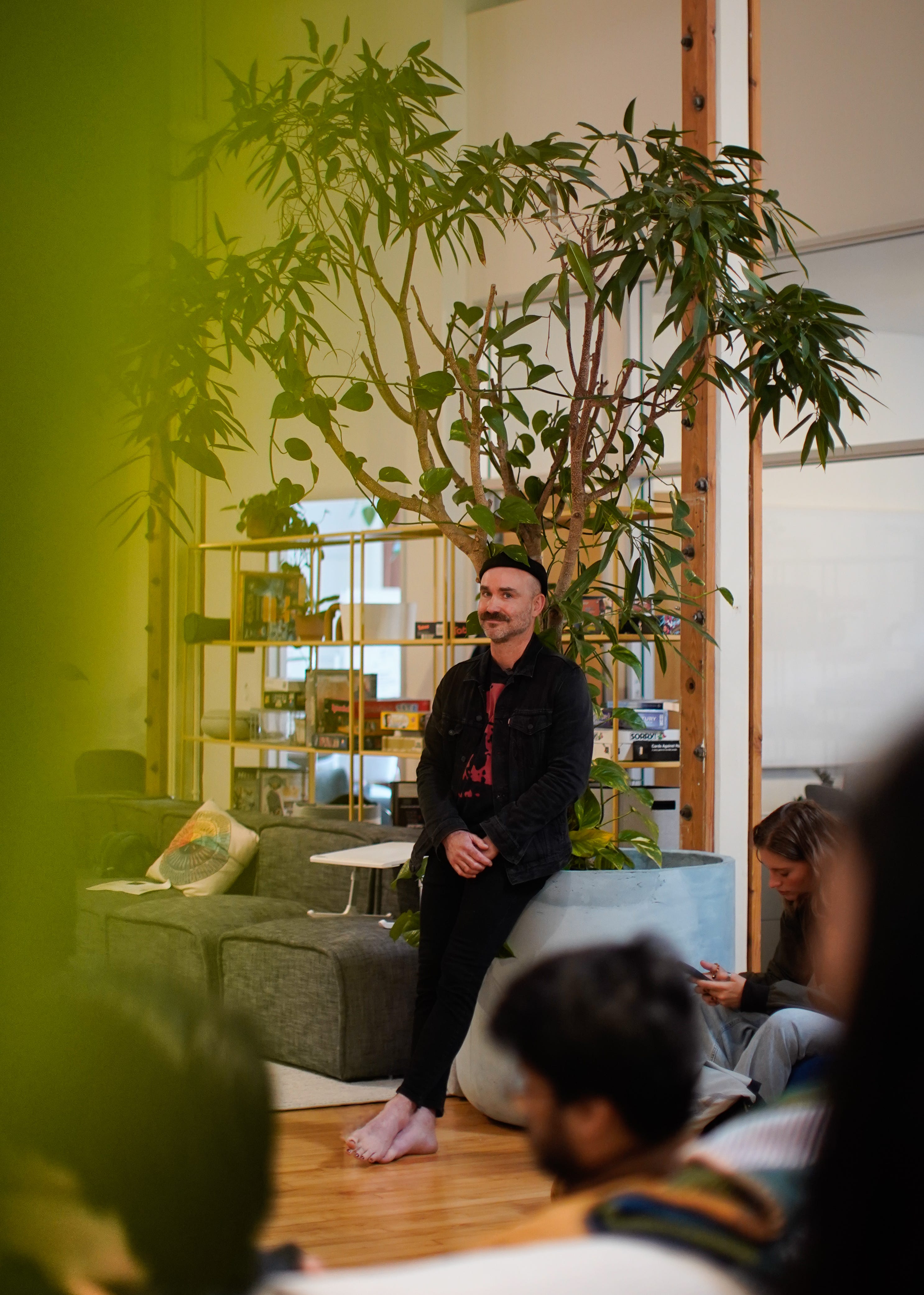
A couple of weeks ago I joined Banu Kellner for a public conversation on “AI’s Indifferent Intelligence.” The event was part of Banu’s ongoing series of “AI Philosophy Nights.” It was generously hosted at Imbue’s vibrant SF headquarters, and it was an inspiring and enlivening night.
We collectively conjured a revelation of, and immersion in, today’s immense thirst for philosophical conversation. No matter what else one might say about current AI systems, it is difficult to avoid the perplexity and disorientation they have thrust upon the world. These are the conditions in which philosophy comes alive. Thank you to Banu for rising to the occasion and convening this series of conversations and inviting me to be a part of it.
The conversations that night inspired several of the participants to share written reflections online the next day. I asked two people if I could re-share their writings here on Without Why. Thank you deeply to Eunju Tae and Yousuf Imran for both agreeing to let me repost thoughts they originally shared on LinkedIn.
AI's Indifferent Intelligence
·
Jul 21
It was wonderful to join Banu Kellner in conversation for an “AI Philosophy Night” last week on July 14, hosted at the vibrant and welcoming headquarters of Imbue.
This was my 3rd AI Philosophy Night and I got so much inspiration again.
Also, knowing that you’re not the only one who wants to ask questions about why we use AI and how we use this tool before just building it was a relief. (I was not alone and I'm not crazy)
CARE is such a common, not special word until tonight.
B. Scot Rousse shared why ‘CARE’ tells so many aspects about being human. He explained the word care as “we giving a damn” and in more sophisticated definition “broader philosophical understanding of human being”
His opening was a literally my story. “This AI contributes to confusion that compels us to think ourselves as something that should be efficient and optimized. Makes us forget what's important to us.” This is the reason I kept asking even small questions to AI is because I measure myself “less accurate, less smart” than AI.
When we interact with systems designed purely for speed and completing the tasks, we subconsciously start measuring our own worth by those same metrics (implicitly!). But efficiency is a machine value, not a human one.
AI is optimized, fast but they are completely indifferent to “why” the task matters. Humans are slow, messy but we actually “giving a damn”
From another AI Philosophy night, we discussed about “what makes human human” and I think the word ‘Care’ has so many aspects of being human.
If you care, you resonate with it, pay attention, engage, act on it, create, share with others.
In short, you can’t help it and you just do it (not because you have very rational reasons on why)
Maybe that’s why care is more powerful because it is something not rational but more you feel!
Rationality can easily be simulated, systematized, and automated. It’s highly logical to optimize everything. But feeling is the messy, subjective, and visceral experience of caring about someone or something to the point of irrational commitment and is entirely wild and bold. That is precisely why it is so powerful. It's the one thing the "indifferent intelligence" can never replicate.
We need to keep asking what we have to CARE especially the world is focusing on optimization only and try not to measure us to the technology standard.
Let's GIVE A DAMN!
A huge thank you to B. Scot Rousse, Banu Kellner and Kanjun Qiu for sharing inspiring thoughts from Imbue for such a grounding evening!
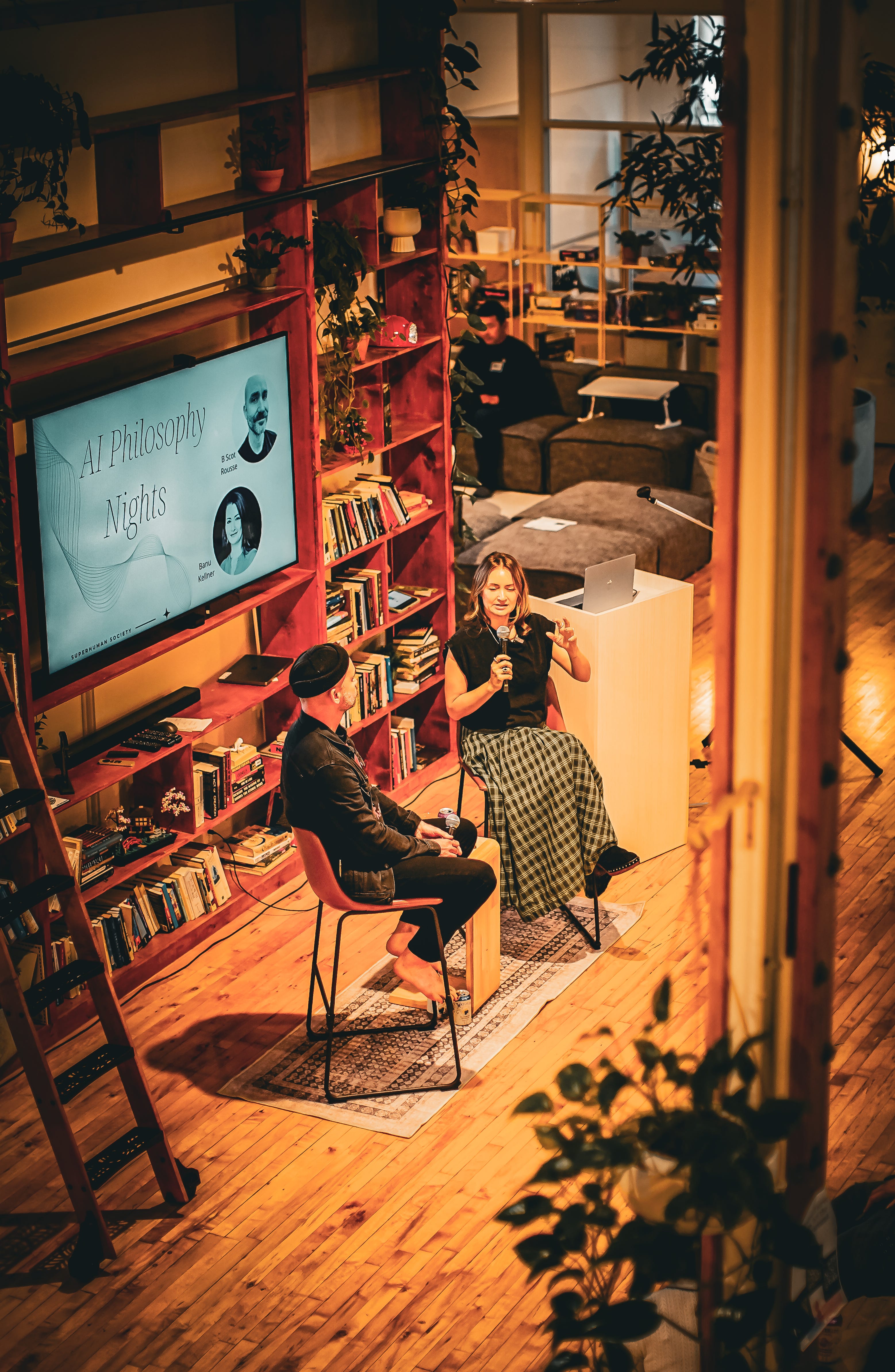
Next, I share two variations of a moving note about the event written by Yousuf Imran. First is a short, punchy first text he posted to LinkedIn right after the event. Second is a longer, more developed version that Yousuf wrote after I asked him if I could share his LinkedIn post.
Yousef is a former account executive at Google and Salesforce and is now a coach and service provider to account executives through his enterprise, Mangosteen Studio. In his writings below “ae” stands for account executive. I hope he helps more people come to share and act upon his compelling, care-centric interpretation of the nature of selling.
you can't automate giving a damn i spent last night at ai philosophy nights in SF listening to his point was disarmingly simple ai doesn't have goals what humans have is receptivity... this pull toward things that don't exist yet the entire drive home, i kept turning over his prompt how do you build ai that increases our capacity to care? and somewhere on the freeway.. that's the job the more you care about a customer, the more problems you uncover... and the more honest the problem solving becomes every great discovery call i've ever run came from caring enough to keep pulling the thread past the point where the checklist ended the models will keep getting better at the tasks but you can't automate giving a damn
its goals are set by us
we get gripped by what matters before we can fully explain why it matters
an ae's entire job is to care
I love how Yourself attuned to the direct relevance of what I was saying about care to the work of an account executive and sales. And indeed what he sees here is close to the interpretation of this role that I learned (and guided people to adopt) while working occasionally as a coach and consultant to account executives, sales people, and leaders with Pluralistic Networks. When I reposted Yousuf’s original post on LinkedIn, I appended this little note:
Care is indeed what drives us — and gets expressed in — our readiness to go beyond the checklist and the tasks; Caring is seeing the big picture while also attuning to minute details, connecting with our client as a whole person, and taking their concerns as our concerns. A care-orientation builds deeper foundations of trust and longer lasting relationships. Thanks for being there last night and for sharing these important reflections, Yousuf.
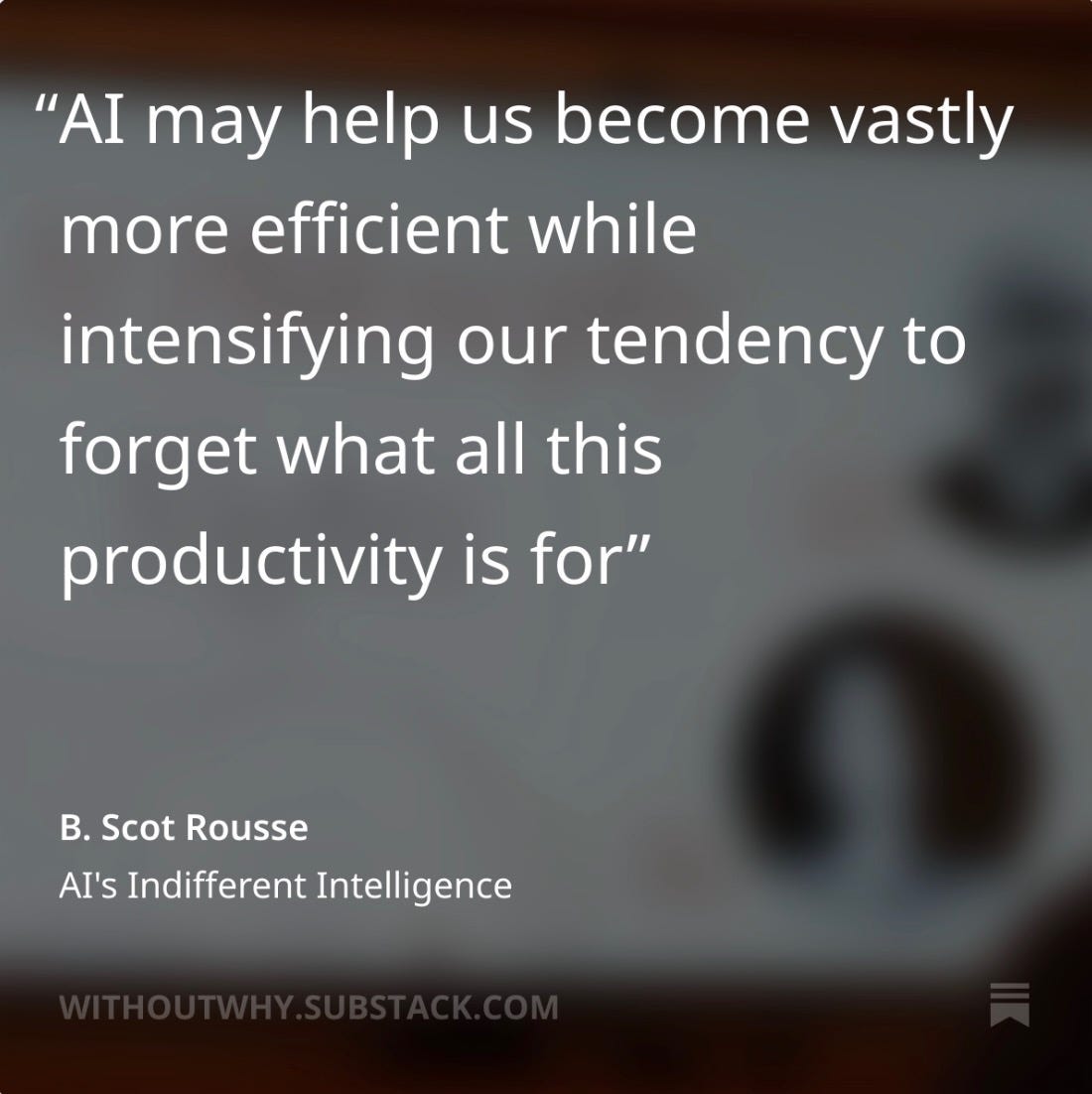
As mentioned, when I initially asked Yousuf if I could share his LinkedIn post, he asked me to give him a couple of days because he was inspired to write a longer piece.
He even did me the honor of reading and replying to one of my posts on Substack where I initially sketched my framework about care and its importance in the age of AI.
In a post from December 2025 that Yourself engages with, “Revitalizing Our Capacities to Care in the Age of AI,” I included at least 8 dimensions in the constitution of care, which frankly is too many. I subsequently boiled this down to the primordial 4 interrelated capacities of care — Receptivity, Articulation, Commitment, and Coordination — that I presented at Imbue with Banu, and also at the UC Berkeley CHAI Workshop in Asilomar back on June 5, and at the AGI-26 conference in SF earlier this week (I’ll share more about that next week).
Here is the December 2025 post:
Last week, I sat in a room in San Francisco listening to UC Berkeley lecturer and philosopher B. Scot Rousse talk about what machines can and cannot do.
His point was disarmingly simple: AI does not have goals. Its goals are set by us.
What humans have is receptivity—this pull toward things that do not exist yet. We get gripped by what matters before we can fully explain why it matters.
The whole drive home, I kept turning over his prompt:
How do you build AI that increases our capacity to care?
And somewhere on the freeway, it hit me.
That is the job.
An AE’s entire job is to care.
I posted that thought, and B generously asked to share it. So I want to return the favor and go deeper.
In his essay, Revitalizing Our Capacities to Care in the Age of AI, he lays out nine dynamics of what he calls the art of giving a damn. They are written by a philosopher describing human life.
I read them as one of the most accurate descriptions of selling I have ever seen.
So here is that framework, translated into the world I have lived in for 20 years: quotas, forecasts, discovery calls, and deal cycles.
If you sell for a living, this is your job—especially in the age of AI.
Receptivity is being gripped by concerns that call to you as intrinsically important—before reward, before advantage, and before you can fully justify why they matter.
Every AE knows this feeling, even if they have never named it.
It is the moment in a discovery call when a customer says something almost in passing and you feel the pull.
Or when you are doing deep account research and uncover one insight that changes how you see the entire company.
The checklist says to move on.
Something in you says, “Stay here.”
The best sellers I know are not necessarily the smoothest talkers. They are the most receptive.
They get gripped by a customer’s problem before the business case exists. The pipeline comes later. The caring comes first.
Reason cannot tell you which account to fall in love with. Neither can your territory plan.
You simply find yourself caring about it.
That is receptivity, and no scoring model has it.
Raw concern does not become commitment until it is articulated in language.
A vague sense that something is wrong becomes an identity, a movement, or a cause only when someone finally puts it into words.
This is the entire craft of point-of-view selling.
Your champion feels the pain every day but cannot express it in a sentence the CFO will fund.
Your job is to give language to a concern that has been living inside the building as a mood.
When you articulate the problem better than the customer can, they do not experience it as being sold to.
They experience it as being understood.
Deals are not won in the demo.
They are won in the sentence your champion repeats in the meeting you were not invited to.
You helped write that sentence.
That is linguistic articulation.
As every strong seller knows, before you ask for something, the best way to engage a customer is to offer value first—and ideally, to offer far more value than you are asking for in return.
The philosopher Fernando Flores put it this way:
Rather than asking what you want out of life, ask what you have to offer the world.
The entire discipline of complex sales is about converting a felt concern into an offer, and then converting that offer into a project with an owner, a scope, and a date.
A concern that never becomes a project remains ambient suffering inside the account.
Companies can live with ambient suffering for decades.
People complain about a problem. Meetings are held about it. Temporary workarounds are created. Everyone agrees it should be fixed.
But no one turns the concern into a coordinated project.
That is where the seller enters.
Your job is not merely to identify pain. It is to help transform that pain into action.
Next comes the courage to commit to a project with no guarantee that you chose correctly, knowing you may fail and have to reinvent yourself.
Sellers do this every day.
Most deals we choose to pursue will eventually become lost opportunities.
Chasing a deal is a commitment. Putting a deal in commit is a public act of courage.
You are attaching your name and your judgment to an uncertain future.
Sandbagging is often the refusal to commit dressed up as prudence.
So is the bloated pipeline full of deals you will not disqualify because killing them feels like a small death.
Caring means taking a position.
You take a position on the deal, the close date, the customer’s urgency, and sometimes whether the customer should buy at all.
Commitment without guarantees is not a flaw in the job.
It is the job.
Care is not a solo act.
It lives inside a shared “we”—a community carrying on a tradition.
The loneliest sellers are the ones who think the deal belongs to them alone.
The strongest deals I was ever part of belonged to a “we”: the AE, the solutions architect, the champion, the executive sponsor, and sometimes even the former customer who agreed to take a reference call at 7:00 a.m.
A deal team is a community formed around a shared concern.
Beyond any single opportunity, sellers also belong to a craft.
We inherit it. We argue about it. We improve it. We pass it on.
That inheritance is why a 20-year veteran and a first-year SDR can talk for an hour without needing to explain the basic language of the work.
We recognize the same fears, rituals, pressures, and moments of possibility.
We belong to the same practice.
This dynamic draws on the book Fernando Flores wrote with Terry Winograd, Understanding Computers and Cognition.
Their central idea was that work is made of conversations: requests, promises, offers, and declarations coordinated among people who are committed to one another.
The book was published in 1986, and it may secretly be one of the best sales methodologies ever written.
A deal cycle is nothing more than a network of commitments.
The customer makes a request. You make a promise. Procurement sets conditions. Legal counters. The champion makes new promises internally.
A mutual action plan is simply that network made visible.
Deals slip when a promise somewhere in the chain was never truly made.
Someone nodded.
Someone said, “That should be fine.”
Someone left a meeting with a different understanding of what had been agreed to.
But nodding is not a commitment.
Taking care of a customer means tending this web of promises as though it were a living thing.
Because it is.
Caring also means questioning what our culture treats as obvious, especially its idolization of optimization and efficiency.
Sales has its own unquestioned gods.
Activity metrics.
Dials per day.
The belief that more pipeline is always better.
The QBR ritual in which everyone performs certainty about numbers nobody actually believes.
But the deeper application is with the customer.
The highest form of care in a sales cycle is questioning the customer’s own status quo—the assumptions they have stopped seeing because they have lived inside them for too long.
Every methodology, from SPIN to Challenger, is underneath the branding a discipline of loving irreverence.
You question the customer because you care about where they are headed, not merely because you have a quota.
Although, yes, you also have a quota.
Caring and commerce are not enemies.
Pretending they are is its own kind of dishonesty.
Pluralistic openness is an openness, and even a sense of awe, toward the many different interpretations of what matters.
Every buying committee is a small civilization of conflicting worlds.
The CFO lives in a world of risk, margins, and payback periods.
The engineer lives in a world of technical debt, system reliability, and 2:00 a.m. pages.
The end user lives in a world of small daily frustrations that nobody in the executive suite has ever experienced.
A mediocre seller delivers the same value proposition to all of them.
A great seller enters each world on its own terms and honors what matters there.
Multithreading is usually taught as a form of risk management.
It is better understood as pluralism: the practiced humility of recognizing that the CIO’s truth and the administrator’s truth can both be real.
Your job is not to flatten those perspectives into one generic message.
It is to understand them well enough to help the group move together.
So, back to the question from the drive home:
Here is my answer after 20 years in the field.
The tasks were never the job.
The research, data entry, follow-up emails, call notes, and CRM updates were the sediment that settled on top of the job.
The job was always the nine things above.
Most sellers simply never had enough time to do them well because the sediment kept piling up.
If AI clears that sediment and we use the reclaimed hours to make more calls that nobody remembers, we will have automated ourselves into irrelevance—and deserved it.
But if we use those hours to become more receptive, articulate concerns more precisely, commit with more courage, and tend the web of promises more faithfully, then the machines will have done something philosophers have been asking of technology for a long time.
They will have made more room for us to give a damn.
You cannot automate giving a damn.
But you can build technology that gives people more room to give one.
With gratitude to B. Scot Rousse whose essay Revitalizing Our Capacities to Care in the Age of AI provided the framework, and whose talk at AI Philosophy Nights started the drive home that started this piece.
Thank you!
Comments
Nothing yet. Say the first thing.
Sign in to join the conversation.