
“Books are a uniquely portable magic.”
—Stephen King, On Writing
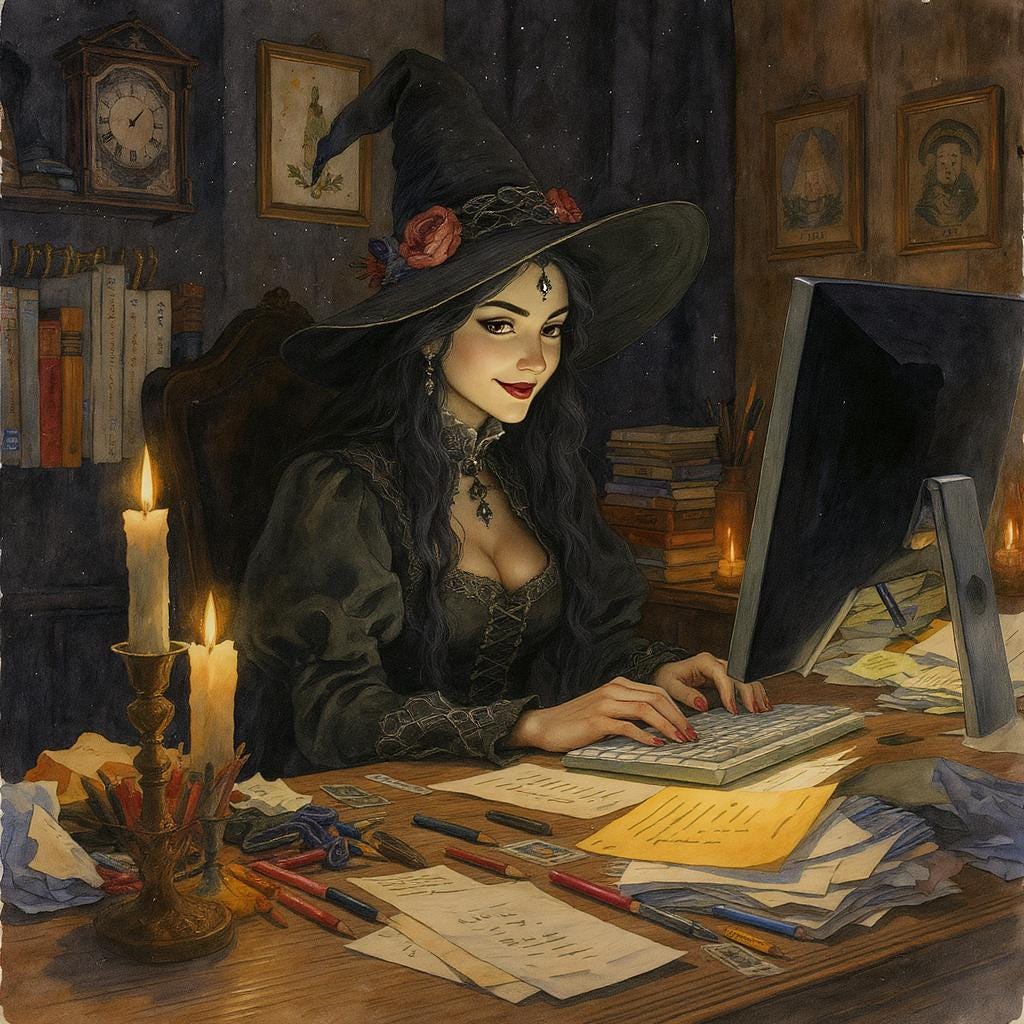
There’s a moment, just before you begin writing a book, that feels like standing at the edge of a sacred circle. The air is charged. Your fingers hover over the keys. Maybe you’ve lit a candle or poured a cup of tea that smells vaguely herbal and comforting. Maybe your cat has claimed a spot beside you, knowing something strange and important is about to happen. This is not just writing. This is invocation.
Writing a book is not unlike casting a spell. It begins with intention, requires focus and ritual, demands energy, and, if done right, alters the world—starting with your own.
In spellwork, intention is everything. You don’t just light a candle and hope the universe reads your mind. You speak your desire into the world. You name it. You claim it. Writing a book is the same: the first draft begins with an intention. It might be to tell a story that haunts you, to explore a question that won’t leave you alone, or to reach someone—anyone—who needs the tale you’re carrying.
But more than that, writing demands an emotional truth. The raw, central pulse of the story. The spell doesn’t work if you don’t believe it. Neither does the book.
Before I begin drafting, I often jot down what the book is about—not plot, but heart. What am I really writing toward? Redemption? Reckoning? Power? Grief? That note becomes my spell’s core. It’s the sigil I draw in invisible ink across every scene.
Witches create a sacred space to do their work. Writers do too.
My writing altar isn’t made of marble or candlewax (okay, sometimes it involves candles), but it is sacred. I have playlists. I have reference objects—crystals, old postcards, weird little bones and relics from flea markets. I might pull a tarot card for the session or anoint my wrists with a ritual oil. None of this is necessary—but all of it helps.
Creating that sacred space isn’t about superstition. It’s about signaling to your brain: this is the threshold. On this side, you’re the human in your sweatpants. On the other, you’re the channel. The priestess. The summoner of stories.
Even opening the same document every day becomes a sort of key. A whispered enchantment. It says: We’re back. Let’s go deeper.
“Words are events, they do things, change things. They transform both speaker and hearer; they feed energy back and forth and amplify it. They feed understanding or emotion back and forth and amplify it.”
—Ursula K. Le Guin
No spell works without ingredients. Eye of newt, tongue of bat—or in our case, dialogue, setting, conflict, character.
The rough draft is the part of the ritual where we’re gathering everything. This is the stage of glorious mess. The bubbling cauldron. The smudge of ink and ash. You don’t worry yet about making it beautiful. You worry about making it real.
Some writers call it the “discovery draft,” and that fits. You’re not writing something you already know. You’re uncovering something old, something hidden, something sacred. You’re trying to listen to the characters, the world, the heartbeat underneath the prose.
Magic takes energy. So does writing. Especially that first draft.
You pour yourself into the work. Your time, your focus, your emotional reserves. There’s a reason you feel drained after a long writing session, even if you haven’t left your chair. You’ve been holding a world on your shoulders.
“Picking up a pen isn’t just picking up a pen. It’s opening a vein and letting the story flow out.”
—Neil Gaiman
Part of my writing ritual involves acknowledging this. I protect my energy. I take breaks. I offer gratitude to whatever part of myself showed up and spilled a thousand words onto the page.
And yes—there are days it doesn’t come easily. Every witch knows some spells misfire. Every writer knows some days the words fight you. That’s okay. That’s part of the ritual, too. You return the next day and try again. Magic is rarely instant. Books never are.
There’s a point in every book where I feel like I’m no longer writing at the story—I’m writing with it. Like it’s risen up out of the earth, or the fog, and started whispering in my ear. The characters speak with voices I didn’t plan. The scenes surprise me. I cry at my own keyboard. (It’s embarrassing. I regret nothing.)
That’s invocation.
You’ve summoned something. You’ve opened the door between worlds, and now the story is stepping through.
But just like spellwork, you must treat that invocation with respect. Write it down. Honor it. Listen. Don’t try to trap it in a box too soon. The first draft is wild magic. It needs space to breathe.
Finishing a first draft is closing the circle. You’ve cast the spell. The candle’s burned low. The air crackles with aftermath.
Whether it’s your tenth book or your first, that final keystroke is holy. You’ve brought something into being. It’s not perfect—it’s not supposed to be. First drafts are raw, and messy, and half-feral. But they’re alive. And now that they exist, you can begin the sacred work of shaping them into something even more powerful.
That shaping—that editing, refining, reworking—is its own magic. But it only exists because you dared to start.
Not every writing session feels magical. Some feel like trudging through mud in the rain while a sarcastic muse hurls insults at your back. But that’s part of the path. That’s the test of the spellcaster: not whether the power shows up easily, but whether you show up for the work.
Trust the process. Trust the mess. Trust the spark that made you begin. Because writing a book isn’t just putting words on a page. It’s conjuring. It’s ritual. It’s you, standing at the edge of the unknown, whispering: Let there be story.
And then letting it rise.
I’d love to hear from you: What are the rituals that anchor your writing practice? Do you cast a circle before you draft—or dive in wild and word-drunk? Drop a comment below and let’s talk shop and spellcraft.
Want to enchant your next writing session? Here’s a simple spell I use when I’m stuck, scared, or simply starting:
Light a candle (or even a digital one—yes, I’ve used a GIF, no shame).
Write down your story’s emotional core. What does it want?
Fold the paper, breathe on it, and tuck it beneath your keyboard or notebook.
Write like the page is catching fire.
Blessed drafting—and may your muse be fierce and slightly unhinged.
Comments
Nothing yet. Say the first thing.
Sign in to join the conversation.