
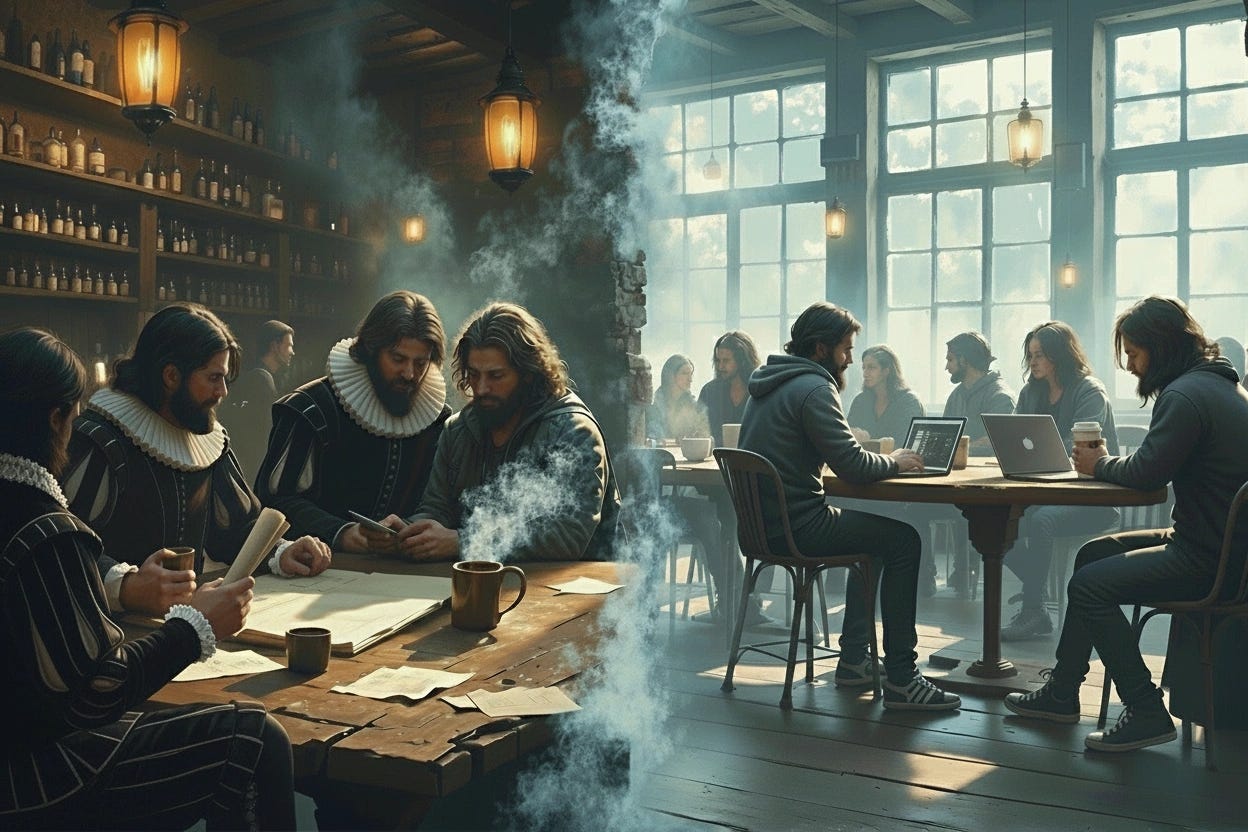
Picture it: a candlelit villa where lightning cracks over the lake. A smoky Elizabethan tavern, echoing with bawdy laughter. A Harlem nightclub alive with jazz and poetry. Different eras, different settings — but always the same spark.
Writers gather, ideas collide, and the world tilts. These weren’t just friendships or study groups. They were circles of fire — places where stories became movements, and movements remade society.
Let’s step inside some of history’s most powerful literary circles.
Before Shakespeare reigned supreme, a group of sharp-tongued playwrights set London’s stage ablaze. Marlowe, Kyd, Greene, Nashe — they were young, loud, and brilliant, drinking and dueling their way through taverns and theaters.
They gave us the first truly modern plays, rich with blood and wit. Greene, jealous of a country upstart named Shakespeare, called him an “upstart crow.” The insult backfired — pushing Shakespeare to rise even higher.
The “Year Without a Summer.” The sun hidden behind volcanic ash. At Villa Diodati, Byron, Percy Shelley, Mary Godwin, Claire Clairmont, and John Polidori huddled indoors, daring each other to invent ghost stories.
Mary dreamed of a stitched-together creature. Polidori imagined an aristocratic vampire. From that storm-lashed circle, modern horror and science fiction were born.
In Concord, writers gathered not in taverns but under trees and in parlors. Emerson, Thoreau, Fuller, and Alcott wove philosophy with poetry, turning thought into action.
Thoreau’s refusal to fund slavery and war landed him in jail — and gave the world Civil Disobedience. His small act rippled outward, inspiring Gandhi, then Martin Luther King Jr. A circle of writers reshaped the conscience of nations.
In elegant drawing rooms, Virginia Woolf, E.M. Forster, Vanessa Bell, and their friends reimagined what art — and life — could be.
They wrote, painted, argued, and published. Woolf’s A Room of One’s Own was both literature and manifesto, opening doors for generations of women. Bloomsbury proved that a circle of friends could redraw the map of creativity itself.
In Harlem, jazz spilled into poetry and poetry into politics. Langston Hughes, Zora Neale Hurston, Claude McKay, and others crafted a chorus of Black voices too strong to be ignored.
When Hughes wrote I, Too, he wasn’t only writing a poem. He was declaring a future. That circle’s words became the bedrock of the Civil Rights Movement.
Exiles of war, they crowded into Paris cafés, drinking, quarreling, and rewriting prose itself. Hemingway, Fitzgerald, Gertrude Stein, Pound, Eliot.
Stein looked at them and said, “You are all a lost generation.” They wore the title like armor, carving novels that still define modern disillusionment.
At the Eagle and Child pub, Tolkien, Lewis, and their friends swapped drafts over pints. Lewis egged Tolkien on to finish The Lord of the Rings. Tolkien returned the favor by challenging Lewis to sharpen Narnia.
From their laughter and arguments came entire mythologies — worlds that millions still wander.
In smoky apartments and over jazz riffs, Kerouac, Ginsberg, Burroughs, and Cassady scribbled the raw heart of postwar America.
When Ginsberg read Howl aloud in San Francisco, it was more than a poem — it was a detonation. The Beats lit the fuse that burned into the counterculture of the 1960s.
Again and again, these circles prove the same truth: literature doesn’t stay on the page.
The Transcendentalists gave us abolition and civil rights. Harlem gave us a proud Black identity. The Bloomsbury Group reframed feminism. The Beats sparked rebellion. Small rooms became revolutions.
Revolutions don’t always begin in parliaments or battlefields. Sometimes they begin in a pub, a parlor, or a candlelit villa.
The University Wits, the Night School, the Inklings — each shows how a handful of dreamers can set the world spinning in a new direction.
And today? The next school of revolution might already exist — in a Discord channel, a podcast collective, or a circle of writers bound by an ember-bright idea.
That’s the spirit we honor in the Obsidian Flame Society: small groups with the audacity to create, to challenge, to spark something larger than themselves.
So pay attention. Somewhere — maybe even here — a circle is gathering. And the world is about to change
.
Comments
Nothing yet. Say the first thing.
Sign in to join the conversation.