
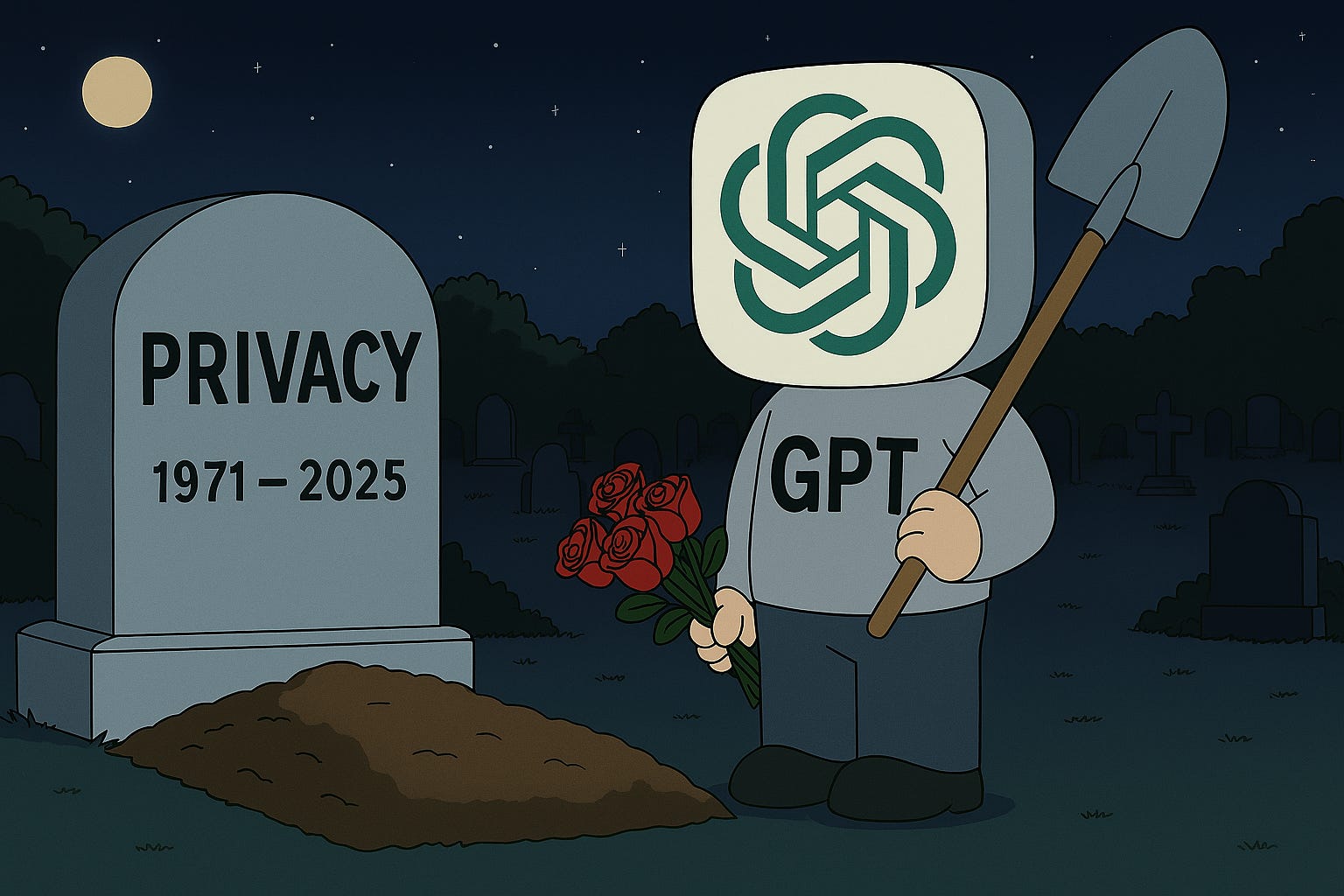
There’s a universal truth scarier than any horror movie jump scare: almost nobody reads privacy policies. Not your boss. Not your coworker. Not even your mom, and she once read the entire owner’s manual for a toaster because she “didn’t trust the timer.”
The only exceptions? A handful of lawyers billing at $600 an hour and the occasional insomniac who uses them as a bedtime sedative. Everyone else scrolls straight to “I agree” like they’re trying to speedrun a tutorial level in a game they’ve already played a thousand times.
And yet, buried inside those dry, bloated walls of legalese is the official rulebook for how companies can use, sell, or “accidentally misplace” your personal data. Your location history. Your shopping habits. That one photo you thought was private but accidentally synced to the cloud. It’s all in there, written in the kind of language that makes your soul want to leave your body.
That’s where ChatGPT walks in, wearing a smug smile and carrying a highlighter. It’s OpenAI’s overly enthusiastic brainchild that actually likes reading this stuff. Imagine the nerdiest friend you’ve ever had, the one who insists on reading every line of a board game rulebook before letting you roll the dice. Except this friend never sleeps, never forgets, and translates corporate double-speak into plain language that doesn’t make you question your life choices.
Reading a privacy policy is like being trapped in a swamp made of wet legal paper. The air is heavy. The ground sucks at your boots. Every paragraph feels like it was written by a committee of medieval monks who got paid per syllable.
Companies swear their policies are “clear and transparent,” but in practice, they’re about as transparent as a brick wall. They’re packed with “heretofores,” “whereases,” and “party of the first parts” like someone fed an AI the complete works of Charles Dickens and told it to write about cookie tracking.
And deep inside these text labyrinths? The legal equivalent of rusty bear traps.
Clauses that quietly let them sell your data to “partners” (translation: literally anyone)
Rules that allow them to keep your info forever “for security purposes”
Opt-out instructions that involve printing a form, mailing it to an address in Delaware, and hoping someone who cares picks it up
It gets better. These policies often “update” right before something controversial happens. A new tracking feature? An acquisition by a data-mining empire? A fresh scandal about how much user data they’ve been siphoning off?
There it is… a shiny new privacy policy quietly slipped under your nose like an unwanted restaurant check.
The whole strategy is clear. Make it long. Make it boring. Make it so unpleasant to read that you would rather watch paint dry on a damp basement wall than get through page two.
So, what do you do when you’re staring down a 10,000-word privacy policy that looks like the Dead Sea Scrolls mated with a phone book? You give it to something that eats this misery for breakfast.
Enter ChatGPT.
Think of it as a digital espresso shot for comprehension. It takes the stale, overcooked text and distills it down to the actual points you care about. It turns “heretofore, in perpetuity” into “yes, they’re selling your data.” It can turn sprawling paragraphs into crisp, actionable sentences.
It can tell you:
Exactly what personal data the company is collecting
How they are tracking you (cookies, pixels, and sometimes the digital equivalent of binoculars)
Whether they plan to share or sell your info
How long they plan to keep it and what “forever” really means in corporate time
And because ChatGPT doesn’t get tired, annoyed, or existential halfway through, it can explain it in the tone you choose. Want plain English? Done. Want it written like a pirate? It’ll happily “Arr matey” your way through the data retention section.
If there’s a sneaky clause that gives them permission to sell your search history to “select partners,” ChatGPT will flag it faster than your ex spots you following someone new on Instagram.
Throw a privacy policy at ChatGPT without context and you’ll get a summary. Not bad, but the real magic happens when you ask sharp, specific questions.
Here are prompts that actually work:
1. Summarize This Privacy Policy
Role: You are a senior privacy compliance analyst with expertise in translating complex legal documents into plain, accurate language for non-lawyers.
Task: Summarize the following privacy policy into bullet points grouped under these categories:
1. Data Collected – Group as Personal Identifiers, Contact Info, Financial Info, Device/Usage Data, Location Data, Behavioral Data, Other. Include exact quotes for vague terms.
2. How Data is Used – Plain language plus quotes for broad/unclear wording.
3. Data Sharing/Selling – State if data is sold/shared, to whom, for what purpose, and whether optional. Quote vague terms.
4. Retention Period – Exact time frames or “indefinite” if stated.
5. User Rights & Controls – Include deletion, export, correction, and opt-out processes.
6. Opt-Out/Deletion Difficulty – Rate on scale 1 (easy) to 5 (nearly impossible).
7. Notable Clauses – Anything unusual or risky.
Output Requirements:
- Use bullet points under each heading.
- Keep bullets under 20 words.
2. Identify All Personal Data Collected
Role: You are a senior privacy compliance analyst.
Task: From the following privacy policy, extract every type of personal data collected. Organize into these categories:
- Personal Identifiers
- Contact Information
- Financial Information
- Device/Usage Data
- Location Data
- Behavioral Data
- Other
For each category:
- Quote the exact text from the policy that mentions the data.
- If the description is vague, note “UNCLEAR” and provide your best interpretation.
- Flag anything that could be sensitive (ALL CAPS).
Text to Analyze: [Paste policy here]
"Does this policy mention selling or sharing my data?"
3. Detect Selling or Sharing of Data
Role: You are a senior privacy compliance analyst.
Task: From the following privacy policy, determine whether personal data is sold or shared. If yes:
1. Identify exactly what types of data are sold/shared.
2. State to whom (e.g., advertisers, partners, affiliates).
3. State why it is sold/shared (e.g., marketing, analytics).
4. Indicate whether the sharing/selling is optional.
5. Quote any vague or overly broad wording.
6. Flag anything potentially high-risk in ALL CAPS.
If no selling/sharing is mentioned, clearly state “No selling/sharing found” and note any language that could indirectly allow it.
Text to Analyze: [Paste policy here]
4. Compare Two Privacy Policies
Role: You are a senior privacy compliance analyst.
Task: Compare these two privacy policies and produce a side-by-side table with the following rows:
- Data Collected
- How Data is Used
- Data Sharing/Selling
- Retention Period
- User Rights & Controls
- Opt-Out/Deletion Process Difficulty (1–5)
- Notable Clauses
For each row:
- Summarize both companies’ approach in under 25 words.
- Bold which company is more privacy-friendly in that category.
- Explain why in 1–2 sentences.
- Use ALL CAPS for any potential risks.
Text to Analyze:
Policy A: [Paste here]
Policy B: [Paste here]
This is the equivalent of handing your lawyer a loaded checklist instead of a vague “tell me if it’s bad.” It cuts through the fluff and focuses on what matters, without making you spend your weekend learning the difference between “data retention” and “data processing.”
Because life is too short to read 8,000 words about cookie tracking, I built a free custom GPT that strips any privacy policy or terms of service down to the bare bones.
You drop in any privacy policy or terms of service, and it hands back:
A clean, structured bullet-point summary with all the key clauses
A full breakdown of every type of personal data collected (with vague terms quoted)
A clear report on whether your info is sold or shared, to whom, and why
Flags on anything shady or worth a closer look
Run the Privacy Policy Decoder GPT here
You might be thinking, “I’ve clicked ‘Agree’ on everything my whole life and nothing bad has happened.” That’s like saying, “I’ve left my front door unlocked for years and nobody has robbed me, so I must be safe forever.”
Privacy policies aren’t just boring documents. They are legally binding contracts. You are literally signing off on how a company will use your digital identity. In a world where your data is worth more than your physical wallet, saying “yes” blindly is asking for trouble.
We live in an era where selling your search history is as normal as selling ad space on a billboard. Companies will mine your photos, your location history, your buying habits, and your private messages if you let them. Sometimes even when you don’t let them.
With AI tools like ChatGPT, there’s no excuse to keep signing without looking. You don’t have to become a privacy lawyer. You just need to know enough to decide whether you’re okay with the trade-off, or whether it’s time to find a service that treats your data with more respect.
Privacy policies are never going to be thrilling. They’re engineered to be the opposite. They are long, dull, and exhausting by design. But now you’ve got a workaround.
Let ChatGPT do the boring work. Let it chew through the legal fat, spit out the essentials, and highlight the red flags. Spend your energy doing literally anything else.
If you’re going to war against bloated, boring legal docs, you want an ally who doesn’t get tired, doesn’t get distracted, and maybe even enjoys the fight.
Hey! It’s Jer! If you’ve made it this far, thanks for reading! If you like this kind of thing, you’ll probably like the AI Builders Lodge. It’s my private corner of the internet where we trade doomscrolling for systems thinking. It’s not just an “elite community” of creators and builders. It’s a working room where you’ll learn how to build the exact systems I’m using to grow my newsletter.

Once you’re a member, I hand you the keys to all of my system blueprints and working protocols:
📔 Style Bible Protocol: learn how to extract your writing DNA, decode its patterns, and train AI to replicate it flawlessly.
📝 Infinite Draft Engine: learn how to build a system that will take you from blank pages to publish-ready content; scale your writing effortlessly
🎙️ Draft-to-Podcast Machine: learn how to automate podcast production by turning your long-form writing into full AI generated podcast episodes on autopilot
You will also receive the following bonus items:
My Substack SEO Checklist: rank on Google and pull traffic
My Secret Prompt Vault: battle-tested prompts that save hours
Builders’ Lodge Chat: swap monetization strategies with other creators and builders
We’re the team behind whatisthat.ai, the AI discovery platform built to cut through the noise. If you found this useful, pass it on. Share it, forward it, spread it. Every share helps us grow and puts real insights into more hands. 🙏
If you liked this, you might like these too:
Comments
Nothing yet. Say the first thing.
Sign in to join the conversation.