
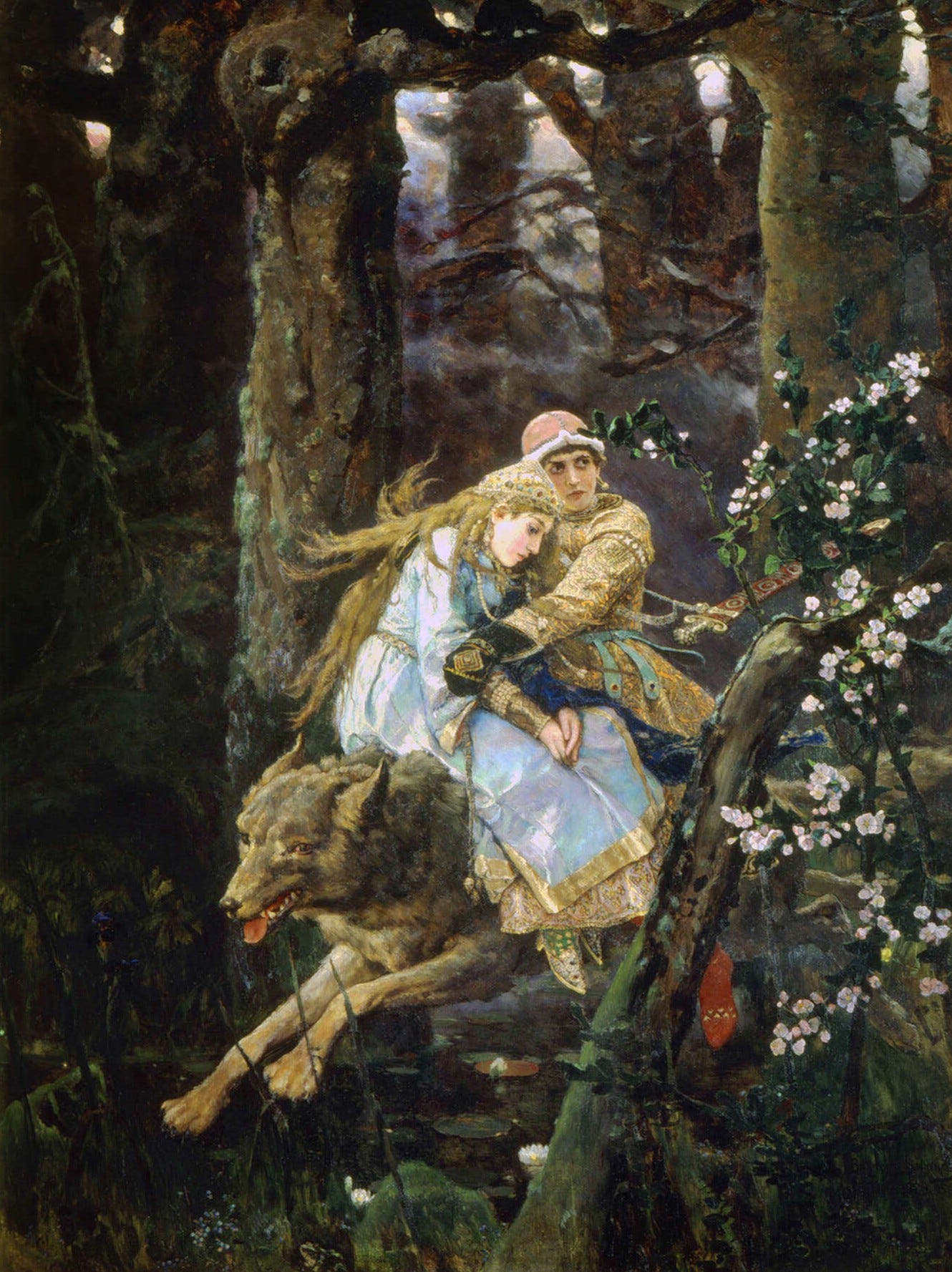
Viktor Vasnetsov, Ivan Tsarevich Riding the Grey Wolf, 1889
Today we’re doing something a little different. Just hang in there, it will come together at the end.
Ivan-Tsarévich rode out across the steppe in the last of the autumn light and the grass bowed and recovered behind him like the closing of a sea. He rode with no company save the horse beneath him and the wind and the wind had no mercy in it. Three days he rode and on the evening of the third day he came upon a stone standing solitary in a green field like some memorial to a god whose name was no longer spoken. Words were cut into the face of the stone and he dismounted and stood before them.
“Whosoever goes straight before him will know cold and hunger. Whosoever goes to the right will be safe and sound but his horse will be killed. Whosoever goes to the left will be killed himself but his horse will be safe and sound.”
He read these words and he read them again. He stood in the grass with the reins in his hand and looked off down each of the three roads and each road looked the same as the others and each led into the same gray distance and the distance gave back nothing. He chose the road to the right. Thinking that a man who loses his horse may yet find another but a man who loses himself will find nothing at all and no one to do the finding. He mounted and rode on.
He rode one day and then another and on the morning of the third there came out of the treeline a wolf of such size as he had not known existed in the world. It stood in the road before him gray and enormous and regarding him with eyes the color of hammered tin. The horse shied and stamped and the wolf spoke.
“So it is you it said. Young lad. Prince Ivan. You read what was written on the stone. You knew what was to come.”
And with that it fell upon the horse.
It tore the animal open from throat to haunch and the prince was thrown clear and lay in the grass and watched the wolf feed. The horse screamed once and then was quiet. The wolf ate with a methodical and unhurried violence and the blood steamed in the cold air and when it was done it turned and looked at him with those flat pale eyes and then it went away into the trees without a sound as if it had been taken back into the fabric of the world.
He sat among the wreckage of the animal that had carried him. Flies were already finding the blood. He wept. Not for long. He wiped his face with the back of his hand and stood and walked on. He walked the whole of that day through country that did not change and the sun passed over him and fell away to the west and the shadows of the grass grew long and tangled and still he walked. His boots had split along the sole and his feet bled and the blood dried and cracked and bled again. Toward evening he could go no further and he sat down in the grass to die or to sleep and he did not much care which.
The wolf came back. It loomed above him against the last light like something called up out of the earth itself.
“I am sorry for the horse it said. But you were told. Now I will carry you. Tell me where you are going.”
“My father sent me to find the Firebird.”
The wolf regarded him. Its eyes held no sympathy and no cruelty. They held only what was.
“You could have ridden that horse three years and never found it. Only I know where it lives. I ate your horse and so I will serve you. Get on my back and hold tight.”
He climbed onto the wolf and the wolf ran. It ran with a speed that was like nothing he had known on horseback and the land streamed past them in a smear of green and black and the trees at the edges of forests leaned in the wind of their passing. They crossed rivers the prince had no names for and the water sprayed up from the wolfs paws and fell back like shards of glass in the failing light. They passed through blue mountains and through the smoke of distant fires and they rode through the dark and into the dark and the dark did not end…
…
The wolf was not at the feast. It was not in the kingdom. Somewhere out past the last fencepost and the last furrowed field and the last human word for what the land was called it was running. It ran through stands of birch that glowed white in the moonlight like the bones of the earth laid bare. It ran through country that had no name and wanted none and the grass hissed against its flanks and overhead the stars turned in their sockets and the night was long and the wolf did not slow and did not rest and would not. It ran as it had always run, before the prince, before the tsar, before the stone with its carved words, before all of it. It ran in the darkness between things and the darkness was its country and it moved through the world as the world moved through the void, which is to say without ceasing and without purpose and without end.”
I encountered this story in Dr. Martin Shaw’s Liturgies of the Wild and I have not been able to stop thinking about it. I have been chewing and gnawing over this story. “Often [I] lean back and closes my eyes over a line I have been reading again, and its meaning spreads through my blood.” I cannot get it out of my mind.
Prince Ivan makes a decision. A path diverged in a yellow wood and he chooses. And in that choice Ivan loses his beautiful, loyal thoroughbred. A gift from his father. It is devoured and his search for the Firebird brutally ended.
But truly, this is just the beginning.
The wolf is the initiatory experience. It is the closing off of one path (the Latin root of decide is literally to “cut off”) and the opening of a new, unforeseen one.
“…To achieve what he needs, [Ivan] must jump on his back.”
The companionship is ended. The horse is the symbol of orderliness, it is stolid and domesticated. It is predictable. But that time is over. Ivan has crossed the threshold on the back of a wild, unsentimental beast.
But Shaw wants us to pause here. To halt in our expectations.
The wolf is not “wicked, I’m saying we need him”.
“If much of the world were mystery the limits of that world were not, for it was without measure or bound and there were contained within it creatures more horrible yet and men of other colors and beings which no man has looked upon and yet not alien none of it more than were in their own hearts alien in them, whatever wilderness contained there and whatever beasts.”
- Cormac McCarthy -
The wolf is the key to the next page of life. Ivan accepts the call, and in accepting the call he is both put in grave danger and also loses that which is solid, trustworthy and dependable.
There’s another way to tell this story. In this version, Ivan refuses the wolf. He now must walk. And he walks, and walks, surviving on berries and other few edibles. He emerges from the woods back onto the bare steppe. But he is back where began.1 Nothing resolved, the Firebird not found, nothing can go forward and everything is stuck. If he mounts the horse, it gets eaten again. Maybe he ends up mucking stalls?
I can’t stop thinking about this story because we’ve undoubtedly entered the Age of the Wolf. There’s a political and geopolitical observation to make here, but that’s not where I’m going. Our industry, both the agricultural and winemaking sides, is beset on many sides with climate-challenged growing, overproduction and falling demand.
The wolf has devoured the horse. What are we to do?
We have grown comfortable, complacent on the back of our thoroughbred. We don’t want to believe that the horse is dead. We’re pretending - we’re fooling ourselves - that we have a choice in the matter.
“The wolf’s eyes held no sympathy and no cruelty. They held only what was.”
Martin Shaw identifies this mythological core here, this “Moving from Horse to Wolf.” The horse can carry us no further. We are in the wood, in the domain of the wolf. It’s wild, unpredictable, and forces in us an obedience we had forced on the horse. It eats what it wants and takes us where it wills. It’s not a moral thing, the wolf isn’t no better nor worse than the horse. It is, simply, a wolf.
The life, and the practices, we engaged in will no longer work. There’s a powerful personal point here - you too can probably think of times in your life where your horse got eaten by a wolf and you then had to hold on for dear life. But this isn’t that kind of newsletter (but hey, I hear you).
So what is the wolf?
First, it’s obvious that the wine industry, especially in the Okanagan, is looking for another horse. We had a perfect blend of ideal climate and skyrocketing wine demand to make things predictable and comfortable for three decades. No longer. In the winter of 2024, the wolf very brutally ate the horse.
The overstocked inventory is the horse being torn apart. The low wages. The global supply shocks. The over-planting and wildfires - the planting in valley bottom and on the peak (or in Garnet Valley). And the industry's instinct is Ivan's instinct: grief, then look for another horse. Replant the same varieties. Rebuild the same business model. Find a new marketing angle. That's the refusal version of the story, where Ivan ends up mucking stalls in a village with no name.
The uncomfortable answer is that getting on the wolf in search of the Firebird is to travel in a land without a map. There is no clear destination. There will be missteps and mistakes. There’s another similar myth where a hunter is sent by his king to bring back a beautiful bride, he spends his life on the quest and does not achieve its end until old age. That’s what it might take. It also means there are no answers here. I’m on the wolf too, and I do not know where it’s going.
You can try and refuse the wolf. Maybe if you find the right label design, the right Instagram strategy, the right canned format, the right low-alcohol SKU. This is trying to get back on the horse. It assumes the fundamental proposition — you should buy our wine — is correct and the problem is just messaging. But the wolf is the message that young people’s bodies and their culture are sending: the alcohol-centric social model is losing its grip. Riding the wolf means accepting that the total addressable market for wine is contracting and is not coming back to its peak. Maybe ever. So build accordingly.
The wolf in the wine industry is probably some combination of (in no particular order): radically site-specific viticulture that accepts failure on some sites as information rather than disaster; business models that decouple revenue from the assumption of perpetual growth; a relationship with climate variability that treats it as a conversation rather than a problem to be engineered away; and a willingness to let the land tell you what it wants to grow rather than telling the land what you’ve decided it will grow. This is just a guess.
More specifically it might might mean a model designed to be profitable at 60% of current volume. It means feasibility only at much cheaper land prices. It means far fewer wineries. It might mean regional cooperatives for smaller players. It certainly means actually outstanding wineries and far, far fewer mediocre ones. Even now, the edges of the bell curve are mostly protected and its the middle getting hit hard.
The
For growers it means radically rethinking how they’re farming and what they’re farming. No more Pinot Noir in Osoyoos. Maybe no more Syrah, unless you can survive frequent crop loss. Tonnages and fundamental relationships between wineries and growers needs to change. Pump (N + H2O) and dump is probably done. All of this - it’s a radical rethink of how and what we’re farming. It means, or will mean, no more dumping water on blindly. Those water restrictions are coming - every customer and site I’ve visited in eastern Washington and California has local ponds.
The sites that lost everything to cold damage are telling us that the combination of variety, site, and exposure that existed there is no longer tenable. Replanting the same thing is Ivan going back to his father's stable to get another horse and riding the same road again. The wolf approach is perhaps: map every site that suffered lethal damage, overlay it with elevation, aspect, cold air drainage, proximity to the lake, and soil type, and publish the results. Let the data redraw the viticultural map of the valley. Some of what gets redrawn will be painful. Some benchland sites that sold for $250,000+ an acre as vineyards might turn out to be $80,000-an-acre orchard land. No one will do this voluntarily, that's how you know it's the wolf - it takes you where it wills.
How about for us at Vintality? I’ve been thinking a lot about this. In practical terms, it might mean what we’re building (more on that some other time) isn’t a precision agriculture tool that helps growers do the same thing better. It’s a wolf. It’s a system that listens to what the land is actually doing and reports back honestly, including when the honest answer is this site shouldn’t be growing grapes or this block needs half the water you think it does or your soil is dead and no amount of sensor data will fix that. The wolf doesn’t flatter. It serves, but on its own terms. The hard part as a business owner is accepting that you no longer have a map.
I know I’m happy we’re so diversified in revenue, between trellising distribution, Lumo, consulting and our precision ag system. We’re also diversifying regionally and seeing where that wolf takes us. There’s another lesson - listen to what the wolf tells you. In the fuller story, the wolf repeatedly advises Ivan on what to do (or not to do) but Ivan still thinks he’s in a domesticated space where he can touch and take. It takes him a long, painful time to learn to listen to the beast. I hope it does not take me as long.
There’s another wolf-worry I have, deep down, something no one in the wine industry wants to hear. I don’t want to hear it. The most primal wolf, the one Shaw would point to, is the possibility that the wine industry as currently constituted is not a permanent feature of the landscape. That the era of European-model viticulture in the Okanagan might be a century-long experiment come to a realistic end. There will still be grapes here, but it will be as an unprofitable wine-backwater supported only by the ultra-wealthy as vanity projects. And then, at some point, they too will be gone. We are all visitors, “we are strangers and sojourners on this earth”.
Shaw says this is to move from seeing to beholding. From managing a vineyard to beholding a landscape that currently has vines on it. The difference sounds small. I don’t have a grasp on it yet. But I’m thinking it through.
That’s it.
It’s the Age of the Wolf.
Ride on.
Of course, if this were an actual fairy tale, the refusal to ride the wolf would result in his death. Real fairy tales rarely reward sentimentality or cowardice.
No posts
Comments
Nothing yet. Say the first thing.
Sign in to join the conversation.