
The artificial intelligence revolution has reached an inflection point in 2026. After years of explosive growth, trillion-dollar capital expenditures, and breathless predictions about transformative technology, investors are increasingly confronted with a fundamental question: Where should capital be allocated to capture sustainable, long-term returns in an AI-dominated landscape? The answer, surprisingly, may not lie in the AI applications themselves, but rather in the semiconductor infrastructure that powers them—a thesis that emerges clearly when examining two innovative exchange-traded funds from YieldMax: $CHPY (YieldMax Semiconductor Portfolio Option Income ETF) and $GPTY (YieldMax AI & Tech Portfolio Option Income ETF).
The comparison between these two funds offers a fascinating parallel to the precious metals market, where investors must choose between exposure to physical gold through instruments like GLD (SPDR Gold Shares) or gold mining companies via GDX (VanEck Gold Miners ETF). Just as GDX represents the “picks and shovels” approach to gold investing—investing in the companies that extract the commodity rather than the commodity itself—CHPY represents a similar upstream positioning in the AI value chain. GPTY, by contrast, more closely resembles a direct play on the AI “commodity” itself, investing in the companies developing and deploying AI applications.
This analytical framework, first articulated by sophisticated retail investors observing these instruments, reveals profound insights about risk, diversification, and the structural economics of technological revolutions. As we navigate through 2026, with AI transitioning from its “build-out” phase to its “monetization” phase, understanding these distinctions becomes critical for portfolio construction.
CHPY represents a compelling evolution in ETF design, combining traditional sector exposure with sophisticated options strategies to generate enhanced yield. Launched in April 2025, this actively managed fund has rapidly accumulated assets under management approaching $500 million—a testament to investor appetite for semiconductor exposure combined with income generation. The fund’s strategy is elegantly simple yet mechanically complex: it maintains concentrated positions in 15-30 leading semiconductor companies while systematically selling call options against these holdings to generate premium income.
The options overlay is particularly suited to the semiconductor sector’s inherent volatility. Semiconductor stocks are notorious for their cyclical swings, driven by capacity expansion cycles, inventory adjustments, and shifting demand patterns across multiple end markets. By selling call options—typically out-of-the-money contracts with weekly or monthly expirations—CHPY captures the volatility premium that is persistently elevated in this sector. This generates the fund’s distinctive weekly distribution schedule, currently yielding approximately 45% annually based on recent distribution rates.
However, this strategy involves explicit trade-offs. The call option sales cap upside participation—if NVIDIA or Broadcom experience explosive gains, CHPY will underperform pure equity exposure as shares are called away or positions are adjusted. Conversely, the premium income provides a downside buffer during corrections, effectively lowering the cost basis of holdings over time. For investors seeking both exposure to semiconductor growth and current income, this structure offers a unique risk-return profile.
As of February 9, 2026, CHPY’s portfolio reveals a sophisticated understanding of semiconductor industry dynamics. The fund’s top ten holdings, representing approximately 46.47% of total assets, span the entire semiconductor manufacturing ecosystem:
NVIDIA Corporation (NVDA, 8.18% weight) stands as the portfolio’s anchor position, reflecting the company’s dominance in AI accelerators and data center GPUs. NVIDIA’s H100 and emerging Blackwell architectures have become the de facto standard for AI training workloads, with the company capturing an estimated 80-90% of the AI training market. However, CHPY’s position sizing—while substantial—remains disciplined, acknowledging the valuation risks inherent in a stock trading at premium multiples.
Broadcom Inc. (AVGO, 7.26%) represents the networking and custom silicon dimension of AI infrastructure. Broadcom’s Ethernet switching chips and custom AI accelerators (developed in partnership with hyperscalers) position it as a critical enabler of scale-out AI clusters. The company’s recent $69 billion acquisition of VMware also provides diversification into enterprise software, though its semiconductor division remains the primary AI exposure.
The manufacturing equipment cluster—comprising Lam Research (LRCX, 5.92%), ASML Holding (ASML, 5.18%), and KLA Corporation (KLAC, 4.23%)—represents a distinctive feature of CHPY’s approach. These companies provide the essential tools for advanced semiconductor manufacturing: ASML’s EUV lithography systems enable sub-3nm node production; Lam Research’s etch and deposition equipment processes the intricate layer structures of modern chips; KLA’s inspection systems ensure yield at these unforgiving process nodes. This equipment exposure provides indirect AI leverage—regardless of which AI chip companies ultimately dominate, they must purchase equipment from these oligopolistic suppliers.
Taiwan Semiconductor Manufacturing Company (TSM, 4.17%) embodies the geopolitical complexity of modern semiconductor supply chains. As the world’s most advanced contract manufacturer, TSMC produces NVIDIA’s most sophisticated AI chips, Apple’s processors, and advanced silicon for countless other clients. The company’s concentration in Taiwan represents both a risk factor (geopolitical tensions with China) and a moat (the difficulty of replicating its manufacturing ecosystem).
The memory and power management components—Micron Technology (MU, 3.89%), ON Semiconductor (ON, 3.79%), and Monolithic Power Systems (MPWR, 3.76%)—address critical bottlenecks in AI infrastructure deployment. Micron’s High Bandwidth Memory (HBM) products are experiencing unprecedented demand tightness, with supply constraints expected to persist through 2026. Power management chips from ON and MPWR address the escalating energy consumption of AI data centers, where power delivery and thermal management increasingly constrain deployment scale.
This portfolio construction reveals CHPY’s fundamental thesis: AI represents a powerful demand driver, but the semiconductor industry’s value creation extends far beyond AI applications. The fund maintains exposure to the full spectrum of semiconductor end markets—automotive, industrial, consumer electronics, communications infrastructure—while capturing AI-driven growth where it intersects with these domains.
The semiconductor industry’s growth trajectory in 2026 reflects a maturation of the AI investment theme. Global semiconductor market projections suggest expansion from approximately $627 billion in 2024 to over $1 trillion by 2030, representing a compound annual growth rate (CAGR) of roughly 8.6%. Within this expansion, AI-related silicon may capture 50% or more of incremental revenue growth, translating to approximately $500 billion in AI-specific semiconductor revenue by 2026.
However, CHPY’s growth thesis extends beyond AI hype. Several structural factors support sustained expansion:
Diversification Across End Markets: Unlike pure-play AI investments, semiconductor demand benefits from multiple concurrent trends. Automotive semiconductor content per vehicle continues escalating with electrification and autonomous driving adoption—electric vehicles contain approximately 3x the semiconductor value of internal combustion vehicles. Industrial automation, IoT deployment, and 5G infrastructure buildout create additional demand layers that buffer against AI-specific downturns.
Manufacturing Complexity Premium: As semiconductor process nodes advance from 3nm to 2nm and beyond, manufacturing equipment intensity increases dramatically. Each new fab generation requires greater capital expenditure per wafer of capacity, benefiting equipment suppliers like ASML and Lam Research. The transition to gate-all-around (GAA) transistor architectures and advanced packaging technologies (2.5D/3D integration) creates sustained equipment upgrade cycles.
Supply Chain Restructuring: Geopolitical tensions have triggered massive reshoring and friend-shoring investments. The U.S. CHIPS Act, European Chips Act, and similar programs in Japan and India are channeling hundreds of billions of dollars into new semiconductor manufacturing capacity. This capital expenditure wave benefits equipment companies and materials suppliers regardless of which regions ultimately capture market share.
Memory Supercycle: The HBM (High Bandwidth Memory) market exemplifies semiconductor supply-demand dynamics. HBM4 generation products command premium pricing 3-4x above standard DRAM, with supply shortages expected to persist through 2026 as AI training clusters scale. Micron and SK Hynix (not in CHPY’s top ten but potentially in the broader portfolio) are expanding capacity as rapidly as manufacturing constraints allow.
For CHPY specifically, these trends suggest continued NAV appreciation potential alongside options income. The fund’s concentrated but diversified semiconductor exposure positions it to capture industry growth while the options overlay monetizes the sector’s characteristic volatility. Quantitative scenarios suggest potential for 20-30% annualized total returns (combining capital appreciation and distribution income) if semiconductor demand remains robust, though investors must accept the capped upside during sharp rallies.
GPTY, launched more recently in January 2025, applies the YieldMax options-income methodology to a different universe: pure-play AI and technology companies. With approximately $66.8 million in assets under management and a net asset value of $37.63 as of February 2026, GPTY represents a more concentrated bet on AI application-layer growth. The fund’s expense ratio of 1.06% aligns with CHPY’s fee structure, reflecting the costs of active management and options strategies.
GPTY’s investment approach mirrors CHPY’s mechanically—investing in 15-30 companies while selling call options to generate weekly income—but applies this to a universe dominated by AI developers, deployers, and enablers rather than semiconductor manufacturers. The resulting portfolio offers more direct exposure to AI revenue generation but with different risk characteristics.
GPTY’s top ten holdings, comprising approximately 55% of the portfolio as of February 2026, read like a who’s who of AI leadership:
NVIDIA Corporation (NVDA, 7.42%) appears in both funds, reflecting its dual role as semiconductor manufacturer and AI platform company. GPTY’s slightly higher weighting acknowledges NVIDIA’s software ecosystem (CUDA, AI Enterprise) as a moat beyond its hardware dominance.
Alphabet Inc. (GOOGL, 6.78%) represents the cloud AI and large language model dimension. Google’s Gemini models, Vertex AI platform, and DeepMind research capabilities position it as a horizontal AI infrastructure provider. The company’s integration of AI across Search, YouTube, and cloud services creates multiple monetization vectors.
Intel Corporation (INTC, 6.01%) appears as a contrarian bet on semiconductor manufacturing resurgence. Intel’s IDM 2.0 strategy, government subsidy support, and Gaudi AI accelerators represent a challenge to NVIDIA’s dominance, though execution risks remain substantial.
Taiwan Semiconductor (TSM, 5.78%) bridges both funds, reflecting its essential role in manufacturing AI chips for NVIDIA, Apple, and others.
Apple Inc. (AAPL, 5.21%) captures the edge AI and consumer AI deployment theme. Apple Intelligence, integrating on-device AI across iPhone, iPad, and Mac ecosystems, represents a massive distribution channel for AI capabilities. The company’s vertical integration—designing custom silicon (A-series, M-series chips) while controlling the software stack—offers unique AI deployment advantages.
Palantir Technologies (PLTR, 5.06%) embodies the enterprise AI and government AI contracting theme. Palantir’s Foundry and AIP platforms enable organizations to deploy AI against proprietary data, addressing the “last mile” problem of AI implementation in regulated industries.
Advanced Micro Devices (AMD, 4.85%) provides competition to NVIDIA in data center AI accelerators (MI300 series) while maintaining strength in traditional CPU markets.
Tesla Inc. (TSLA, 4.74%) represents autonomous systems and edge AI, with its Dojo training infrastructure and Full Self-Driving AI creating substantial semiconductor demand.
Meta Platforms (META, 4.61%) captures social media AI deployment and open-source AI model development (Llama series), with Reality Labs providing longer-term AR/VR optionality.
Broadcom Inc. (AVGO, 4.56%) rounds out the top ten, representing networking infrastructure for AI clusters and custom AI chip development for hyperscalers.
This portfolio construction reveals GPTY’s fundamental bet: direct exposure to companies monetizing AI capabilities across cloud infrastructure, enterprise software, consumer devices, and autonomous systems. The fund captures the full AI stack—from infrastructure (NVIDIA, AMD, TSM) to platform (Alphabet, Meta, Palantir) to application (Apple, Tesla).
Global AI market projections suggest expansion from approximately $200 billion in 2025 to $1.8 trillion by 2030, representing a 37% CAGR. This growth encompasses infrastructure (data centers, chips), software (platforms, models), and services (implementation, consulting). GPTY’s holdings are positioned across these layers, with particular concentration in infrastructure and platform layers where competitive moats are strongest.
Key growth drivers for GPTY holdings include:
Enterprise AI Adoption: The transition from AI experimentation to production deployment accelerates software revenue for companies like Palantir, Microsoft (not in top ten but likely in broader portfolio), and Alphabet. Enterprise AI spending is projected to grow at 40%+ annually through decade’s end.
Cloud AI Services: Hyperscaler AI revenue (AWS, Azure, Google Cloud) represents high-margin, recurring revenue streams. GPTY’s Alphabet and potential Microsoft exposure capture this trend.
Edge AI Deployment: The shift from cloud-training to edge-inference benefits Apple’s on-device AI strategy and Tesla’s autonomous systems. Edge AI market growth projected at 25% CAGR through 2030.
Generative AI Proliferation: Multi-modal models (text, image, video, audio) expand addressable use cases, driving compute demand and platform adoption.
However, GPTY’s growth thesis faces distinct risks compared to CHPY. The AI application layer is characterized by intense competition, rapid technological obsolescence, and winner-take-most market dynamics. While semiconductor equipment oligopolies (ASML, Lam Research) enjoy structural pricing power, AI software platforms face constant disruption from open-source alternatives, new model architectures, and shifting customer preferences.
The comparison between CHPY/GPTY and GDX/GLD provides more than metaphorical convenience—it reveals structural economic relationships that inform investment decisions.
GDX (Gold Miners) represents leveraged exposure to gold prices through companies that extract the commodity. Miners benefit from operating leverage (fixed costs against rising gold prices) but face operational risks (mining costs, reserve depletion, geopolitical jurisdictions). Similarly, CHPY provides leveraged exposure to AI-driven semiconductor demand through companies that manufacture the essential components. Equipment suppliers (ASML, Lam Research) benefit from operating leverage in upcycles but face cyclical demand risk.
GLD (Physical Gold) provides direct exposure to the commodity itself, without operational leverage or company-specific risks. Similarly, GPTY provides more direct exposure to AI “commodity”—the capabilities and services being deployed—through companies that generate AI revenue directly.
This analogy illuminates critical distinctions:
Value Capture Location: In gold markets, the commodity itself (gold) maintains value regardless of which miners produce it. In AI markets, the “commodity” (AI capabilities) may be captured by a few dominant platforms, while the infrastructure (semiconductors) serves all players. CHPY benefits regardless of which AI companies win; GPTY requires picking winners.
Supply Dynamics: Gold supply is geologically constrained and globally distributed. Semiconductor manufacturing capacity is similarly constrained (fabs take years to build) and increasingly geographically distributed due to geopolitical concerns. Both CHPY and GDX benefit from supply inelasticity during demand surges.
Cyclicality: Gold mining is notoriously cyclical, with boom-bust patterns driven by metal prices. Semiconductors exhibit similar cyclicality (memory pricing, capacity gluts). Both CHPY and GDX face these cyclical risks, though CHPY’s options strategy attempts to monetize the volatility.
The most profound distinction between CHPY and GPTY lies in market structure dynamics:
AI Application Layer Concentration: The AI software market exhibits strong network effects and scale economies that drive concentration. Large language models require massive capital investment (training costs exceeding $100 million for frontier models), creating barriers to entry. Data flywheels (more users → more data → better models → more users) reinforce incumbent advantages. This suggests a “winner-take-most” outcome where a few platforms (perhaps OpenAI/Microsoft, Google, Meta) capture disproportionate value.
Evidence of this concentration is already visible: the “Magnificent Seven” technology stocks (including several GPTY holdings) have accounted for the majority of S&P 500 gains in recent years, with these companies representing approximately 54% of technology benchmark indices. However, this concentration creates fragility—if AI monetization disappoints or competitive dynamics shift, these positions face disproportionate downside.
Semiconductor Supply Chain Distribution: By contrast, semiconductor value creation is distributed across a complex global supply chain. No single company dominates: ASML has lithography oligopoly but doesn’t manufacture chips; TSMC leads foundry services but relies on equipment suppliers; NVIDIA designs chips but depends on TSMC manufacturing. This distributed structure prevents extreme winner-take-all outcomes—ASML will sell equipment to any chip manufacturer regardless of which AI platforms ultimately succeed.
The semiconductor supply chain’s geographic distribution further diversifies risk. While TSMC concentration in Taiwan represents a vulnerability, capacity expansion in the U.S. (Arizona fabs), Japan (Rapidus 2nm initiative), and Europe (Intel, STMicroelectronics expansion) gradually redistributes manufacturing. Equipment suppliers like Lam Research and KLA benefit from capacity additions regardless of location.
While both funds have limited operating histories, available performance data through February 2026 supports the thesis of CHPY’s structural advantages:
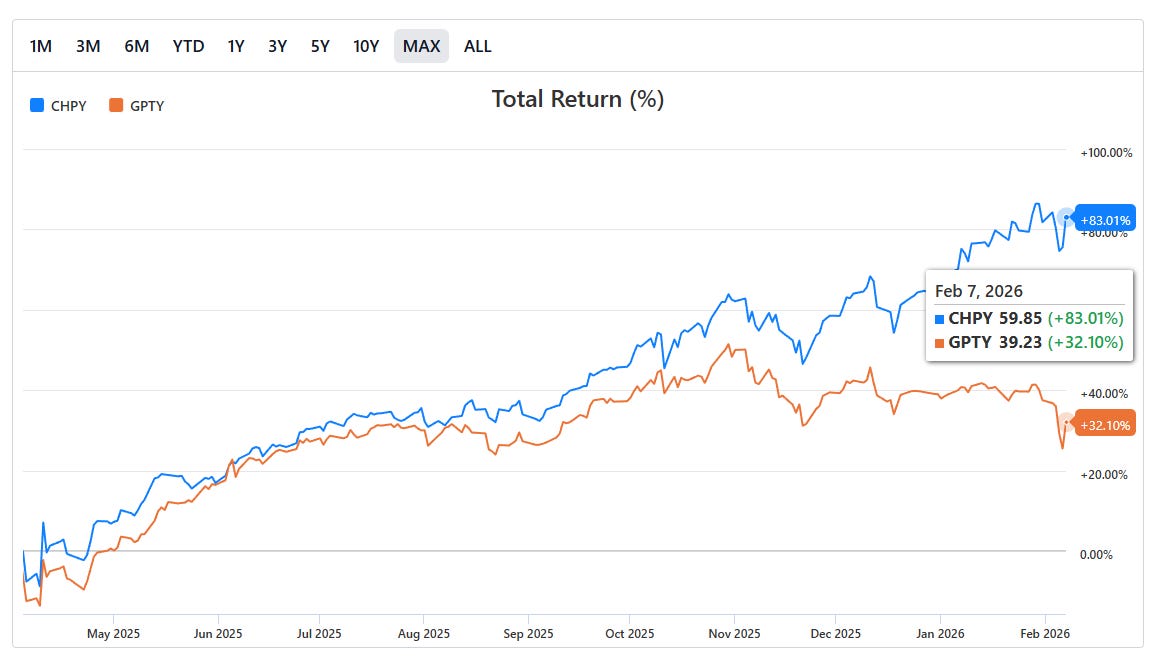
Year-to-Date 2026: CHPY has delivered total returns of +12.34% (including distributions) compared to GPTY’s -4.27%. This 16.6 percentage point differential suggests that in the current market environment—characterized by AI monetization concerns and valuation compression in high-growth tech—semiconductor infrastructure has outperformed direct AI exposure.
Since Inception: CHPY (launched April 2025) has generated total returns of +83.01% (annualized +104.29%), while GPTY (launched January 2025) has returned +39.95% (annualized +48.78%). While both funds have benefited from AI-driven enthusiasm, CHPY’s superior risk-adjusted returns (maximum drawdown of -1.83% vs. GPTY’s -12.81%) suggest greater resilience.
Distribution Sustainability: Both funds employ options strategies that may return capital as part of distributions, requiring careful analysis of distribution composition. CHPY’s recent distribution rate of approximately 45% annualized exceeds GPTY’s 30%, reflecting higher volatility in semiconductor stocks (generating greater options premium) and potentially more aggressive option strike selection.
These performance patterns align with the theoretical framework: semiconductor infrastructure provides more stable exposure to AI growth because it benefits regardless of which application-layer companies ultimately dominate, while avoiding the concentration risks inherent in AI platform competition.
The AI industry in 2026 faces a critical transition. After years of massive capital expenditure—hyperscalers projected to spend over $500 billion on AI infrastructure in 2026—investors increasingly demand evidence of returns on these investments. This “show me the money” phase creates divergent implications for CHPY and GPTY:
For CHPY: The infrastructure build-out phase continues supporting equipment demand. Even if AI application revenue growth moderates, the installed base of AI infrastructure requires ongoing semiconductor supply for expansion, replacement, and upgrades. Data center capital expenditure may fluctuate but the underlying trend of silicon intensity per workload continues increasing. Additionally, non-AI semiconductor demand (automotive, industrial) provides diversification.
For GPTY: The transition to ROI-focused investment creates vulnerability for AI platform companies that have not yet demonstrated sustainable monetization. If enterprise AI adoption slows or consumer AI services fail to convert users to paid subscriptions, companies like Palantir and even Alphabet may face valuation compression. The winner-take-most dynamics intensify competition, potentially compressing margins for all but the dominant players.
Several emerging technology trends will differentially impact CHPY and GPTY:
Edge AI Proliferation: The shift from cloud-centric AI training to distributed edge inference benefits both funds but in different ways. For CHPY, edge AI requires specialized low-power silicon (benefiting Qualcomm, potentially in portfolio; and power management specialists like ON Semiconductor and Monolithic Power Systems). For GPTY, edge AI benefits Apple and Tesla specifically but may threaten cloud-centric platforms if processing migrates away from hyperscaler data centers.
Model Efficiency Improvements: Algorithmic advances that reduce training and inference compute requirements (such as more efficient transformer architectures or alternative approaches like state space models) could reduce semiconductor demand growth—a risk for CHPY’s growth trajectory. However, Jevons Paradox effects (improved efficiency increases overall usage) may offset this. For GPTY, model efficiency could democratize AI development, potentially eroding the advantages of well-capitalized incumbents.
Agentic AI and Automation: AI systems capable of autonomous action (agents) represent the next frontier of application-layer development. This benefits GPTY’s platform holdings (Alphabet, Palantir, Meta) but also increases infrastructure demands, supporting CHPY’s semiconductor exposure.
Geopolitical Fragmentation: Continued U.S.-China technological decoupling creates parallel supply chains. CHPY benefits from equipment sales to both ecosystems (though export controls limit China exposure) and from Western capacity expansion. GPTY faces more complex risks: Chinese AI platform competition (ByteDance, Alibaba, Baidu) may capture global market share in regions not aligned with U.S. technology, while U.S. platform companies face restrictions on serving Chinese markets.
Extending the analysis to a 2030 horizon illuminates the sustainability of each fund’s thesis:
CHPY’s Semiconductor Foundation: By 2030, the semiconductor industry is projected to reach $1.6 trillion in revenue, with AI-related applications representing 50-60% of this total. However, the industry’s diversification across automotive (autonomous vehicles requiring $2,000+ semiconductor content per vehicle), industrial IoT, and healthcare devices ensures that growth is not solely AI-dependent. The ongoing manufacturing technology transitions (2nm production, advanced packaging, potentially novel computing paradigms like photonics or neuromorphic chips) sustain equipment demand cycles.
The options income strategy, meanwhile, continues monetizing semiconductor volatility—a persistent characteristic of this capital-intensive, cyclical industry. Even as the industry matures, the mismatch between capacity expansion lead times (3-5 years for fabs) and demand fluctuations creates pricing volatility that options strategies can harvest.
GPTY’s AI Transformation: By 2030, AI markets may have consolidated around a few dominant platforms, with clear winners and losers among current contenders. If current market structure trends continue, 2-3 companies may capture 70%+ of AI platform value, while others face commoditization or obsolescence. GPTY’s diversified approach—holding both potential winners (Alphabet, Meta) and challengers (Intel, Palantir)—may face pressure if portfolio holdings experience divergent outcomes.
However, if AI creates entirely new application categories (humanoid robotics, scientific discovery platforms, creative industry transformation) that expand the addressable market beyond current platforms, GPTY’s exposure could capture these emergent opportunities more directly than CHPY’s infrastructure-focused approach.
CHPY suits investors who:
Believe AI infrastructure demand will persist regardless of which application companies dominate
Seek diversification beyond pure-play AI into broader semiconductor end markets (automotive, industrial, communications)
Prioritize income generation through options premium in a volatile sector
Are concerned about AI application-layer valuation risks and competitive disruption
Accept capped upside participation during extreme semiconductor rallies in exchange for downside income buffering
GPTY suits investors who:
Have high conviction in specific AI platform companies’ ability to maintain competitive advantages
Believe AI application revenue growth will outpace infrastructure growth as the technology matures
Are comfortable with concentrated exposure to technology sector volatility
Seek income generation but with potentially lower distribution rates than CHPY
Accept the risk of winner-take-most dynamics potentially disadvantaging portfolio holdings
For sophisticated investors, the CHPY/GPTY comparison suggests a barbell approach may be optimal:
Core Infrastructure Allocation (CHPY): Position CHPY as a foundational holding providing exposure to the “picks and shovels” of AI and digital transformation. The semiconductor industry’s diversification across end markets, distributed supply chain value creation, and structural supply constraints support long-term holding. The options income strategy provides current cash flow while maintaining equity participation.
Tactical Application Exposure (GPTY): Allocate to GPTY as a tactical, higher-conviction position reflecting specific views on AI platform winners. Given the winner-take-most risks, this allocation might be smaller than the CHPY position, treated as a venture-like bet on AI application layer development rather than core infrastructure holding.
Hedging and Risk Management: Both funds’ options strategies introduce complexity requiring monitoring. The high distribution rates (45% for CHPY, 30% for GPTY) likely include return of capital components given the mechanics of covered call strategies in volatile markets. Investors should analyze distribution composition quarterly and assess whether NAV erosion (if present) is offsetting income benefits.
The analytical framework developed through this comparison strongly supports the thesis that CHPY offers superior risk-adjusted long-term returns compared to GPTY, particularly as AI markets mature from hypergrowth to sustainable expansion.
Structural Diversification Advantage: CHPY’s semiconductor holdings serve AI, automotive, industrial, communications, and consumer markets. This diversification ensures that even if AI demand cycles slow, other end markets provide revenue stability. GPTY’s concentrated AI focus creates dependency on a single demand driver that may experience volatility as monetization challenges emerge.
Supply Chain Value Distribution: The semiconductor industry’s distributed value creation—across equipment, materials, design, manufacturing, and testing—prevents the extreme concentration risks facing AI applications. While ASML, TSMC, and NVIDIA are dominant in their respective niches, no single company controls the entire value chain, and technological shifts can redistribute power (e.g., Intel’s manufacturing resurgence, emergence of new memory architectures). AI platforms face more binary outcomes: winner-take-most dynamics may concentrate value in 2-3 companies while marginalizing others.
Income Generation Sustainability: Semiconductor volatility is structural—driven by capacity cycles, inventory dynamics, and technology transitions—and likely to persist indefinitely. This supports sustainable options premium generation for CHPY. AI stock volatility, while currently elevated, may compress as the industry matures and winners emerge, potentially reducing GPTY’s income generation capacity.
Valuation Risk Asymmetry: AI application companies in GPTY trade at valuations implying sustained hypergrowth and market dominance. Disappointment on either dimension creates significant downside risk. Semiconductor companies in CHPY, while also benefiting from AI enthusiasm, trade on more tangible metrics (capacity utilization, equipment order backlogs, memory pricing) that provide valuation anchors.
Geopolitical Resilience: CHPY’s global supply chain exposure—including beneficiaries of U.S., European, Japanese, and emerging market capacity expansion—provides optionality regardless of how geopolitical alignments evolve. GPTY’s heavy reliance on U.S. technology platforms creates vulnerability if global AI markets fragment along geopolitical lines or if foreign competition erodes market access.
The comparison between CHPY and GPTY transcends simple ETF analysis, illuminating fundamental principles of technology investing. In gold markets, experienced investors often prefer GDX (miners) over GLD (physical gold) because miners provide leveraged exposure with income generation potential (dividends) while physical gold generates no cash flow. In AI markets, an analogous logic favors CHPY: semiconductor infrastructure provides leveraged exposure to AI growth with income generation (options premium), while maintaining diversification beyond AI into broader digital transformation trends.
The critical insight is that AI, like gold, is a commodity-like enabler of value creation rather than the value creation itself. Just as gold’s value derives from its applications (jewelry, investment, industrial uses) rather than inherent properties, AI’s value derives from its deployment across economic activities. The companies that enable AI—through semiconductor manufacturing, equipment supply, and component provision—capture value regardless of which specific AI applications succeed.
As 2026 unfolds and AI transitions from infrastructure build-out to monetization proof-points, CHPY’s positioning becomes increasingly attractive. The fund provides exposure to the structural growth of digital transformation while avoiding the binary risks of AI platform competition. Its options strategy generates income from the semiconductor sector’s inherent volatility, offering a risk-managed approach to participating in one of the century’s defining technological trends.
For investors constructing portfolios for the AI era, CHPY represents the foundational infrastructure play—analogous to owning the railroads during the industrial revolution or the network equipment providers during the internet build-out. GPTY, while offering compelling exposure to AI’s application layer, carries greater concentration risk and competitive uncertainty. The prudent allocation likely favors CHPY as the core holding, with GPTY as a tactical satellite for those with specific convictions about AI platform winners.
In the final analysis, the CHPY/GPTY comparison validates a timeless investment principle: in gold rushes, sell picks and shovels. In the AI revolution, invest in the semiconductor infrastructure that powers every application, every platform, and every transformation. CHPY offers that exposure with sophisticated risk management—positioning it as the superior long-term vehicle for capturing AI-driven growth while generating sustainable income.
Disclaimer: This analysis is for informational purposes only and does not constitute investment advice. ETF performance data is based on available information through February 2026. Past performance does not guarantee future results. Investors should conduct independent due diligence and consider their risk tolerance before investing in these or any financial instruments.
No posts
Comments
Nothing yet. Say the first thing.
Sign in to join the conversation.