
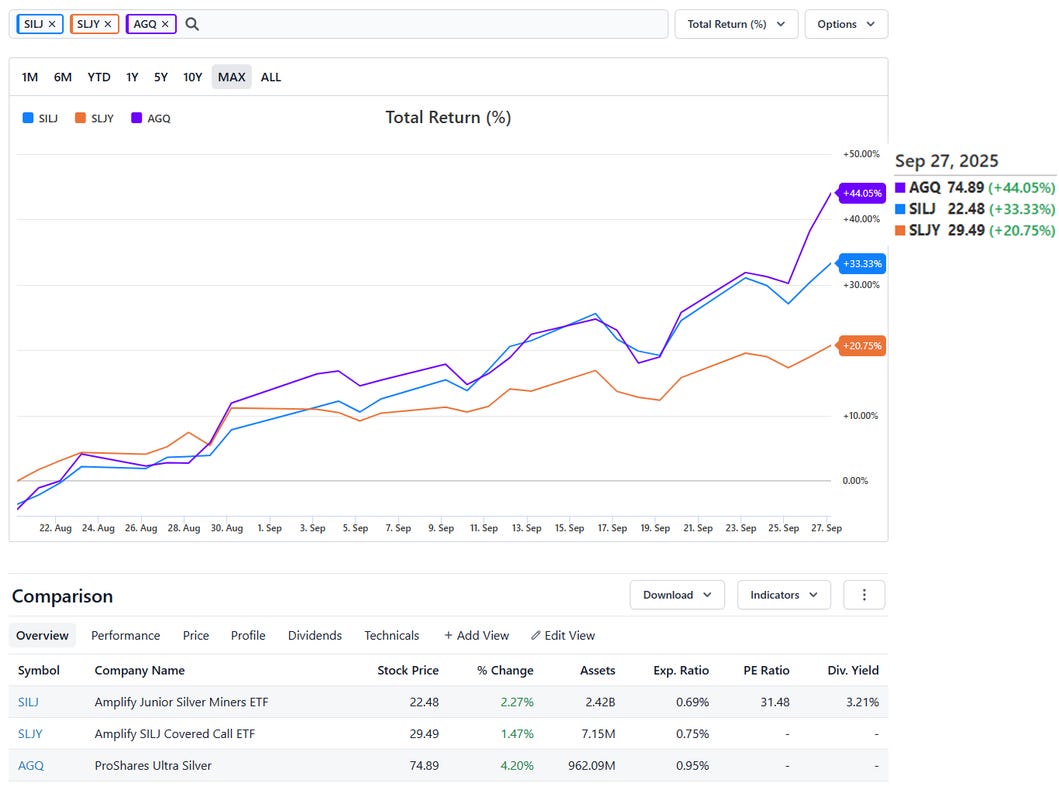
In 2025, silver prices have performed strongly, driven by industrial demand (such as solar and electronics), as well as safe-haven demand amid geopolitical uncertainty, which has surged to a 14-year high of more than $44 per ounce. The global silver market has been in deficit for seven consecutive years, with a projected deficit of 117.6 million ounces in 2025, with a 2% increase in supply but a slight decline in demand but still high. In this context, investors turned to silver-related ETFs to capture opportunities. Let’s analyze the investment value of three silver-themed ETFs – Amplify Junior Silver Miners ETF (SILJ), Amplify SILJ Covered Call ETF (SLJY), and ProShares Ultra Silver ETF (AGQ) – and compare their performance. The data is based on the latest market information as of September 27, 2025.
SILJ is a passive fund managed by Amplify ETFs that tracks the Nasdaq Junior Silver Miners index and invests primarily in small-cap silver mining companies around the world whose revenue is primarily derived from silver mining, production or exploration. The fund holds shares in dozens of small mining companies, with assets under management (AUM) of about $1.98 billion and an expense ratio of 0.69%. Its investment value lies in the rise in leveraged silver prices: mining companies’ profits often amplify silver price fluctuations, because rising prices at fixed costs can significantly increase gross profits. However, risks are also higher, including geopolitical (such as policy changes in the country where the mine is located) and operational risks (such as mine accidents).
In terms of performance, SILJ performed well in 2025, driven by a sharp rise in silver prices. As of September 26, its year-to-date return (YTD) was as high as 126.38%, far exceeding the average of 80.87% in the precious metals equity category. In the short term, the 1-month return is 24.87%, and the 3-month return is 39.24%; In the medium and long term, the 1-year return is 62.96%, the 3-year return is 30.15%, and the 5-year return is 4.53%. With a yield of 3.97%, it is suitable for investors looking for growth, but it is volatile and suitable for medium to long-term holding.
SLJY is a new ETF launched by Amplify in August 2025, based on SILJ’s holdings, balancing income with capital appreciation through a covered call strategy. The fund invests in SILJ’s equity, underlying silver mine stocks and silver ETPs (such as products that track silver spot), while selling out-of-the-money (OTM) call options on a weekly rolling basis, with the goal of generating an annualized option premium income of 18%. AUM is approximately $1.97 million, with an expense ratio of 0.75%. Its value lies in its high dividend potential: option income can be distributed monthly, making it suitable for income-oriented investors. However, the disadvantage is that the option strategy limits the upside, and if the silver price skyrockets, the fund may not be able to capture the full increase.
Performance data is limited due to new listings. As of September 26, both YTD and 1-year returns were 0.00% (as only 1 month of trading) but have reached new 52-week highs, indicating strong initial developments. 99.97% of the holdings are basic materials, highly concentrated in silver mines. Compared with pure growth funds, SLJY is more suitable for conservative investors, and can buffer downside risks through option income during periods of silver price shocks.
AGQ is a leveraged ETF managed by ProShares, with the goal of achieving 2x the daily performance of silver prices. AUM is approximately US$862 million, with an expense ratio of 0.95%. Its investment value lies in amplifying silver price fluctuations: when silver prices rise, returns can increase exponentially, making it suitable for short-term trading or strong markets. However, the leverage effect also amplifies losses, and due to the compound effect, long-term holding may deviate from the 2x target, especially in volatile markets.
Strong performance but wild fluctuations. As of September 26, YTD returned 122.42%, 1-month return 19.68%, and 3-month return 44.26%; The 1-year return is 74.28%, the 3-year return is 56.82%, but the 5-year return is -2.04%, indicating long-term decay. No yield (0.00%), purely capital appreciation design. Suitable for experienced traders, but not recommended for long-term holding.
The following table summarizes the key indicators of the three funds (data as of September 26, 2025):
indexSILJSLJYAGQYTD return126.38%0.00% (New Fund)122.42%1 month return24.87%N/A 不适用19.68%3 months return39.24%N/A 不适用44.26%1 year return62.96%0.00%74.28%3 years return30.15%N/A 不适用56.82%5-year return4.53%N/A 不适用-2.04%Expense ratio0.69%0.75%0.95%AUM$1.98 billion$1.97 million$862 millionYield3.97%High option income0.00%
In terms of performance, SILJ and AGQ have similar YTD returns in 2025, both benefiting from rising silver prices, but AGQ’s leverage makes it more aggressive in the short term (such as higher 3-month returns) and poor in the long term (negative 5-year returns). SLJY lacks new listing data, but its options strategy is expected to provide stable income in volatile markets, sacrificing some upside potential. SILJ is more suitable for investors who are optimistic about the long-term growth of silver mining; AGQ is suitable for short-term silver price bullishness; SLJY is an income supplementary product.
The silver market outlook for 2025 is positive – with prices expected to reach $40 per ounce and deficits continuing to drive the upward trend – all three funds are attractive. SILJ provides leverage exposure to mining companies to benefit from supply shortages; SLJY enhances income through options and is suitable for retirement portfolios; AGQ amplifies silver prices, but needs to be wary of leverage attenuation and futures rollover costs.
No posts
Comments
Nothing yet. Say the first thing.
Sign in to join the conversation.