
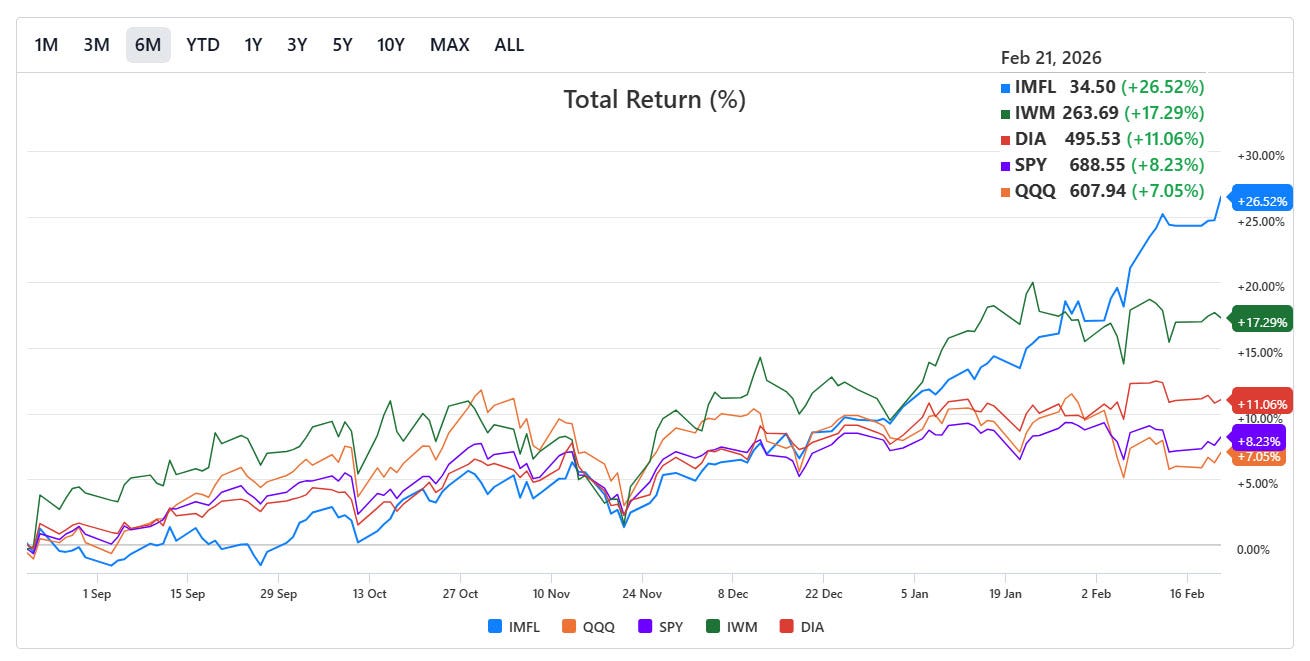
As global markets continue to evolve amid economic uncertainties, exchange-traded funds (ETFs) employing sophisticated strategies like dynamic multifactor investing are gaining traction. The Invesco International Developed Dynamic Multifactor ETF ($IMFL) stands out as a compelling option for investors seeking diversified exposure to developed markets outside the U.S. This report provides a comprehensive analysis, drawing on the fund’s strategy, performance, portfolio composition, drivers of success, risks, and investment implications.
Launched in 2017 by Invesco, IMFL is an international equity ETF that tracks the FTSE Developed ex US Invesco Dynamic Multifactor Index. With $722 million in assets under management as of February 2026, it offers a low expense ratio of 0.25% and quarterly dividends. The fund’s dynamic multifactor approach—targeting low volatility, momentum, quality, size, and value—aims to deliver excess returns across market cycles. Recent performance has been strong, with a 37.55% one-year return and 9.89% annualized since inception, driven by factor rotation and international valuation repairs. However, investors should note risks from sector concentration in financials and currency fluctuations. IMFL suits long-term portfolios focused on non-U.S. developed markets.
IMFL provides diversified access to developed international equities, excluding the U.S., through a quantitative, rules-based index developed by FTSE and Invesco. At least 80% of assets are invested in index constituents, ensuring tight tracking. The fund’s medium size positions it well in the multifactor ETF space, with a competitive cost structure and stable income via quarterly payouts (yielding 2.67%-2.93%). This setup appeals to investors prioritizing efficiency and income alongside growth.
Rooted in modern portfolio theory and factor investing, IMFL diverges from cap-weighted indexes by systematically tilting toward five key factors:
Low Volatility: Selects stable stocks for downside protection and solid risk-adjusted returns.
Momentum: Captures trends by favoring recent outperformers.
Quality: Focuses on fundamentals like profitability, low leverage, and earnings consistency to avoid weak companies.
Value: Targets undervalued stocks for potential revaluation gains.
Size: Incorporates mid- and small-cap exposure for added return potential, though large-caps dominate.
This combination fosters diversification and adaptability, enabling the fund to thrive in varied environments.
IMFL’s edge lies in its dynamic rebalancing, which adjusts factor weights based on market signals—quarterly or monthly. In volatile times, low volatility ramps up for defense; in trending markets, momentum and quality take precedence for upside capture. This rules-based flexibility mitigates opportunity costs from static exposures, enhancing long-term performance.
The fund spans Europe, Asia-Pacific, and select emerging-but-developed-like markets, focusing on liquid large- and mid-cap stocks. Scoring occurs across factors, followed by optimized portfolio construction with weight caps to ensure diversification (369 holdings; top 10 at 8.05%). This broad, systematic approach minimizes idiosyncratic risks while tapping global growth.
IMFL’s holdings reflect factor biases:
Financial Services: 31.99% (e.g., banks with stable cash flows).
Industrials: 26.06% (cyclical exposure to recovery).
Consumer Cyclical: 8.10%.
Basic Materials: 7.30%.
Technology: 5.86%.
Utilities: 4.78%.
Consumer Staples: 3.95%.
Energy: 3.49%.
Communication Services: 3.26%.
Healthcare: 2.63%.
Real Estate: 2.57%.
This mix balances offense (cyclicals) and defense (utilities, staples), aligned with quality and value tilts.
Diversification extends regionally:
South Korea: High allocation (e.g., SK Square, Woori Financial, Hana Financial) for tech and finance opportunities.
Europe: Emphasis on banks like Italy’s Banco BPM and Banca Monte dei Paschi, Spain’s Banco de Sabadell, France’s Société Générale.
UK: Utilities and financials (Centrica, Prudential).
Japan: Industrials (Sumitomo Electric).
This spread reduces single-market vulnerabilities while capturing regional rebounds.
Top positions underscore financial dominance:
SK Square Co., Ltd. (Korea): 1.32%.
Banco BPM S.p.A. (Italy): 0.88%.
Woori Financial Group Inc. (Korea): 0.84%.
Banca Monte dei Paschi di Siena S.p.A. (Italy): 0.81%.
Banco de Sabadell, S.A. (Spain): 0.77%.
Société Générale (France): 0.71%.
Centrica plc (UK): 0.70%.
Sumitomo Electric Industries, Ltd. (Japan): 0.69%.
Hana Financial Group Inc. (Korea): 0.68%.
Prudential plc (UK): 0.64%.
Low concentration enhances resilience.
IMFL has excelled recently:
One-year return: 37.55% (outpacing benchmarks).
YTD 2026: 13.80%-14.17%.
Since inception: 9.89% annualized.
These figures, inclusive of reinvested dividends, highlight resilience through challenges like trade tensions and pandemics.
Success stems from:
Dynamic shifts capturing 2024-2025 style rotations (tech to value).
Quality and value outperformance amid economic concerns.
Sector gains in finance and industrials during recoveries.
Broader international rallies, aided by low U.S. valuations.
Synergies across factors for balanced returns.
Factor Rotation Efficacy: Adaptive weighting exploits cycle-specific strengths, e.g., value/quality in slowdowns, momentum in uptrends.
Global Valuation Rebound: Non-U.S. markets’ undervaluation fueled repairs, boosted by rate peaks and regional factors like yen weakness.
Quality as a Safeguard: Screens for robust fundamentals yield resilient picks, complementing other factors.
Low Volatility Stabilization: Limits drawdowns, amplifying compounded returns.
Equity exposure invites downturns from macro, geopolitical, or policy shifts. Financial overweight (32%) amplifies sector-specific hits, like rate reversals or regulations.
Underperforming factors (e.g., simultaneous quality/value failures) could lag benchmarks. Premium erosion from market efficiency poses long-term threats.
Dollar strength erodes non-U.S. returns; regional holdings (e.g., Korea) may face liquidity squeezes in stress scenarios.
IMFL’s innovative multifactor design positions it as a strong diversifier for U.S.-heavy portfolios, offering alpha potential through adaptive strategies. Ideal for long-term investors optimistic on financials and international recoveries, but patience is key—factor efficacy shines over cycles. Past results (e.g., 37.55% one-year) aren’t guarantees; assess personal risk tolerance and sector views before allocating. In a fragmented global landscape, IMFL merits consideration for balanced, factor-enhanced exposure.
No posts
Comments
Nothing yet. Say the first thing.
Sign in to join the conversation.