
Behind the Brand is written by the team over at Defiant. We bring together big agency brains with Effie winning writers, comedians & creators with millions of followers. We help brands define razor-sharp strategy & develop creative ideas that win the war on attention.
Learn more about us HERE
Most challenger brands would sell a kidney for an origin story like DASH’s.
Two founders from farming families. Roughly a third of Britain’s fruit and veg crop rejected by supermarkets for being insufficiently photogenic. A sparkling water built from exactly that wonky, unwanted produce, and aiming to ‘find a better way’ of creating a healthy soft drink. It’s the kind of narrative that writes its own PR, makes journalists misty-eyed, and earns you shelf space on vibes alone.
So the most interesting thing Bridget Hirst, DASH’s Brand Director, told me is that the smartest move they’ve made is to quietly demote it from its primary message.
We covered a lot of ground over an hour, from which four themes about how DASH actually scales kept surfacing. Let’s dive in.
When DASH launched, wonky sat front and centre. It was the hook, the differentiator, the thing you remembered. And whilst it was a brilliant founding centre of gravity, the brand has now cleverly began to move beyond it.
“Wonky remains a complete hygiene factor for us, but it’s not the main reason people buy. People are buying us because they think we taste great, we’re a healthier option, and they’re really proud to be seen with the can.” Bridget Hirst, Brand Director, DASH Water
That’s a subtle but important shift, because whilst DASH hasn’t abandoned their founding story, they have stopped asking it to do much of the heavy lifting when it comes to selling. As Hirst puts it, the ambition is bigger than a waste story: they want to “drive a healthy hydration revolution.”
Simply DASH has moved it to where it belongs: the reassurance, not the reason. It’s a pattern I’ve seen before too. Olipop in the US started as a hardcore probiotic and grew into a modern soda that happens to be better for you. Same instinct: lead with the want, let the worthiness back it up.
When DASH launched, wonky sat front and centre. It was the hook, the differentiator, the thing you remembered. The trouble with hooks is that they’re brilliant at getting you noticed but not always the right answer to get you to a hundred million.
I am sure you have all seen that Kantar deck a thousand times. You know the one. The one that proclaims that taste is the number one driver of purchase in food and drink. Whilst it may be true, i do believe there are problems with it. me. My problem with it is that if everyone leads on taste, nobody owns it. You end up with fifty brands and one identical tagline, all shouting “delicious” into the same void.
Hirst’s instinct here is exactly right:
“Taste is everyone’s number one driver of purchase, but it’s the hygiene factor. Your drink would have to be doing something really fundamental for taste not to be number one.” Bridget Hirst, Brand Director, DASH water
Her answer to the trap is the platform DASH has built its last year around: a bold rejection of compromise. Not “we taste great”, everyone says that, but it’s not about what you give up, it’s about what you keep. The wellness aisle has historically spoken the language of sacrifice: less sugar, fewer calories, none of the fun. DASH flipped the script. You get the taste and the no-sugar, no-sweetener credentials, and you’re asked to surrender nothing.
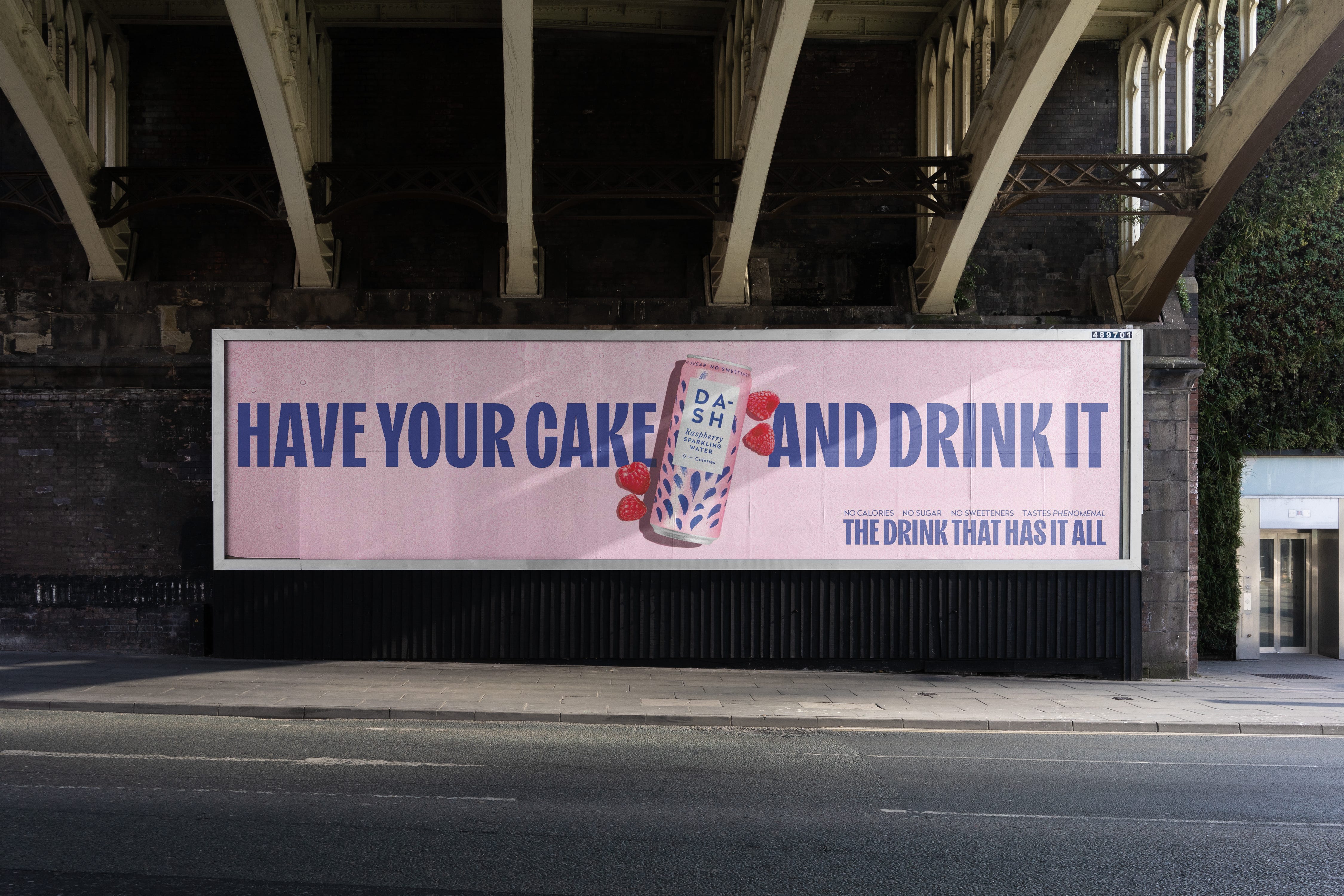
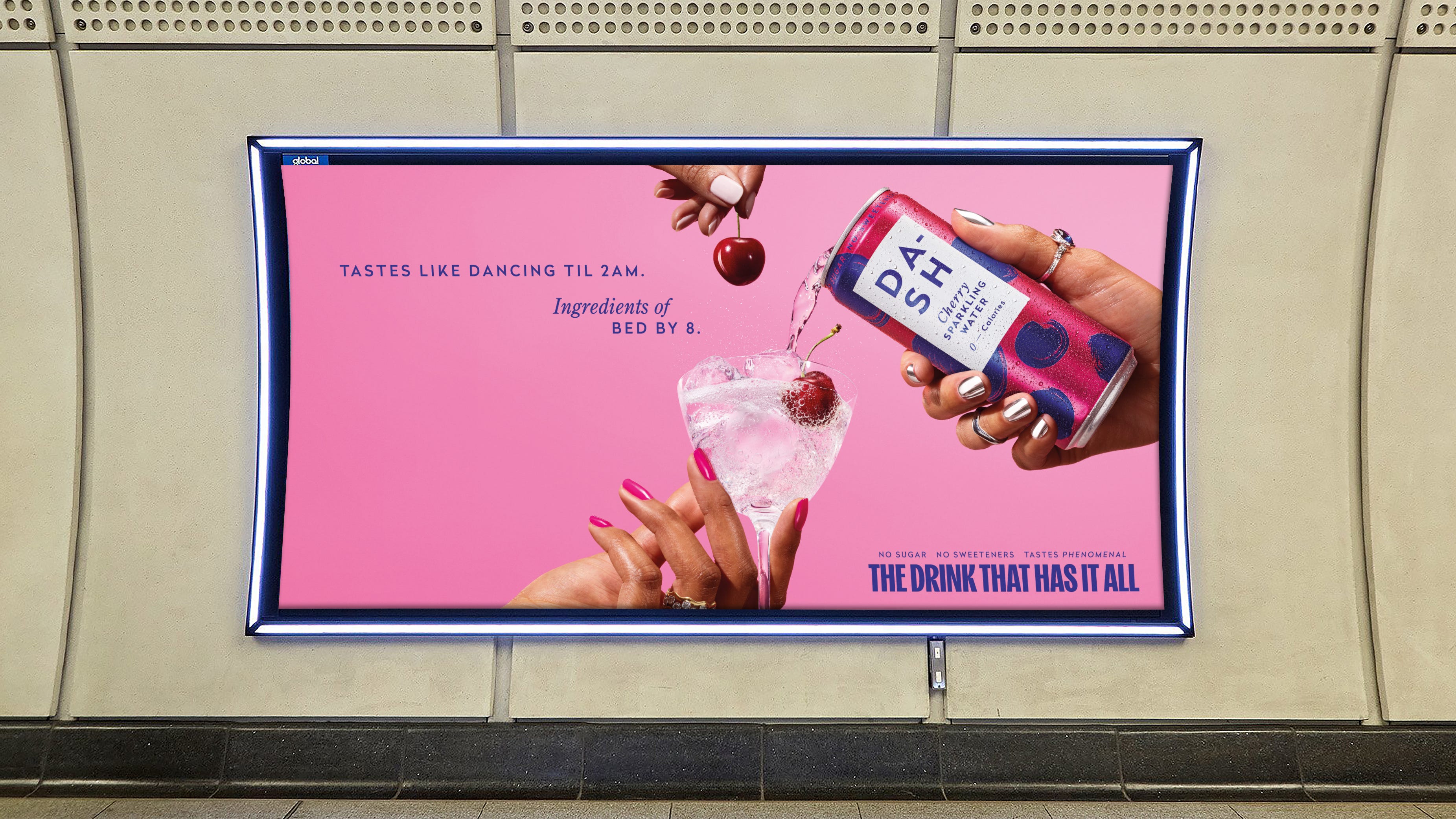
The craft is all in the execution. This summer’s out-of-home doesn’t just say taste, it conveys it through the way product is treated and shown.
There’s a quiet revolution happening in how brands and agencies work together, and DASH is a tidy case study. The original “rejection of compromise” platform, the TV idea that became campaign of the week, was built with an external agency as a one-off. Everything since has been made in-house: Dry January, the Pink Lady launch, this summer’s campaign. The platform was bought once and has been compounded internally ever since.
“The continuation of the platform has been done in-house. We are a small team wearing many hats at once… you can be the brand manager, strategist, creative director and producer all in one day.” Bridget Hirst, Brand Director, DASH water
This is a small, agile team,running national campaigns that out-score work made for several times the money. Their drink-that-has-it-all TV ad scored 5.1 on System One on a very modest production budget.
The clearest proof of the model is the campaign landing right now. Rather than reinvent, the team has taken last year’s award-winner and pushed it further: TV rolling out wider from the start of July, the high-reach London out-of-home repeating, and radio added for the first time as a complementary layer. The one thing they deliberately rebuilt was the out-of-home creative. The reshoot trades flat neon for crisp, premium product photography and a fresh run of those double-win lines: taste like a festival headline set, and eight hours’ sleep after; the returning taste like a summer fling, ingredients of a life partner; and, for the cherry can and its younger, 2am-Pasha-nightclub shopper, taste like dancing till 2am, ingredients of bed by eight. There’s even a long-format version that simply lists every quiet compromise modern life asks of you ( shared the suitcase, chosen the salad when you wanted the chips, pretended deep house is your jam) before offering a drink that doesn’t. The same thesis is heading to France too, dialled towards the functional reason-to-believe for an audience that’s never met the brand.
It isn’t all glossy brand work, either. Big DASH, the larger can that’s become a serious growth lever in Sainsbury’s and Tesco meal deals, gets a tactical on-pack promo this summer. The prize is a Mini, chosen with a straight face for a “very female-leaning buyer of a certain age,” which is exactly the kind of detail that separates a promotion that builds the brand from one that just shifts tins. Even a sales mechanic, in Hirst’s words, doesn’t have to be “really lame.”
Ask any challenger marketer where the disproportionate returns hide and, if they’re honest, they’ll point at partnerships. Hirst has the receipts. At Proper, a Barbie collaboration, Pantone-matched pink, a handful of activations, unlocked two thousand units of grocery feature space the brand had never had before, and set the template for KFC and Netflix tie-ups that followed. At DASH, a Perello “clean dirty martini” box for Dry January cost next to nothing and delivered the best PR the brand has ever had.
The selection logic is sharp and entirely unsentimental:
“Either their awareness is higher than yours, or they’re more relevant or more cool than you and how can you borrow a bit of that equity?” Bridget Hirst, Brand Director, DASH water
But the part she kept circling back to wasn’t strategy. It was effort.
“This is the difference between challengers and big brands. It’s the hustle.” Bridget Hirst, Brand Director, DASH water
The unglamorous truth of a small brand is that the brand team also becomes the sales team, the CEO occasionally gets dispatched to take someone out for a drink, and a launch can hinge on whether you can physically track down the fruit buyer in Tesco and persuade him to shelve your can next to the apples, which is precisely how DASH got its Pink Lady flavour into incremental, out-of-category space. Big brands buy distribution. Challengers improvise it.
If you take nothing else from an hour with Bridget Hirst, take these:
Moving beyond the founding story. DASH’s wonky-fruit origin is a hygiene factor and a source of permission, not the reason anyone buys. So do keep the ethics as a feature, but not as the main driver of purchase. .
You can’t win on taste, so don’t try. Taste is table stakes for the entire category. DASH made it ownable by building a platform around the rejection of compromise and by showing taste rather than claiming it.
Own the platform in-house. A small, agile team holding both strategy and creative buys you consistency and punches absurdly above its budget. You give up a little specialist polish; you gain a brand idea that compounds instead of resetting every quarter.
The hustle is the moat. Borrowed-equity partnerships pay back disproportionately but only if everyone, from brand to sales to the founders, is willing to graft for them. Big brands buy their way in. Challengers earn it.
None of this is exotic. That’s rather the point. DASH isn’t winning because it found a secret; it’s winning because it keeps asking the boring, disciplined question most brands to often skip.
Found this useful? Share it with someone who needs to hear it.
Comments
Nothing yet. Say the first thing.
Sign in to join the conversation.