
In this post I unpack a song and share some demos! Tickets are on-sale for the Sept-Oct-Nov-December tour! And pre-orders for “The Universal Bubba” are here, too.
One of the reasons I can make a living playing music is that people understand I can’t do much else: I think that’s what a ‘calling’ really is. There are a lot of artists who, like me, maybe aren’t the best pickers or the most talented, but are driven by creative energies, addiction, and mental struggles. We cannot seem to live normal lives, but grind out a living this way instead. I think this sense that I’m not going to be okay has made compassionate people open their doors to me. If you’re reading this, thank you! I prolly owe you a few chords and a song. I’m not really embarrassed by this broken part of me anymore— I already got fired. I want to cultivate something in me that isn’t self-destructive, though, and to take this opportunity to grow. If someone calls it selling out (as a couple people have), they don’t understand the years that I spent sleeping on other people’s couches to get here, all the times I smiled when I didn’t want to, the asses I kissed and the asses I kicked, the promoter in St. Louis who wouldn’t cough up any money, the dopesick pal, the shows I played with the flu, sleeping under overpasses, the locked doors and shattered windows. I wouldn’t trade ‘em. Because I couldn’t do much else! This is my lot, and I love it. Hell, it’s inexorable.
Of course, it’s worth mentioning the great pop-scientist Robert Sapolsky and his wonderful interviews. I’ve struggled to make it through his books and find them boring, but I’ve enjoyed listening to an evolutionary biologist talk about something akin to predetermination. He promotes the idea that our genetic makeup and our initial rearing make us do what we do.
Toward that end it’s silly to insist on being perfect individuals when we are flawed collections of genes, experiences, and communities. I am a product of love and poems and conversations. I remember in graduate school for poetry I kept meeting writers who had never written a sonnet, a traditional poetry form, even as an experiment or exercise. They told me things like, “I don’t know, I don’t want to write like the old people, I just want to be original.” I felt like there was a certain arrogance to never try your hand at something old just because it was old. To act as if your work was not in conversations with ghosts, lovers, circumstances, parents, history beyond your control.
Seriously, here’s a 2020 phone demo snippet, full of hem-hawing and looking for words. This is a minute out of about 15 minutes of mumbling about this concept.
0:00
-1:15
I’ve got something like a chorus, and I know I want to say something specific about the perspective of country people that I’m encountering. Something about giving up worldly possessions, something about how whatever happens can seem like god’s will, if you’re religious.
But the whole thing is kinda goopy, looking for a musical shape. I tried a ton of shapes, including a minor-keyed talking blues format in the style of Blind Willie McTell.
Phone demo, probably 2021?:
0:00
-0:30
This did not feel right. Years later, in 2023, I tried again. I couldn’t move on from the chorus, which felt so cool, but didn’t have a form I was happy with yet.
0:00
-0:31
I had plenty of shapes and concepts, and a couple of malformed verses. What I needed was a main subject. I found it in Australia in 2025.
Oh Australia! That farthest-flung shore for an American folksinger. Goddamn, what a place, a climate! The local birds alone gave me endless joy, so colorful and lovely. The food, the clean streets, the kind people! I felt very creative there. It helped I was on tour with Tyler, and didn’t have to worry about money as much as I normally do.
After a particularly hectic and fun show in Korumburra, I was feeling bold. Korumburra is a town of just three-thousand people, and we’d played to just a thousand folks: essentially a tiny concert for the kinda act that sells over 50,000 tickets regularly. The Aussie hillbillies were hilarious, fun, drunk, incredibly handsome.
“Cahm pahhhty with us!” I remember a buxom lass screaming at me. I retreated, feeling like the tremulous, fleshy mob would pour liquor down my throat until I died.
I ended up in conversation with Jesse Wells, Tyler’s fiddler/banjoist/guitarist/expert, (also known as “The Professor,”) about regional Kentucky and Missouri traditional musicians. He knows a lot more than I do, and it was fascinating.
It struck me as wild that we revered many of the same old musicians who never got to travel the world like we did, but that we had their particular shine with us. Talking about home that far away from home puts the world in perspective.
Here’s the romantic part. In my banjo case there was a tiny party favor from an Ozark friend’s wedding: his own moonshine tincture in a miniature jar. I quaffed it in a Melbourne motel room. I had my subject! The Mason Jar would be the perspective, the glass of the jar like a glass on the phone/TV screen, that all-ruining prejudicial lens. The shine would be (as always) moonlight and liquor, but now also the warm glow of a screen.
It struck me that the only literature I know about jars was also about this topic: Wallace Steven’s lovely little 1920’s poem “The Anecdote of the Jar”:
Anecdote of the Jar
I placed a jar in Tennessee,
And round it was, upon a hill.
It made the slovenly wilderness
Surround that hill.
The wilderness rose up to it,
And sprawled around, no longer wild.
The jar was round upon the ground
And tall and of a port in air.
It took dominion everywhere.
The jar was gray and bare.
It did not give of bird or bush,
Like nothing else in Tennessee.
I thought, why not riff here? In this poem, the jar seems to be kinda “unwilding” the place, civilizing the “slovenly wilderness.” It “takes dominion.”
I wanted my own mason jar, with its intoxicating brew, to be the opposite: a sign of wildness. Maybe wildness itself. The ever-changing soul-substance. I wanted it to be a vessel for us to “take communion,” instead of “take dominion.” Not control, but connection, the kind I felt with Jesse while talking about old fiddlers. Wherever I went, I couldn’t shake where I had come from, and this was a beautiful, world-drunk thing.
I kept messing with the strongest ideas I could find, finding disagreement and harmony. I’d kicked the chorus around enough, and figured I should look at folk tunes. I thought “Say Darlin’ Say,” the old nursery rhyme, was a perfect jumping off point. “Hush little darlin’ don’t say a word/pappa’s gonna buy you a mockingbird/if that Mockingbird won’t sing,/Pappa’s gonna buy you a diamond ring.” Here's a song with a chain of events happening: if this, then that, and so on. It felt like I could use the jar as a way to show various perspectives in this format.
I love, as many people do, Susie Goehring and Rayna Gellert’s version of this public domain nursery rhyme! I have listened to this about a thousand times, and learned it myself in 2025 out of sheer joy. Turns out this kinda melodic version was first recorded in the 1920’s.
Another favorite reinvention is from Martha Scanlan— a lovely song called “Little Bird of Heaven” that I’ve been listening to for a decade, a sort of “Say Darlin’ Say” interpolation. In it, she sings: “I looked up and I looked back/ walked a hundred miles on the railroad track/ all’s I can tell where from where I stand / I got a little bird of heaven right here in my hand.”
I wrote: “Everywhere that I have been/that jelly jar has been my friend/gone across the ocean and back again/ I’ve got the center of the world in the middle of my hand.” I know what I’m doing: we don’t have the same meaning, and the similarities end, but we both are using the nursery rhyme’s format to look closely at something we’re holding. Her’s is about holding onto love through pain, mine is about perspectives through time. She holds “heaven,” I hold “the world,” and these are awfully different.
It’s similar with the word “Tennessee” in Wallace Stevens’ poem. I’m taking my spirit from the Ozarks and abandoning it in the Smoky Mountains until it chases me, not placing a jar that stays in place and has the world grow around it. Both me and Stevens’ are doing the same thing, initially: we’re both placing a jar in Tennessee.
You could do this with almost any song. Maybe not as clearly (not all songs have roots in old nursery rhymes and poems), but you could. I don’t always want to do endless unpacking, but here it’s interesting. Novelists don’t tell you who they really ran into at the grocery store, what they overheard, what captures their attention and how it’s translated into fiction, but music is often endlessly copyrighted because jerks want to “own” it.
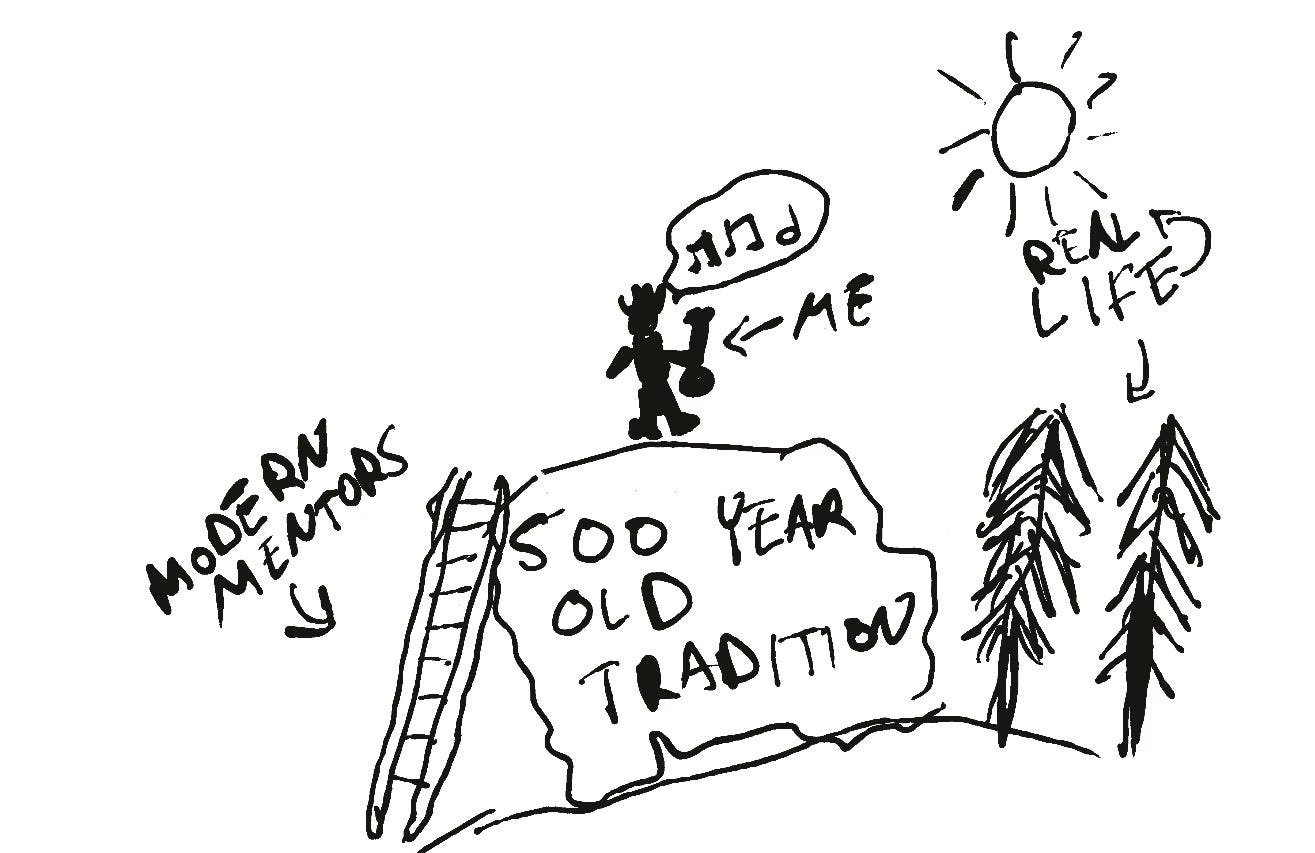
And folk music isn’t a vacuum! It never has been! This is broad and intertextual work, and individual talent is a myth. I wrote a folksong based on a nursery rhyme-ditty with 500-year-old roots influenced by a 125 year-old arrangement and a 25-year-old folksong and 100-year-old poem. I love all of these things, and feel lucky to have lived the kind of life that smashed them together.
I can usually unwind my process after years of recalling. Tulsa’s Last Magician? I wanted to write a better version of a Jimmy Buffet song called “Death of an Unpopular Poet,” and smash it up against the Ramblin’ Jack Elliot’s drop-D tuned song “If I Was a Carpenter” against the life story of a real-life magician I know named Cody Clark. I liked the way Bob Dylan did hammer-on’s in “Seven Curses,” too, and liked the way I thought John R Miller used the VI minor chord in “Faustina”. There’s a hint of each of those things somewhere in the song.
Phew! So much for brevity. For all the previous iterations of “Mason Jar” I’d already done, the demo that I sent to Tyler and the Food Stamps came very quickly. I made it on my phone in Australia, doing banjo, guitar, fiddle, and three-part-harmony. It’s rough as hell, but here’s a snippet:
0:00
-0:58
In modernity there’s so much pressure to create a “brand” or “signature” that makes your art scalable, where you’re supposed to be a unique sculpture instead of a product of your own beautiful life. This is a relatively new idea: the artist as an individual instead of a force of nature. I think our paths open in front of us like blossoming flowers! We can learn to smell them. Abundance unfurls.
Paid subs get the full demo below, so I can have health insurance. Threw in another demo too, where I’m crying about a dog. Much love forever!
Comments
Nothing yet. Say the first thing.
Sign in to join the conversation.