
This article is Chapter 3 of “Repression and Resilience: The Rise of Anti-LGBTQ+ Groups, Enduring Police Violence and Montreal’s Queer Defiance”. The contextual background behind this demonstration is laid out in detail in Chapters 1 and 2. Read those chapters before moving on to this one.
Everything I write and report on is free on this platform and always will be. If you would like to support my work, you can subscribe here or here on Ko-fi where you can make a one-time donation or subscribe for any monthly rate.
CW: Detailed descriptions and images of extreme police violence
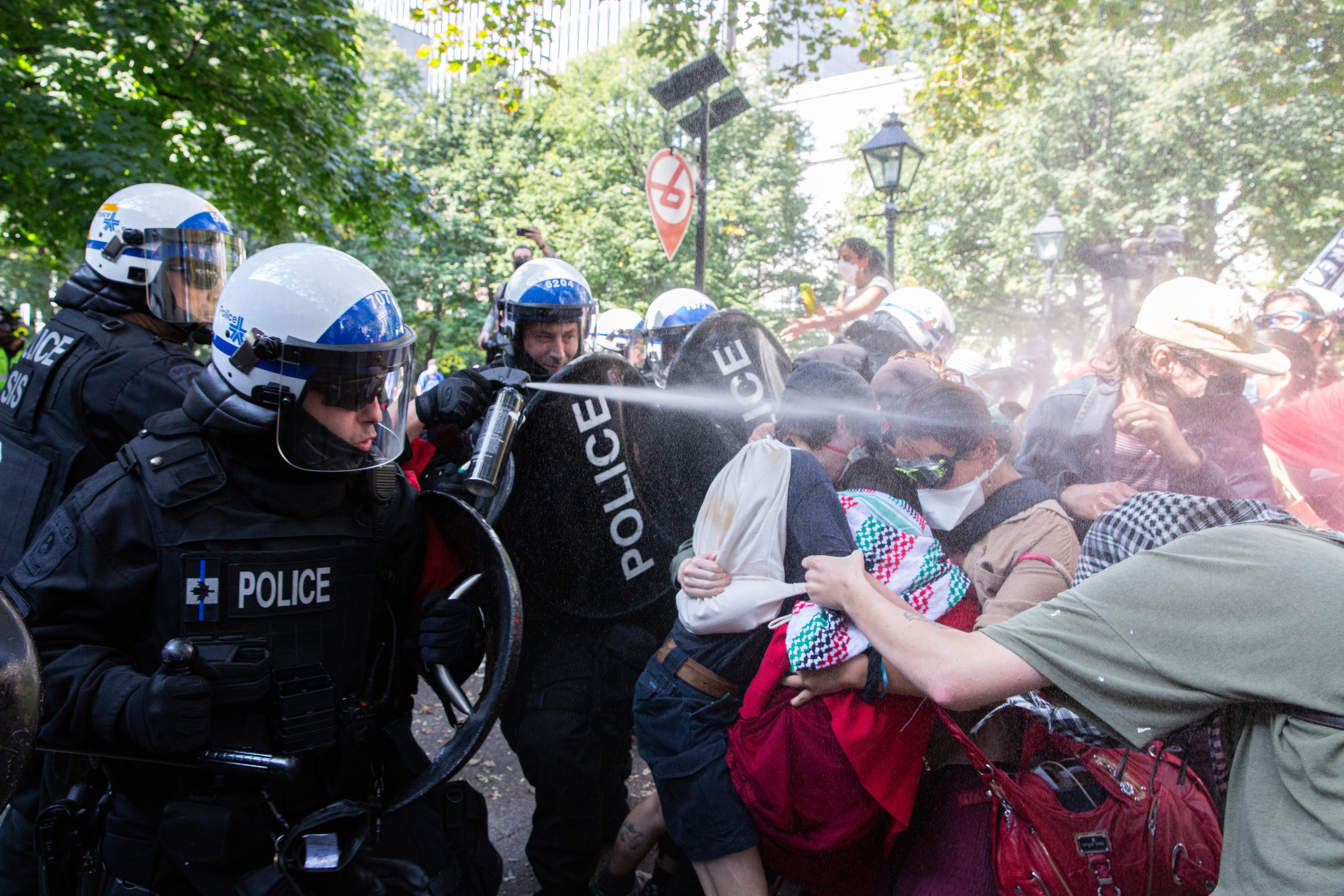
There is a widely held belief among queer people in Montreal that the police are bad.
That belief was reinforced on Sept. 20, 2024, when counter-protestors who showed their opposition to an anti-trans demonstration were brutalized by Montreal police (SPVM).
It’s one of the latest in a long, traumatic legacy of police repression of LGBTQ+ people and their allies in Montreal.
Montreal police became known for brutalizing and arresting LGBTQ+ people in targeted raids. Some events are engraved in the city’s collective memory, like when cops swarmed Truxx bar with machine guns in 1977 and when they crashed a warehouse party called Sex Garage in 1990.
These episodes of intense homophobic violence by the police provoked organized backlash, giving rise to new forms of political mobilization and consciousness in their wake. Such efforts led to tangible benefits for LGBTQ+ people in the passage of anti-discrimination legislation.
Despite tangible gains, antagonisms persisted.
In recent years, the LGBTQ+ community has experienced rising levels of hate and violence. Resistance against this intensification of anti-queer vitriolic rhetoric and violence have had a corresponding increase in police repression of queer-led demonstrations.
The deployment of heavily militarized riot police and the use of chemical weapons to disperse LGBTQ+ demonstrations is more common today than it was in the 1970s and 1980s.
The repression of the 2024 counter-demonstration against Ensemble pour protéger nos enfants (EPPNE)’s second 1 Million March 4 Children (1MM4C) was another high-water mark in Montreal’s police force’s history of brutality against the queer community.
This is the story of that event.
In Quebec, two self-proclaimed child protection organizations have been fighting against LGBTQ+ rights: Ensemble pour protéger nos enfants (EPPNE) and Hands Off Our Kids (HOOK).
HOOK and EPPNE’s mission: scrap protections for LGBTQ+ people in Canada. Driven by religious and social conservatism and an emphasis on “family values”, they have set their sights on altering education policy. Their demands include the removal of the topic of gender in education, the removal of any LGBTQ+ flags at public schools, expanding parental influence in the curriculum, the limiting of “sexualized content” in sex-ed and opposing trans inclusivity, just to name a few. Their tactics have included lobbying local school boards, extensive social media campaigning, and organizing street demonstrations.
On Sept. 20, 2023, thousands of people showed up for the Montreal 1MM4C in downtown Montreal. That same morning, several hundred counter-demonstrators gathered under the Roddick Gates outside McGill University in opposition. The HOOK/EPPNE crowd outnumbered them by the thousands, making plain the threat posed to the LGBTQ+ community.
Faced with the rising threat of HOOK/EPPNE, queer activists had a clear objective: to develop fresh organizing efforts and street mobilizations to counter the homophobic messages emerging from these new groups.
Jorick, a local queer activist, attended the 2023 counterprotest. He said the levels of vitriol towards the community were growing. “Queer people around me were starting to feel the hatred, threats and disinformation that we were already witnessing online,” he recalled. Taking a counter-narrative to the streets was imperative.
HOOK and EPPNE leaders have publicly used dehumanizing language to describe LGBTQ+ people, describing them as “psychopaths,” “perverts,” “evil,” “demons” and “disgusting.” They have stated that gender identity is an “ideology” that has been imposed upon children by “gender radicals” and “groomers” by force of “indoctrination”. This is without mentioning the hideous nature of the content and comment sections in their Facebook and WhatsApp groups.
“I felt like going there physically could show other queer people impacted by these lies that they are not alone [and that] the lies repeated loudly by the 1MM4C were not just completely false, but also dangerous,” said Jorick.
Emma, another activist who attended the 2023 counter-demonstration, said, “Allowing [the 1MM4C event] to go unopposed legitimizes it. It’s important to visibly show up and have a presence there, saying ‘Actually, this event and this ideology are really hateful and we don’t want this in our city.’”
Despite the success of the September 2023 march, EPPNE and HOOK were beset by internal strife. The tenuous coalition of conservative Christian and Muslim religious organizations, white nationalists and other far-right reactionary groups could not maintain unity. Some fundamentalist Christian organizations were vocal in their refusal to attend any events alongside a Muslim Arab leadership, despite agreeing on the fundamentals of loathing “gender ideology”. Vastly lower attendance at the September 2024 march reflected these divisions.
Following the 2023 1MM4C march, the CAQ appointed a “Comité des sages (expert committee)” to commission a report on issues surrounding sexual education and identity in education and public services. EPPNE took full credit for the policy achievement despite their internal turmoil
The hardcore members of the EPPNE leadership in Quebec, however, remained committed to furthering their policy aims beyond government committees. They demanded the immediate cessation of all sex education in the province of Quebec. They would continue demonstrating in the streets and lobbying until their goals were met.
As 2023 came to a close, queer organizers in Montreal were in broad agreement about the acute necessity of countering EPPNE in the streets. The 2023 counter-demonstration was perceived as a “serious defeat” by organizers. Bee1 told me that “a large coalition with wide ranges of politics and tactics” would be involved in planning opposition to the 2024 demonstration.
The following is based on my own reporting on-site, eye-witness statements, videos from counter-protestors, and other coverage of the events of Sept. 20, 2024.
Under cloudy skies and a crisp morning air, young queer activists distributed free coffee and breakfast under a pair of pink tents. Upbeat music pumped through a PA system as counter-demonstrators arrived at Place Vauquelin at 8 a.m. The dress code ranged from edgy streetwear to vibrant and flamboyant clothes. Many wore a mix of coloured hair, keffiyehs and N95 masks. Several flags smattered throughout the crowd added colour and symbolic clarity to the throng: the turquoise and pink flag of trans identity, the familiar rainbow flag, a Montreal Antifascist flag and the Palestinian flag blew in the gentle morning wind. Many held signs stating “let trans youth thrive”, “trans rights are human rights” and other inclusive messaging. One becaped counter-demonstrator wore a complete Superman costume, draped in a red-and-white keffiyeh. As the sun sporadically broke through the clouds, the atmosphere was festive.
On the south side of Rue Notre Dame, HOOK and EPPNE convened around a U-Haul truck. The cargo bed was stuffed with a PA system and several dozen pre-made signs, printed on white paper with black-and-red block text.
In French and English, EPPNE’s signs read “STOP GENDER IDEOLOGY IN SCHOOLS”, “DON’T IMPOSE YOUR BELIEFS ON US”, “EDUCATION, NOT SEXUALIZATION”, “LEAVE OUR KIDS ALONE”, “PARENTS KNOW BEST”, “LEAVE THE INNOCENCE OF CHILDREN”, “SCHOOLS [sic] FOR EDUCATION, NOT INDOCTRINATION”. One young child, pulled from school to attend the demonstration, held a sign reading, “I BELONG TO MY PARENTS.”
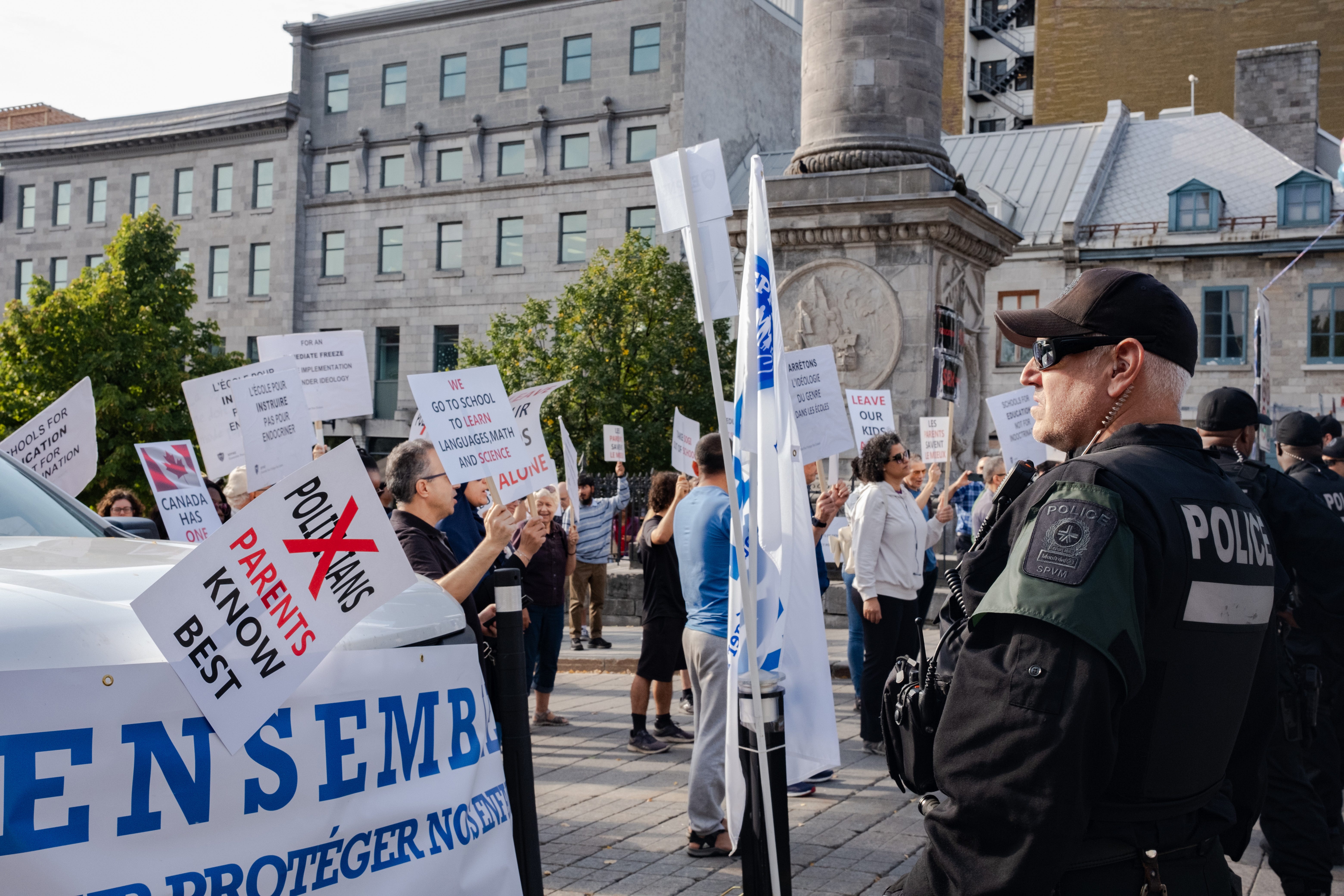
A line of SPVM officers separated the EPPNE demonstration from the vibrant counter-protesters.
Shortly after 9 a.m., the bulk of the competing demonstrations’ attendees had arrived. The main EPPNE march was composed of roughly 70 protesters. A crowd of around 300 made up the counter-demonstration. Speeches and chants echoed through competing PAs against the facade of Montreal City Hall in a booming jumble of music and impassioned voices. The volume was dizzying.
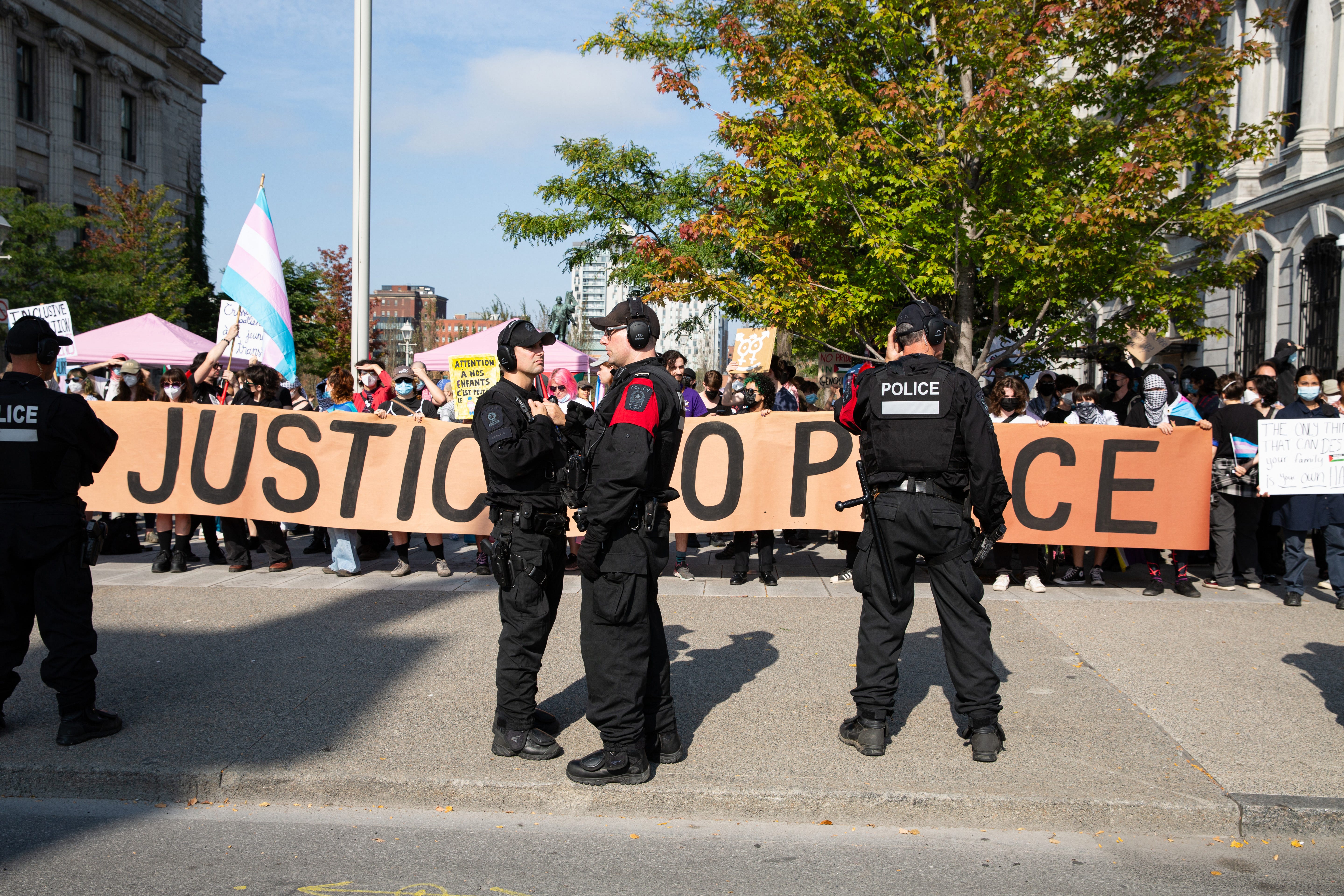
Counter-demonstrators unfurled a long tan-coloured banner reading NO JUSTICE NO PEACE, towards the direction of the EPPNE crowd. SPVM officers belonging to the riot squad, or Soutien et Intervention Spécialisé (SIS), formed a line along the north side of the sidewalk, their stern attention turned towards the counter-demonstration.
Onlookers passed by the demonstrations and rows of police, sipping their morning coffees, inquisitively peering at the smattering of signs, parsing out what the noise was all about. Lawyers wearing court gowns, walking from the nearby Palais du Justice, smiled at the counter-demonstrators. Although the height of tourist season had fizzled out by mid-September, scattered tourists milled about Old Port. A large chartered bus unloaded a boisterous class of middle school students on a field trip to frolic about the historic neighbourhood.
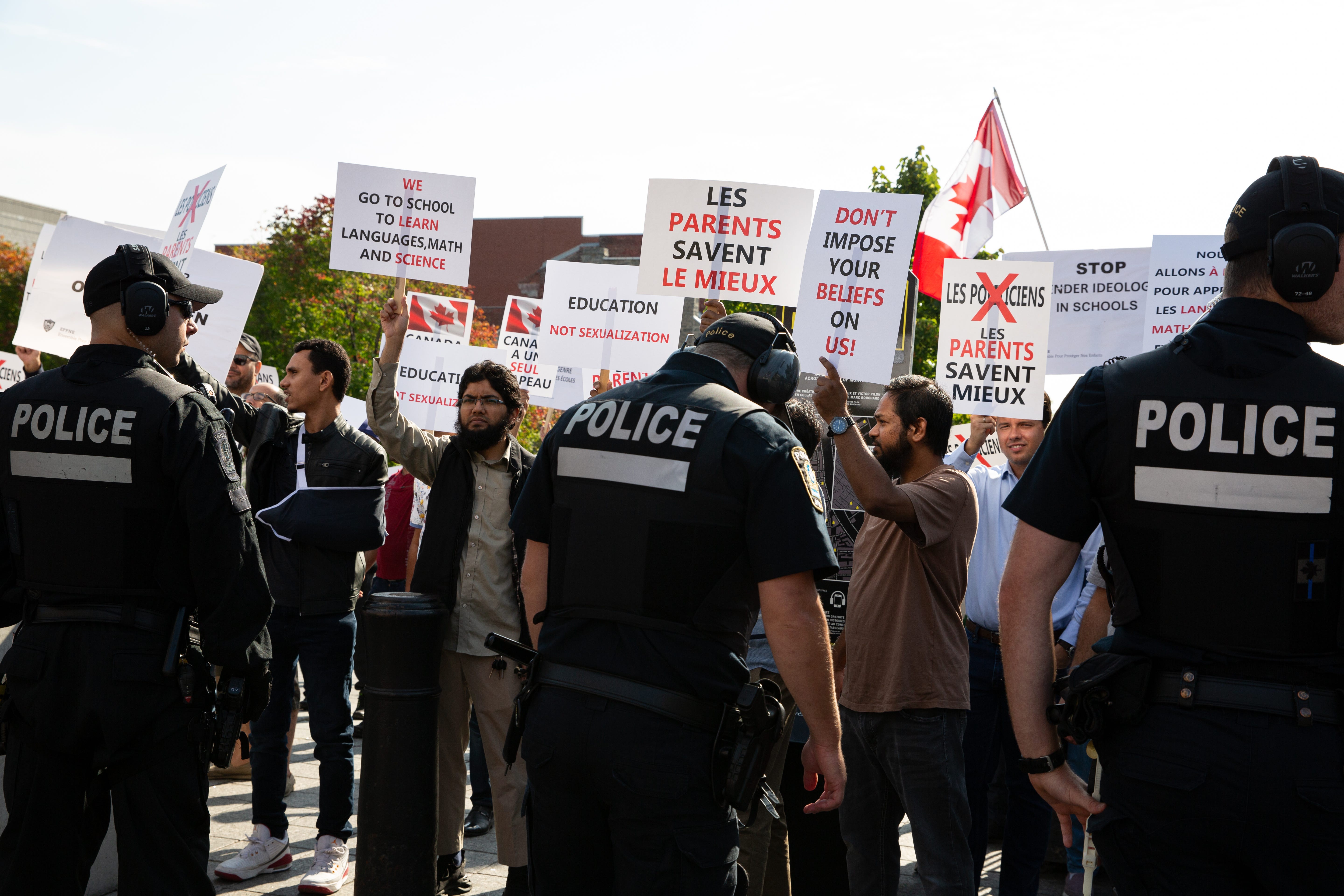
Veteran organizers, familiar with the heavy hand of the SIS, did not want an escalation from the police. “There were many children around on a field trip. Elementary [school] students,” said Zev, one of the event organizers. “We had discussed making sure that we did absolutely nothing that would be perceived as instigating, so that police wouldn’t deploy chemical weapons. We didn’t want all these children that [EPPNE] claims to be protecting to be caught in the crossfire of a whole bunch of chemical weapons.”
Speeches from counter-demonstrators addressed their experiences growing up queer or trans and the obstacles they faced coming out to their families. They also emphasized the inadequacies of Quebec schools’ sex and gender education, and the lack of recognition of LGBTQ+ identities.
Some speeches by counter-demonstrators were conducted fully in Arabic. With a strong Arab and Muslim presence among the EPPNE crowd, the act appeared as an attempt to bridge the cultural and linguistic gaps between the divergent groups. The framing of their positions by these speakers, rather than hostile and dismissive, offered an appeal for persuasion; a recognition of their humanity, their compassion and understanding.
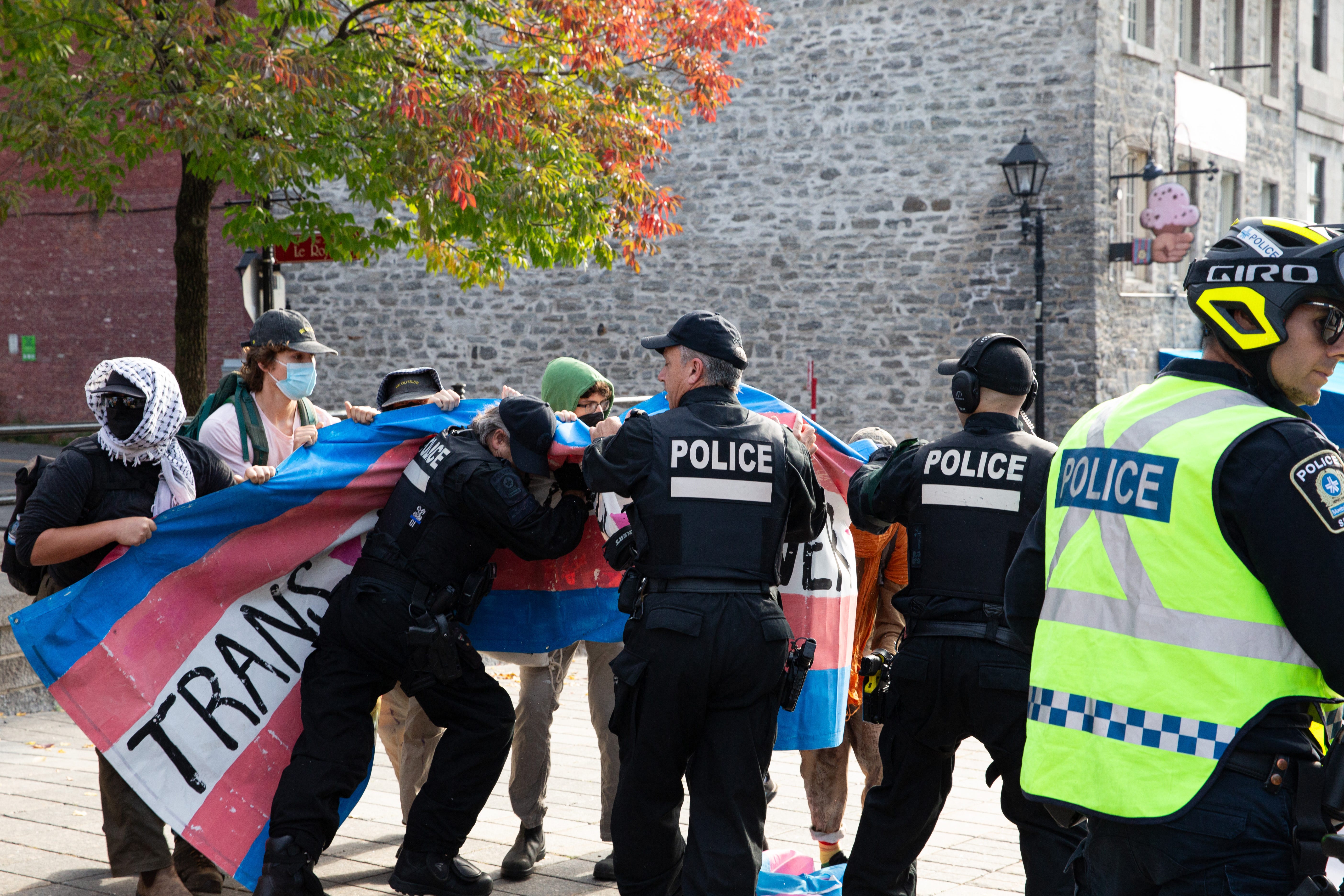
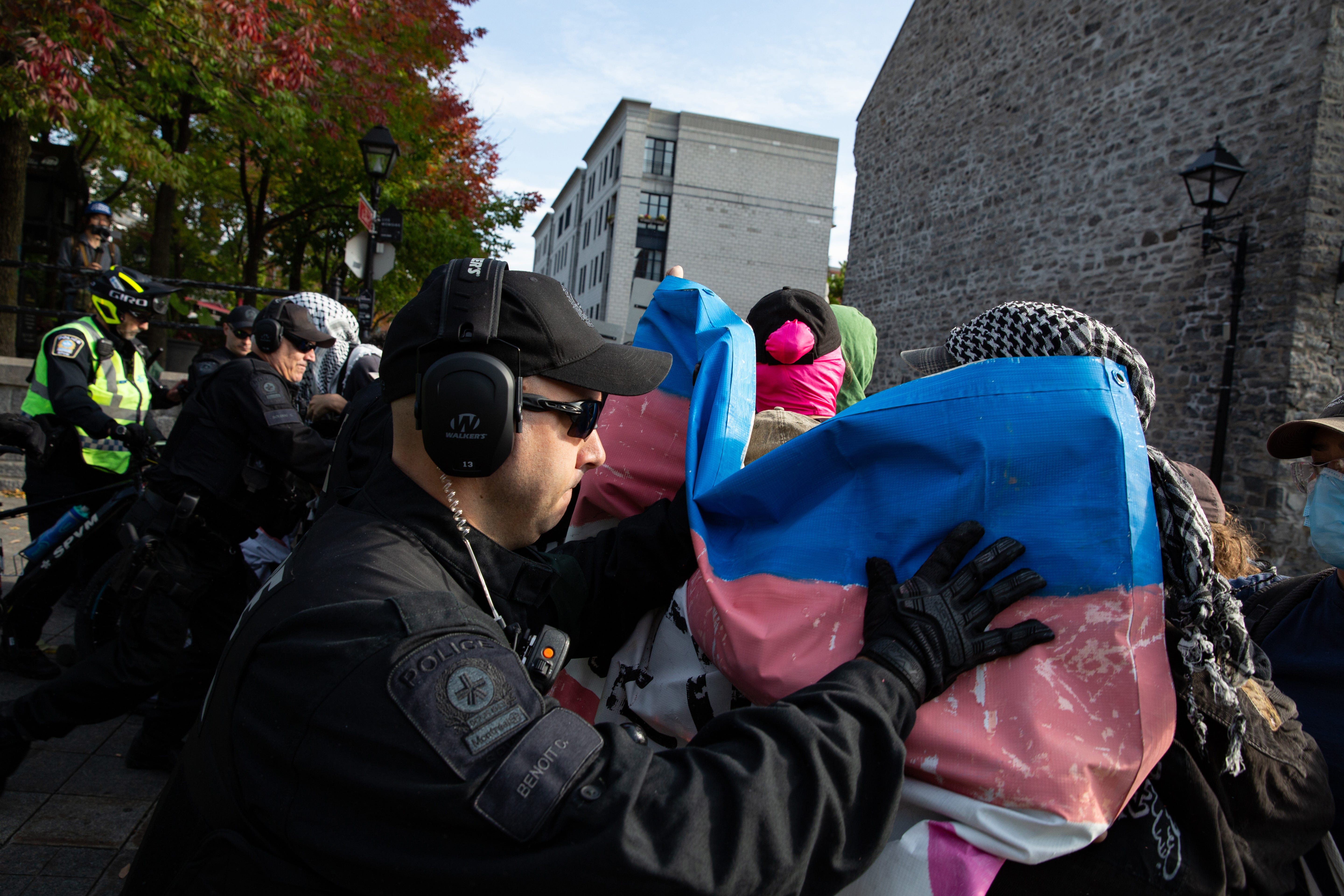
Further south, in a “mobile unit,” counter-demonstrators flanked the police lines to establish another physical presence and create more noise surrounding the EPPNE crowd. Around a dozen held a pink-and-turquoise canvas banner reading “Trans Lives Matter.” They stood about 50 feet from the EPNNE march in Place Jacques-Cartier, chanting pro-queer slogans.
The SIS immediately ran over to the newly formed contingent of counter-demonstrators and began pushing against the banner, punching and hitting those behind it to move them further from the EPPNE demonstration. Neither the SIS nor the SPVM verbally asked them to move backwards before their use of force. This would be the first major instance of police escalation that would soon increase sharply.
Following speeches denouncing the “indoctrination of children in schools,” at around 10:30 a.m., the EPPNE demonstration took to the streets. SPVM officers spoke with the organizers about how they’d like the march and police presence to proceed. This courtesy was never offered to the counter-demonstrators.
Led by the crawling advance of the U-Haul truck blaring slogans from the PA in the cargo bed, the EPPNE march began. The counter-demonstration lurched towards Rue Notre-Dame. Police ranks closed and pushed firmly up against them, preventing counter-demonstrators from moving towards the street.
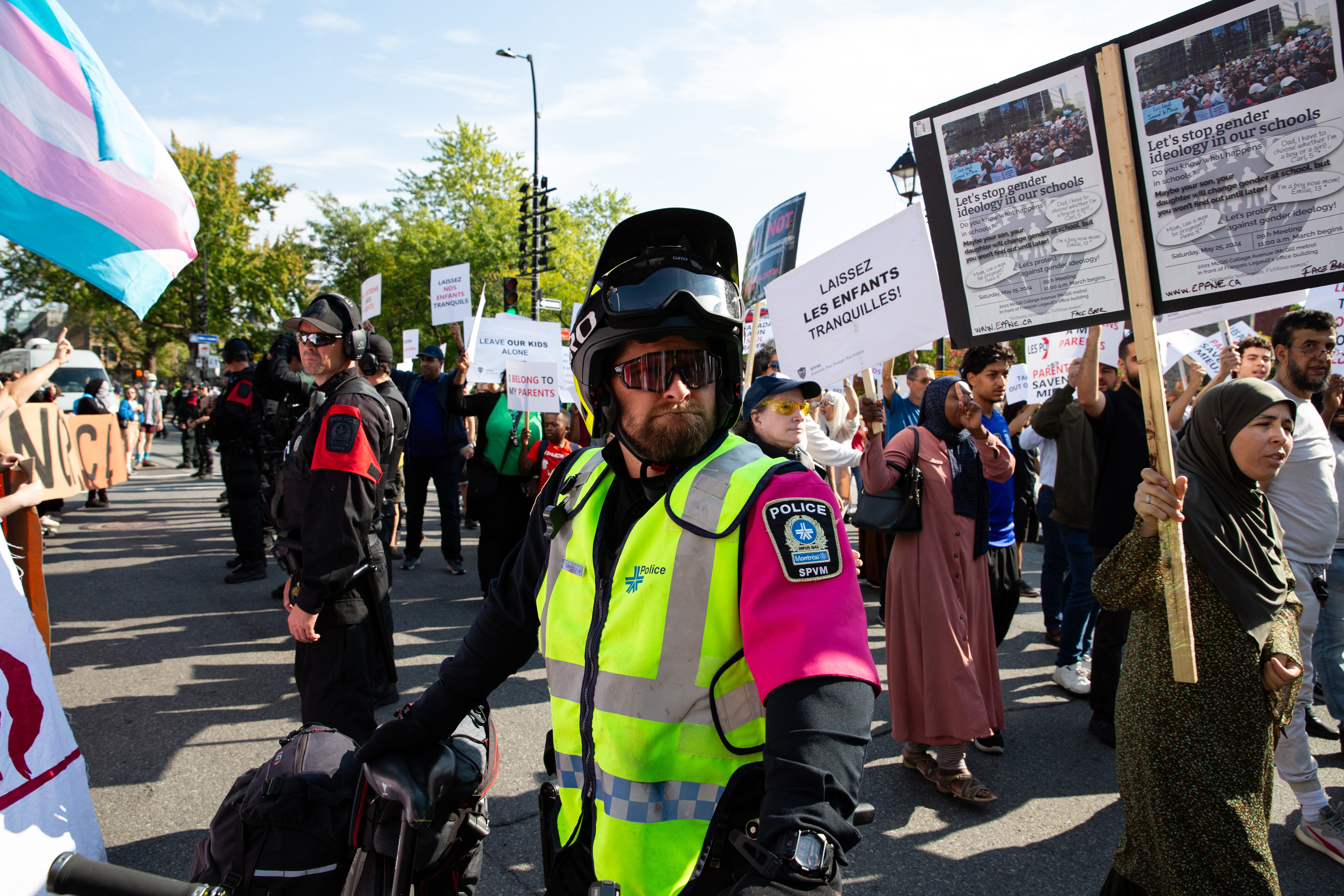
Dozens of fresh SPVM officers joined the ranks along the street. A contingent of police with bicycles pushed up against the No Justice No Peace banner as SIS riot police walked beside the EPPNE march.
The counter-demonstration intensified their chants. From a few feet away, advancing EPPNE demonstrators jeered and mocked them. They chanted their own slogans decrying “gender ideology” and waved their signs in their direction. It became clear that the SPVM would not permit the counter-demonstration to move anywhere on the streets or on the sidewalk on Notre-Dame. The queer activists began mapping out new maneuvers.
Meanwhile, as the main demonstration was beginning to march, a mobile unit had outflanked the police a block ahead of the EPPNE march’s route. At the intersection of Boul. St-Laurent and Rue Notre-Dame, a group of around 25 counter-demonstrators stood in the streets holding banners. Led by an energetic activist with a portable loudspeaker, they chanted “Hey hey, ho ho, transphobia has got to go!”
Riot police immediately descended upon the group. Without warning, they began to beat counter-demonstrators with thick black batons. One officer shot a close-range tear gas muzzle projectile point-blank at the counter-demonstrators’ heads.
Videos I obtained of this incident2 show SPVM riot police grabbing and throwing demonstrators to the ground. Some police jabbed their batons in a forward, thrusting motion. Others swung their weapons in fierce 180-degree clubbing motions. Several demonstrators fell to the ground on top of one another as police shoved them against a construction barrier. None fought back.
At one point in the beating captured on video, an officer stepped towards the small group, screaming “Bouge! (Move!)” A person wearing a red bicycle helmet held a first-aid kit above their head and said “Medic! Medic!” in the SIS officer’s direction. The officer then smacked the first aid kit away from the person with his left hand, then struck them with a hard swing of his baton with his right. He then pushed the medic onto the pile of counter-demonstrators clambering to get up from a heap on the ground.
One of the counter-demonstrators, Ki’ra Prentice, was caught up in this fray. “At one point, a cop grabs me from behind and picks me up and throws me, I got like a foot and a half of air,” they recalled with disdain.
The counter-demonstrators retreated from the road. “It’s safer together, stay together!” the demonstrator with the loudspeaker shouted. The police too retreated, their glances darting in every direction as their grip on the situation appeared to be deteriorating.
In this video, a counter-demonstrator said, “They literally came out and attacked us out of nowhere!”
During the police beating of counter-demonstrators at the intersection of Rue Notre-Dame and Boul. St-Laurent, EPPNE’s march had been stalled. The U-Haul idled in the middle of Rue Notre-Dame. Demonstrators stopped chanting and stood in the sun, wondering what the holdup was.
In another video perspective captured from beside the EPPNE demonstration, cheers emanated from the EPPNE crowd as the police advanced towards the counter-demonstrators and started beating them. The person filming turned the camera towards the elated throng and said, “They’re cheering on the police brutality, what the fuck!” before they were interrupted by a thunderous reverberation from a tear gas projectile. The EPPNE protest again erupted in cheers as the SPVM continued to beat counter-demonstrators.
Meanwhile, the main body of the counter-demonstration, having been met by a solid, infallible line of police, had moved north, then westbound to try to outflank the SIS. Upon meeting another line of riot police at St-Laurent preventing progress, they turned back the way they came, and emerged at Place Vauquelin once again.
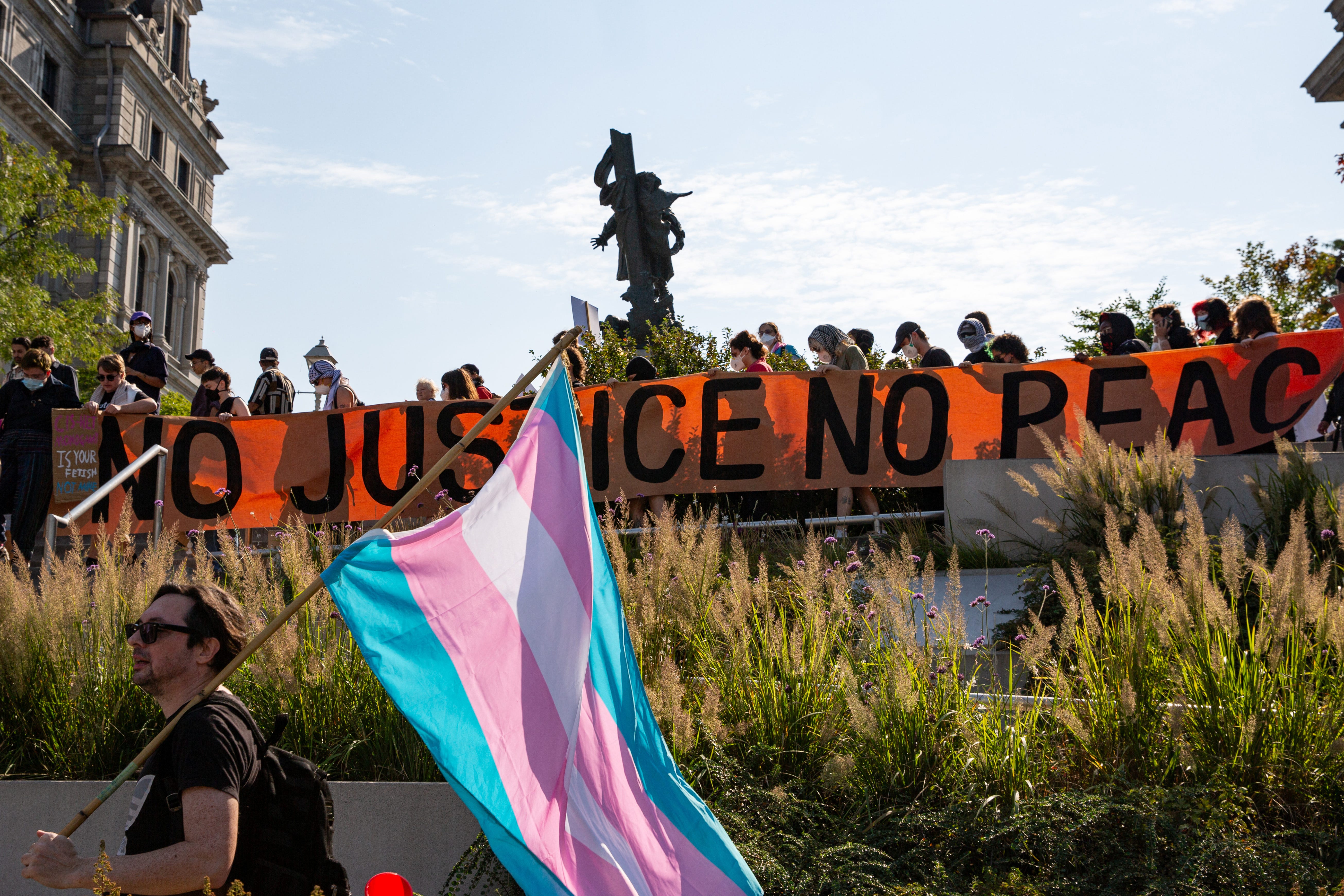
The SPVM were totally outmaneuvered by this movement.
The counter-demonstration then approached from the rear of the EPPNE demonstration, unobstructed by riot police. They chanted slogans and held banners on Notre-Dame beside the Palais de Justice.
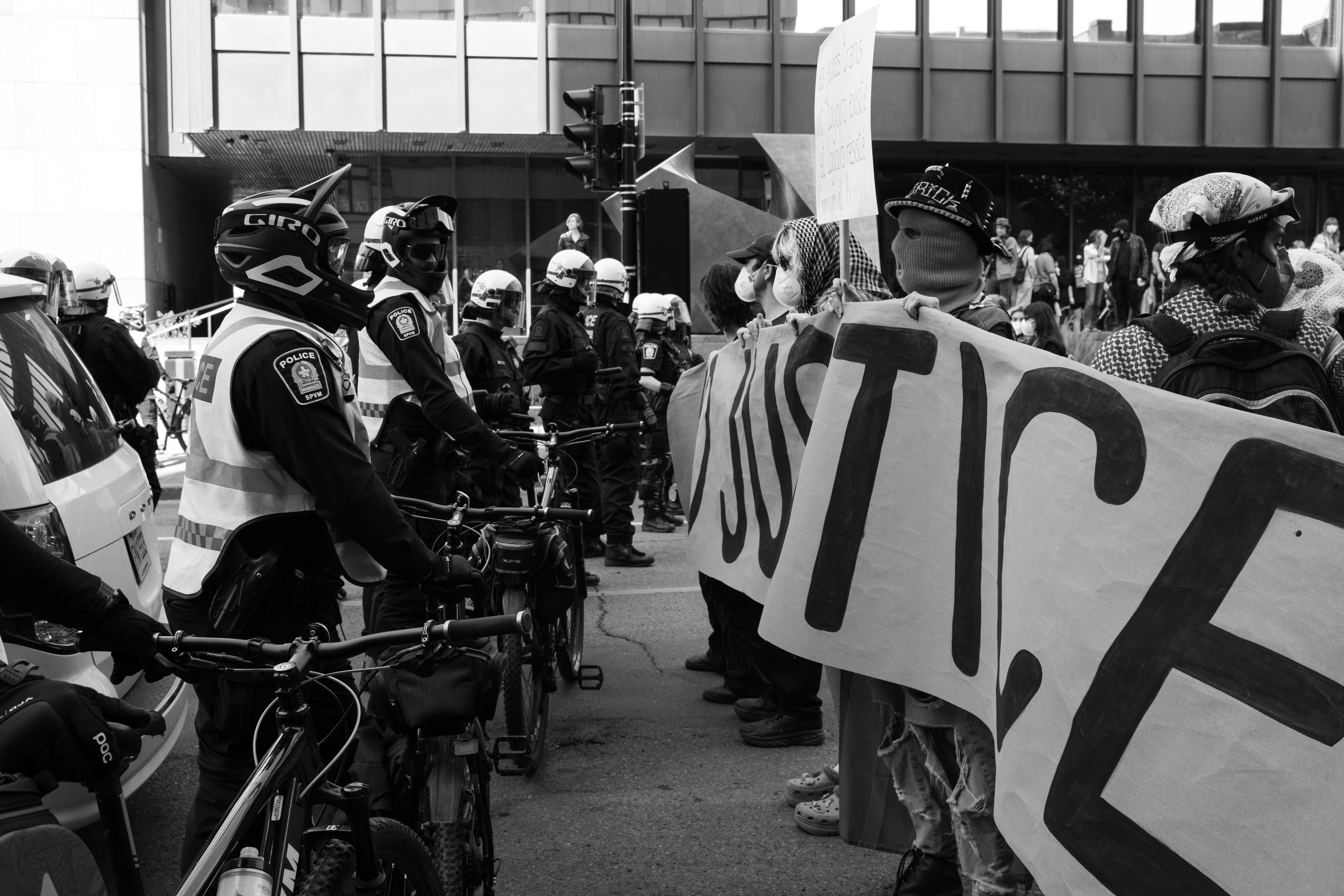
The counter-demonstrators did not attempt to physically harm or confront the EPPNE demonstrators.
A line of SPVM on bicycles formed a loose line between the competing demonstrations. Despite the lack of violent intent, the officers were visibly frightened.
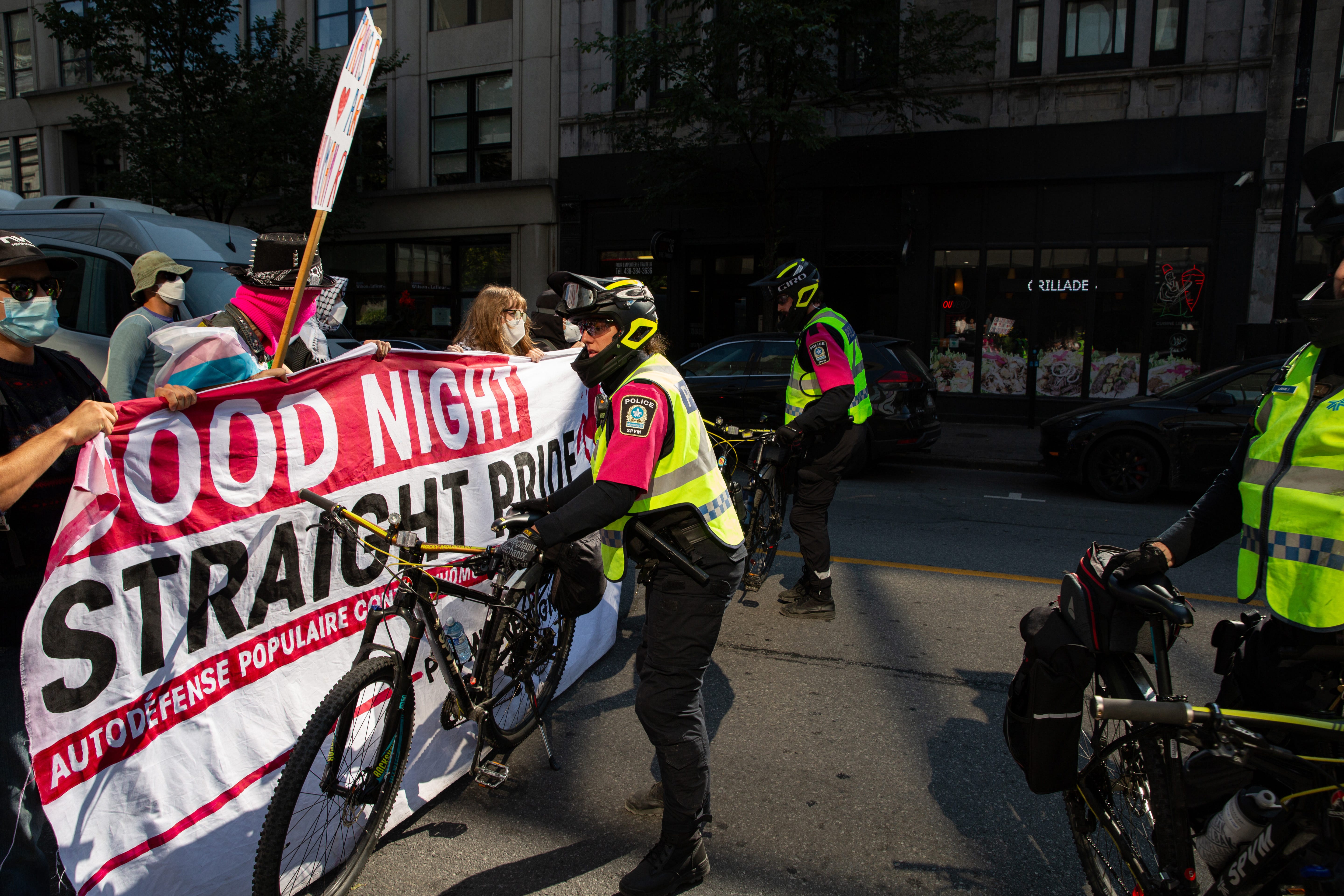
Embarrassed, the SPVM had lost the upper hand and sought to regain its domination of public space. The group of riot police that had been beating the small mobile group at the intersection quickly repositioned towards the counter-demonstration.
The cops were angry.
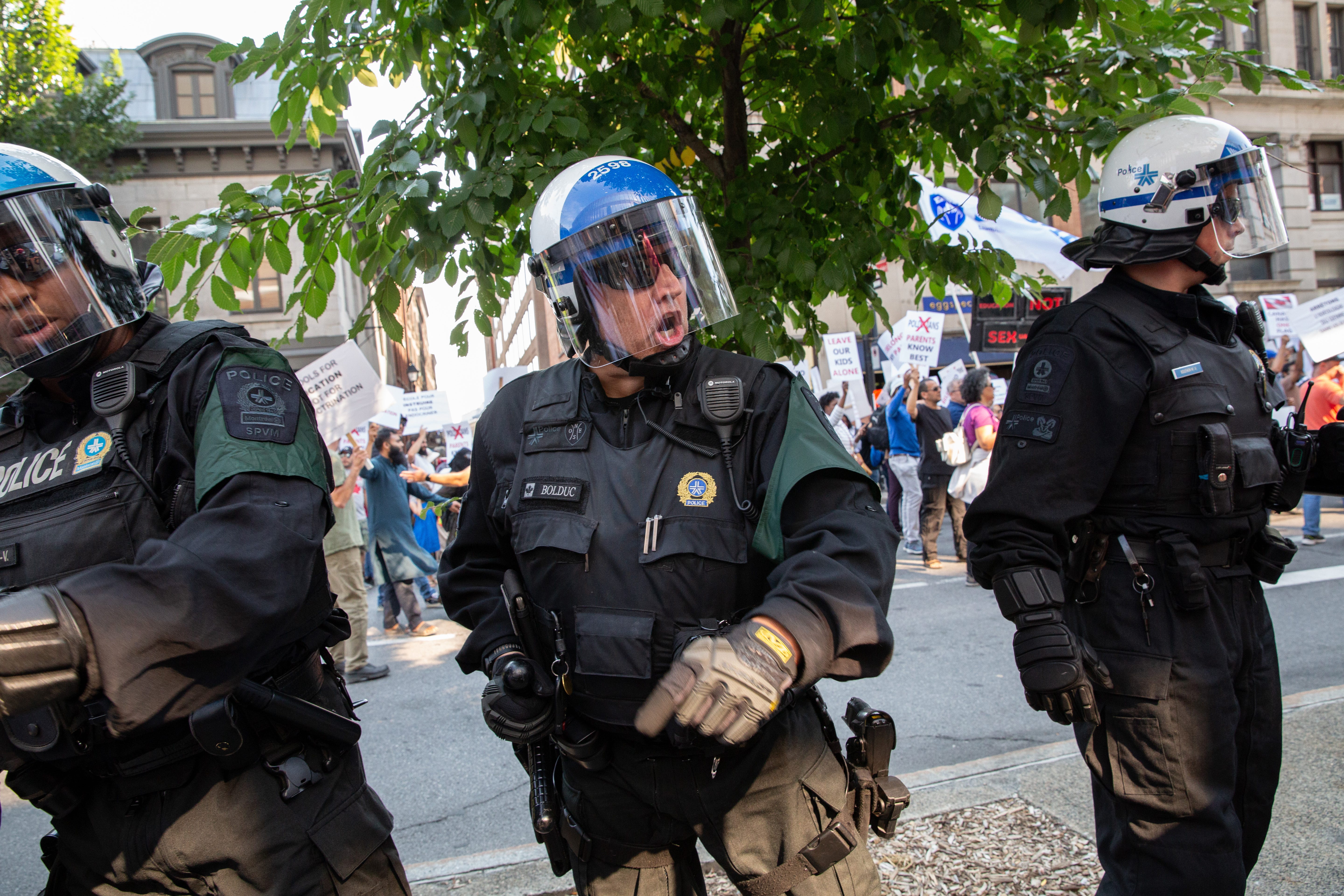
The SIS charged the activists holding banners and began beating them with their batons. An officer holding a 40mm grenade launcher briskly walked towards the steps of the Palais de Justice and shot a close-range muzzle blast projectile point-blank at the head of a counter-demonstrator standing idly with a trans pride flag over their shoulder.
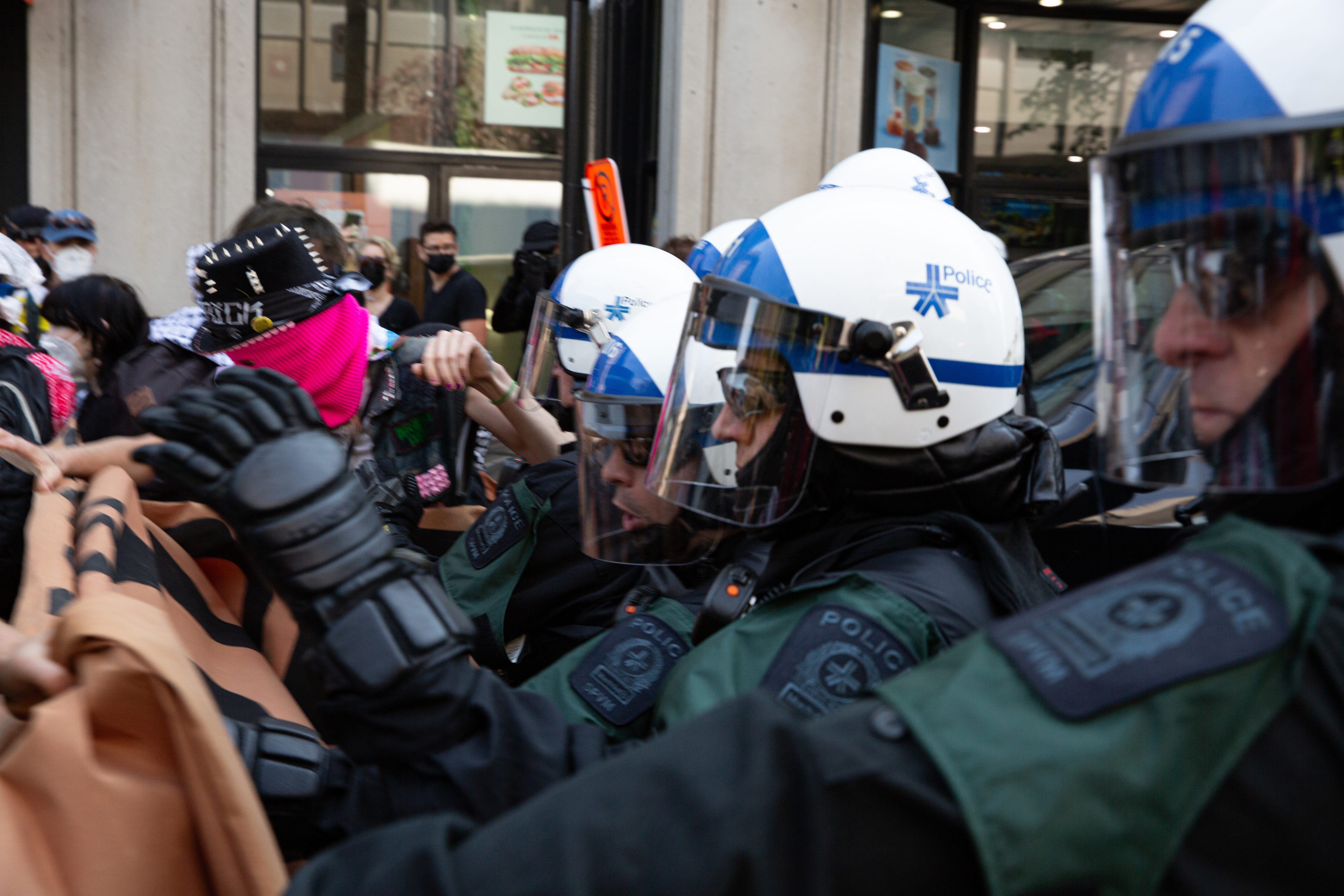
A line of police on Rue Notre-Dame pushed against the “No Justice No Peace” banner. They tugged at the banner and ripped it in two while thrashing batons at the demonstrators behind it. Injuries mounted as a human crush developed. Some counter-demonstrators fell to the pavement as the beatings intensified.
The crowd retreated, creating more space between them and the police.
A round of tear gas was then shot at the crowd and landed in the middle of the street. A small projectile emitted a heavy outpouring plume of choking white gas, its indiscriminate effect at the whims of the wind.
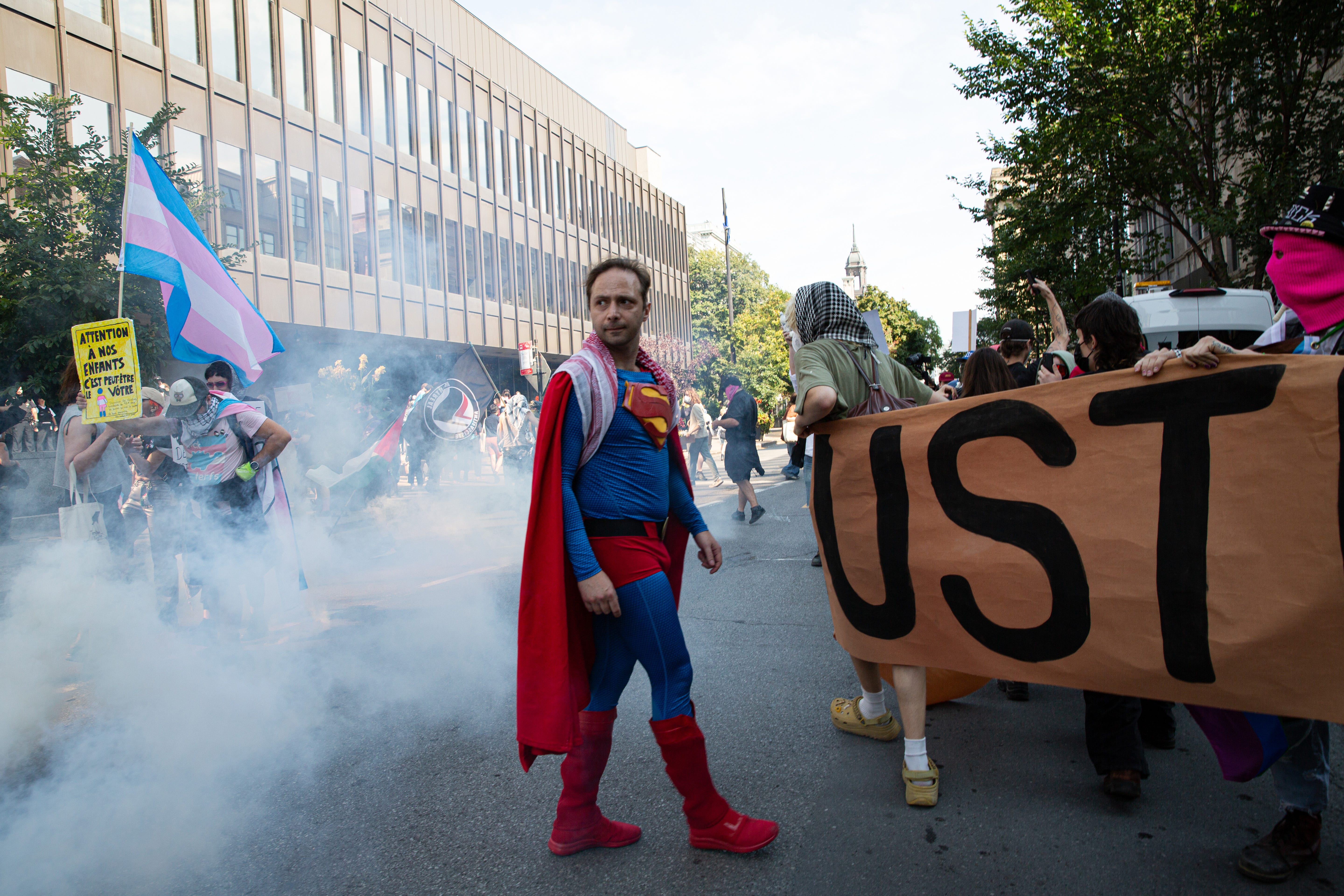
Riot police continued advancing through the tear gas towards the remnants of the counter-demonstration. Officers emerged from the dissipating chemical haze red-faced and wheezing.
Medics provided first aid to injured counter-demonstrators, some of whom were in extreme emotional distress from the unexpected police violence.
A video I obtained captured the most disturbing police assault that took place that day.
The footage begins with a pan of the remnants of the crowd and a line of SPVM riot police just behind them. The person filming is among a small crowd surrounding someone with a cane who is injured. A medic is administering first aid to them. They appear to be in shock. Nobody advances towards the police, nor does anyone make an act of aggression towards the officers.
A few counter-demonstrators can be seen providing support to the injured demonstrator and the medic as they attempt to move away from the advancing riot police. The extent of their injuries, the thickness of the crowd, the intense state of distress and their limited mobility all hamper their ability to meet the police’s demands to “Bouge! Bouge! Bouge!” One demonstrator can be heard passing along their demands, “Keep it moving! Keep it moving!” as the threat draws near.
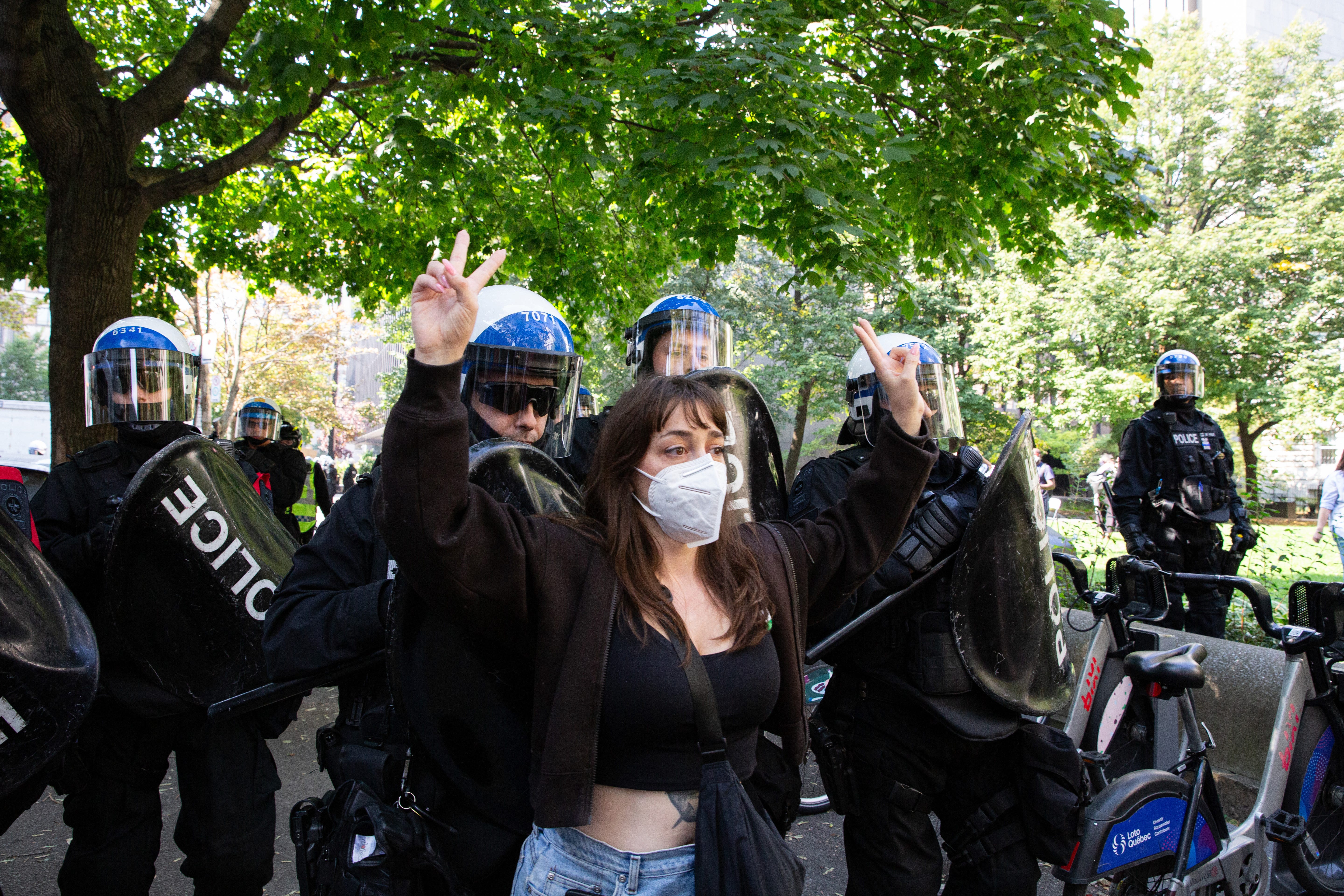
The footage shows the riot police reach the group of medics and the injured who are sheltering on the sidewalk. They start shoving them with their shields and screaming “Bouge!” The counter-demonstrators plead with the police to stop using force, repeating that they are tending to injured people.
The police ignore their appeals. They continue to shove the counter-demonstrators with their shields. They then escalate their use of force to using their batons to beat the demonstrators in their midsections. Nobody fights back.
An SPVM officer then walks from behind the ranks of the police, lifts his right arm between the heads of two other riot police with shields, and unleashes a dousing of pepper spray at the group of counter-demonstrators for several seconds. They are huddled with their arms around one another, shielding the injured person with the cane in the middle. One person’s dark-blonde hair is blown skyward as the highly condensed pressure of the pepper spray meets their head.
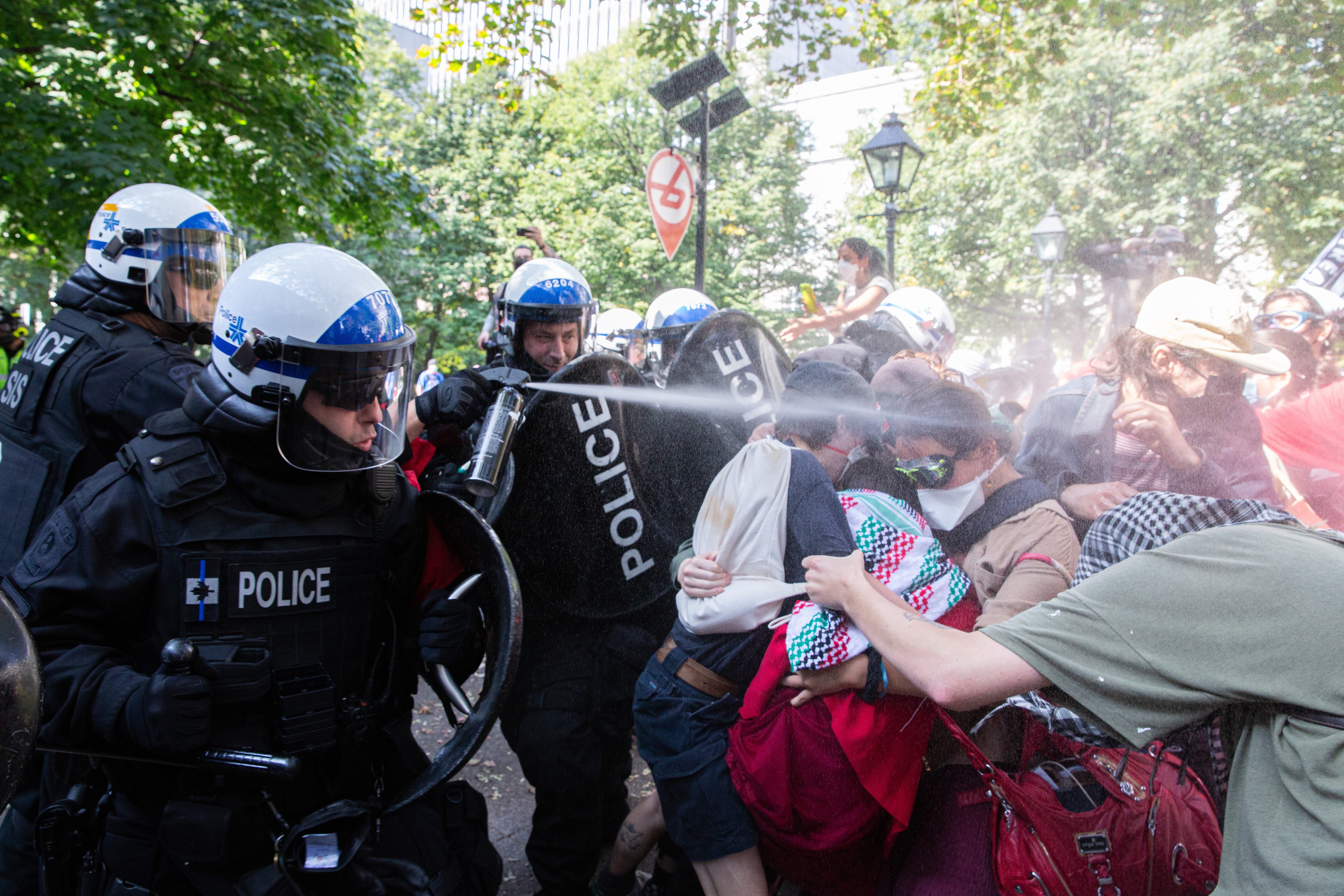
Screams of terror.
After pepper-spraying the group of injured counter-demonstrators, the police halt their advance.
The small group, many of whom are soaked in pepper spray, are in complete shock. Some are crying. One person in the midst of the crowd grabs the arm of a panicked stranger, soaked in pepper spray and says, “I’m going to get you out of here, come on!” and leads them away from the police lines.
“Maalox! Maalox!3” some scream as they seek respite from the excruciating pain of the pepper spray seeping into their eyes and pores. Chants had been replaced by the sounds of spitting, coughing, and wheezing, though quick, panicked breaths, elevated by adrenaline.
“Tilt your head back,” a medic calmly asks of one counter-demonstrator as they pour liquid into their eyes.
The camera pans back to the injured demonstrator with a cane. They say, “I can’t breathe. I can’t breathe,” in severe distress. Their entire face and hair are soaked in pepper spray.
“Anyone have Maalox?” another pleads, the pain audible in their trembling voice.
The video ends.
At Place Vauquelin, dozens of counter-demonstrators huddled in small groups throughout the square with stunned expressions across their faces. Many were doing their best to clean the chemicals from themselves, pouring water from plastic bottles into one another’s eyes. A group of counter-demonstrators approached the medics standing idly with the riot police and asked for medical assistance in administering first aid, including one counter-demonstrator suffering an asthma attack. The police medics denied them help.
Some were weeping, tormented by the severity and broadly unforeseen police violence.
The EPPNE march continued unabated. A small group of counter-demonstrators trailed along the sidewalk beside the main protest, chanting pro-LGBTQ+ chants through a portable loudspeaker. The police tolerated them. For everyone else, the counter-demonstration was over.
Multiple people were hospitalized with injuries from the event. Two with serious concussions and at least two others from respiratory complications as a result of tear gas.
Counter-demonstrators were perplexed by the severity of the police violence they experienced that day. “We really weren’t doing anything aggressive or instigating,” said Zev. “[The SPVM] really came out full force without warning. They’re usually supposed to warn us to disperse or they will unleash their toxins upon us, but they didn’t. They just started really heavy-handedly hitting us.”
He asserted that the violence initiated by the police that morning was due to the unexpected double-back movement of the counter-demonstration, “They got embarrassed. They then wanted to show dominance.”
Zev spent the afternoon in the hospital in support of a friend who suffered an asthma attack from the mix of chemical weapons.
“I go [to demonstrations] with the expectation that I’m probably going to get beat up today,” said Zev.
Another individual, Erin4 stopped by the event to show their solidarity with counter-demonstrators as they were on their way to the library for a day of studying. “I was not prepared for violence,” Erin* said as they remembered witnessing the pepper-spraying incident. “There was a medical emergency and the cops made it worse,” they said. “Were [the police] trying to move people? Personally, I move slower when I’m pepper-sprayed”
After they were tear-gassed, a stranger led Erin away to the Place Vaqeueilin, where they poured water in each other’s eyes to wash the pepper spray and tear gas away.
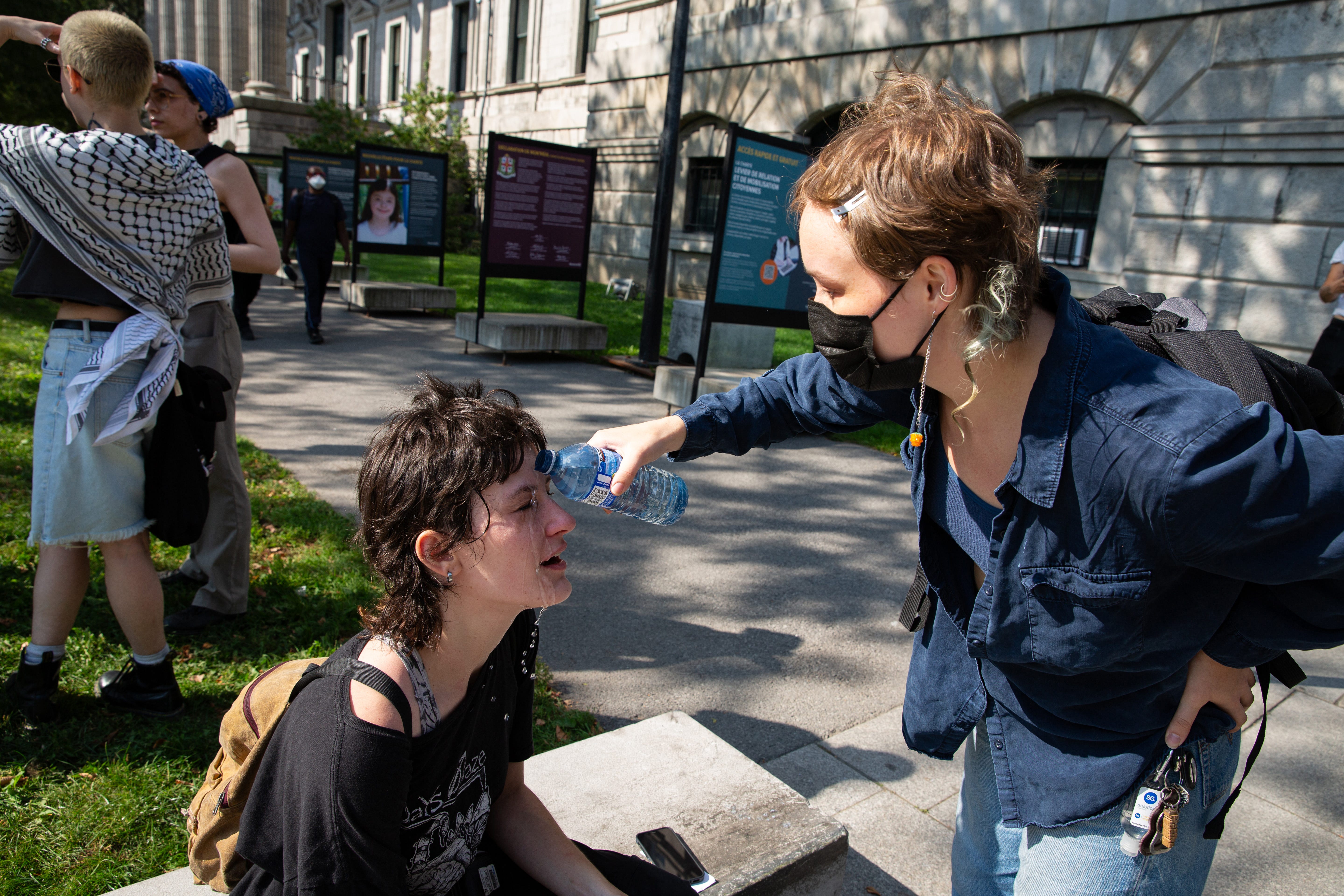
In the aftermath of the event, Erin said the experience solidified the notion that the LGBTQ+ community was under threat from not merely the perennial conservative interest groups, but the police as well. They said the outcome of the demonstration was a clear affirmation that the police are “going to use violence to protect people who don’t believe you should be who you are.”
Far from deterring Erin from participating in future demonstrations, Sept. 20, 2024 reminded them of the importance of showing solidarity on the ground, saying “the most gay thing you could do is get tear-gassed at a protest for queer rights.”
“They were beating the shit out of us, in order to let transphobes march” said one anonymous demonstrator.
For many attendees, the toll of the violence endured. One anonymous counter-demonstrator said, “That protest made my anxiety so much worse. Set me into a sort of a spiral for the following few months. It caused me a lot of trauma…I had been physically hit by the police in the past. That specific day was much more traumatizing for me psychologically because the police were fully protecting transphobes.”
Emma, another counter-protestor, said Sept. 20 was a grim confirmation of their suspicions. “I was very distrustful of the SPVM and didn’t expect any moral standards from them. This is just further confirmation that trans people and queer people are not safe with the police. The police won’t protect marginalized communities when it comes down to it.”
“It’s just hard to imagine how police can just do that to other people and sleep at night and continue with their jobs,” they added.
Many believed that the identity of many counter-demonstrators was a contributing factor in the police’s level of brutality.
“I believe that the SPVM is more than happy to have a reason to beat queers,” said Frankie, who was at the counter-demonstration. “I feel like when they are disproportionately violent towards us, they enjoy it.”
Another counter-demonstrator, Shafir, thought the police tactics echoed the routine treatment of left-leaning political expression, saying that police violence “is just a given, no matter what the protest is. If it’s advocating for the rights of marginalized people, I just expect it’s going to end in tear gas.”
Bee saw their demonstration as a blow against the hateful messages and presence of EPPNE. “I see the day as a tactical victory… [EPPNE] dispersed earlier than we thought they would. We outmaneuvered the police repeatedly, they could not keep up with us.”
Beyond that, Bee noted that the counter-protest radicalized some who witnessed and experienced SPVM violence for the first time.
“On Sept. 20, I saw a lot of my friends who are not involved in this stuff,” said Bee*, a queer organizer. “They’ve maybe been to a couple of protests before, have never confronted police before — and they were on banner lines. They were getting hit with bikes; they were maneuvering; they were taking charge of small groups of people and taking them to block EPPNE. That was the most striking success of the day… It’s inspiring how much people were able to just take the initiative. They see the goal; they see what we were fighting for.”
Counter-demonstrators vastly outnumbered the EPPNE protest and dwindling attendance numbers relative to the 2023 event suggested the 1MM4C movement was losing momentum.
During an email exchange with EPPNE’s Isabelle Laurin, I asked about EPPNE’s response to the widespread police violence against counter-demonstrators. Laurin did not provide a response.
The SPVM also refused to respond to any of my inquiries regarding their conduct on the morning of Sept. 20, 20245.
The counter-demonstration had been strategized from the outset as a peaceful, non-violent act of civil disobedience. Throughout the morning, no acts of aggression against any participant of the EPPNE event or the police occurred. Nevertheless, the SPVM’s intervention was marked by severe violence: they deployed tear gas against hundreds of protesters and bystanders alike, pepper-sprayed those seeking medical shelter, and inflicted injuries that left several people hospitalized.
In the aftermath of Sept. 20, 2024, many queer organizers wanted more than a peaceful demonstration: they wanted vengeance.
Part 4 will cover the Trans Day of Vengeance.
Edited by Emelia Fournier
Name changed to protect their identity.
That I can’t share to protect the identity of activists.
A common over-the-counter treatment for exposure to chemical weapons.
Name changed to protect their identity.
They provided the same response as usual to enquires about police conduct at demonstrations: “The Montreal Police Service (SPVM) does not typically comment on specific police interventions in order to avoid any influence on potential legal, ethical, or disciplinary proceedings. Furthermore, for security reasons, we never disclose the intervention strategies we use or the personnel we deploy. We adapt our operations to each situation and the behavior of individuals. Our officers are always ready to intervene should there be any disturbances or violations of laws and regulations.”
No posts
Comments
Nothing yet. Say the first thing.
Sign in to join the conversation.