
Before I get into this story, I’m obliged to say that while slavery is technically illegal everywhere in the world. Modern slavery — forced labor, forced marriage, human trafficking, and state‑imposed labor — still exists in every region of the world. Some countries have especially high prevalence, either per capita or in absolute numbers.
These are countries where the rate of people in slavery per thousand is highest.
North Korea — highest prevalence globally, with state‑imposed forced labor and extremely weak government response.
Eritrea — extremely high forced labor prevalence.
Mauritania — hereditary slavery persists despite legal bans.
Saudi Arabia, Turkey, Tajikistan, UAE, Russia, Afghanistan, Kuwait — all rank among the highest prevalence countries.
The Global Slavery Index also identifies severe vulnerability in:
South Sudan, Somalia, Central African Republic, DR Congo, Yemen, Chad, Syria, Sudan, Pakistan, Libya, Guinea‑Bissau, Papua New Guinea, Burundi, Republic of the Congo, Nigeria, Niger, Zimbabwe, Mali, Cameroon, Equatorial Guinea, Iran, Ethiopia, Myanmar, Mozambique, Tajikistan, and many others.
These are countries with the largest total populations in modern slavery:
India — estimated 11+ million people in modern slavery.
China — roughly 5.7 million.
You might be surprised that several of the countries with a large slave population are allies and trade partners with the United States. You’ll also note the absence of the United States and European countries, depending on how you treat Russia. I’ll get back to them later and see if it’s simply a matter of definition. I get lots of responses to my stories about slavery from those anxious to point out continuing enslavement in Africa while American slavery ended in 1865.
An estimated 40.3 million people are in modern slavery worldwide.
Only 1 in 10 victims are ever identified.
Forced labor accounts for 44%, sexual exploitation 32%, forced marriage 14%.
Asia-Pacific accounts for 46% of trafficking cases; Africa 20%.
I recently did a story about the importation of bananas to America, which began after slavery ended but involved the enslavement of Central Americans. The infrastructure that made the banana trade possible was built entirely on the ruins of slavery, and the labor that first cultivated bananas at commercial scale was performed overwhelmingly by the formerly enslaved and their descendants.
What emerged after emancipation was not freedom — it was a cascading set of systems, each designed to extract the same coerced labor that slavery had provided, while maintaining enough legal distance to avoid the name. Several of these systems operated simultaneously in the banana world. Just like America replaced chattel slavery with the Black Codes and Jim Crow. Slavery found new names with the same results in Central America.
1. The Coolie Trade — A New Middle Passage
Within years of British abolition in 1834, plantation owners throughout the Caribbean and Latin America began complaining loudly of a “labor shortage.” What they meant, precisely, was a shortage of people willing to work for the wages they were willing to pay under the conditions they were willing to provide. The solution the colonial system devised was the indenture of South Asian and Chinese workers — the so-called “coolie trade.”
Between 1834 and 1917, approximately 1.3 to 1.5 million Indian workers were transported to British colonies under indenture contracts. Simultaneously, roughly 215,000 to 242,000 Chinese laborers were shipped to Cuba and Peru. The contracts were legally distinct from slavery — workers received a nominal wage, and their term of service was fixed, usually five to eight years. But in practice, the system differed from slavery primarily in paperwork. Recruiters used false promises, debt, kidnapping, and outright coercion to fill the ships. Once workers arrived, absence, desertion, or refusal to work could trigger criminal prosecution, fines, imprisonment, or additional forced labor. The plantation owner who purchased a worker’s contract became, functionally, their master.
Indigenous forced labor systems (repartimiento → mandamiento → vagrancy laws) persisted into the early 20th century.
Coffee plantation labor under debt peonage was widespread until the 1920s–1930s.
After 1824 abolition, coerced Indigenous labor and debt peonage continued through the late 19th century.
Coffee boom (1870s–1930s) relied heavily on quasi‑forced labor.
Debt peonage and coerced agricultural labor persisted into the early 20th century.
U.S. banana companies (late 1800s–1930s) used labor systems that historians widely describe as coercive and quasi‑servile.
Slavery was abolished in 1824, but:
Indigenous servitude and debt peonage continued through the late 19th century.
William Walker’s 1856 invasion attempted to re‑legalize slavery.
Plantation servitude persisted into the early 20th century.
Slavery ended in 1824, but peonage and coerced labor on coffee and banana plantations persisted into the late 19th century.
By the early 20th century, Costa Rica had largely dismantled formal peonage systems.
Slavery ended in 1833, but the mahogany economy relied on coerced Black labor under master‑servant laws into the late 19th century.
Slavery ended in 1851, but coerced labor and racialized servitude persisted into the late 19th century, especially under Colombian rule and early canal construction.
Central America abolished slavery early (1824), but de facto slavery — forced Indigenous labor, debt peonage, plantation servitude, and coercive labor laws — persisted until roughly 1880–1930 depending on the country.
This is why historians emphasize that legal abolition ≠ immediate freedom.
China abolished slavery as a legally recognized institution through a 1909 law, fully enacted in 1910.
This imperial rescript ended:
The buying and selling of enslaved people
Hereditary servitude
Household slave status
Despite legal abolition, slavery‑like practices persisted until at least 1949, especially in rural areas and domestic servitude.
Modern slavery in China does not resemble chattel slavery, but multiple international bodies classify current practices as forced labor or enslavement‑like conditions.
The UN Special Rapporteur concluded that forced labor among Uyghurs and other minorities in Xinjiang shows indicators of enslavement as a crime against humanity. Key features include:
Internment in “reeducation” camps
Coerced work placements
Excessive surveillance
Restricted movement
Threats, violence, and degrading treatment
The U.S. Trafficking in Persons Report (2025) designates China as a Tier 3 country for widespread forced labor, including:
Cotton production
Electronics assembly
Solar panel manufacturing
Food processing. These systems involve both state coercion and private‑sector exploitation.
Illegal acts of forced labor and sexual slavery continue in the 21st century, with harsh penalties for traffickers — but the crimes persist.
Internal migration controls (e.g., hukou restrictions) and labor brokerage systems create conditions where migrant workers face:
Debt bondage
Passport confiscation
Coercive contracts
Russia abolished serfdom on March 3, 1861, through the Emancipation Manifesto issued by Tsar Alexander II. This reform legally freed more than 23 million people from bondage.
Key points:
Serfdom in Russia was functionally similar to slavery: peasants could be bought, sold, and punished by landowners.
The reform granted personal freedom but did not provide adequate land, leaving many peasants economically dependent and still tied to landlords through redemption payments.
State-owned serfs were emancipated later, in 1866.
Modern slavery does not resemble 19th‑century serfdom, but Russia — like all countries — has contemporary slavery‑like practices defined by international bodies.
Modern slavery includes forced labor where individuals are compelled to work under threat, coercion, or fraud. Russia has documented cases of:
Forced labor in prisons
Coercive labor in conflict zones
Exploitative labor systems affecting migrants and vulnerable populations
These align with global definitions of forced labor: coercion, threats, confiscation of documents, and inability to leave freely.
Human trafficking — forced labor and sexual exploitation — remains a significant issue. Trafficking involves recruitment or transport through coercion for labor or commercial sex.
Debt bondage is one of the most widespread forms of modern slavery globally. In Russia, migrant workers and undocumented laborers are particularly vulnerable to:
Manipulated debts
Passport confiscation
Coercive contracts
Domestic workers — often migrants — may face coercive conditions, isolation, and inability to leave freely.
The British passed Act V of 1843, which outlawed:
The sale of any person as a slave
Legal recognition of slave status
Enforcement of any “property rights” over another person’s labor
This act formally abolished slavery within East India Company territories.
Even after 1843:
Debt bondage remained legal and widespread.
Plantation labor in Assam and Tamil Nadu resembled slavery conditions.
Former slaves often became perpetually bonded laborers because debt bondage was regulated, not abolished.
Research shows India’s abolition was gradual, evolving through:
1843 Slavery Act
1859 Workman’s Breach of Contract Act
1976 Bonded Labour System (Abolition) Act
1990s constitutional and judicial reinforcement of bonded labor as a fundamental rights violation
This 150‑year trajectory reflects slow institutional change.
Bonded labor — debt bondage — is India’s most prevalent slavery‑like system.
Workers accept small loans and become trapped by inflated debts.
An estimated 8–18 million people are in bonded labor.
Industries: brick kilns, agriculture, stone quarries, textile mills.
Dalit and low‑caste children are disproportionately affected.
Brick kilns, cottonseed farms, domestic work, mining.
Children as young as five are trapped in generational debt.
48% of identified trafficking victims in 2022 were children.
Women and girls — especially Dalit girls — are trafficked into domestic work.
Many are live‑in workers with restricted movement.
Abuse, underpayment, and sexual violence are common.
India is simultaneously a source, destination, and transit country.
Sexual exploitation in brothels, bars, and private homes.
Forced labor in brick kilns, textiles, agriculture, and domestic work.
20–65 million Indians may be affected by bonded or forced labor.
Caste discrimination drives vulnerability:
Dalit families trapped in intergenerational debt.
Devadasi system forces girls into temple‑linked sexual servitude.
I could continue around the world and find systems defined as slavery, yet accepted because we choose to ignore them. Let’s take a similar look at America and see what we find.
Emancipation Proclamation (Jan. 1, 1863) declared enslaved people in rebelling Confederate states free, but did not end slavery nationwide. It did not apply to border states or Union‑controlled Confederate areas.
13th Amendment (Dec. 6, 1865) abolished slavery and involuntary servitude except as punishment for a crime. This is the formal end of chattel slavery across the entire United States.
Slavery practiced within the Cherokee, Chickasaw, Choctaw, Creek, and Seminole Nations ended with the Treaty of 1866, completing abolition in Indian Territory.
The 13th Amendment’s exception clause — allowing involuntary servitude “as punishment for crime” — created a legal pathway for:
Convict leasing
Chain gangs
Forced prison labor
These systems disproportionately targeted Black Americans and are widely described as slavery by another name.
Modern slavery does not resemble antebellum chattel slavery, but the U.S. still experiences slavery‑like exploitation as defined by international law.
Forced labor occurs when people are compelled to work through coercion, threats, fraud, or manipulation. It appears in:
Agriculture
Domestic work
Hospitality
Factories
Illicit industries
The U.S. government recognizes forced labor as one of the two primary forms of modern slavery.
Sex trafficking involves coercion, fraud, or force to compel commercial sex acts. For minors, any commercial sex act is legally trafficking, regardless of coercion.
Children coerced into labor — especially when deprived of food, rest, or schooling — are considered victims of slavery‑like practices.
Domestic workers, often migrants, may be isolated in private homes, have documents confiscated, and be unable to leave freely — conditions that meet forced labor indicators.
While less common than in some regions, debt‑based coercion still appears in labor trafficking cases, where debts are manipulated to trap workers.
The U.S. acknowledges that forced prison labor can constitute modern slavery when it involves coercion, threats, or exploitation beyond lawful punishment. Do you really have to ask if the forced labor in Louisiana and Mississippi prison systems is coerced?
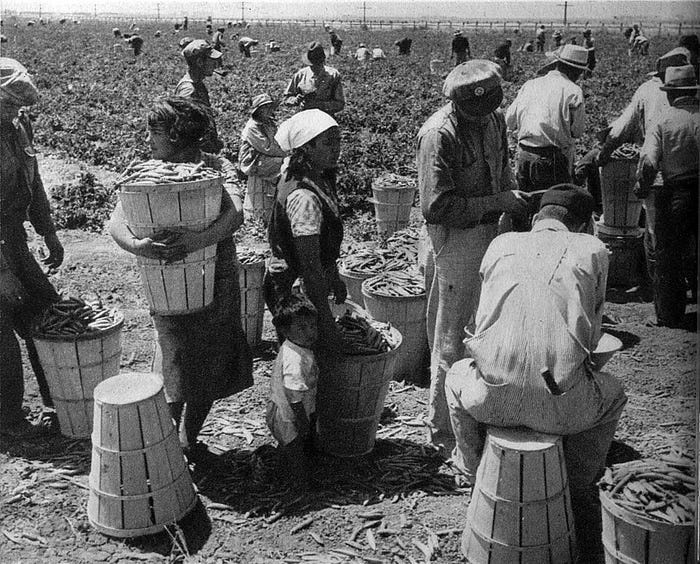
I want to take a closer look at America’s migrant labor system and compare it to slavery. The migrant labor system in America is not legally slavery. Still, it reproduces many of slavery’s core mechanics: restricted mobility, debt bondage, coercion, racialized vulnerability, and employer control over workers’ lives. These conditions fit international definitions of modern slavery, even though U.S. law classifies the labor as legal.
Many migrant workers:
Cannot freely change employers
Live in employer‑controlled housing
Have passports confiscated
Face retaliation or deportation if they complain
This mirrors the mobility restrictions of slavery and later sharecropping.
Recruitment fees, travel costs, and illegal deductions create:
Debts workers cannot realistically repay
A cycle of dependency that traps them in the same job
Debt bondage is one of the core indicators of modern slavery.
Federal investigations repeatedly document:
Threats of deportation
Threats of violence
Threats against family members
Retaliatory firings
Coercion is a defining feature of slavery‑like labor.
Just as slavery targeted Africans and African Americans, today’s migrant labor system disproportionately exploits:
Mexicans
Central Americans
Caribbean migrants
South Asian migrants in specialized industries
The racialization of labor vulnerability is a continuity, not a coincidence.
Workers who leave:
Lose legal status
Lose housing
Risk arrest or deportation
Risk blacklisting from future visas
This is not chattel slavery, but it is structural captivity.
Slavery did not vanish in 1865, or 1843, or 1910, or any of the dates we like to circle on timelines and teach as endings. It simply shed its name, changed its paperwork, and learned to operate in the shadows of legality. Today, more than fifty million people live in conditions that meet every international definition of slavery — forced labor, debt bondage, coerced migration, sexual exploitation, and state‑imposed servitude. Every region of the world participates. Every economy benefits from it. And the United States, for all its declarations of freedom, is no exception.
We see it in migrant labor bound by debt and threat. We see it in domestic workers whose passports are taken. We see it in children trafficked across borders and state lines. We see it in prison labor justified by a constitutional loophole written in 1865. Slavery is not gone; it has been rebranded.
And until we name it — plainly, without euphemism, without the comfort of distance — we will never erase it. You cannot dismantle what you refuse to acknowledge. Slavery is alive and well all over the world, including America. The only question left is whether we will keep pretending it ended, or finally confront the fact that it didn’t.
Comments
Nothing yet. Say the first thing.
Sign in to join the conversation.