
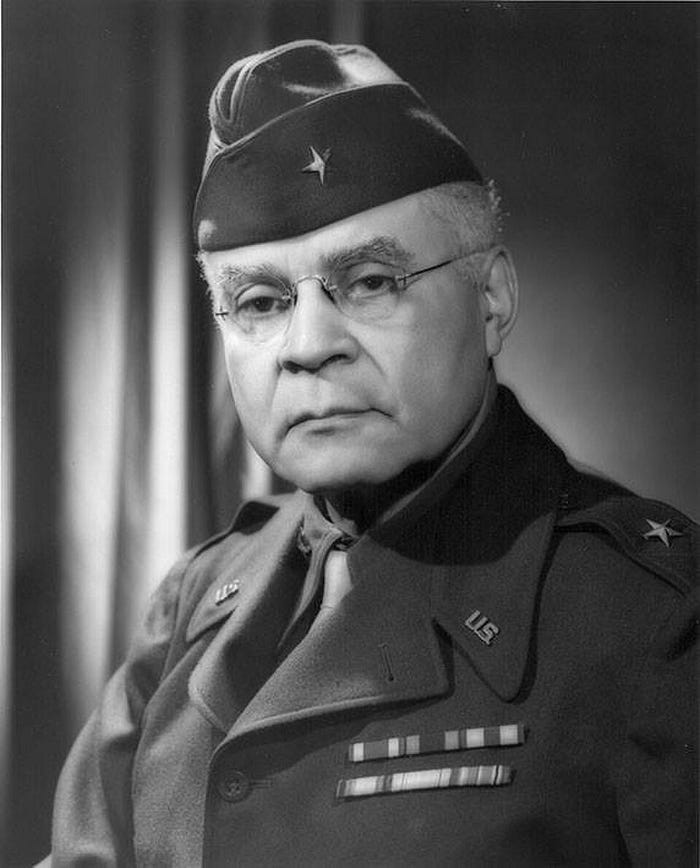
My wife sent me a short video about Benjamin O. Davis, Jr., and the Tuskegee Airmen, which inspired me to look deeper. As I researched, I found that his story begins with his father and the cadets that preceded him at West Point and continues with his role in forming the Tuskegee Airmen. I had in mind mentioning Benjamin O. Davis Sr. as a preface but found he required a story of his own.
When Benjamin O. Davis Sr. was assigned to Tuskegee in the 1930s, he served as the Professor of Military Science and Tactics for the Tuskegee Institute’s ROTC program. In that role, he was responsible for building and running one of the few pathways through which young Black men could receive formal military training in a period when the Army kept Black officers marginalized and segregated. Davis Sr. oversaw drill instruction, discipline, leadership development, and officer‑candidate preparation. He shaped the curriculum, mentored cadets, and enforced the standards of a professional military education at a time when the War Department expected Black ROTC units to be inferior. His presence at Tuskegee was itself a political act: he was the highest‑ranking Black officer in the Army, and placing him at the Institute signaled that Tuskegee’s military program was meant to be taken seriously. Davis Sr.’s work created a disciplined, structured environment that produced young Black men prepared for military service long before the Air Corps agreed to train Black pilots. In short, he built the institutional backbone that made Tuskegee a credible site for future aviation training — even though he had no direct role in the later Tuskegee Airmen program.
Benjamin Oliver Davis Sr. (1877–1970) was the first Black general in the U.S. Army, a milestone he reached in 1940 after more than four decades of service. His career is best understood as a long negotiation with an institution that both relied on him and resisted his advancement.
Davis, Sr., was born in Washington, D.C., to a working‑class family and attended M Street High School, a center of Black intellectual life. He enlisted in the Army in 1898 during the Spanish–American War and rose through the ranks not by appointment but by sheer endurance. Davis served in the Buffalo Soldiers regiments (9th and 10th Cavalry), where Black troops were commanded almost exclusively by white officers.
He became a career officer despite systemic barriers that prevented Black soldiers from attending West Point or receiving regular commissions. Davis held posts in Liberia (military attaché), Tuskegee (ROTC), and various segregated units across the U.S.
When Benjamin O. Davis Sr. was assigned to Tuskegee in the 1930s, he served as the Professor of Military Science and Tactics for the Tuskegee Institute’s ROTC program. In that role, he was responsible for building and running one of the few pathways through which young Black men could receive formal military training in a period when the Army kept Black officers marginalized and segregated. Davis Sr. oversaw drill instruction, discipline, leadership development, and officer‑candidate preparation. He shaped the curriculum, mentored cadets, and enforced the standards of a professional military education at a time when the War Department expected Black ROTC units to be inferior.
His presence at Tuskegee was itself a political act: he was the highest‑ranking Black officer in the Army, and placing him at the Institute signaled that Tuskegee’s military program was meant to be taken seriously. Davis Sr.’s work created a disciplined, structured environment that produced young Black men prepared for military service long before the Air Corps agreed to train Black pilots. In short, he built the institutional backbone that made Tuskegee a credible site for future aviation training — even though he had no direct role in the later Tuskegee Airmen program.
For all but the first year Davis was at Tuskegee from 1930–1938, the U.S. Public Health Service was conducting the Tuskegee Syphilis Study (1932–1972). There are no known ties between the ROTC Unit and the study.
After departing Tuskegee in 1938, Davis Sr. was assigned to a series of posts that reflected both his seniority and the Army’s reluctance to place Black officers in command of white troops. He served as an instructor and advisor in various segregated units, then was appointed military attaché to Liberia, a role the War Department often used for Black officers because it avoided integrating domestic commands.
When World War II began, Davis was brought back to the United States and placed in charge of Black training and personnel policy, overseeing the organization, discipline, and deployment of segregated units across the Army. His leadership during the war — especially his insistence on fair treatment and professional standards for Black soldiers — led President Franklin D. Roosevelt to promote him to brigadier general in 1940, making him the first Black general in American history.
Throughout the 1940s, Davis Sr. continued to inspect Black units, advise the War Department on racial policy, and push for incremental reforms in a military still committed to segregation. He retired in 1948, just as President Truman issued Executive Order 9981, desegregating the armed forces — a milestone Davis had spent his entire career preparing the institution to face. His post‑Tuskegee years were not glamorous, but they were foundational: he became the Army’s most senior Black officer, the inspector of its segregated system, and the quiet architect of the conditions that allowed his son, Benjamin O. Davis Jr., to rise in an Air Force no longer legally segregated.
Benjamin O. Davis Sr. shaped the conditions that made the Tuskegee Airmen possible long before the first Black pilot ever climbed into a cockpit. As the highest‑ranking Black officer in the U.S. Army and the Professor of Military Science and Tactics at Tuskegee Institute from 1931 to 1938, Davis built a disciplined, credible ROTC program that demonstrated Tuskegee’s capacity to train Black men to Army standards. When civil‑rights pressure forced the War Department to consider an all‑Black aviation unit in the early 1940s, Tuskegee’s existing military infrastructure — created and professionalized under Davis Sr. — made it the only institution the Army trusted to host such an experiment.
During World War II, Davis Sr. also served as the Army’s senior inspector of Black units, advising the War Department on racial policy and pushing for fair treatment, adequate resources, and competent leadership for segregated formations. His advocacy ensured that the new Black flying unit would receive legitimate training, proper equipment, and a command structure not designed to sabotage it. Most importantly, Davis Sr.’s decades‑long fight for Black officers paved the way for his son, Benjamin O. Davis Jr., to be appointed commander of the 99th Pursuit Squadron. This appointment gave the Tuskegee Airmen the disciplined leadership they needed to succeed. In short, Davis Sr. didn’t create the Tuskegee Airmen directly; he created the institutional possibility of them, and then protected that possibility until it could take flight.
Comments
Nothing yet. Say the first thing.
Sign in to join the conversation.