
My great-uncle was once asked what his experiences were like as an American soldier in the First World War. “Terrible!” was his response, and then he changed the subject. He was a respected high school teacher and principal after he returned home from the Army, and he remained a patriotic American. But to my knowledge he never said much more about the war. Like many men who fought in it, he understandably preferred to leave that part of his life behind him. He never had children of his own, but he found joy and contentment in taking his nephews to baseball games, and mentoring students at his school.
Fortunately, many men did share details of their World War I experiences for the historical record. And a wealth of photographs and film footage survived. The 2018 documentary film They Shall Not Grow Old vividly shows us the experiences of British soldiers in what they called The Great War. Britain suffered almost a million dead in that conflict, and over a million and a half wounded. There were around 30 million total casualties among all of the nations which fought. And the war was a great turning point in history, with tremendous effects on culture, society and politics.
They Shall Not Grow Old was a collaboration between staff of the Imperial War Museum in London and New Zealand director Peter Jackson, who is famous for his Lord of the Rings movie adaptations. The film follows typical British soldiers from their enlistment, through training, heading to the front lines, living in the trenches, experiencing battle, resting and working behind the lines, and adjusting to life back home after the Armistice.
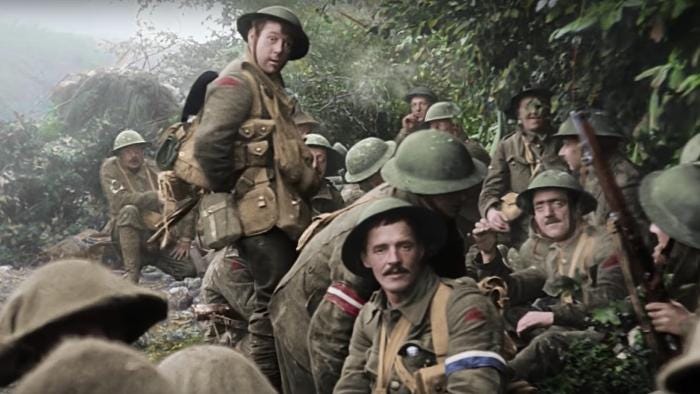
Jackson selected film segments from hundreds of black and white, silent, herky-jerky newsreels of World War I. In the early 20th century, film cameras were typically operated by a cameraman who turned a crank by hand, and often these cameras did not record as many images per second as later cameras. This resulted in a speeded-up quality of many World War I-era films. Jackson and his assistants used computer software to slow these films down to a natural-looking speed, and also colorized them. The filmmakers carefully added sound effects. Expert lip-readers determined what the soldiers actually were saying in the silent films. Actors who spoke in the same British dialects as the soldiers provided their speech. The overall results are stunning, especially for those of us who grew up watching some of those old silent newsreels. No matter the age of the viewer, the film is a very touching depiction of men in a long-ago war.
One of the film’s best features is how it presents the voices of several actual veterans, speaking after the war, who tell us about their experiences and offer their impressions. These veterans provide the narration of the film. The men’s various accents indicate a range of social backgrounds and home regions. Their voices seem to be from another world. Many were very young and innocent when they joined the British Army, and they learned the ropes with the help of the more experienced “Old Sweats.” Their war in the trenches was grueling. Rats, lice, and mud were commonplace. Poison gas was used as a weapon, and one ominous film segment shows a cloud of gas rolling steadily toward the viewer from the German lines, while veterans describe some desperate measures that they took to survive gas attacks. Terrible artillery bombardments were frequent for both sides, the likes of which had not been seen before. Snipers were a common threat, and men sometimes had to go on raiding parties through “no-man’s-land.” During larger attacks, soldiers were very vulnerable when they went “over the top” of their own trench, and advanced towards the well-fortified enemy. Movie cameras of the time were too cumbersome to be carried into the midst of actual battles, so contemporary magazine illustrations are shown in Jackson’s film while the men describe what the fighting was like.
Many of the veterans who speak in the film are modest and matter-of-fact. The once-common British form of understatement is present, with one man saying about the war, “After a time, it begins to wear on one, you know.” Multiple veterans describe their service in terms similar to the way another man put it: “There was a job to be done, and you’d just go on and did it.” They also give us unforgettable details which explain why the war was often “ghastly.” More than one man, though, describes it as an interesting adventure, similar in some ways to a boys’ camping trip. Comradeship is deeply appreciated by many of the men. And they are sometimes confronted with the unspeakable. One veteran weeps as he tells how he had to put a terribly-wounded comrade out of his misery. Some of the men were heroes, but some were not, at least at times. One veteran is frank about how he hid during an attack.
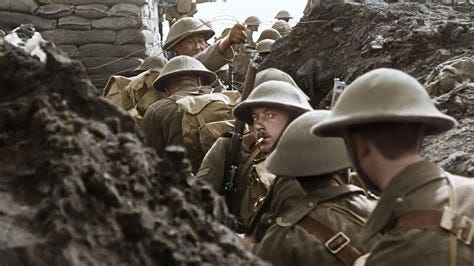
Several battles in World War I were horrendous slaughters, with the use of new, overwhelming technology such as advanced artillery, machine guns, and flame-throwers. On the Western Front, a static war of attrition developed, with extensive trenches constructed on both sides that were almost impenetrable. The Germans were finally defeated by new tactics of movement and coordination, and with the use of tanks.[i]
In the years right after the war, the British honored their veterans, including the top commanders, but eventually some writers used the expression “lions led by donkeys,” in referring to the dedicated, heroic men of the lower ranks, and obstinate officers who kept the slaughter going. Yet historians have recently affirmed that many British officers were conscientious leaders who did their best for their men. Officers suffered high casualty rates as a result of leading at the forefront. Frederick Manning was an infantryman who wrote a memorable novel The Middle Parts of Fortune, based on his experiences. One of his passages which stood out for me was about an officer who said little, but had a good, trusting, mutually-respectful relationship with his men. In at least one scene of They Shall Not Grow Old, a group of soldiers appears to have a good rapport with their commanding officer. One of the narrating veterans describes an officer as “a splendid man. He would never bark an order.”
Several veterans express brotherly feeling for their German opponents in the film, although there is also some bitterness, as one would expect. “Mostly they were just boys, as we were,” said one Briton about his opponents. Some touching scenes of German prisoners and their captives are included. And the film does not shy away from the bloody results of the fighting. There are stark images of wounded receiving care, and gory, disturbing views of the dead. Some especially striking still photographs are also included, such as a soldier wading through deep mud, and a sentry on the lookout, with exhausted comrades trying to sleep nearby.
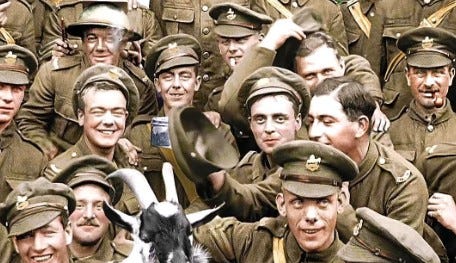
For me, the most memorable elements of the film, along with the veterans’ accounts, are the faces of the men: cheerful, friendly soldiers sitting with a toddler; a terrified young man soon before an attack; weary soldiers, relieved at the news of the Armistice.
They Shall Not Grow Old is not a comprehensive history of World War I. It focuses on the British experience of the Western Front. Jackson’s grandfather served in the war, and the documentary is a fitting tribute to him and his comrades. Along with the original black-and-white films, and the full accounts of the men who were there, it’s an important document that needs to be preserved. And it’s a haunting depiction of sons, husbands, fathers, and brothers who were faced with an awesome duty. Highly recommended.
[i] Two good, readable histories of the war are: John Keegan, The First World War, New York: Knopf, 1999; and Michael Howard, The First World War, New York: Oxford University Press, 2002. The Howard book is very concise. An older, well-written and well-illustrated volume is John Terraine, The Great War, London: Hutchinson & Co., 1965. There is also a lavishly illustrated edition of the Keegan book.
Comments
Nothing yet. Say the first thing.
Sign in to join the conversation.