
PROJECT 2029 as proposed in this post should be adopted by a new generation of Democrats and clearly described in their campaign to get elected in 2028.
To solve affordability of housing, Democrats stop promoting the new housing bill which was not a solution to affordable housing and propose the real solution described in PROJECT 2029. The housing bill was a Republican scam designed to make Democrats look like fools who accept Republican free market trickle down economic policy as Democrats have been doing over the last 55 years while Republicans stole wealth from 95% of Americans and transferred the wealth to billionaire oligarchs like Musk and their corporations. The Republican economic policy caused the transfer of wealth and created the affordability problems in housing, food, energy and healthcare.
The 21st Century ROAD to Housing Act (H.R. 6644), combined nearly 50 bipartisan proposals to supposedly increase housing supply, lower construction costs, and combat corporate ownership. But the Republicans once again convinced Democrats to fail again and lose voter trust by falsely believing the Republican scam that the “free market” will solve the problem of affordability with reduced regulations.
PROJECT 2029 – AFFORDABILITY SOLUTIONS
The most important affordability problems are the lack of affordable housing and food plus the lack of good paying jobs for the working class. The solutions require new tax revenue from higher taxes on the wealthy to enable the federal government to fund solutions which include supplying land and building new affordable homes. The solution is much less costly than Social Security or Medicare but could be called Housing Security. Working class households making under $70,000 annually would be eligible to receive a homestead “farm” on a half-acre, with a 2000 sq ft 3-bedroom 2-bath modular house and hydroponic/aquaponic solar energy power water recycled food production facility. The new homesteads would be rented for $200 per month with ownership transferred at no cost to the original residents after they lived on the homestead for ten years and produced food. The American Dream of home ownership is denied in a Republican and billionaire oligarch rigged economy to all except the wealthy.
The solutions to affordability must be created and implemented by a new generation of progressive Democrats who can gain total control of the federal government by campaigning in 2028 to implement solutions with PROJECT 2029 described in the following paragraphs in this post.
Analysis of the problem of affordable housing
The free market is NOT supplying affordable homes, food, or new good paying jobs and will not without intervention by the federal government. Bad tax policy is causing a lack of funding for the federal government to fix core problems including the lack of affordable housing and the lack of good paying jobs for the working class.
For 50 years the federal government controlled by the wealthy has been taking and stealing wealth from 95% of people and giving it to the top 5% mostly to the top 0.01%. The wealth transfer needs to be stopped and fair taxes restored. The tax rates for the top 1% and 5% in 2024 should be changed to what the tax rates were for the top 1% and 5% in 1965 with the tax rates for the 95% in 2024 remaining unchanged to what the rates were in 2024. That would create $1.3 trillion of new federal revenue for funding solutions to core problems including affordability of healthcare and housing.
Recently, Reich posted a list of ten ways to make America more affordable.
Note that Reich didn’t say make America affordable just more affordable. But implementation of the ten ways proposed by Reich requires Democrats to get elected in 2028, win the WH, and control the House and Senate.
The ten ways listed by Reich were (1) eliminating tariffs, (2) busting up monopolies, (3) fighting for stronger unions, (4) raising the national minimum wage to $20 an hour, (5) making housing more affordable, (6) cutting healthcare costs by making Medicare available to everyone, (7) getting working families help with childcare and elder care, (8) giving working families paid family leave, (9) provide a universal basic income if adequate-paying jobs are unavailable to keep them out of poverty, (10) raising taxes on the wealthiest to pay for this – including raising the top marginal tax rate to 70 percent — what it was before Reagan.
All the ten ways listed by Reich would be good pledges to help Democrats get elected except (5) and (9). Reich’s proposals with (5) and (9) will not satisfy voters and would NOT get Democrats elected with solutions that makes housing affordable and supplies good paying jobs for the working class.
The root causes of the lack of affordable housing are (1) a lack of land available for housing, which is fundamentally limited in cities or large urban areas, (2) the slow and costly stick-built housing construction process, and (3) the limited amount of new homes built each year in America which is only about 1 million which is insufficient to satisfy the demand.
In a recent post, Krugman said the lack of affordable home ownership and good paying jobs for the working middle class are the two most important affordability problems.
SOLUTIONS FOR AFFORDABLE HOUSING, FOOD, AND GOOD PAYING JOBS
As mentioned, Democrats can get elected in 2028 by campaigning with commitments to implement the solutions described in PROJECT 2029 to the core problems of affordability of housing and a lack of good paying jobs for the working class.
Here is a summary of the solutions in PROJECT 2029 for affordable housing and good paying jobs for the working class.
Funding - For 50 years the federal government controlled by the wealthy has been taking and stealing wealth from 95% of people and giving it to the top 5% - mostly to the top 0.01%. The wealth transfer must be stopped and fair progressive taxes restored. The tax rates for the top 1% and 5% in 2024 must be changed to what the tax rates were for the top 1% and 5% in 1965 with the tax rates for the 95% in 2024 remaining unchanged to what the rates were in 2024. That would create $1.3 trillion of new federal revenue for funding solutions to core problems including affordability of healthcare and housing.
Affordable housing for the working class – There are about 60 million working class households. To meet the demand for affordable housing for 25% of the working class, the federal government must supply the land and fund the construction of 15 million affordable homes at a rate of 1 million new homes built and delivered annually. The homes would be operated as a homestead “farm”. A “farm” would have a modular home and a hydroponic/aquaponic food production facility on half acre lots. Producing affordable housing requires doubling the amount of new housing built each year in America from 1 million to 2 million by building 1 million new modular homes in new factories each year for 15 years. Homes would be built in 20 factories with food production facilities built in another 20 factories. The factories would produce 1000 homes and food production facilities per week by 20,000 workers in each factory to produce 1 million “farms” annually. The “farms” would cost about $400,000 which requires a federal project and an annual budget of $500 billion to be allocated from the $1.3 trillion of new tax revenue. The project would be managed by a new federal agency, the New Economic Development Agency (NEDA). The construction of the new factories would be funded by the federal government in cooperation with corporate partners. The homes would be installed on rural land to be acquired in purchases or supplied as federal land by the federal government and located in 750 new communities to be built with each community of about 20,000 homes. The communities would be created with retail stores. The communities could be built in clusters of 15 surrounding 50 new regional hubs to be built around a small town with retail stores and a hospital located in these 18 states: California (4), Arizona (3), Nevada (3), New Mexico (2), Utah (2), Texas (8), Oklahoma (2), Arkansas (3), Kansas (2), Missouri (3), Illinois (3), Kentucky (2), Tennessee (2), Louisiana (2), Mississippi (2), Alabama (2), Georgia (3), Florida (2). But land is available throughout all 50 states.
Installing 15 million homes as “farms” in 50 regional hubs in 15 years requires delivery of one community of 20,000 homes in each of the 50 regional hubs annually. About 90% of the construction of the modular homes would be done in the 40 factories with homes delivered to site for final construction on site.
The federal government must implement transformational innovation in housing construction with these five projects for the housing solution.
1. Acquiring and developing the tracts of land containing the 9 million acres required for new housing as 15 million new homesteads in 750 new “farm” communities surrounding 50 new regional hubs.
2. Contracting and paying for building 15 million new “farm” homesteads for working class households making under $70,000 annually each on a half-acre, with a 2000 sq ft 3-bedroom 2-bath modular house and hydroponic/aquaponic solar energy power water recycled food production facility. The new homesteads would be rented for $200 per month with ownership transferred at no cost to the original residents after they lived on the homestead for ten years and produced food.
3. Building 50 new regional hubs around small towns in 15 years with each hub surrounded by 15 new “farm” communities.
4. Building new communities with one built in each of the 50 hubs annually with each community having about 20,000 homesteads.
5. Building 750 new “farm” communities after 15 years with each community having a population of about 40,000 adults, about two children per household, and 15 communities surrounding each of 50 new hubs to be built, with each hub operating as a small city having an adult population of about 600,000.
6. For each new community built, a school district would be created and supplied with 1 high school, 1 middle school, and 2 elementary schools to be built for a total of 200 new schools built each year and a total of 3000 new schools built in 15 years.
Good paying jobs for the working class – The federal government with the housing programs would create millions of new manufacturing, construction, trucking, education, retail service, food service, and healthcare jobs.
1. Construction jobs to develop the land and build the 40 large new factories that are required to build the modular home factories and food production facilities, finish the assembly of the 15 million modular homes on each half acre site, and build the 3000 new schools.
2. Trucking jobs to deliver materials to the factories and construction sites and deliver the modular homes and food production facilities to the homestead sites.
3. Manufacturing jobs working for at least 15 years in the 40 new factories to be built in 20 of the new regional hubs located in California, Arizona, Nevada, New Mexico, Utah, Texas (3), Oklahoma, Arkansas, Kansas, Missouri, Illinois, Kentucky, Tennessee, Colorado, Mississippi, Alabama, Georgia, and Florida.
4. Educations jobs for teaching, support of other activities, and administration in each of the new 3000 new schools
5. Healthcare jobs in new clinics and hospitals to be built in the 750 new communities
LAND
There would be two major sources of the required 9 million acres of land (1) land acquired by federal government purchasing many large tracts of listed private land for sale, and (2) federal land owned by the federal government which is mainly in western states as shown in this map. But land is available in all 50 states.
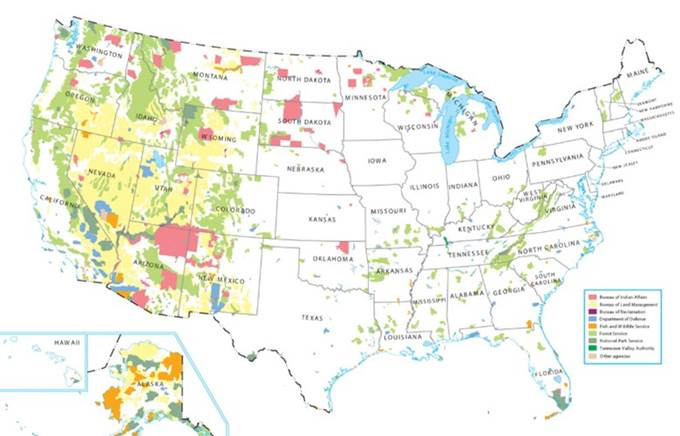
The land for housing exists in America. For example, Texas has 125 million acres of farmland. Land.com has 28 parcels of land listed for sale in Texas with each parcel ranging from 88,000 acres to 10,000 acres for a total of about 622,000 acres. California has 25 parcels of land listed for sale ranging from 41,000 acres to 3,000 acres for a total of 224,000 acres. Arizona has 23 parcels of land listed for sale ranging from 145,000 acres to 1,000 acres for a total of 343,000 acres. Colorado has 9 parcels of land larger than 10,000 acres listed for sale ranging from 120,000 acres to 11,000 acres for a total of 358,000 acres. Here’s an example of farmland with water in Texas suitable for about 20,000 new half-acre homes.
https://www.land.com/property/van-horn-texas-79855/23586888/
Other land is available for purchase in other states and millions of acres of federal land are available.
FOOD PRODUCTION FACILITY
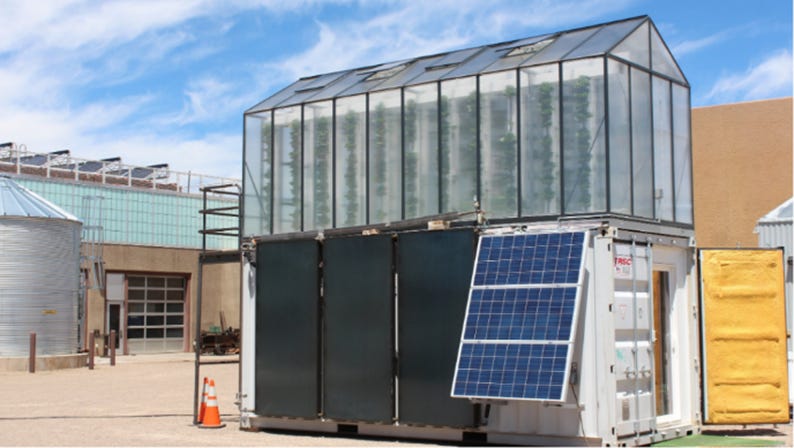
“Farms” use food production facilities as farm pods supplied by companies including FarmPod LLC which is a company that sells turnkey hydroponic and aquaponic farms in stacked shipping containers.
A photo of a farm pod shows plants being grown on the second floor in a greenhouse and fish being grown on the first floor in a shipping container in temperature-controlled tanks.
MODULAR HOMES
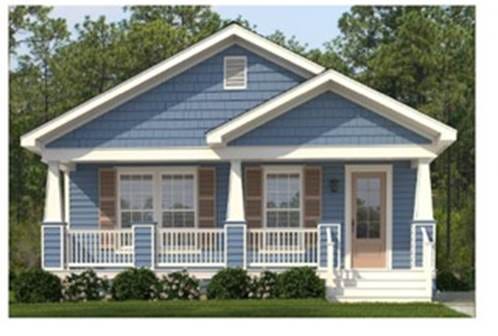
A good design comes from a small company, Impressa Modular, but the company has inadequate capacity.
In Van Horn, Texas.
https://impresamodular.com/state/texas/van-horn/
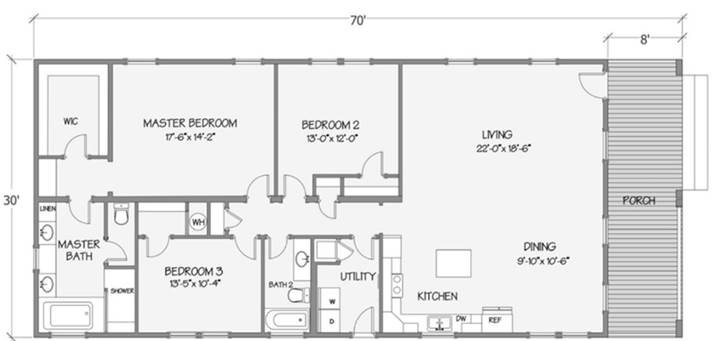
Homewood I-FHM-008
Specifications – 2100 sqft, 3 bedrooms, 2 bathrooms, optional garage
Estimated breakdown of costs
Base Home Price: Starting at $115,500 (price at the factory)
Installation & Finish: $17–$40 per square foot
Site Work: $7,000–$40,000
Foundation: $9–$25 per square foot for a crawlspace, but this depends on your location
Utilities: $15,000–$25,000
Heating & Cooling: $10,000–$35,000
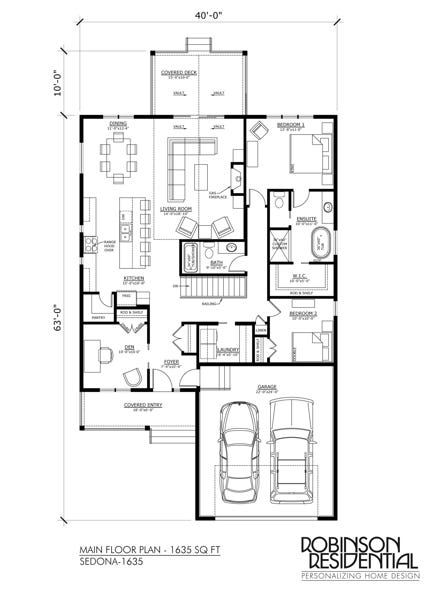
Another option is a modular home design from Pacific Homes.
Pacific Homes
https://pacific-homes.com/about-us-pacific-homes/

A NEW GENERATION OF HOME CONSTRUCTION
Transformational innovation is needed to create a new generation of affordable home construction methods with volume lower cost and faster construction of modular homes with modules built in factories and assembly on-site. But the innovation must be implemented by the federal government placing orders for homes with corporations and with cooperation with those corporations to build new factories subsidized by the government to create a solution to affordable housing in America.
The challenge for implementing the affordable housing program in PROJECT 2029 with “farms” is mainly contracting and building (1) the required manufacturing capacity that can produce the annual 1 million new modular houses that are on a “farm” and contracting and building (2) the required manufacturing capacity that can produce the annual 1 million new hydroponic and aquaponic food production facilities that are also on a “farm”. The capacity requires the 40 new factories, 20 for modular homes and 20 for food production facilities.
The solution to increasing the manufacturing capacity for the food production facility and modular housing and is (1) a cooperative partnership negotiated by the federal government between FarmPod LLC, Just Vertical, Freight Farms, and Ford, GM, Toyota, and RV manufacturers, and (2) a cooperative partnership negotiated by the federal government (between Impress and Pacific for designs, manufacturers such as Champion and Clayton and Ford, GM, Toyota, RV manufacturers, and large national home builders like DR Horton to handle delivery and installation rather than rely on small retail builders as practiced currently by Champion and Clayton. DR Horton is frequently recognized as the largest homebuilder by volume, constructing over 80,000 homes annually and holding a significant market share. For the fiscal year ending September 30, 2024, DR Horton’s annual revenue was $36.8 billion.
The federal government in PROJECT 2029 would negotiate contracts with Ford and GM, Toyota, and potentially also RV manufacturers including Thor Industries, Forest River and Winnebago with INCENTIVES to own and operate new 40 new factories to be built during the 3-year pilot program with 100% financing of the construction by the federal government at no cost to the companies. The 40 new factories in the 20 new hubs would then build modular homes and food production facilities under license from current builders of modular homes and food production facilities. Building a new automobile assembly plant takes 2 to 3 years and costs about $10 billion. Therefore, building 40 new factories would cost $400 billion, which would be 100% financed by the federal government at no cost to the companies out of the $500 billion allocated for PROJECT 2029 each year in the 3-year pilot program.
In parallel with the manufacturing and delivery of “farms”, development must occur for the capability of residents of “farms”, who are also operators of the food production facility on “farms”, to sell and distribute the food produced for income and have jobs for income building the “farms” in new factories, and completing the construction and installation of the homes and food production facilities on-site in the new 50 new hubs.
THE ECONOMICS OF INNOVATION
Currently practiced economic policy by Republicans and Democrats doesn’t adequately understand innovation. The Economics of Innovation is a new field that attempts to describe how innovation, both technological and otherwise, drives economic growth and development.
In 2025, the Nobel Prize in Economy was awarded for work based on research that analyzed history and explained how transformational innovation drove beneficial economic growth and a better standard of living in America for the last 200 years. The three noble laureates discovered the requirements to create and sustain beneficial transformational innovation. Read the press release and the cite article.
https://www.nobelprize.org/prizes/economic-sciences/2025/press-release/
https://www.nobelprize.org/uploads/2025/10/popular-economicsciences2025-3.pdf
The new theory of the Economics of Innovation is studied by innovation economists who correctly believe what primarily drives economic growth in today’s knowledge-based economy is not capital accumulation as neoclassical economics and Republicans asset but innovative capacity which in PROJECT 2029 is created by the federal government in cooperation with corporations.
For the last 50 years, Republicans have rejected any planned innovation management by the federal government and believe innovation is only produced in a random and unpredictable process that occurs only in corporations. Republicans have followed Milton Friedman’s theory of economics which believes economic growth is driven by capital accumulation by the wealthy and corporations supplied with tax cuts for the rich and corporations to implement “trickle down” economics which is sometimes identified as “supply-side” economics.
Trump and Republicans in the Big Beautiful Bill are practicing Reagan’s failed “trickle down” and “supply-side” economics. The objective is to reduce federal income taxes for the wealthy and corporations that create huge federal deficits but then reduce the size of the deficit by reducing federal spending on social support including SNAP and healthcare such as cutting Medicaid and the ACA subsidies.
The failure of Democrats to get elected in 2016 and 2024 was caused by their failure to solve problems in the economy that were harming the working class without an adequate understanding of innovation and without an adequate understanding of how to solve affordability which requires providing affordable housing and good paying jobs for the working class which is 60% of the U.S. workforce. Roughly half of U.S. households earn under $70,000 placing them in both the lower income and working-class.
THE CHALLENGE TO ADOPT PROJECT 2029
The challenge for “we the people” now is getting Democrats to adopt the proposed solutions to affordability and the lack of good paying jobs in PROJECT 2029 to get elected in 2028.
No posts
Comments
Nothing yet. Say the first thing.
Sign in to join the conversation.