
Florida killed two men today. Not on different days. Not after separate periods of reflection. Not with even the pretense that taking a human life ought to make the machinery of government pause.
Florida killed one man shortly after noon, cleaned the room, reset the equipment, and killed another before supper. James Aren Duckett was pronounced dead at 1:19 p.m. Dominick Anthony Occhicone was pronounced dead at 6:13 p.m.
Less than five hours separated their deaths.
That is where Florida is now.
James Duckett, 68, was convicted of the rape and murder of 11-year-old Teresa McAbee in 1987. He was a police officer at the time. The facts presented against him were horrible, and Teresa’s death was a monstrous thing. She was a child. She deserved to grow up. She deserved birthdays, scraped knees, first love, old age, and all the ordinary things that were stolen from her.
Dominick Occhicone, 80, was convicted of murdering Raymond and Martha Artzner, the parents of his former girlfriend, in 1986. They also deserved to live. Their family has carried that violence for nearly forty years.
Nothing I say here is meant to minimize those deaths. I will not dishonor the victims by treating them as props in an argument. Their lives mattered before the crimes, and they still matter now.
But here is the thing we refuse to confront:
Killing James Duckett did not bring Teresa McAbee back. Killing Dominick Occhicone did not return Raymond and Martha Artzner to their family.
Florida simply added two more dead bodies to the pile.
And then called it “justice.”
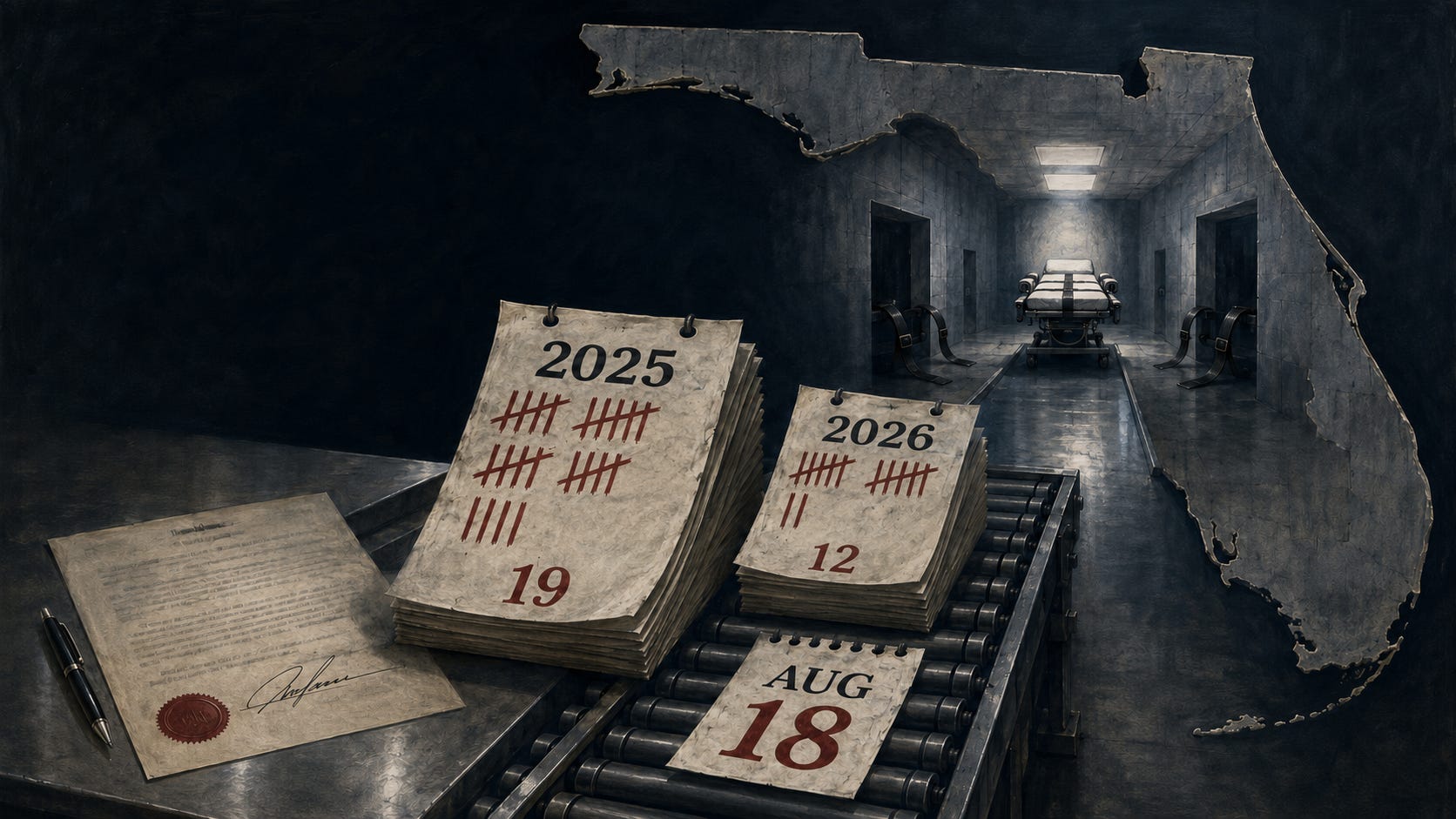
Today was the first time Florida carried out two executions on the same day since 1964. It was also the first time in nearly a decade that any state executed two people in one day. Duckett and Occhicone became Florida’s 11th and 12th executions of 2026. They were the 39th and 40th executions carried out under Governor Ron DeSantis.
Think about those numbers.
Forty executions under one governor. Thirty-one of them during his final two years in office. Nineteen last year - a Florida record - and twelve more before July has even ended this year. Another execution is already scheduled for August.
This is not simply the enforcement of old sentences. It is an acceleration. It is a campaign. It is the deliberate conversion of a death chamber into an assembly line.
The governor has not explained why these two executions were placed on the same day. Perhaps he does not believe an explanation is necessary anymore. Perhaps death has become so routine inside his administration that scheduling two human beings six hours apart looks like efficiency.
That should frighten us.
The state was not forced to do this. No emergency required it. Neither man was escaping. Neither man presented an immediate danger to the public. Duckett had spent almost four decades under a sentence of death. Occhicone had been on death row since 1987.
Florida had all the time in the world. Then, suddenly, it had no time at all.
James Duckett maintained his innocence for decades.
His earlier execution date was stayed so modern DNA testing could be conducted. The testing did not identify him as the contributor - but it did not exclude him either. The result was inconclusive.
His expert said the available evidence was insufficient to determine whether Duckett was or was not a contributor to the DNA mixture. The biological sample was consumed during testing, eliminating any further opportunity to test it. Duckett sought an evidentiary hearing. The court refused. His stay was lifted, and less than a week later, Governor DeSantis placed him on today’s schedule.
Let us be painfully clear.
An inconclusive result is not proof of innocence.
But it is not proof of guilt either.
And when the punishment is death, uncertainty ought to matter.
We are constantly told that the courts reviewed the case, that the appeals were exhausted, and that the conviction remained valid. But courts do not possess some mystical ability to transform uncertainty into truth.
Courts make mistakes.
Prosecutors make mistakes.
Police make mistakes.
Laboratories make mistakes.
Witnesses lie.
Evidence disappears.
Evidence is destroyed.
And once a man is dead, the state’s mistake becomes permanent. Duckett made no final statement today. He had maintained his innocence for almost forty years. Florida killed him anyway.
Then came Dominick Occhicone.
He was 80 years old - nearly 81 - and became the oldest person executed in modern Florida history. He suffered from chronic kidney and heart problems, poor vision, hearing impairment and other conditions associated with advanced age. He needed assistance from guards to negotiate stairs and use the shower.
Florida did not release him. Florida did not forgive him. Florida did not even have to pretend that he remained a physical threat to society.
It wheeled an old man into the execution chamber, strapped him to a gurney and injected him with three drugs until his heart stopped.
Occhicone had been sentenced to death after a jury recommendation of only 7–5. Five jurors voted to spare his life. Such a vote would not be enough to impose a death sentence under Florida law today. The sentencing court also found that he had acted under extreme mental or emotional disturbance. None of that saved him.
Before he died, Occhicone thanked the Christian men who had visited him over the years. He apologized to his own family and to the family of Raymond and Martha Artzner.
He said he was sorry for the hurt he had caused. Then Florida killed him.
What public-safety purpose was served? What threat was eliminated? What great moral victory was achieved by killing a sick, nearly 81-year-old man who had already spent almost half his life waiting to die?
There was none. There was only vengeance.
Some people will read this and accuse me of caring more about those executed than those they killed.
That is dishonest. I can mourn Teresa McAbee without asking the state to imitate the person who killed her. I can grieve for Raymond and Martha Artzner without believing that another family should receive a phone call saying their father, brother, uncle or grandfather has been killed by government employees.
Compassion is not a bucket with a limited supply. Showing humanity toward one person does not steal humanity from another. The death-penalty supporter insists that we must choose. Victim or prisoner. Innocent or guilty. Them or us. Mercy or justice.
I reject that bargain.
Justice does not require us to become cold. It does not require us to celebrate death. It does not require us to build special rooms, train people to kill, purchase chemicals in secrecy, rehearse the procedure and then invite witnesses to watch a human being stop breathing.
And I have to say this plainly: I am disgusted by those who cheer this.
Not those who struggle with the issue. Not those whose pain makes mercy difficult. I understand pain. I understand anger. I understand the desire to strike back.
I am talking about those who enjoy it. Those who count executions like points on a scoreboard. Those who call for more, faster, louder. Those who mock the condemned man’s fear. Those who confuse cruelty with strength and bloodlust with concern for victims.
That is not justice. It is inhumanity.
And the fact that the killing is done by people wearing uniforms, following written procedures and standing beneath the authority of a governor does not make it more moral. It only makes the violence cleaner, quieter and easier for the public to ignore.
I spent most of my life inside Louisiana’s Angola prison. I lived among men under death sentences. I represented incarcerated people. I watched warrants approach. I saw what the waiting did - not only to the condemned, but to families, wives, lawyers, officers, friends and everyone pulled into the orbit of a scheduled execution.
The public sees a date. The condemned man hears footsteps. The conden=mned man waits for the fib=nal message,
He watches meals arrive and wonders how many remain. He looks at the people around him and wonders which goodbye will be the last. His family measures the hours. His lawyers race through the courts. Prison employees prepare a man they may have known for decades to be killed by their colleagues.
Then the witnesses leave. The room is cleaned. The gurney waits for the next body. Today, Florida used it twice.
I am not doing this work because it is easy. It is not easy to read about murdered children. It is not easy to study photographs of victims and the people who killed them. It is not easy to write about death over and over again and still believe that the public can be reached.
But silence is exactly what the machinery depends upon. It depends on people turning away.
It depends on executions becoming little notices buried beneath the day’s louder news. It depends on people accepting the language of “closure,” “procedure” and “lawful sentence” without looking too closely at the old man strapped to the table.
I refuse to look away. I will continue to write about the death penalty. I will continue to expose its cruelty, its racial unfairness, its errors, its politics and its terrible appetite for human life.
But I need people standing with me.
Follow this publication. Share these articles.
Send them to someone who still believes executions are harmless because they happen behind prison walls. Become a paid subscriber if you are able. Your support gives me the ability to continue researching, speaking and pushing against a system with enormous power and very little interest in examining itself.
I do not expect everyone to agree with me immediately. I only ask that they look. Look at what Florida did today.
One man dead at 1:19. Another dead at 6:13.
The room cleaned between them.
And somewhere tonight, another condemned man is listening for footsteps outside his door.



Comments
Nothing yet. Say the first thing.
Sign in to join the conversation.