
Camp J was - what turned about to be - the most notorious Camp in Angola. If there were actually Levels of Hell as Dante defined, this was below the final destination, where it was beyond hope. I honestly hope to never return there, whether in my mind or, certainly, physically.
It is now known as “Camp 57,” one of those concentration camps as a part of the ICE detention centers (mostly operated by private prison operators like CoreCivic, GeoGroup, and others).
Camp J was shut down by LaDPSC in 2018 after years of litigation, violence, danger and turmoil within Angola and the Department. It was long the worst living space in Angola. Except for about 75 low-risk and trusted convicts who lived in a separate dormitory called “Bass,” who were employed as dorm orderlies. yard orderlies, kitchen workers and laundry workers, all of the rest of the guys were maximum custody. Every one of them was there for either serious disciplinary issues, escapes, or in a relatively few cases, serious protection concerns.
And, yes, before you ask, I have lived at Camp J three times during my 47 years in Angola. Once on a (false) disciplinary report and once as a cook in the kitchen. The third stay was for 14 days in the midst of the COVID-19 pandemic when I tested positive for the virus. Needless to say, my stint as a cook was much more pleasant than my stay as a COVID-19 patient or as a cell-bound prisoner on a false and trumped-up DB charge. (BTW, I later won that case and was ordered released. I’ll tell you about it later in another post.)
So, all of the units at Camp J were named after creatures from the waters: Bass, Cuda, Gator, Gar and Shark
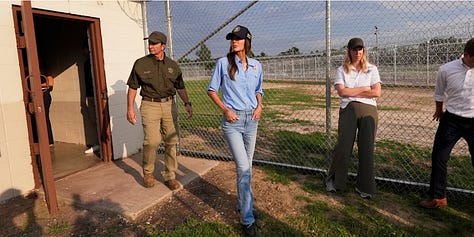


Camp J was where I was living and working as a cook when I was notified that I had been approved and assigned to be an Inmate Counsel. [BTW, I worked with the man depicted in this video - Calvin Duncan] Our Assistant warden was a jovial and basically fair man named Louie Calvert.
Back in the day, however, Camp J was a miserable place. Before its closure, Camp J was notoriously regarded as one of the most punitive environments in the American penal system.
The Extended Lockdown Purpose: Unlike general population inmates who lived in open-air dormitories, Camp J was an “extended lockdown” and administrative segregation unit. It was strictly reserved for inmates who committed severe infractions inside Angola, such as escape, contraband, gangfights or attacking guards.
Severe Isolation: Inmates spent 23 hours a day isolated in small cells. Air conditioning was non-existent for decades, creating sweltering, unsafe conditions in the Louisiana summer heat.
Systemic Decay: By the mid-2010s, the physical infrastructure of Camp J was failing. A 2018 prison report highlighted malfunctioning cell locks, jammed doors, and high rates of self-harm and suicide attempts. The state permanently closed and abandoned the site in December 2018.
Temporary Re-activation: The site sat completely empty until 2020, when the state briefly utilized a portion of it as an emergency isolation zone for inmates with mild cases of COVID-19. It was subsequently abandoned again until its 2025 fast-track conversion into an immigration lockup. [CoronaVirus Facility]
Truth be told, however, some of the “severe disciplinary cases” were, in fact, cases of “serious mental illness.” Inmates suffering from severe psychological disorders - such as schizophrenia or major clinical depression - were historically placed in extended lockdown (solitary confinement) such as Camp J. This prolonged 23-hour-a-day isolation heavily speeded up cognitive decline, hallucinations, and actually encouraged self-harm.
Angola depends heavily on transient, part-time contract psychiatrists and underqualified medical staff who regularly fail to recognize or properly document acute psychiatric decompensation. Inmates can wait months to receive basic medication changes or see a mental health counselor or even a social worker.
So, the team of Inmate Counsels at Camp J consisted of me and Patrick DeVille who lived at BASS dormitory, and 4-5 other Inmate Counsels who lived at Main Prison (“The Walk”) and were transported daily to and from Camp J. Usually, Patrick and I took turns representing convicts at DB courts, then made rounds on one of the units. “Making rounds” required us to visit each cell on each tier - average of 13x2x4 = 104 cells - and handle requests.
Requests might consist of pulling specific law books, court reports, typing self-prepared writs, researching specific issues, Shepardizing a case, or similar tasks. It was usually a harrowing experience due to the heat on the tiers, encounters with hateful convicts, lack of cooperation from guards, etc.
The unit I was assigned to was GAR (Shortened from ““Alligator Gar”) I actually enjoyed DB court as it was fun to challenge DB officers and Classification and whoever else was on the Board that day. The crew I usually confronted was made up of a “Randy” and a “Della.” They were goofy as hell and were a lot of fun to work with, and usually gave me a good “deal” to offer my client if he pleaded guilty. If I chose to fight a case, they were fair and firm. Everybody had the same goal: get it over with, and get out of there, and get on with our day.
So, on this particular day I had finished DB court, but one of the guys from Main Prison had a callout that morning and hadn’t shown up, so I was tasked to sub in for him and had to cover for him on CUDA, short for “Barracuda.” Already tired from DB court and my rounds on GAR, I went on down to CUDA and knocked on CUDA’s door. The beefy, tattooed and ridiculously redneck guard opened the door and let me in, and I stepped over to the desk to sign the logbook. Instantly, I was overwhelmed by the horrible odor coming from somewhere through the lobby. When I asked about it, I was met with a derisive laugh. “That’s that fuckin’ Bobby Freeman again.” Not quite the introduction one would want, particularly for a possibly new “client.”
When the same guard opened the gate, I ventured down the tier and headed for the most unusual interaction I had yet encountered. After a few cells, I “met” Bobby. Bobby Freeman. The odor was terrible. Bobby was standing in the middle of his cell, arms akimbo, stuck in a trance-like state, humming noisily to himself. I saw it instantly - Bobby was severely mentally troubled. Among many things I learned that day was that one of the most important things was that Bobby had been referred several times to the East Feliciana State Hospital, or Jackson, as it was known. Just as with Angola, Jackson had a terribly dark history of abuse, sexual assault and death. But - it was the only state institution capable of dealing with someone like Bobby.
I tried several times to engage Bobby, and finally succeeded when I began imitating his humming but at a much lower volume. He stopped suddenly and put his blank-eyed gaze on me…I had his attention. When he asked me what I wanted, I responded with, “I want to know who you are and what you need.”
“I’m my own Jesus!” he responded. “I own me…not Louisiana! Louisiana don’t own shit!”
Surprisingly - or not - I had to agree with him. Louisiana didn’t own ME either.
But Louisiana didn’t own him - Louisiana owned the right to care for him - care, custody and control, right? That’s what LaDPS&C claims. Their very own creed claims that right. So, why was this obviously mentally ill man still sitting in this cell, banned from showers and exercise and fresh air simply because guards didn’t want to deal with him?
It was a cycle of disillusionment that haunted me. After a few moments of interaction with Bobby, I went further down the tier, and eventually completed my rounds on CUDA. I went back to the office and immediately began a series of efforts (ARPSs and a civil lawsuit) aimed at getting him out of Angola and into Jackson. Bobby needed help, and needed it fast.
Over the next few weeks, I learned (YES, I went back again and still again) that Bobby had stuck an inkpen into his chest - directly into his heart - and a pencil into his urethra, forever damaging his manhood, his penis. Whether this was a statement on his manhood against Louisiana or not, I don’t know and cannot say now. (I’ve been free for 3-1/2 years as of today.)
When he stuck the Bic into his chest, he wanted to watch the pen record his departure from this life,
And I went to bed that night wondering if I had done enough to help this man, this human being, this man who refused to allow Louisiana to take ownership over his soul, his essence. I constantly asked him why he did this. His response was quick and shaped out by the challenges I faced, and this was my personal Sysiphus.
Bobby angrily confronted me the next tine I saw him - we had become semi-good communicators by this time. “Why you writing about me sticking a pencil up me dick?!” he said. “Because I want to know why you did it, who you were trying to hurt, what you were really saying, and who you were saying it to,” I told him. This was when he stopped and looked at me, that haunted stare that pierced me and demanded that I look deeper into him.
He grabbed a cup off of the edge of his bunk - it was a white styrofoam cup and it was shriveling and deformed at the edges - and it was full of a foul and clumpy semi-liquid slab of butter. He began smearing it all over his body, starting at his neck and working downwards. He was a very black and wiry man with spindly, spike-like tufts of hair coming out of his head that looked like radio antennae.
The butter! That’s what was creating this horrid and sickening odor that permeated the entire building and seemed to settle onto your skin and claw its way deep into you. Stumbling backwards from the cell-door, I asked him, “Bobby, why the hell you smearing that stuff on you, man?!”
“Because it keeps them blue demons away from me! They’re fucking demons, don’t you understand that?!” The vehemence with which he threw this out there was a bit disarming, and I almost didn’t know how to respond. The smell was terrible and I had to get away from him, so I hurried away and out of the building before I threw up all over myself. The fat guard was chuckling as he let me out of the unit.
It was a week or so before I went back to see Bobby again. This time he shocked me even worse…instead of butter, he rubbed his own feces over his chest. He had already streaked it across the cell walls and now he was slathering it onto his body. I couldn’t even pretend to understand this and I turned and hurried away from his cell, leaving behind the cackling and hyena-like laughing he was giving out.
Some poor SOB was going to be called out from the dormitory and forced to clean this mess up, sh*t and all…they would be provided ZERO protective gear while they did it. At Camp J, you did what you were told to do and you did it, like it or not, or you would promptly go into one of their own cells.
And the ARP I had filed to try to help Bobby, to try to protect him? It had gone nowhere. It was ignored by everyone all along the chain-of-command. Everyone knew about Bobby, knew about his problems, knew the harm he was doing to himself, knew about the danger he posed to others, and did nothing to prevent it.
Did they also know about the harm they did to me? I think they did, and chose to do…nothing, just like they did to Bobby. The main problem with Camp J was staffing. It was a known and proven fact that was admitted by the Warden at the time that the closure was proposed to the Secretary of Corrections.
In July 2017, Louisiana State Penitentiary at Angola Warden Darrel Vannoy wrote an internal letter to Louisiana Department of Public Safety and Corrections Secretary James "Jimmy" LeBlanc advocating for the closure of the notorious Camp J isolation unit.
Camp J became infamous among officers and offenders alike, a spot where conditions were harsh and where severe mental health issues became commonplace. In a letter Angola Warden Darryl Vannoy wrote to LeBlanc in July 2017 advocating for its closure, Vannoy explained that within one year 85 corrections officers assigned to Camp J had resigned, retired or were terminated.
“The challenges staff encounter at Camp J are more complex than other areas of the institution,” Vannoy wrote in the letter, obtained by The Advocate in a public records request. “Numerous times upon an officer’s knowledge that they will be assigned to Camp J or ‘loaned’ to Camp J for work detail they will leave work sick, walk off the job, or report to Human Resources to resign.”
Completed in 1976, Camp J has four cell blocks each with eight tiers made up of 13 single-man cells. It was used to discipline offenders following grave infractions of prison rules, such as fighting with a weapon, or for behavioral issues, officials have said, with the opportunity for offenders to earn their way out after meeting certain conditions.
Vannoy wrote that the locks for the cells in Camp J had recently begun malfunctioning, sometimes opening on their own, and offenders had figured out ways to jam cell doors – often with toothpaste caps or buttons – circumventing security checks by making unlocked cells appear closed. Weapons use had been on the rise along with the security breaches, Vannoy wrote, with 44 weapons found at Camp J in the first seven months of 2017.
Because of staff shortages at the Camp, officers at Roll Calls around the farm were told that they had to report to Camp J. When told this, many refused, or reported to HR immediately that they would resign, or declared that they were “sick” and needed to go home. NO ONE wanted to work at Camp J. When Angola enforced anti-smoking bans, it created the perfect storm - guards were in the position where they had the ultimate upper hand: they could offer something of immense value that would make their jobs much easier. Then, they took it to another level: they started trading cigarettes for “yard” hours and shower times. They’d trade one or two cigarettes for a prisoner refusing his yard call or his “shower hour.”
Peace reigned for a while. But, not for long.
Were there escapes from Camp J? Not directly from Camp J, but there have been a number of escapes….many escapees who were recaptured spent time at Camp J. Roy McLaughlin was one of them. Camp J was a human disposal, and it was the nexus of many a conspiracy, some true and some false. Trust me, Angola had a culture of its’ own. B-Line especially…the common joke was that “shift change was coming up, and who knew who was jumping out of whose’ back window?”
There was no speculation that there were many extramarital/situationships being violated at Camp J’s population at Camp J.
That aside, Camp J had developed into its’ own little world.
Nothing mattered anymore. Absolutely nothing.
The federal ruling in Lewis v. Cain noted that the Louisiana Department of Public Safety and Corrections entirely lacked the fundamental infrastructure to deliver adequate healthcare.
Absence of Specialized Beds: Angola lacked a sufficient number of intermediate or acute psychiatric beds. Camp J’s disciplinary cells were systematically used as an overflow dump for individuals experiencing active psychotic episodes.
Unqualified Security Staff: The guards managing the day-to-day operations at Camp J were not equipped with Crisis Intervention Training (CIT) or basic psychiatric care training. This frequently led to volatile escalations, structural neglect, and an inability to recognize severe psychiatric decompensation until a crisis or suicide occurred.
The systemic failure of this setup is what eventually led federal courts to rule that health and psychiatric management at Angola violated the Eighth Amendment’s prohibition on cruel and unusual punishment.
Bobby remained on my mind. His plight remained on my mind. How many more Bobby’s were there out there? How many more were there smearing feces on themselves, or on the walls of their cells? How many more were there crying out for help when there was none there?
This started me on my efforts on speaking out for mental health for the convicts at Camp J. Efforts never go in vain. You may not see the results in the form of what you want to achieve but it will certainly help you to achieve something else.
We often relate our efforts to our success. If we don’t succeed in doing something, we believe that everything we did was useless. We must remember that anything we do in life provides new skills to us. These skills are not necessarily professional skills but life skills such as patience, persistence and perseverance.
Your efforts always add worth to your life. If you see your progress, you will see it as your success.
Go with God, Bobby. Others may not see your humanity, but I DID,

Comments
Nothing yet. Say the first thing.
Sign in to join the conversation.