
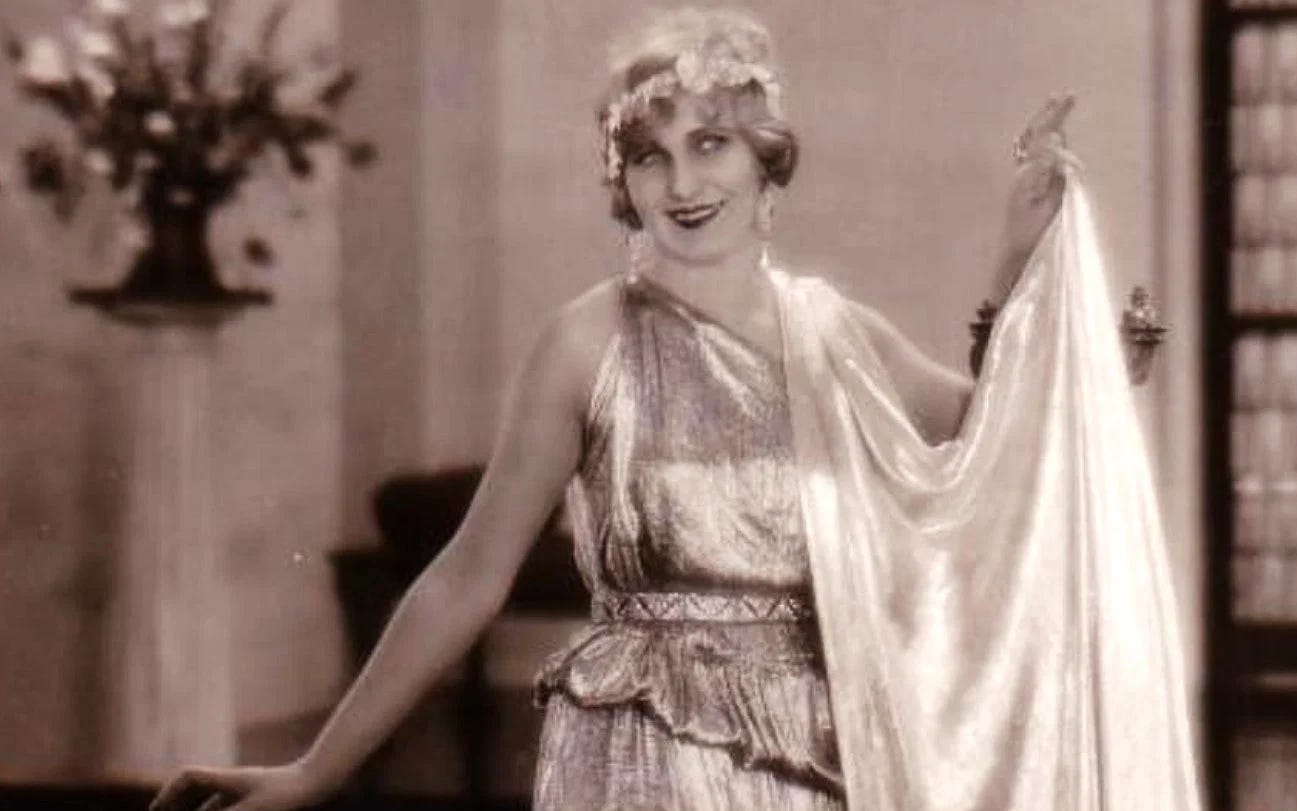
As you may have heard, there’s a high-end movie adaptation of The Odyssey on the way, directed by Christopher Nolan, with Lupita Nyong’o playing Helen of Troy, who, in the poem, and in the mythology the poem is based on, is the most beautiful woman in the world. Helen is not a major character in the Homeric epic now under adaptation (she’s not all that major even in the other one), but a few weeks ago, Nolan’s casting choice was subjected to some heated online discussion. Now, having waited a decent interval to be sure the topic is no longer hot (BAD HISTORY policy), I’m reporting some of the things I gleaned from observing and occasionally engaging in that discourse.
At the crudest level, a lot of people are offended by the casting because Helen of Troy was, as they put it, white. Nyong’o is black.
I’m not talking here about the criticism that this casting choice is a little on-the-nose, a tad show-offy and self-congratulatory. To the extent that people have any picture of Helen in mind, it would be based on illustrations, and for that matter movies, where she’s ranged from Nordic to Mediterranean, but not until now Kenyan or African American. “Ooo, how bold, how game-changing, how of-the-moment, how controversial” might seem to be the intended response to the casting, and sure, that might be annoying, in a Hollywoodish way.
On the other hand, how would you cast the most beautiful woman in late-prehistoric Europe? or for that matter in the much later period, maybe around 800 BCE, when the epic was probably composed? Go out of your way not to be bold and game-changing? That would be annoying too. If we could travel back in a time machine, every single person from that time would look utterly unexpected to us. Add the fact that these are supposed to be mighty heroes and demigods, and wow. In their presence, the tops of our heads would blow off from the sheer surprise.
And yet Matt Damon, who plays Odysseus in the upcoming movie, seems quite familiar. Quite unsurprising. Kind of all-American. If you’re going to be offended by a lack of verisimilitude, maybe start there?
The most beautiful woman in the world can’t be depicted anyway. Even Homer barely describes her. Which gets into the question of why adapt The Odyssey to film at all. Maybe don’t.
But the people I’m talking about take these issues a lot more seriously than that. It turns out that the kind who like to nerd out publicly about Homer and want everyone on the Internet to know (or believe) they read Ancient Greek overlap with and form a kind of brain-trust division of the larger Great Replacement type—those white people who, while not always totally up on Homer, see themselves, their kind, and their heritage being destroyed by forces dedicated to erasing the exceptional greatness of Western Civilization, here defined as white.
Defined, one might say, as Aryan—a concept that has tracked neatly with certain longstanding fantasies about the myths and legends of the Achaeans, as Homer called the people that others call the Mycenaeans—the Bronze Age people who came to dominate the Aegean region. They were Indo-European migrants, related to the people who also migrated into the Indian subcontinent and into Scandinavia. 19th Century scholarship glorified those migrations as imposing superior organizational discipline, military ambition, and patriarchy on supposedly cute and interesting but supposedly physically shorter and darker, less developed, more goddess-worshipping peoples, and thereby beginning to establish what 19th Century scholarship constructed as Western Civilization.
We know some of what that kind of thinking led to. The hoopla over the Helen casting gives me the feeling that some people, in the 21st Century, believe that in Homeric epic and its forebears, “the most beautiful woman in the world” means “the whitest woman.”
Another batch of critics came out swinging against the casting choice because the actress isn’t one particular subset of white: Greek. Matt Damon, as noted, isn’t Greek. Anne Hathaway, who plays Penelope, isn’t Greek. Like Mary, there’s something about Helen—but do people really view the ancient Mycenaeans as in some fundamental way nationalistically Greek? Pursue these notions to their illogical conclusions and you’ll have to cast a late-Bronze-Age Spartan as Helen. You’re not going to find her sitting at Schwab’s lunch counter. No movies could be made. We’d have nothing to argue about.
There was also this (manifestly idiotic) angle: So then I’m going to make a movie where Martin Luther King is played by a white actor, how’s that!
Also: You wouldn’t cast a white actor as Othell—Oh. Never mind.
I made up that last one.
Online pushback to the online objections to Nyong’o took some obvious forms. One was That’s racist!
Which in some cases was manifestly true, not even denied. Those accusations never have any impact.
Other pushback tried to remind those who demand faithfulness to the original character that the original character didn’t exist. (Odysseus didn’t exist either—who am I to say Matt Damon isn’t good casting?) In the old stories, Helen’s father was Zeus, who took the form of a swan in order to have sex with—in many tellings, to rape—her mother, Leda, Queen of Sparta. Leda hatched an egg. Out popped Helen. Does anyone see all this as essentially . . . white? Santa Claus was originally and is still most often depicted as an old white dude. He also lives at the North Pole with elves and delivers toys on Christmas Eve—so how culturally important and essential is his whiteness? or even his maleness, or even his long marriage to Mrs. Claus? The Ancient Greeks may not have imagined a black Helen. Their culture also didn’t contemplate the category of whiteness that postmodern self-appointed saviors of Western Civilization obsessively contemplate. The Ancient Greeks had other things to do. The saviors have nothing to do but tap tap tap on their phones, in hopes of saving a heritage they don’t have any real understanding of, any real sympathy for.
I do get, though, that “she wasn’t real” isn’t perfectly germane. Helen is really in the poem and the mythology, and it’s the poem and the mythology that some people insist should be depicted what they call authentically. This is where we get into the notion, startling to me, that a film adaptation of The Odyssey is a period piece, and should be treated as such, with period accuracy.
The problem for me with discussing this period-piece critique is that it involves Professional Smart Guy (PSG) Charles Murray, and I recently made fun of him in another post, so this might seem like piling on, but it’s not my fault. Murray weighed in on the casting controversy with the period-piece angle, beginning here:
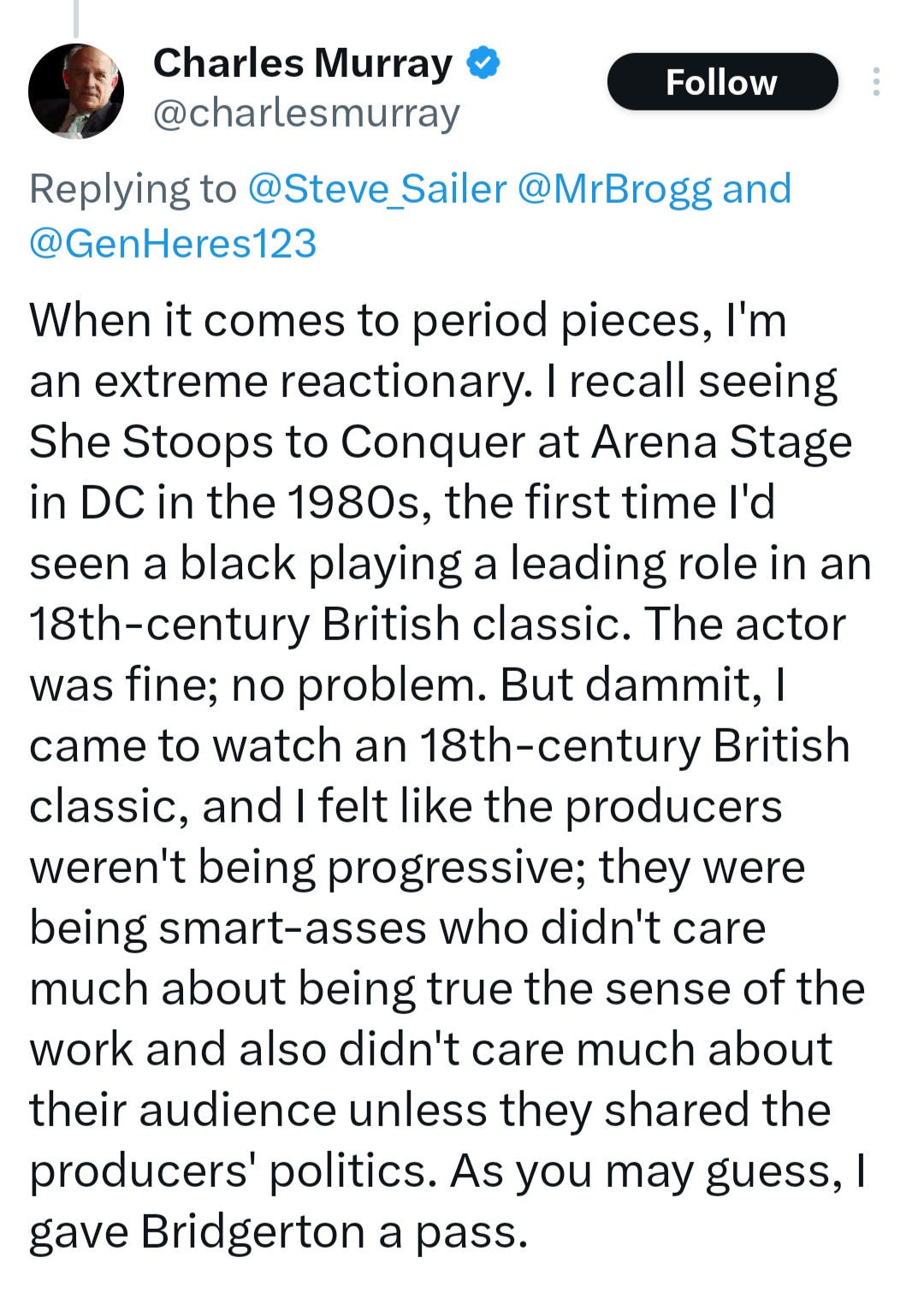
The goofball idea here is “dammit, I came to watch an 18th Century classic,” which just can’t help but bleed right into “I came to watch an 18th Century classic—in the 18th Century.” Nobody in Goldsmith’s time would have cast a black actor or used electric lights. For the classic experience, you really want a white actor and smoky tallow candles and stinky open-flame gaslight, the whole place lit up, no distinction between the audience and the action. You also want to make sure the audience knows to mill about, talking and eating and drinking throughout the show. The text was in fact written to accommodate those conditions. It makes less sense without them. Push this idea back to Shakespeare’s time and casting gets particularly challenging. The classic experience means men in the women’s roles. …
Murray then developed his theme (with a touch of TMI):
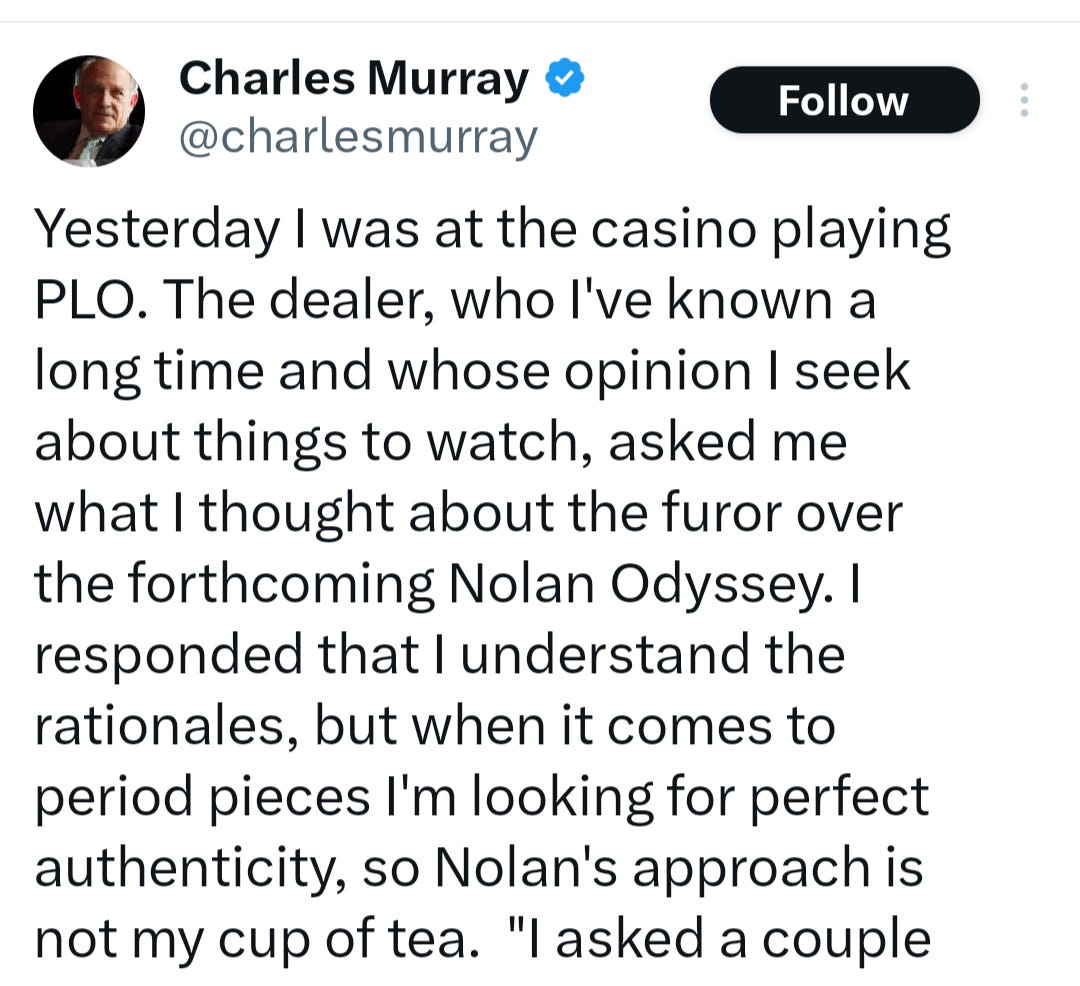
PLO means pot-limit Omaha. I don’t know that if I were at the casino playing pot-limit Omaha, I’d enjoy having to listen to one of the regulars gabbing with his favorite dealer about stuff like this, just me, but if we tiptoe past that distracting glimpse into the personal life of a PSG, we encounter the notion that when watching “period pieces,” “perfect authenticity” can be achieved, and is something to be prized.
This a silly idea to have, even about a period as recent as the 1950s, say, and it’s come up before on BAD HISTORY with reference to, among other things, the Napoleonic Wars. When you’re talking period authenticity, ideas about perfection and imperfection range from techniques for stitching military uniforms to degrees of cannon kickback to conquering Egypt; to evaluate perfection, you’d have to be up on all that, and much more, and Murray isn’t, because nobody is. Like the social historians who prefer to focus on and approve or disapprove the stitching, and like the military historians who prefer to note the kickback, his standard for perfect authenticity amounts to nothing more than his personal feeling for perfect authenticity. As with other things, he presents something subjective as if it were something objectively measurable.
The silliest idea of all, though, is thinking of movies based on the Homeric epics as period pieces at all. Period does exist, when movies are set in the past. Certain anachronisms can be jarring. Excessive authenticity can be jarring too: What’s the right amount of shit on the street? The real issue with period is always flavor, a conjuring of confidence that another world once existed, a world different enough from ours to transport us, and not so different that we’re so overwhelmed by the difference that we can’t care about anything else, like characters and action, as we would be, if we suddenly showed up in the past in real life.
The Odyssey is categorically different, though. What period would we even be talking about here? The period when gods involved themselves in the affairs of human beings and directed the day-to-day course of human events? But wait, OK—set aside the influence of the supernatural. As somebody pointed out online, with a vampire movie set in Victorian London, we still want to feel that it’s authentically Victorian London. (I don’t think that’s universally true—I’ve enjoyed recent period TV shows, like “Death by Lightning” and “The Great,” that revel in anachronism—but I get the point.)
The more important issue, as you might expect these Western Civ fanboys to take into account, is that Homer (or whoever) was singing the epics long, long after the events, real and unreal, they describe; in the interim, everything had drastically changed. Is the demand for period authenticity a demand for an authentic 8th Century BCE? Or an authentic 12th or 13th Century BCE? If you wanted to be true to the earlier period, the period of the Trojan War itself—if that even happened, so let’s just say the period when there was a Troy-like city state—then you’d have to face the fact that the Homeric poet is by no means the ultimate authority. Modern archeological research is. But if you decide to replace Homeric description with archeologically accurate info, then you’re not being true to the poem, which is supposedly what’s being adapted.
With anything like this, it’s all about choices. They have nothing to do with period authenticity.
You can even cast Matt Damon as Odysseus. There’s a choice.
One of the most interesting things about the epics is the degree to which Homer was and was not faithful to the period described, and how that issue was and was not managed via centuries of oral transmission (“was accurate” is amazingly interesting). And yet a lot of the people who present themselves as hyper-committed to the sanctity of Western Civilization seem to have no interest in any of that, so shen I gaze into the distant past, I discern an ancient ancestor of Charles Murray. He’s sitting around the fire, listening to the song, and complaining about the inauthenticity of the blind poet’s story. There’s one in every crowd.
No posts
Comments
Nothing yet. Say the first thing.
Sign in to join the conversation.