
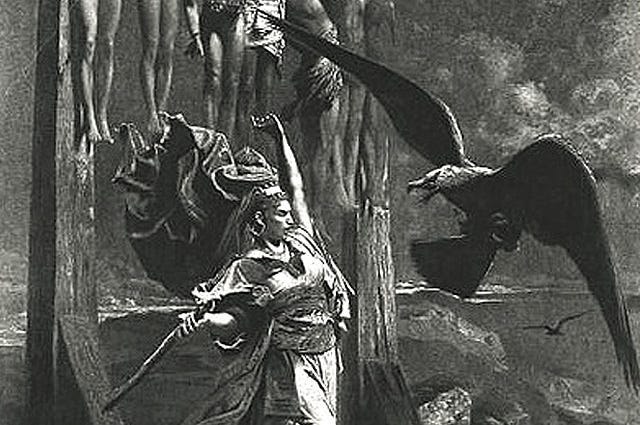
Rizpah’s vigil in 2 Samuel 21:1–14 is a haunting biblical story of remembered violence, yet many readers have never heard it. After the brutal deaths of her two sons and five other descendants of Saul, Rizpah refuses to leave their bodies unguarded. Her rarely told story feels disturbingly close to our own time.
Rizpah had been a secondary wife of Saul, Israel’s former king, whose dynasty David had replaced. After three years of famine, David learns that the land bears bloodguilt because Saul tried to destroy the Gibeonites, a people Israel had sworn to spare. David asks how to make amends. The Gibeonites demand seven of Saul’s descendants, and David agrees.
Among them are Rizpah’s sons, Armoni and Mephibosheth. David hands the seven over to the Gibeonites, who impale them and leave their bodies exposed to birds and wild animals.
Rizpah cannot undo what has happened. She has little power and no public voice. She does what she can: stays beside her sons’ bodies.
She spreads sackcloth on a rock and keeps watch, driving away birds by day and wild animals by night. The story gives her no words and records no demands. Her refusal to leave becomes her protest.
David hears what Rizpah has done. He retrieves the bones of Saul and Jonathan, David’s beloved friend, gathers the remains of the seven, and gives them all honorable burial in the family tomb. Only after the dead are buried does the story say that God heeds prayer for the land.
Rizpah cannot bring her sons back or command justice. Yet her refusal to abandon the dead changes what the king does. The dead are powerless, but they still make claims upon the living.
The story offers no easy answers. Saul wronged the Gibeonites, and Israel owed them redress. But what becomes of justice when descendants pay for an ancestor’s crimes? Does making amends to one wronged people require creating new victims? Justice that makes the innocent suffer for the guilt of the guilty resembles the violence it seeks to redress.
The story presents another discomfort. The deaths also remove seven members of the displaced royal house, an outcome that benefits the king who hands them over. Nothing in the text proves calculation. But justice becomes especially dangerous when what can be justified also serves the interests of those with power.
Rizpah gains no power. She holds power accountable by refusing to look away. When nothing can be undone, courage decides what will not be abandoned.
It is easy to identify with Rizpah. The harder truth is that we are often closer to David, accepting what has happened when its reasons also serve us—until someone makes us see what was lost.
Think of mothers searching for the disappeared, families keeping vigil after shootings, relatives looking for migrants lost along borders, and communities naming the dead after war or atrocity. Their persistence reminds us that what is over is not always finished.
Think, too, of people who keep photographs on mantels, tend forgotten graves, or keep telling the story of someone history has reduced to a number. Love refuses to let another person become unreal.
The story gives moral weight to someone the political order barely counts. David acts and commands; Rizpah can do neither. Yet the king changes course after hearing what she has done. He does not awaken Rizpah’s conscience. Rizpah awakens his. Her vigil forces him to attend not only to her sons but also to Saul and Jonathan and to give the dead the burial they had been denied.
Jesus said, “Let the dead bury their own dead.” He did not say, “Just move on.” Sometimes courage means keeping faith with what the world has already given up on.
Memory is the energy of hope. In Habits of the Heart (1985), Robert Bellah and his colleagues called a genuine community a “community of memory,” one that keeps telling the stories that formed it and thereby turns toward the future as a community of hope. Remembering is not the opposite of moving on. It makes moving forward possible.
Dylan Thomas wrote, “Death shall have no dominion . . . though lovers be lost love shall not.” Rizpah shows the courage hidden in such love: staying faithful even when the world has already moved on.
What love refuses to abandon, death cannot defeat.
Notes and reading
Biblical faith rarely separates spiritual meaning from material life. The Word becomes flesh, and again and again bodies, meals, graves, gestures, and acts of fidelity become bearers of theological meaning. Rizpah’s vigil belongs to that biblical pattern.
Requiem for a Nun — William Faulkner (1951). Faulkner’s novel is haunted by the persistence of the past and its continuing impact on the present.
The David Story: A Translation with Commentary of 1 and 2 Samuel — Robert Alter (1999). Alter’s translation and commentary bring out the literary and moral complexity of the David narratives. Rizpah’s vigil is not incidental mourning: her refusal to abandon the dead becomes the action that moves David to honor them.
Habits of the Heart — Robert Bellah et al. (1985). Bellah and his colleagues describe genuine communities as “communities of memory,” sustained by stories that keep the past present without imprisoning people in it. Such memory becomes a source of hope, binding what has been lost to what may still be made possible.
“And Death Shall Have No Dominion” — Dylan Thomas (1933). Thomas’s poem imagines love outlasting death’s claim. “Though lovers be lost love shall not” recalls Rizpah’s fidelity to those she cannot save but will not abandon.
Rizpah’s vigil — 2 Samuel 21:1–14. The story comes from a world in which bloodguilt, covenant, and proper burial carried communal as well as personal meaning. “Secondary wife” translates the Hebrew word traditionally rendered “concubine.” The term refers to a woman recognized as a wife but of lower status than a primary wife.
Editorial note: I sometimes use AI-assisted tools for proofreading, clarification, and revision. The ideas, judgments, and final wording remain my own.
Comments
Nothing yet. Say the first thing.
Sign in to join the conversation.