
We have come to treat freedom as nearly absolute. Restraint easily becomes repression, and limits become obstacles. Janis Joplin gave this one of its most memorable popular expressions: “Freedom’s just another word for nothing left to lose.”
Freedom and liberty are often used interchangeably, causing much confusion. Freedom means the ability to act without restraint. Liberty is freedom made political, lived among others and bounded by law, obligation, and their equal claims.
Freedom is not being answerable to no one, but being recognized by someone whose freedom you recognize in turn.
When liberty becomes freedom from restraint, necessary limits start to look like intrusions. Language is regulated, prejudices exposed, motives examined, even thought corrected. Limitless freedom can lead to limitless control. We remove restraints from ourselves and create new ones for everyone else.
Politics becomes morally corrupt when conscience ends argument instead of sharpening it. Algorithms reward outrage, and certainty outruns judgment. Abortion, sex and gender, affirmative action, DEI—the temptation is the same. Moral conviction hardens into political certainty. Once disagreement is proof of moral failure, argument is over.
When absolutes become weapons, the culture war is complete.
People keep lists of things others should not be allowed to say. Every liberty draws a boundary somewhere. The question is who draws it. The cage is gone, but conformity survives in the pressure to stand out. Even originality becomes an obligation.
Thomas Hobbes, whose account of political authority helped shape later liberal thought and, indirectly, the American constitutional tradition, started with a simple claim: human beings need restraint as much as freedom. Conflict is not simply the result of bad institutions. Something unruly belongs to human nature. Forbidden fruit needs no marketing.
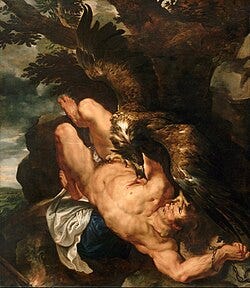
Christianity has often been taken to make a similar claim in the language of sin. Greek myth made the point through Prometheus, punished for defying the gods. Hobbes belonged to the same older tradition in thinking that freedom without limits does not change human nature. He was also suspicious of the way people turn preferences into principles: “Their moral philosophy is but a description of their own passions.”
We blame leaders for polarization, though they can only exploit divisions ordinary people help deepen.
The larger temptation is older than our politics. Nietzsche thought the West had begun transferring its old religious hopes to reason, science, and humanity itself—the hope that knowledge might finally master suffering, disorder, even tragedy. But knowledge can increase power without increasing wisdom. Sometimes it only gives madness better equipment.
His contrast between Apollo, the god of order and measure, and Dionysus, the god of ecstasy and disorder, sharpens the point. Human life needs both form and force, reason and appetite. Civilization requires both. The mistake is believing that order can finally defeat chaos, or that Apollo can do away with Dionysus.
For Nietzsche, modern optimism concealed a revolt against mortality and limits. Yet the Übermensch risks repeating the same ambition, enlarging humanity to fill the space left by God.
Hobbes, oddly enough, looks more modest. Leviathan is not salvation. Government is an artifact, and politics a necessary craft. The insistence that one form of life must fit everyone can itself become tyrannical. At best, peace is a truce the human animal negotiates with itself.
And that animal is the real Leviathan. Hobbes thought it chiefly wanted to survive. He underestimated our strange capacity to risk life for abstractions, gods, nations, ideologies, and words. Knowing that we die, we invent things for which we are willing to die.
But the same strange freedom can turn toward life. Human beings can spend themselves for fantasies, or for one another. We go on because life itself keeps making claims upon us.
When Nina Simone sang “I Wish I Knew How It Would Feel to Be Free,” freedom meant something more concrete: not escape from every limit, but release from domination, humiliation, and fear.
In her voice, longing becomes resolve.
Freedom is not the absence of bonds. It is learning which bonds make life possible, and which must be broken.
Listen: Nina Simone, “I Wish I Knew How It Would Feel to Be Free” — 3:10
Notes and reading
Liberty or Equality? Liberty and equality are often treated as natural allies, but the alliance is uneasy. Liberty permits unequal outcomes; equality can require limits on liberty. The problem is keeping either from destroying the conditions that make the other possible.
Übermensch. Often translated as “Superman,” Nietzsche’s term is better rendered “Overman” or “Beyond-Man”: not a biologically superior race, but a figure of self-overcoming who creates values after the collapse of inherited moral and religious certainties. The Nazis later appropriated Nietzsche selectively, assisted by the nationalist and antisemitic sympathies of his sister Elisabeth. They turned themes of strength and overcoming toward a racial mythology the Übermensch did not originally mean.
Thomas Hobbes. In Leviathan (1651), Hobbes defines liberty as the absence of external impediments and argues that liberty and necessity can coexist. Law restricts what subjects may do, but also makes civil peace possible. What remains unregulated matters greatly: Hobbes locates “the greatest liberty of subjects” in “the silence of the law.”
John Gray, The New Leviathans: Thoughts After Liberalism (2023). Gray returns to Hobbes to challenge the modern hope that liberal institutions, reason, and progress can finally overcome the unruly parts of human nature. His “new Leviathans” promise not merely security but meaning, belonging, and relief from the burdens of freedom.
Further reading: Slavoj Žižek, Heaven in Disorder (2021). Žižek has long argued that liberalism can translate conflicts over power and inequality into problems of tolerance, leaving us with the safely distanced, “decaffeinated” Other—difference shorn of too much disturbance.
Editorial note: I sometimes use AI-assisted tools for proofreading, clarification, and revision. The ideas, judgments, and final wording remain my own.
Comments
Nothing yet. Say the first thing.
Sign in to join the conversation.