

(Quick note: today’s article provides some footnotes for more depth of context if anyone was interested. These reminded me of my Grade 10 English teacher, the late Mr. Fraser, who was the most demanding of teachers and, looking back on that time in high school, the most important of my life. The footnote crushed me then but I am glad he was hard on all of us. Thanks Mr. Fraser. You made us better.)
Research has driven a vast amount of cultural direction in the last 30 years. If it is not evidence-based it doesn’t wash. Sports were slow to respond, in large part because the result on the scoreboard was a substantive enough dataset for most. We won, you lost, look at the score. She has the most goals and is therefore the best.
What we measure matters. But when a measure becomes a target, it loses its value. Goodhart’s Law1 reminds us that metrics can slip into stories of their own, no longer reflecting the game they were meant to describe.
Sport showcases two examples at opposite ends of the spectrum. In development terms, the world has been enamoured with the Long Term Athlete Development model (LTAD). Because of its scientific predisposition and layout, it has been adopted around the world as a gold standard. Problematically, as Ford et al. (2011)2 point out, LTAD “lacks empirical evidence and fails to consider the non-linear nature of talent development.”
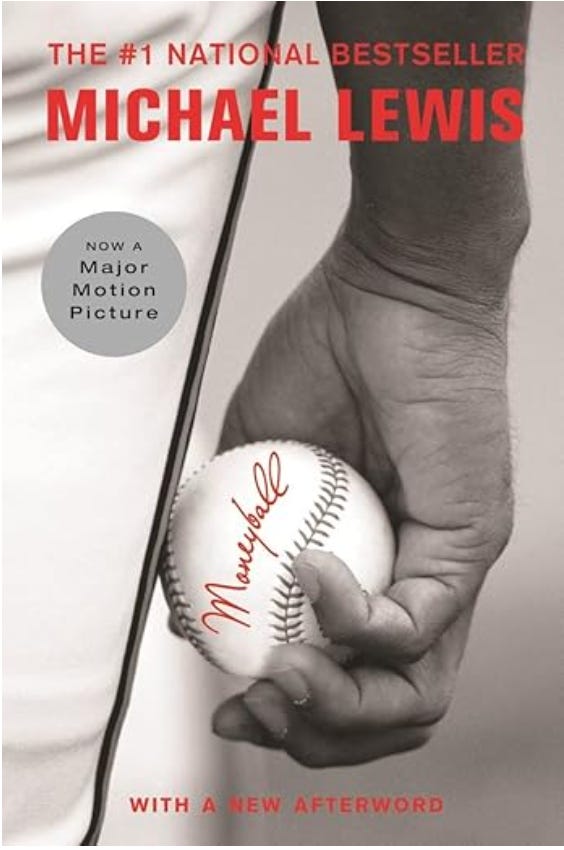
At the other end, we see the growth of “Moneyball” clubs like Brentford and Brighton, who have upended the simple scoreline brigade with deep data models. Billy Beane, the architect of Moneyball, put it plainly:
“If we win, on our budget, with this team… we’ll have changed the game.”3
In both these professed but not entirely studied examples we are invited to believe that the code has been cracked. Do x and the outcome will be y. Simple. Research has stated as such. Say it enough, see it enough, and it is fact. But not all the facts.
Where I struggle with this narrative, and ultimately the arrogance scientific models can illicit with their followers, is that the humanity is excluded in many cases. I also think this is where the hope resides.
Having spent thousands and thousands of hours on the pitch both playing and coaching it seems obvious to me that things can change in a “moment of madness” that the pundits on television are so fond of illuminating. A human made a mistake in this instance. It may just as well be a “moment of genius.” The truth is every moment in every game has a human touch. An innate feeling of what to do next. Agency lies in these moments.
Marcelo Bielsa once said: “A man with new ideas is strong, but a man with convictions is stronger.”4
That conviction, the willingness to decide and act, cannot be coded into a system. And it is not all that easy to count up or study.
When research and science are the only filter, we forget that ideas and moments, including those in our daily life, are filled with choices we make or don’t make. We are part of what makes up the data in the first place, and not everything has been discovered or figured out.
Self-Determination Theory5 reminds us that autonomy, competence, and relatedness are the building blocks of human motivation. Strip autonomy away and you strip away the possibility of genius.
Johan Cruyff captured this truth in football terms: “Playing football is very simple, but playing simple football is the hardest thing there is.”6
The simplicity lies in decision-making, not in pre-drawn patterns.
Hope springs eternal when players are given agency and moments of artistry are enabled.
But it’s a fight against the pervasive systems of the time. Barcelona’s style of play was ridiculed by pundits with more vitriol than you could shake a stick at. However, when Pep moved on to Manchester City they proceeded to win 6 league titles in their beloved Premier League. Now you’ll be hard pressed to find an academy team that isn’t copying some form of Guardiola build-up play.
Pep himself once said: “I will not change. If we win, we win this way. If we lose, we will lose this way.”7
Systems bring conviction, but they eventually also bring rigidity. Things change and eventually adaption has to happen.
Which brings me to the dreadful Liverpool loss to Crystal Palace last weekend, and in fact to the entire season Liverpool have put together thus far.
Here are some of last weekend’s remarks, fairly assessed in general, after a first Premier League loss, Liverpool’s second loss to the same opposition this season (names left out but they are real I promise):
“There was no structure, no soul, and no sign that the players knew what they were meant to be doing.”
“The right side a catastrophe of miscommunication and poor decisions.”
“You could throw a blanket over all of Slot’s players.”
“A lack of balance.”
The data after the match was abysmal. Expected goals in favour of the winner and not championship calibre for the loser. Big chances given up and reliance on a world class goalkeeper to save the day, ultimately a day that couldn’t be saved. Viewed through a lens of winning and what is normal, top league, world class football the above statements are all verifiably true.
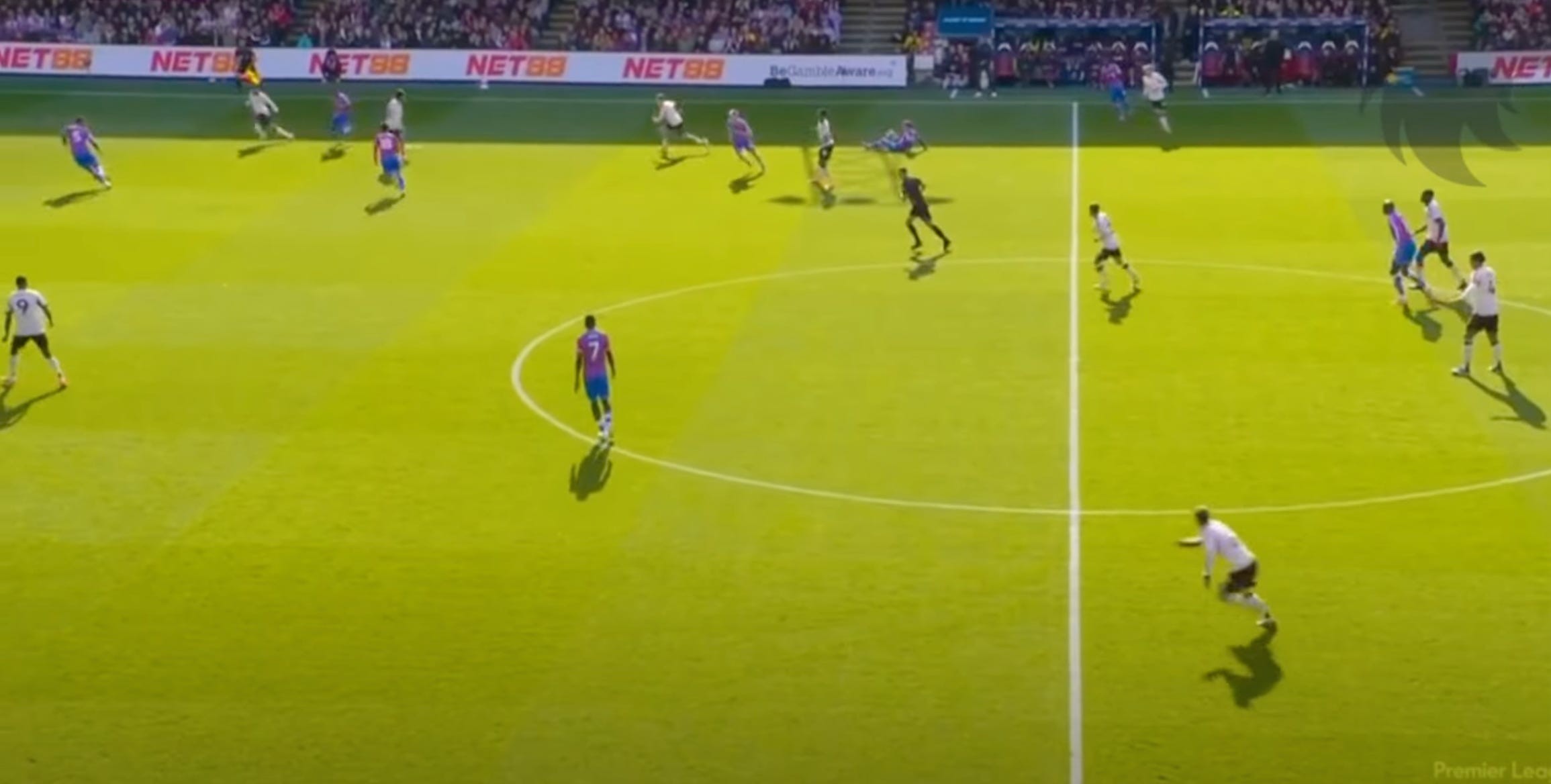
So where’s the hope.
Agency was given and chances were taken, leaving me to believe a sea-change that has started in less highlighted and lower leagues around the globe might be reaching parts of the most demanding, pressure packed, and frankly boring at times, league on the planet. And if you don’t believe me that this can be a boring league at times then simply turn off your sound and watch the football. Maybe you can see quality and technical ability of the highest levels, but maybe you are also buying into the noises and commentary selling “the greatest,” “the best,” and more underdog narratives than you could possibly imagine. At times we are being entertained as much by the circus surrounding the event as the match itself.
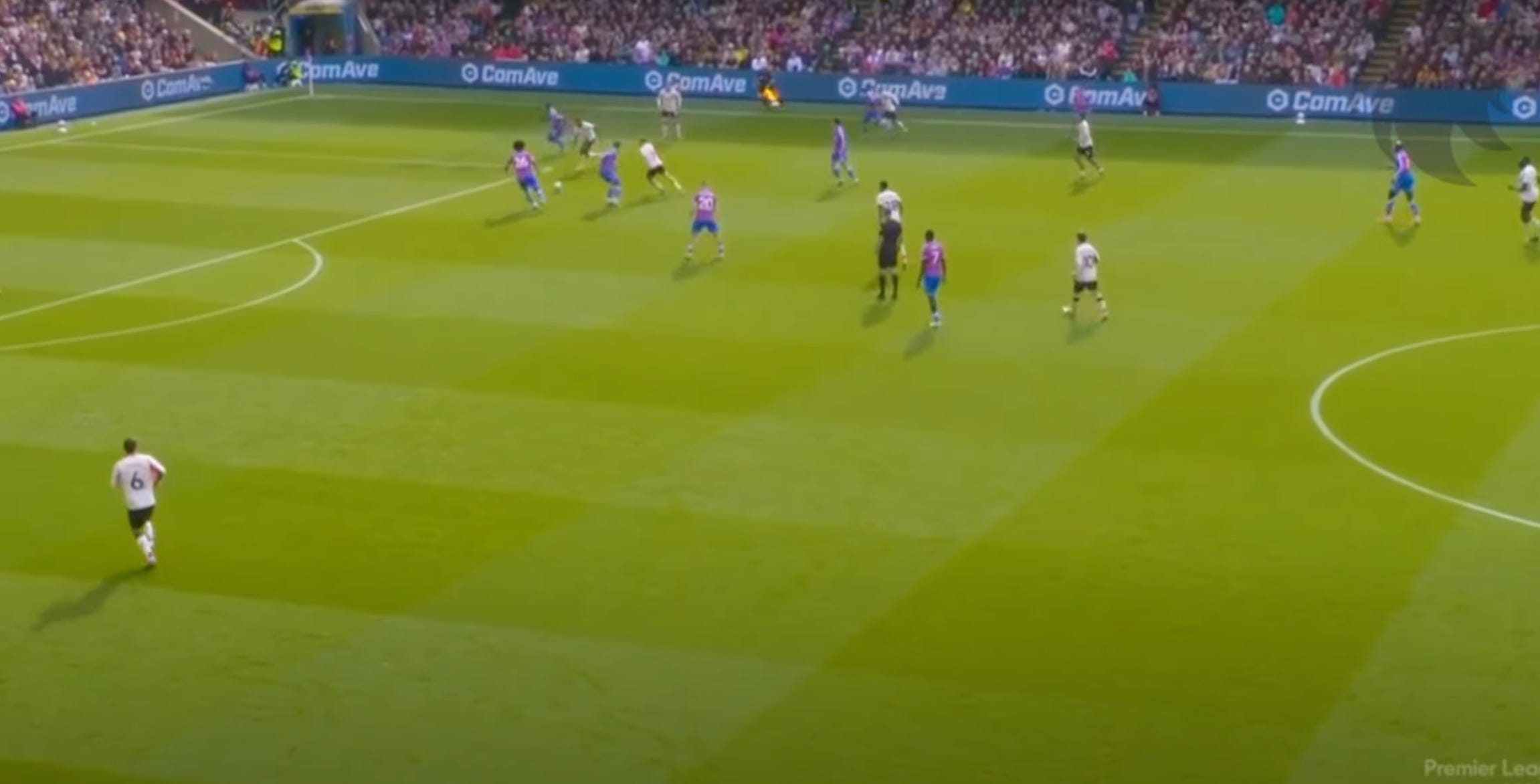
Back to the football. Players overloading areas of the pitch while also watching Florian Wirtz move about the field this season, even more so in the Palace loss, has me excited. Excited that players are being invited to bring their innovative ideas, develop connections, and create solutions within the match. Now, the Dutch master manager, Arne Slot, has most definitely not instructed a free-for-all and, based on his statements after the match, adjusted back to “normal” tactical approach when chasing the game to level up proceedings. But there is a glimmer of possibility that perhaps Liverpool will bring a more agentic style of play to the Premier League.
And the only reason they would even consider doing that is that they believe they can win.
Fluminense, in the Brazilian Serie A (seen in the below clip), has been successful under Fernando Diniz, who said: “Football is art. It is not only about winning, it is about creating something that makes people feel alive.”8 Malmö won league titles in Sweden, Bologna found a renaissance in Italy through player insight and relationships, and Messi and Scaloni’s Argentina are the World Cup champions playing with their famed La Nuestra form of football.
Lionel Scaloni framed Argentina’s approach simply: “With Messi, we built the team around freedom and confidence. He doesn’t need systems; he needs space to express.”9
Agency might be the next frontier. A way to defeat or compete with the biggest of big money clubs, and yes it is not lost on me that my example is one of the most expensive signings in history, by playing differently and handing more autonomy to the players. (Potentially why a club pays for these types of players.)
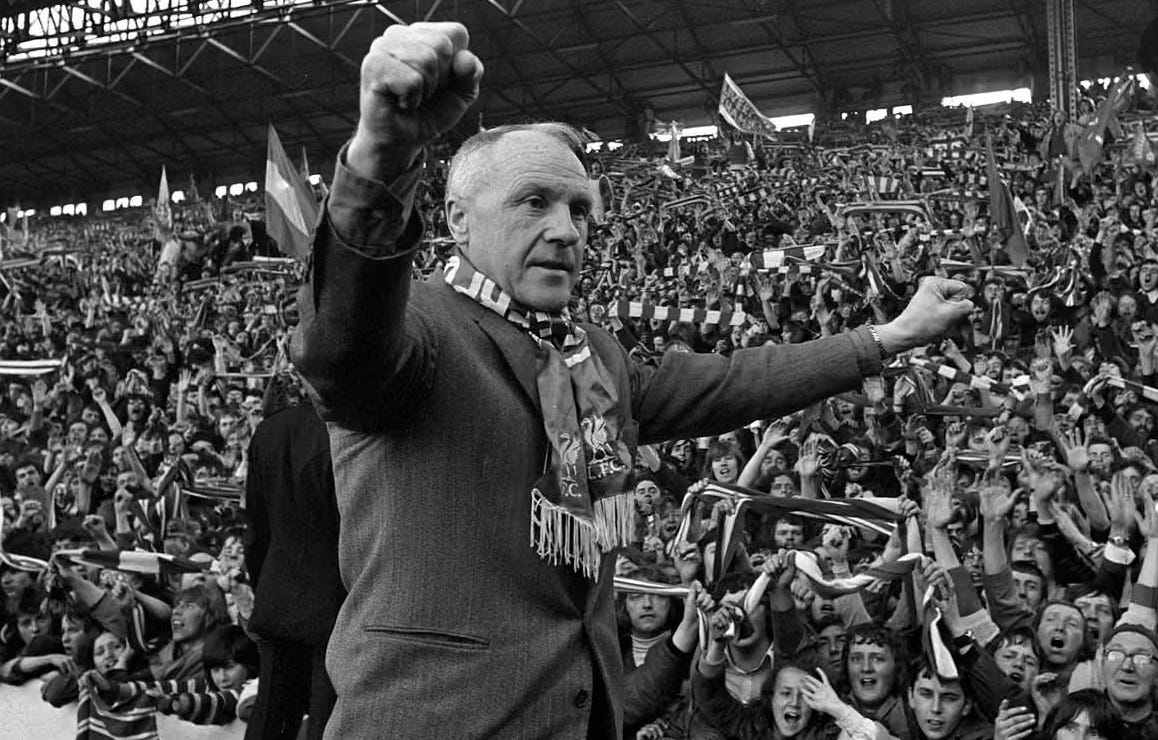
Liverpool’s own Bill Shankly built an era defining club on movement, individual technical ability, a workers mentality of social behaviour, and by harnessing the attitude of the city’s people into a type of football. An agentic style of play is not only tactical, the pass and move style is cultural, and it resonates with the city’s history.
Scott Barry Kaufman reminds us in Transcend: “Security and autonomy provide the foundation for creativity and growth.”10 The same is true for football. The courage to hand players that security and autonomy is the only way to unlock the artistry buried within the game.
There is hope for football in the oligarch era, but you will rarely find it at the top end of the food chain. And if it does show up eventually, it will have taken immense courage to buck the conservative trends that engulf sport in general. We may have seen a glimpse of what is on the horizon.
It didn’t work on Saturday but that doesn’t mean it won’t.
Thanks for reading as always,
Will
__________________________________________________________________________
Past articles you might like on The Art of Football:
The Examined Game: Bielsa In Bilbao
Socrates: The Corinthians Democracy
He Told Me to F##k Off… So I Gave Him the Captain’s Armband
__________________________________________________________________________
Charles Goodhart, “Problems of Monetary Management: The U.K. Experience,” Papers in Monetary Economics, Reserve Bank of Australia, 1975. (Goodhart’s Law: “When a measure becomes a target, it ceases to be a good measure.”)
P. R. Ford, M. De Ste Croix, R. S. Lloyd, R. Meyers, M. Moosavi, J. L. Oliver, K. Till, & C. A. Williams, “The Long-Term Athlete Development model: Physiological evidence and application,” Journal of Sports Sciences 29, no. 4 (2011): 389–402.
Michael Lewis, Moneyball: The Art of Winning an Unfair Game (New York: W. W. Norton & Company, 2003). Billy Beane: “If we win, on our budget, with this team… we’ll have changed the game.”
Marcelo Bielsa, quoted in The Guardian, August 2020, during his tenure at Leeds United: “A man with new ideas is strong, but a man with convictions is stronger.”
Edward L. Deci & Richard M. Ryan, Intrinsic Motivation and Self-Determination in Human Behavior (New York: Springer, 1985).
Johan Cruyff, quoted in The Guardian, March 24, 2016: “Playing football is very simple, but playing simple football is the hardest thing there is.”
Pep Guardiola, quoted in The Telegraph, May 2012, following Barcelona’s Champions League semi-final defeat: “I will not change. If we win, we win this way. If we lose, we will lose this way.”
Fernando Diniz, post–Copa Libertadores press conference, November 2023. Reported in ESPN Brasil: “Football is art. It is not only about winning — it is about creating something that makes people feel alive.”
Lionel Scaloni, post–World Cup interview, December 2022. Reported in Marca: “With Messi, we built the team around freedom and confidence. He doesn’t need systems; he needs space to express.”
Scott Barry Kaufman, Transcend: The New Science of Self-Actualization (New York: TarcherPerigee, 2020), 112. “Security and autonomy provide the foundation for creativity and growth.”
No posts
Comments
Nothing yet. Say the first thing.
Sign in to join the conversation.