
Reporting by the Newsletter Team
Hello everyone,
Recess has just started but there is still plenty to talk about. We have a quote from the UK Government which genuinely made my jaw drop, growing discontent in Reform’s Senedd group…oh, and a new Prime Minister.
Before we jump into it, I have had a few people messaging me saying they have not been receiving our emails. I have done some digging with Substack and it is most likely that you have “email notifications” turned off on your Substack account (god knows why it does that). If you are having problems you can read the full guide here.
Sponsor or advertise in this newsletter
This newsletter has over 15k subscribers including many of Wales’ leading decision makers. To get your brand/message/product into their inboxes, consider partnering with us.
If you or anyone you know would be interested in either sponsoring or advertising in this newsletter, please get in touch on marcus@willhayward.co.uk.
Rhun ap Iorwerth and Andy Burnham have had their first call. The two leaders spoke on Tuesday, after which the First Minister said:
“I was pleased to congratulate the new Prime Minister on a call this morning and to set out my hope that we can build a positive and productive relationship.
“I urged him to turn his commitment to devolution into action by giving Wales the powers we need to improve outcomes for all our communities on policing, justice, the Crown Estates, rail and on funding. I also conveyed my eagerness to work with him to tackle the cost of living crisis.
“I look forward to a meeting very soon so I can begin our discussions in earnest on behalf of the people of Wales.”
This is similar in tone to what was said in his first call with Starmer. Sir Keir did not stick around long enough for them to have their promised meeting, but it will be interesting to see how long it is until the two leaders meet, given that large parts of Plaid’s plan for their early days in government have been based on “opening negotiations” with the UK Government to reform funding and expand devolution.
Burnham has generally made far more positive noises than Starmer about being open to further and reformed devolution, though he has also been far more England-focussed in his rhetoric. After he took office a Downing Street spokesperson seemed to suggest he was open to deeper devolution in Wales but not for Wales.
A Downing Street spokesperson said:
“The Prime Minister had calls with the First Minister of Scotland, the First Minister of Wales and the First Minister and Deputy First Minister of Northern Ireland today.
“The Prime Minister said he was serious about creating a new politics - rooted in finding common ground based on collaborative, practical and pragmatic relations with the heads of the devolved governments.
“Working in partnership, the Prime Minister said together they could drive deeper devolution to all parts of the United Kingdom to get growth going.
“The Prime Minister added he was focused on practical measures, not constitutional changes like further referendums, to give families more breathing room by helping them with the cost of living, which he has done today by helping millions of households with their energy bills.
“The Prime Minister said he looked forward to meeting with the heads of the devolved governments soon and visiting Scotland, Wales and Northern Ireland shortly.”
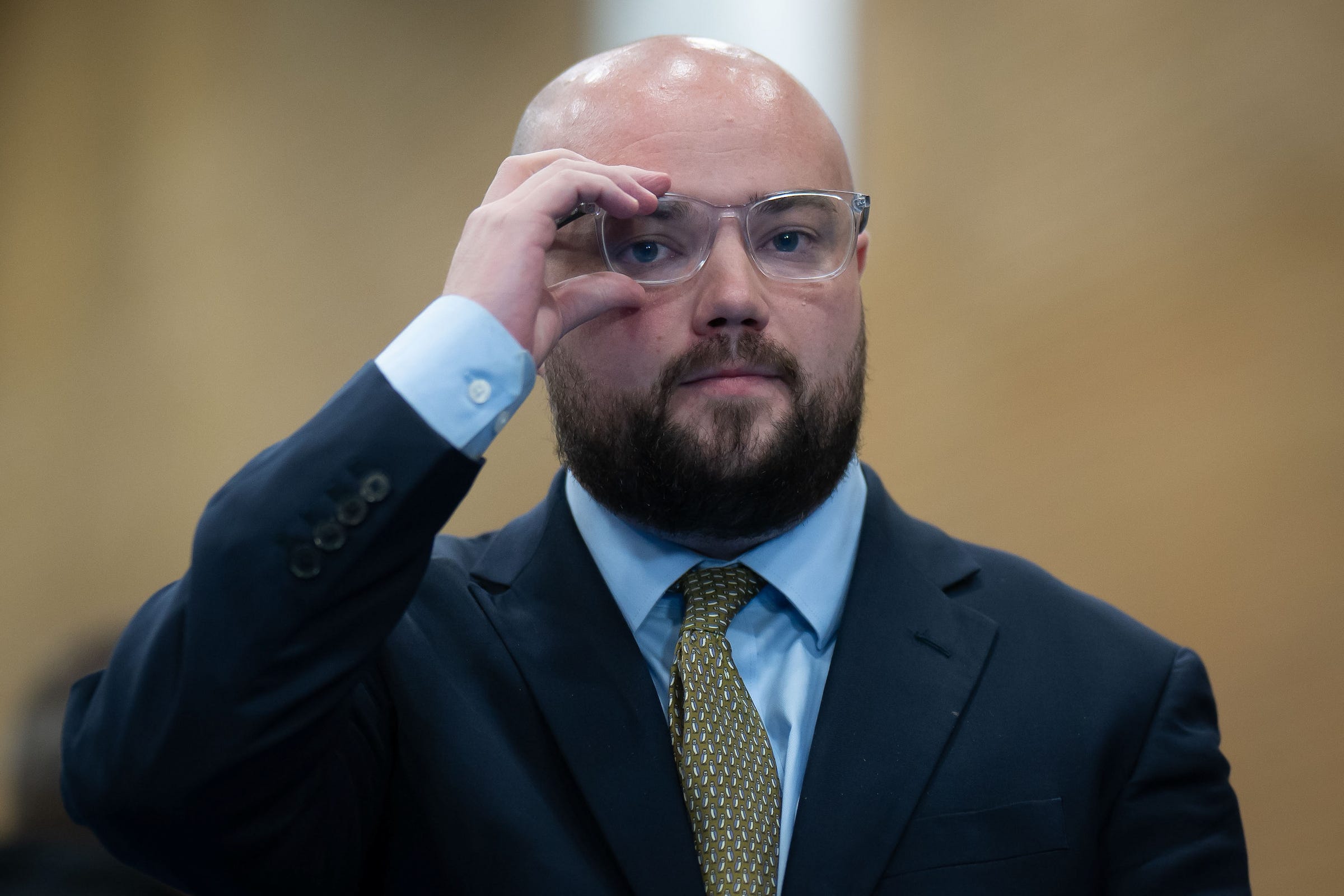
We are hearing about growing anger within the Reform group inside the Senedd.
This newsletter understands that following plenary last Wednesday there was a “heated discussion” between chief whip Llyr Powell and some other Reform MSs.
The MSs in question were talking to some members of other parties when Mr Powell apparently told them not to do it. Sources have told us that two of them “took exception to being spoken to like kids.”
This builds on growing discontentment among some in the group (who are the official opposition in the Senedd) that Mr Powell is “showing favouritism” to certain members when it comes to who has been given opportunities to speak in the chamber.
We also understand that about five MSs are seeking to stand as MPs in the event of an election (though this is also causing tensions in the group).
It’s a tough time for the party in Wales at the moment. Their chief of staff David Thomas is travelling around Cymru seemingly trying to reinvigorate the various branches ahead of the next general election. Sources have told us that attendance at some meetings have fallen from “highs of over 100” to “less than half a dozen.”
Reform were approached for comment but did not reply.
It’s not often that my mouth drops open when I read a quote from a UK Government “spokesperson”. Often their answers are anodyne and cookie cutter. However I was genuinely shocked when I read the quote that the BBC had received from a Department for Culture, Media and Sport (DCMS) spokesperson.
The Welsh Government have unveiled their first steps into the devolution of broadcasting powers to Wales, pledging to establish a ‘Shadow Broadcasting and Communications Authority’ with a working group to be established later this year.
Here is the DCMS spokesperson quote in response:
“In light of their failure to agree a budget this week, it would be advisable for the Welsh government to focus on better running the services they have, rather than wasting more taxpayers money by seeking to acquire new functions for them to further run into the ground.”
This is a wild response.
What you have here is a UK Labour Government making accusations of “wasting taxpayer money” and “running services into the ground” towards a Welsh Government that for the last 27 years has been run by their own party.
Was this actually signed off by a minister? We approached the DCMS for comment and asked them if they were actually blaming their own party for failures in Wales.
We got no official comment in response but they did indicate that they would continue to work with the Welsh Government on issues related to broadcasting.
Cymru has a new Secretary of State for Wales after Andy Burnham’s Cabinet announcement on Monday evening.
Jo Stevens has stepped down and has been replaced by Stephen Kinnock, the MP for Aberafan Maesteg. He is one of several Welsh MPs to have landed jobs in the Burnham Cabinet with Sir Chris Bryant also named Secretary of State for Northern Ireland and Vale of Glamorgan MP Kanishka Narayan becoming the new Minister for Artificial Intelligence.
There will be more to say about this in coming months but it’s worth briefly reflecting on a few points:
Should the role exist in its current form?
The Welsh secretary is supposed to be the “voice of Wales in cabinet”. The idea is that they can advocate for Wales inside the UK Government.
But for a long time, it’s just as often been the voice of the UK government in Wales.
I am of the view that the role needs to be totally reformed or simply abolished and replaced by something new.
At the moment it’s the worst of both worlds. It gives Wales the pretence of a voice in cabinet while actually having no power, influence or staff. You can read a Guardian article I wrote on the issue here and a video I made yesterday here.
How did Jo Stevens do as Sec of State?
I first met Jo Stevens the week before I started my training at journalism school (I was actually practicing my shorthand when she knocked on my door). She was out leafleting in 2015 to try and become an MP for the first time. I have always found her affable and friendly, with a superb knowledge of cricket.
However, I think it’s hard to put her term as Welsh Sec as anything other than a disappointment. Not because she wasn’t hardworking, but because she was clearly not enamoured with even the idea of devolution. Her lack of demonstrable success in areas like rail gave a perception that she was arguing for the UK Government rather than for Wales.
Here are two quotes from her a year apart:
“It is utterly illogical to designate [HS2] an ‘England and Wales’ project.”
– then-opposition MP Jo Stevens, 2023
“We can’t go back in time and change the way that [HS2] was commissioned, was managed, and classified.”
– Secretary of State for Wales Jo Stevens after entering government, 2024
It was inevitable that Ms Stevens would have to leave her role. She didn’t have a good relationship with Eluned Morgan when she was First Minister and they were in the same party. She was seen by the new Plaid government as hostile. This isn’t the tone that Burnham wants to set.
What will Stephen Kinnock be like as Welsh Sec?
Upon taking the job Mr Kinnock said:
“It is the privilege of my life to be appointed Welsh Secretary, and to serve the people of Wales as part of Prime Minister Andy Burnham’s new Cabinet.
“Wales succeeds when we all pull in the same direction, and I will work across all levels of government to deliver the best possible outcomes for our communities as a dynamic and confident country in a dynamic and strong United Kingdom.
“As Welsh Secretary I will ensure that the Wales Office will continue to champion Wales within the UK Government and that the needs of the Welsh people are prioritised.
“This is about building a strong Wales within a strong United Kingdom where everyone has the opportunity to reach their full potential with good growth in every Welsh postcode and where communities are in control and supported by government at every level.
“I am truly honoured to be taking on this role at such a pivotal time for Wales and for the UK, and I am clear that there is no limit to what we can achieve by working together.”
Since the announcement I have seen many people questioning the appointment, citing Stephen Kinnock’s father Neil who opposed Welsh devolution in 1979.
I have never spoken to Stephen Kinnock about his stance on devolution but, if you look at some of what he has said, he seems quite practical.
In a 2022 interview, Mr Kinnock was asked about whether he would support further devolution or even potentially Welsh independence. He said:
“I am convinced that this so-called levelling up policy cannot work without real and meaningful devolution. But I think it needs to happen across the UK. What we have got into is a dangerous imbalance between Wales and Scotland, having very visible, high-profile political representation now and clearly defined policies.
“And that I think has reinforced the value of devolution, bringing decision-making closer to people, making it clear to people that they have got more ownership of the issues and that you can solve problems more effectively by taking decisions closer to people than thinking you can just pull a lever in Whitehall and it is going to have the desired impact in Scunthorpe or Wigan or Cornwall, or wherever it may be.
“So I believe in the principle of devolution as a better way of delivering good outcomes. But it has to be across the UK. So I think we need a constitutional convention. I think we need citizens’ assemblies about how this should work because it would be pretty ironic, wouldn’t it, if you ended up making decisions about devolution through some men in pinstripe suits in Westminster’s ivory towers.”
However, we also see echoes of what I think is going to be a key flashpoint between the Welsh and UK Governments around the perception of UK Gov interference in how devolution works within Wales. Local government is devolved and therefore not the responsibility of Westminster to change. But Mr Burnham has already made comments about wanting to do just that.
In 2022 Mr Kinnock also said:
“I think that more UK-wide devolution would be very helpful for devolution in Wales and Scotland as well. And it would ensure that you do not end up with a situation where power gets centralised in Westminster or Cardiff, or Edinburgh. It needs to be to local authorities, local enterprise partnerships, and city region deals that we have in Wales.”
We are just three months into the 48 month Senedd term and one MS has already announced they don’t plan to run again…in 2030.
On Monday, Reform’s James Evans announced he would not be seeking another term in office when the next election rolls around.
Writing on Facebook he said:
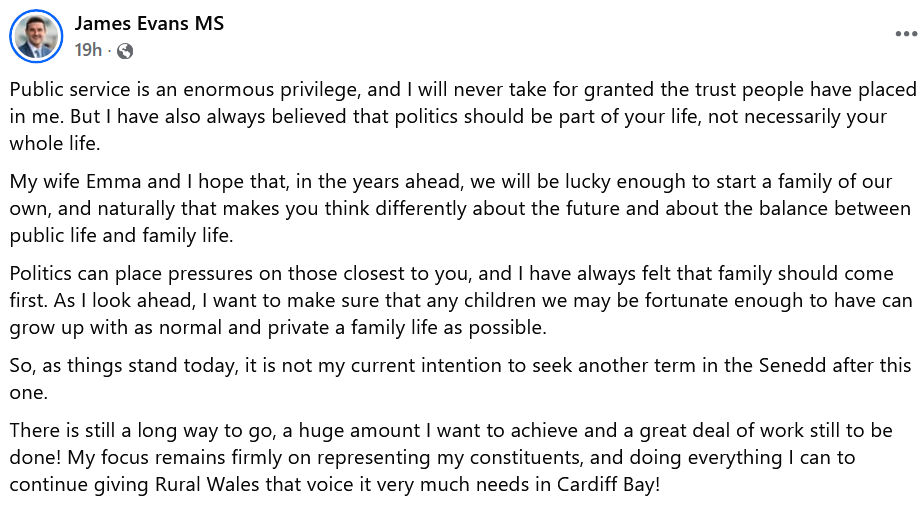
Mr Evans does leave the door open to change his mind by saying that this is his plan “as things stand”.
It’s worth noting that the mid-Wales MS also categorically ruled out joining Reform just months before doing so.
In March last year he said he would not be joining Farage’s party who he said had “no serious policies” and “no leader” in Wales while labelling Tory councillors who had jumped to Reform “total hypocrites”. Ahead of his switch he also came on my podcast and called Reform “quite scary” and accused them of using “dangerous rhetoric” towards minorities.
The Welsh Gov has announced major plans for farming in Wales.
At the Royal Welsh on Monday, Rural Resilience Minister Llyr Gruffydd revealed a new ‘farm to fork’ strategy to link up food policy with production, processing, retail, health, education, public procurement and the circular economy.
As part of the plans, an expert group will look at what is and isn’t working well in Welsh food policy and issue recommendations with a final strategy to be presented to ministers during 2027.
Mr Gruffydd said:
“This strategy will bring together the whole food system; from our farmers and fishers to our retailers, schools and communities, so that we can make better, more joined-up decisions for the benefit of everyone in Wales.”
On Monday ministers also announced £340m a year towards the controversial Sustainable Farming Scheme (SFS) for three years until 2030, as well as simplifying some parts of the process from next year. Multi-year funding has been a long standing call from the agricultural industry.
Only 50% of farmers have signed up for the new SFS as of this year. Others are opting to stay with the old scheme which will see their funding cut over the next few years until it is phased out.
Some slips of the tongue are simply too funny to ignore.
During last week’s debate in the Senedd on youth employment, Jason O’Connell stood up for several minutes to explain why his party Reform would be abstaining from the vote.
Except he didn’t say ‘Reform’, he said something else.
The new Plaid Cymru Welsh Government found common ground with its official opposition last week following a debate over the possibility of culling badgers to control Bovine TB.
Reform UK tabled a debate urging the government to consider culling wildlife to control the disease in the event it is recommended by the TB Technical Advisory Group, which has yet to publish its report.
The motion passed with support from Plaid Cymru, Reform UK and the Conservatives, with the Labour group and the Green’s voting against.
Currently the Welsh Government has a ban on the culling of badgers, favouring vaccination and other measures to control the disease. The move diverged from the UK Government’s approach to the disease, with England pursuing widespread badger culling in affected areas.
England recently confirmed culling had ended, in favour of a move towards vaccinating badgers.
Llŷr Gruffydd said he would wait for recommendations from the technical advisory group before considering any change in policy.
Welsh companies and organisations will be able to access R&D funding from an EU scheme, despite our exit from Europe.
Wales has joined the UNITE European Digital Health Valleys project with a £700,000 grant to the Welsh Gov - the first EU grant the Welsh Gov has secured since Brexit.
It means universities, health boards and other bodies will be able to access the scheme, which will allow them to develop, test and scale up healthcare solutions and projects and improve healthcare in Wales.
Over the last few weeks we have seen terrible wildfires in north Wales and in England.
As of Tuesday evening fire crews were battling six separate incidents across north Wales with people being asked to avoid the area and to keep doors and windows closed.
Changing wind conditions mean smoke is now affecting communities that weren’t previously impacted, which crews say could become ‘more noticeable’ on Wednesday.
Wildfires are particularly dangerous because they happen in wilder, un-contained stretches of land, meaning they can spread further and more unpredictable and destroy homes and ecological habitats for animals and wildlife. They are also extremely polluting, through smoke, carbon monoxide and carbon dioxide that is released into the earth’s atmosphere.
That’s all for this week.
Thanks for reading.
Will and the team
Comments
Nothing yet. Say the first thing.
Sign in to join the conversation.