
Hello everyone,
Before we start I want to outline our publication plans for the rest of August.
This will be the last newsletter for a couple of weeks. Over the election period we were averaging four newsletters per week and we are going to take a break over the next fortnight.
However, we will not be just putting our feet up. There is a brand new project that we are in the final stages of putting together and we are using this time to get all our ducks in a row for that.
So the next newsletter will be on Sunday the 30th of August. In that I will be announcing this new project, which I am really excited to talk to you about. It’s ambitious but I think it can build on everything we have all collectively done here.
After that, normal service will resume with the midweek briefing, Sunday deepdives and special reports. The first weekend in September will be our grading of Plaid’s first 100 days in power.
Right, let’s get into the midweek briefing!
If you want a textbook example of how we in Wales are continuing to pay (literally) for Brexit ten years on, take a look at this.
In 2024 the Welsh Government started work on a border post facility near Holyhead port to facilitate checks on live animals and goods from Ireland in line with post-Brexit rules.
The UK Government footed most of the bill, providing £44m of the £51m cost of the site.
The problem is, it has never been used.
Just before it was due to be handed over to the Welsh Gov, the UK and EU announced they would be working towards an agreement aimed at making it cheaper and easier for goods passing between Ireland and the rest of the UK.
This is yet to be agreed but if it is, it’s highly likely that a lot of the checks that were supposed to be carried out at this border post won’t be needed at all.
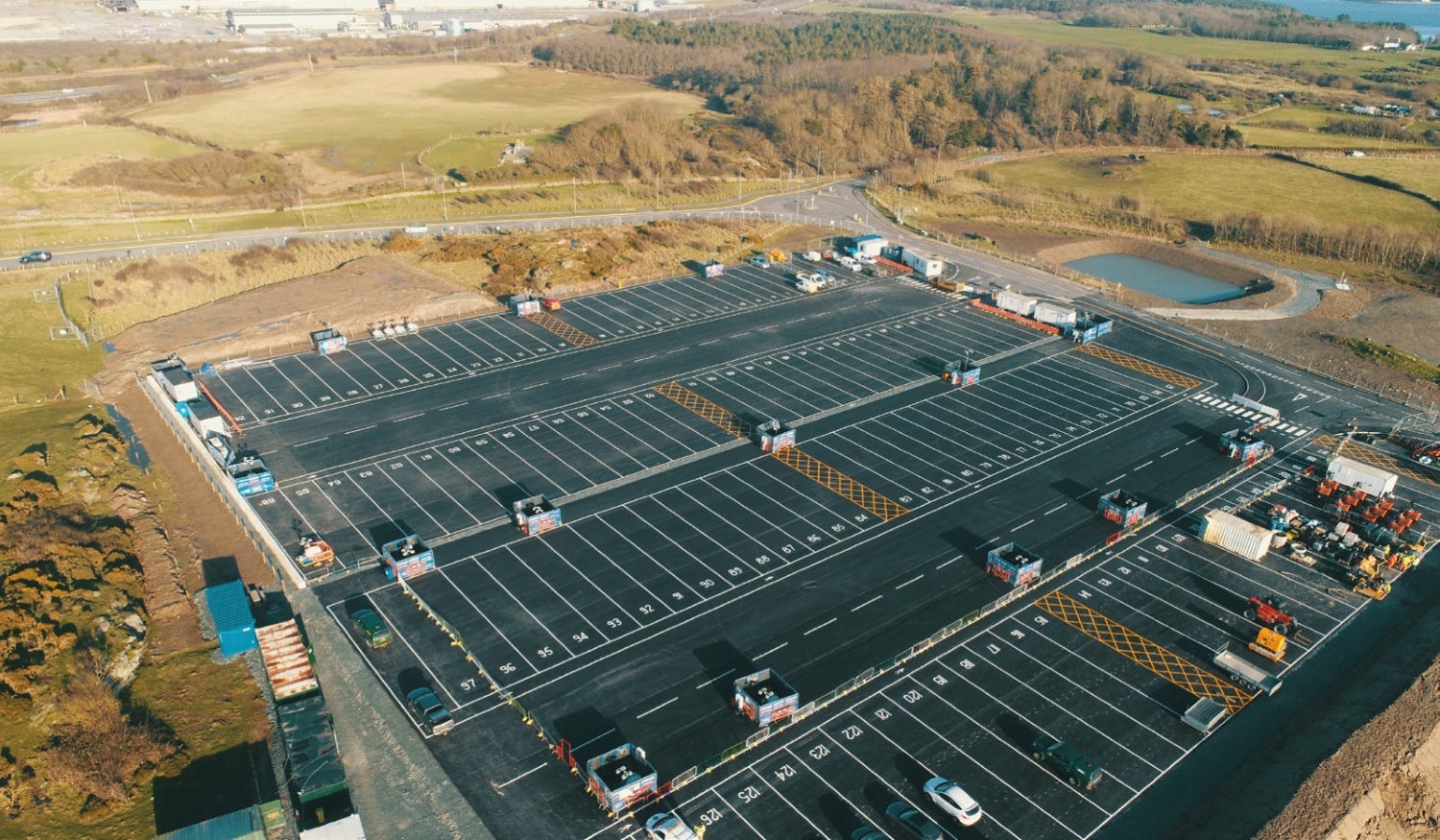
Recently, an FOI published on the Welsh Government website revealed that £15.6m was spent in 2025/26 on the Holyhead site. Another £53k has been spent on a similar facility in Pembrokeshire. This is Welsh Government money.
We went through older Welsh Government statements and documents and found that as well as the original £7m committed by Welsh ministers, another £6.4m revenue funding was promised in 2024/25.
That’s nearly £30m gone on an empty building that seems unlikely to ever be used for its intended purpose.
We approached the Welsh Government asking what the £15m was spent on last year and they told us it was to prepare the site for completion and operation as a border post or be repurposed as something else if it isn’t needed, as well as on maintenance of the building.
Ten years on from the referendum result, which Plaid claim has cost the Welsh economy £4bn - and which recent polls show most people in Wales now think was a mistake - this is just another “Brexit dividend”.
The Welsh Gov say they remain hopeful of progress on the UK-EU deal so plans for the building can be resolved as soon as possible.
An independent investigation of issues at Cardiff and Vale University Health Board has detailed patient safety concerns, a lack of staff confidence in leadership and a “fear culture” around speaking up about problems.
The assessment was commissioned after the health board was placed at Level 4 last year — the second-highest level of NHS Wales escalation — following concerns about finance, quality, clinical services, governance and leadership.
A report published last week said an “excessive number” of never events (preventable incidents that could compromise patient safety and shouldn’t ever happen) had been recorded over the previous two years, but found inadequate processes to prevent recurrence.
The specific number and nature of the incidents were not detailed, but examples of never events could include things like operating on the wrong body part, leaving a tool inside a patient, or giving a mismatched blood transfusion.
The poor condition of the physical estate was also found to be compromising staff ability to deliver safe care. Assessors heard of four power outages in critical care in 12 months and flooding in the outpatients department.
Most staff interviewed said they lacked confidence in the executive leadership to lead the organisation out of escalation, and some spoke of a “fear culture” in parts of the organisation. Some said they believed internal complainants could be sidelined and were reluctant to raise issues because of negative consequences.
Under level four targeted intervention, the Welsh Government will maintain closer oversight over the health board’s operations.
One senior figure in the health board told this newsletter:
“Making actual changes in C&V is a very big task. It is good that a proper spotlight is now on the situation but look at Betsi - special measures have achieved nothing.”
Just a note on last week’s story about Gareth Evans, the Welsh Government’s new Chief Allied Health Professional Officer (CAHPO).
Our understanding was that Mr Evans would be doing this while also keeping his job as a director at Betsi Cadwaladr health board, but we have since been told this is not the case
Over the last few weeks wildfires across Wales have been having a devastating impact on wildlife and ecological habitats, as well as on people affected by smoke and air pollution.
At the weekend Reform’s Laura Anne Jones posted on X, where she called the fires “heartbreaking” and wrote the following message:
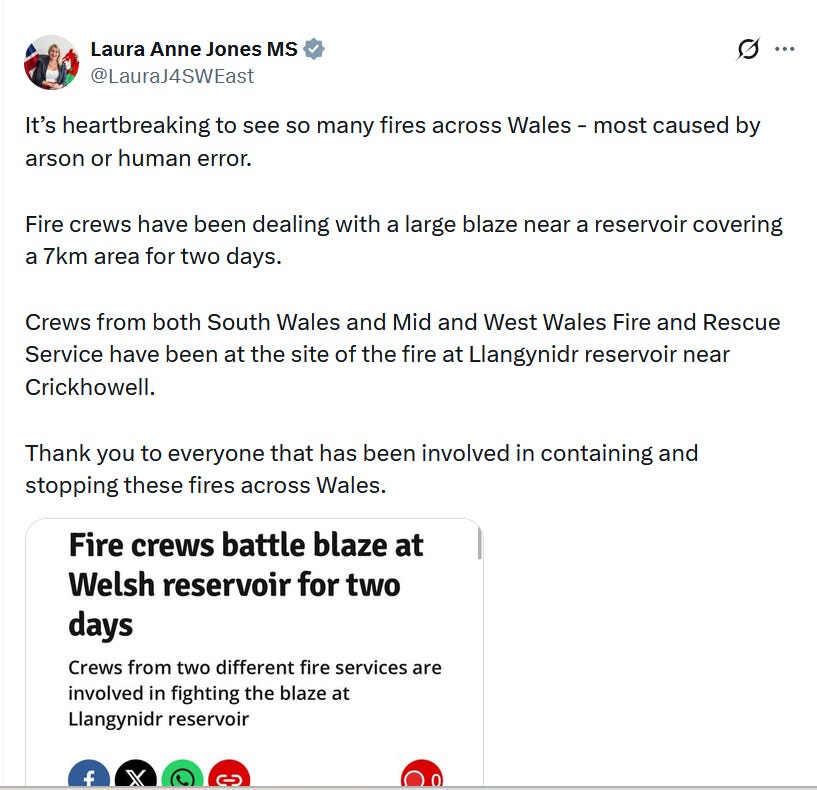
Now, it is true that wildfires often start because of arson or human actions.
But there is a vital piece of context missing from this post: arson is sadly not an uncommon crime and has happened for many years, but the reason these fires can now spread so easily and quickly is because they feed off dry land.
Wales has just had its driest July since records began. There have been numerous messages from stretched fire crews about the challenges they have faced because of the hot and dry weather. On Tuesday afternoon, the Met Office said the UK is set for its hottest summer on record.
It is an irrefutable fact that this is caused by manmade decisions that are heating our planet.
Ms Jones calls the fires “heartbreaking”, yet her party actively promotes climate denial and repeatedly calls to scrap Net Zero. Her party colleagues appear to see these heatwaves we have experienced as a ‘normal British summer’.
Here is Ms Jones in the Senedd back in March calling to “end these ridiculous net-zero targets that are bringing our Welsh economy to our knees.”
A new study suggests the Welsh Government is not doing enough to clamp down on holiday accommodation despite our housing crisis.
A new report by the Bevan Foundation called ‘Homes or Holidays?’ made the following estimation which, when you stop and think about it, is a shocking state of affairs:
Between 21,300 and 25,300 properties which could otherwise be used as permanent homes are being used as holiday lets or second homes - enough to rehouse every household in temporary accommodation in Wales in September 2025 three times over.
The report, published in partnership with Shelter Cymru, suggests the problem is becoming more Wales-wide, not just in tourist hotspots like Gwynedd and Pembrokeshire. It says the number of holiday lets in Wales actually rose about 10% from 2022 to 2026, equivalent to about 1,345 additional homes.
While it praised the Welsh Government for measures like raising Land Transaction Tax (the Welsh equivalent of stamp duty) and allowing councils to charge premiums to second home owners, it said these had not done enough to curb the rise of holiday homes and made a number of recommendations to:
introduce a national requirement for planning permission for change of use from a permanent home to holiday accommodation
increase the higher rate of Land Transaction Tax by 2%
reconsider the 182-day business-rates rule (in last week’s newsletter we wrote that the Welsh Government are already looking at this)
ring-fence money made from council tax premiums on second homes to be spent on housing
Reform politicians have been scrambling to distance themselves from an online post about a Plaid MS’ late husband.
Housing minister Siân Gwenllian recently gave an interview to WalesOnline where she spoke about her experience raising her four young children after her husband Dafydd died from cancer in 1999.
The BBC reports that a post appearing to be from the Reform Brycheiniog Tawe Nedd branch account on Facebook accused Ms Gwenllian of using her experience as a “card for political gain” before later deleting the comment.
The post was criticised by Reform’s MSs in the constituency, who have all distanced themselves from the account. James Evans called it “totally unacceptable” while his colleagues Iain McIntosh and David Mills have also said they are not behind the post.
A Reform UK spokesperson told the BBC:
“This is not a London HQ or Senedd Group office account.”
Not Wales-specific, but all eyes will be on Clacton tomorrow as Nigel Farage takes on Count Binface.
34 candidates are running in the by-election nobody asked for, which is actually a record for any UK parliamentary by-election. The previous record was the 2008 vote in Haltemprice and Howden when Tory MP David Davis suddenly resigned his seat to re-run.
The other Westminster parties have opted not to contest, mostly in protest over what they consider to be an attempt from Reform’s leader to divert attention from scrutiny over his finances.

We wrote previously that either a Farage loss (which remains, in my view, very unlikely) or a less than emphatic win could have ripple effects for Reform in Wales.
We won’t know the result until Friday, but what we can say is that standing on the stage proclaiming victory over a man dressed as a bin is unlikely to be the two fingers to the “establishment” the Architect of Brexit hoped for.
Complaints about public services to the Ombudsman of Wales have risen by nearly 50% compared to this time last year.
The Public Services Ombudsman for Wales said it received 1,130 new complaints about public services between April and June this year - a 48% increase compared to the same period last year.
The ombudsman, which will next lay its annual report before the Senedd, said complaints relating to members of public bodies breaking the code of conduct had risen 18% compared with this time last year.
Among its findings were that man died of a morphine overdose two days after he was mistakenly prescribed it while being discharged from Wrexham Maelor Hospital, which Betsi health board apologised for earlier this summer, and that a Cardiff councillor who was charged with a criminal offence related to a public protest had breached the code of conduct.
The new Plaid government have approved their first floating offshore wind project in the Celtic Sea.
Ministers have granted permission for the construction of Llŷr Wind Farm 35km off the coast of Pembrokeshire. The project, which is being developed by Cierco Energy, will include two sites with a total capacity of 200 MW and is expected to create 2,000 jobs during construction.
It received a marine licence by NRW last month and has also secured seabed rights from the Crown Estate, with an aim to begin generating power in 2031.
It might seem well in the rearview mirror, but May’s Senedd election triggered a host of by-elections across Wales.
19 out of the 96 MSs elected in May were sitting councillors in Wales, so by-elections have been taking place across the summer in 14 of Wales’ 22 council areas to replace them.
Last week, Caerphilly held a vote to replace Plaid’s Donna Cushing. Plaid held the seat with their candidate Anthony Cook.
All by-elections have been completed. Here’s how each of the political parties fared:
Plaid: 8 seats held, 1 gain, 2 lost
Reform: 4 seats held, 4 lost
Welsh Labour: 1 hold, 1 gain
Conservatives: 1 gain
Lib Dems: 1 gain
Greens: None
Independents: 2 gains
All in all Plaid had a pretty good time, although they lost two council seats to independent candidates. Reform will have to put this down as a disappointment, having held onto only half of the seats vacated by their now Senedd MSs.
Single council seat by-elections are not always a great barometer for the wider mood. The numbers of people voting is usually very low while local issues and personalities can play a large part in the result.
The Welsh Government have published the first details of their plan to reform culture and sport in Wales.
As we have written about before, investment in culture in Wales is something previous Welsh Governments have seriously overlooked. Cultural spending per head in Wales is one of the lowest in Europe.
When we interviewed Heledd Fychan earlier this year she said Plaid were specifically committing to increase culture spending each year.
Ms Fychan was at the Eisteddfod last week where a discussion was held as part of Plaid’s proposals for a new ten-year culture and sport strategy “based on real actions to turn the vision of Wales as a culture and sport powerhouse into reality.” A Call for Evidence asking for people to contribute to the strategy will run until December 18
A new report has called for more action on gender inequality to tackle poverty in Wales.
The report, commissioned by Public Health Wales and carried out by Liverpool John Moores University, says women who become parents face additional challenges compared to their male counterparts including high childcare costs, limited state support in the early years, and unequal take up of parental leave.
As well as men who become fathers being more economically insulated, the report also found women are overrepresented in part time, low paid and insecure roles. The authors called for more action on gender equality, including investment in childcare and early years provision, secure work and adequate parental leave.
The Wales Office has been criticised for wrongly claiming defence spending in the UK was increasing.
The UK Statistics Authority said a post on X by the Wales Office referenced the UK Government “increasing defence spending by £270bn over this Parliament.”
However, the arms-length government body said this was not correct and that the £270m figure actually represented the total sum promised by Westminster between 2025 and 2029, rather than any increase. The original Wales Office post was later deleted.
The authority said similar claims were also made by then-Prime Minister Keir Starmer in the House of Commons as well as by the MoD implying the £270m was extra money.
A letter from Penny Young, Interim Chair at the UK Statistics Authority, said the Wales Office acknowledged that the figure used was a mistake and had been amended.
Finally, a quick date for your diary - I will be taking part in an event at Mumbles Tabernacle on Wednesday, September 16th at 6.30pm. I will be in conversation with former Welsh Government minister Andrew Davies about my book.
To find out more or grab a ticket click here.
That’s all for today. We will be back in two weeks with the big announcement.
Take care,
Will and Ryan
Comments
Nothing yet. Say the first thing.
Sign in to join the conversation.