
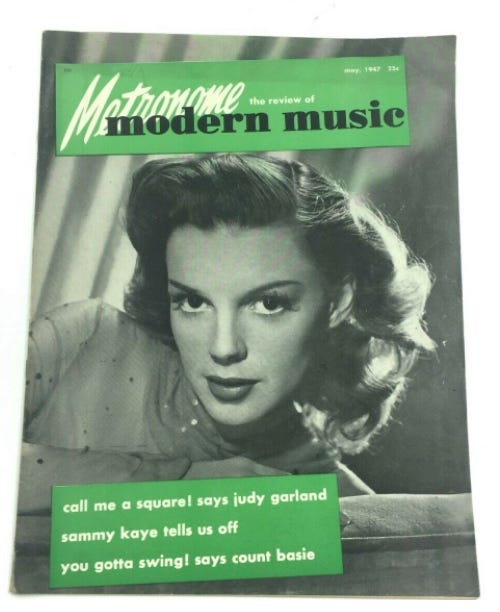
Yes! I made it just under the wire. I wanted to get in a Judy Garland story before the end of this month, because, as everyone knows, June is the perfect time to celebrate Garland the great, who was born on the 10th in 1922 and died on the 22nd, a much-too-short 47 years later. (For more intel on Judy and June, our pal Rob Lester has graciously supplied a postscript, which you will find at the end of this missive.) Two years ago, I wrote about an occasion (read about it here) when Judy Garland shared a stage (sort of) with John Coltrane; today I make a connection between Judy Garland and Lee Konitz and Lennie Tristano. Special thanks to Rob Lester and, for the previously unpublished photo, to Lawrence Schulman.
Metronome magazine, which was founded in 1885 as an industry journal for professional (usually classical) musicians was, throughout the swing and bebop eras, ranked alongside DownBeat as the major publication covering jazz and jazz-adjacent popular music. During these years, they also covered pop singers—George Simon did one of the major interviews with Sinatra in 1948—but relatively few movie stars. In fact, the subheadline to the story refers to Garland as a “moom pitchah star,” which is, as Dan Weinstein reminds us, Yinglish “the written Jewish dialect humor characteristic of Milt Gross’s ‘Nize Baby,’ and the ‘Hyman Kaplan’ stories of Leo Rosten.”
Ruth Barry, who was 21 in 1947 (even younger than Garland) was one of the few women writing professionally about music at that time, but she’s more famous for another reason. That same year, she married the great saxophonist and jazz icon Lee Konitz, and was the mother of his five children. She had been born Ruth Marie Hamalainen in 1926 to a Finnish-American family, her father being the Reverend Eino J. Hamalainen. In 1946, she had worked with the more famous Metronome writer and editor Barry Ulanov on one of the first feature stories about the legendary pianist and pedagogue Lennie Tristano. Apparently, she took her literary alias from Ulanov.
As she says in the article, Ruth Hamalainen / Barry went to the MGM studio to interview Garland, who seems to have completely charmed her, the way Garland did with everybody she ever met.
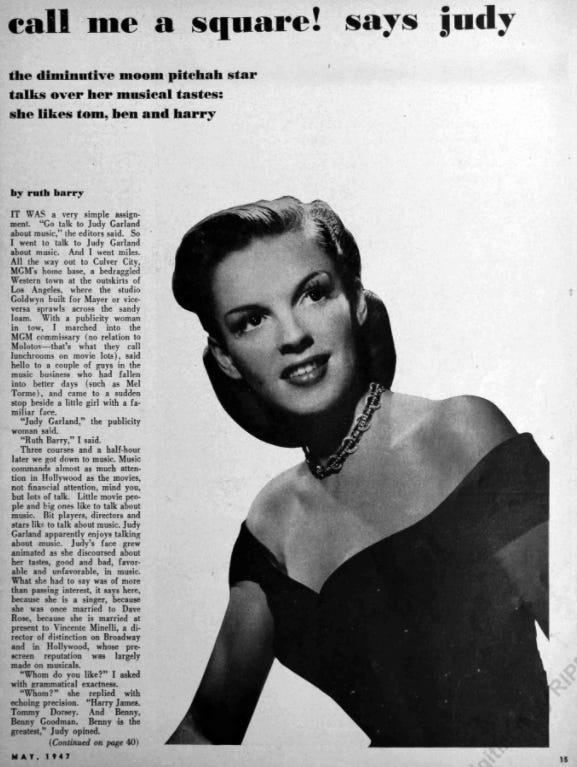
It was a very simple assignment. “Go talk to Judy Garland about music,” the editors said. So I went to talk to Judy Garland about music. And I went miles. All the way out to Culver City, MGM’s home base, a bedraggled Western town at the outskirts of Los Angeles, where the studio Goldwyn built for Mayer or vice-versa sprawls across the sandy loam. With a publicity woman in tow, I marched into the MGM commissary (no relation to Molotov—that’s what they call lunchrooms on movie lots), said hello to a couple of guys in the music business who had fallen into better days (such as Mel Tormé), and came to a sudden stop beside a little girl with a familiar face.
“Judy Garland,” the publicity woman said.
“Ruth Barry,” I said.
How cool that Barry happened to run into Mel Tormé, who was someone of interest to Metronome readers—more so than Lauritz Melchior or José Iturbi. Barry also suggests that when those of us who are not in the movie business hear the term “commissary,” the first thing we would think of are the Kommisars in the Soviet Union, specifically Vyacheslav Molotov, who was effectively Stalin’s second-in-command. But let us move on:
Three courses and a half-hour later we got down to music. Music commands almost as much attention in Hollywood as the movies, not financial attention, mind you, but lots of talk. Little movie people and big ones like to talk about music. Bit players, directors and stars like to talk about music. Judy Garland apparently enjoys talking about music. Judy’s face grew animated as she discoursed about her tastes, good and bad, favorable and unfavorable, in music. What she had to say was of more than passing interest, it says here, because she is a singer, because she was once married to Dave Rose, because she is married at present to Vincente Minelli {sic}, a director of distinction on Broadway and in Hollywood, whose pre-screen reputation was largely made on musicals.
So this is where we are in the Garland story. She was probably in the middle of production for The Pirate, released in May 1948, directed by Vincente Minnelli. She was also in the middle of marriage #2, to Minnelli (whose name is misspelled) and her first child, Liza, is about a year old. Barry mentions that Minnelli was best known as a director of musicals, although they really don’t talk about either theater or film in this discussion. Barry asks Garland who she likes (and note that Judy apparently knows more about proper grammar than a professional journalist) in terms of music, and they get into it.
“Whom do you like?” I asked with grammatical exactness.
“Whom?” she replied with echoing precision. “Harry James, Tommy Dorsey. And Benny, Benny Goodman. Benny is the greatest,” Judy opined.
None of these are particularly surprising, they were probably the three most popular bandleaders of the swing era, leaving aside Glenn Miller, who was gone by 1947. Still, it’s hard to list three better musicians or bandleaders than these three. (I’m including Garland’s 1944 V-Disc of “I May Be Wrong,” in which she is accompanied by Tommy Dorsey and his Orchestra. Also Harry James’s classic 1941 record of “You Made Me Love You,” famously inspired by Garland.)
“Any other musician?”
“Willard Robison. Such an underrated musician. Such a fine composer. I’ve been listening to his songs for years, as often as possible to him singing his songs. They have a quality. The greatest. He is really an idol of mine.”
Now this is a major surprise. You really would think she would have picked Harold Arlen, the name-above-the-title songwriter who was most important to her career. (See this week’s Sing Sing Sing or Lawrence Schulman’s 2015 compilation Judy Garland Sings the Harold Arlen Songbook for more details.) I keep meaning to do a substack—or more than one—about Willard Robison, a marvelously idiosyncratic composer who bridged the worlds of the American Songbook with folk and country music and exerted a profound influence on both Hoagy Carmichael and Johnny Mercer, to name just two. (And there’s a longish essay on Robison in my 2017 book, The Great Jazz and Pop Vocal Albums.) Apparently Garland sang only one Robison song in her career, “A Cottage for Sale,” his most widely performed number, on the November 10, 1963 episode of The Judy Garland Show.
“Any other composers of popular music?”
“Richard Rodgers, of course,” Judy said with some vehemence. “There’s no musical comedy composer like him. In his field, he’s the greatest.”
As we know, she sang quite a few more songs by Richard Rodgers, with both Lorenz Hart and Oscar Hammerstein II. In 1947, Rodgers was on her mind, not least because she was set to make a classic cameo—alongside the aforementioned Mel Tormé— in the 1948 Rodgers & Hart biomusical, Words and Music. (An underrated movie which I still prefer to the 2025 Blue Moon.)
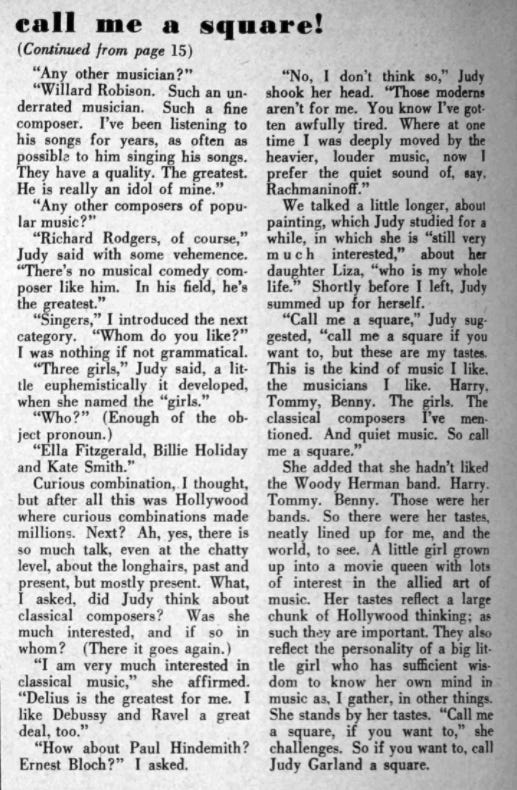
“Singers,” I introduced the next category. “Whom do you like?” I was nothing if not grammatical.
“Three girls,” Judy said, a little euphemistically it developed, when she named the “girls.”
“Who?” (Enough of the object pronoun.)
“Ella Fitzgerald, Billie Holiday and Kate Smith.”
Curious combination, I thought, but after all this was Hollywood where curious combinations made millions.
Barry makes more minor gags about Garland’s grammatical expertise. But her three choices of favorite singers are the most memorable part of the entire interview. If she were picking caucasian female singers, she probably would have leaned towards Jo Stafford, Peggy Lee, Dinah Shore, or Ginny Simms, in addition to Smith, but her choices here are amazingly prescient and relevant to Garland’s own canon. Like Ella Fitzgerald, Judy Garland was a superb musician, a great artist, and never merely a pop idol or a moom pitcha star. Like Billie Holiday, she had a unique gift for incorporating her own story into the lyrics that she sang, making that story ring true, and created a direct and intimate connection with her listeners. And like Kate Smith, Garland kept everything simple and forthright, and sang warmly, from the heart. From the perspective of 2026, Smith has been an undervalued music and pop culture icon for many decades now, and fully worthy of Garland’s—and our—appreciation.
Next? Ah, yes, there is so much talk, even at the chatty level, about the longhairs, past and present, but mostly present. What, I asked, did Judy think about classical composers? Was she much interested, and if so, in whom? (There it goes again.)
“I am very much interested in classical music,” she affirmed. “Delius is the greatest for me. I like Debussy and Ravel a great deal, too.”
“How about Paul Hindemith? Ernest Bloch?” I asked.
“No, I don’t think so,” Judy shook her head. “Those moderns aren’t for me. You know I’ve gotten awfully tired. Where at one time I was deeply moved by the heavier, louder music, now I prefer the quiet sound of, say, Rachmaninoff.”
Here’s another piece of archaic slang: “longhair,” referring to classical music. This was a generation before The Beatles. In retrospect, Hindemith and Bloch (but especially Hindemith) don’t sound much more “modern,” at least to me, or avant-garde than Frederick Delius, Claude Debussy, or Maurice Ravel, but I will leave Judy to her opinion. (And PS: Sergei Rachmaninoff could be pretty loud, too.)
We talked a little longer, about painting, which Judy studied for a while, in which she is “still very much interested,” about her daughter Liza, “who is my whole life.”
Yes! It’s very cool that she mentions (Baby) Liza.
Shortly before I left, Judy summed up for herself.
“Call me a square,” Judy suggested, “call me a square if you want to, but these are my tastes. This is the kind of music I like, the musicians I like. Harry, Tommy, Benny. The girls. The classical composers I’ve mentioned. And quiet music. So call me a square.”She added that she hadn’t liked the Woody Herman band. Harry. Tommy. Benny. Those were her bands. So there were her tastes, neatly lined up for me, and the world, to see. A little girl grown up into a movie queen with lots of interest in the allied art of music. Her tastes reflect a large chunk of Hollywood thinking; as such they are important. They also reflect the personality of a big little girl who has sufficient wisdom to know her own mind in music as, I gather, in other things. She stands by her tastes. “Call me a square, if you want to,” she challenges. So if you want to, call Judy Garland a square.
It’s funny that Garland, as if suddenly becoming aware that she’s talking to a hepcat (a hep kitten?) from Metronome, now feels somewhat self-conscious about not liking the most far-out, cutting-edge music that there was. (Yes, in 1947, Woody Herman was already delving into modern jazz, and, around the same time, so would Benny Goodman.) Barry gives us a good ending, somewhat tongue-in-cheek, and which correlates perfectly with Garland’s own highly developed sense of irony. The truth is that nobody would ever call Judy Garland a square, neither then nor now.
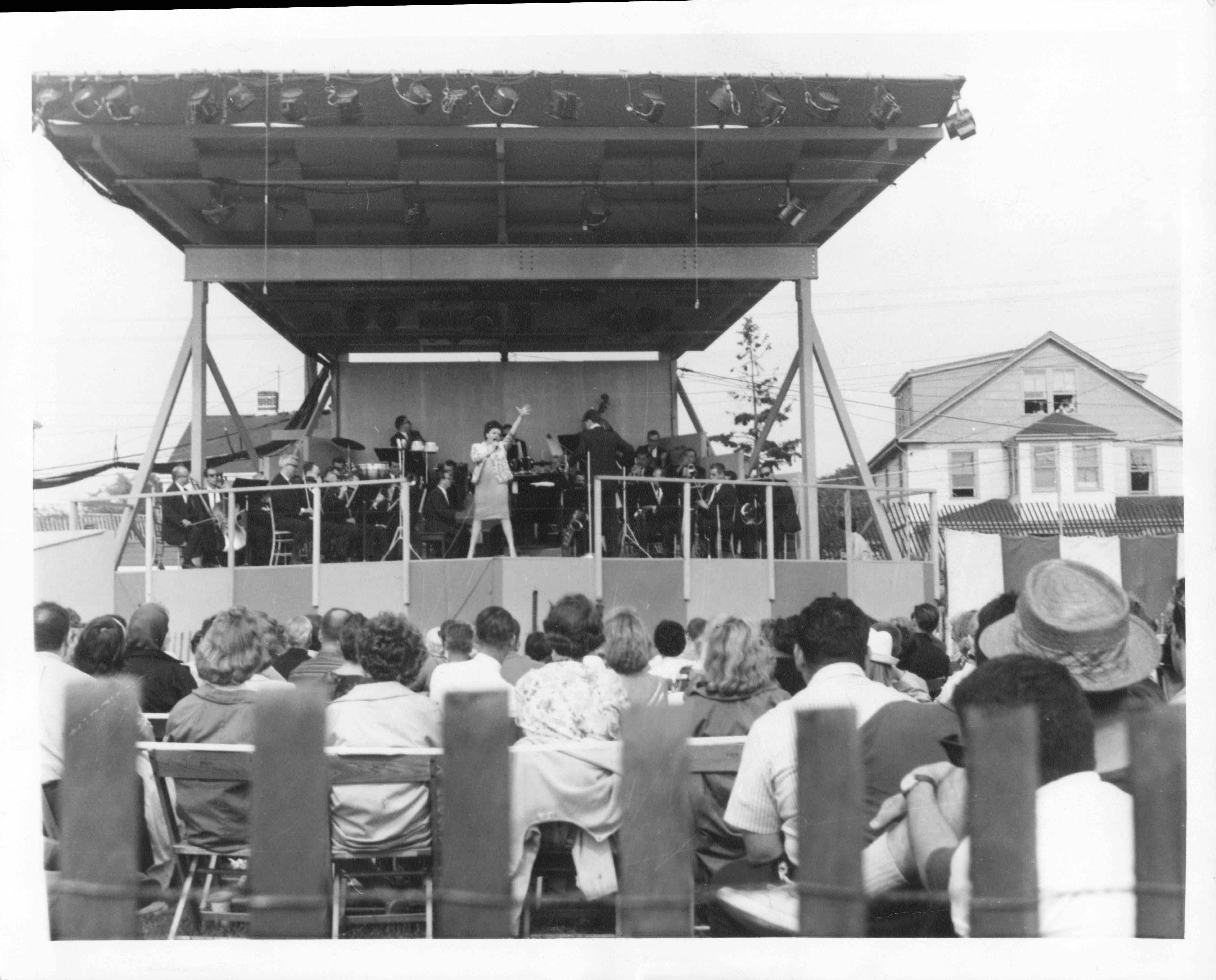
postscript #1 by Rob “On-The-Job” Lester: Before June’s ”bustin’ out all over” is a bust or just a memory as July steps in, I thought we should reflect on the departing month because it’s the perfect one to celebrate Judy Garland who was born in June of 1922 and: appeared in vaudeville in June of 1926 with her sisters and parents; completed her first film (The Big Revue) in June of 1929; recorded her first single record (“Stompin’ at the Savoy” and “Swing Mister Charlie”) in June of 1936; and spent June of 1939 filming Babes in Arms with music by Richard Rodgers who had a June birth 20 years before Judy’s. Then there were her marriages.... In June of 1941 the newspapers announced that she was engaged to the man who would be the first of her husbands (David Rose), but a Rose is a Rose is a Rose and in June of 1945 she married her second husband, Vincente Minnelli, in June of 1952 she wed her third husband (her manager Sid Luft) and in June of 1965, she married Mark Herron, her fourth husband. Her other "June" connection was being hired for the leads in the films In the Good Old Summertime and Royal Wedding, replacing June Allyson both times. But the latter role, first given to June, then Judy, went to a Jane (Jane Powell) when Judy didn’t work out and her contract was ended in June of 1950. She died in June of 1969.
Did Judy ever sing about the month of June? Sources tell us that Judy was originally considered as the leading lady for the film version of Carousel, which contains the aforementioned "June Is Bustin' Out All Over," and we'd have had Judy playing Julie, but that character isn't in that song anyway. However, Miss Garland did sing "June in January" one October on the radio. Lastly, how about "How About You?" with the first line of its chorus "I like New York in June. How about you?" She duetted on this in the film Babes on Broadway with Mickey Rooney and in two episodes of her TV series (once with him, once in a medley with Barbra Streisand). And while she may not have played a character named June, at the time of her death that June in 1969, daughter Liza Minnelli was beginning work on her early movie role, playing the title character in Tell Me That You Love Me, Junie Moon.
postscript #2 by Daniel Weinstein: One last comment about Judy’s dislike of the Woody Herman band. Circa 1944-6, Woody’s First Herd seemed in a competition with Stan Kenton’s ever enlarging group for “loudest big band.” I have a hunch she is referencing the First, rather than the Second Herd, though the 1947-’48 group could also play very loud. I’d say it was less of an identifier for that later band. Also, the First Herd, though not as “hard core bebop” as, say Billy Eckstine’s contemporaneous group, was still considered a “modern jazz” big band for its time.
Coming Next: Summer Time is Comedy Time
Mel Brooks, Anne Bancroft, Perry Como, & Gordon Jenkins: “Married She Could Always Get.”
Jackie (Mason) and Me: In Honor of The Jackie Mason Musical, written by his longtime partner, Ginger Reiter, and starring his daughter, Sheba Mason, in a limited run in New York. At the Actor’s Temple Theater July 25-26. For Tickets and more info, click here.
Very special thanks to Elizabeth Zimmer, Rob Lester, & Dan Fortune for their expert proofing, hey!) Special Thanks again to Daniel Weinstein, Jordan Taylor, & Rob Waldman.)
Slouching Towards Birdland (Will Friedwald’s Substack) is a reader-supported publication. To receive new posts and support my work, consider becoming a free or paid subscriber.
Sing! Sing! Sing! : My tagline is, “Celebrating the great jazz—and jazz-adjacent—singers, as well as the composers, lyricists, arrangers, soloists, and sidemen who help to make them great.”
A production of KSDS heard Saturdays at 10:00 AM Pacific; 1:00 PM Eastern.
To listen to KSDS via the internet (current and recent shows are available for streaming) click here. Here is the running list of recent shows.
The whole series is also listenable on Podbean.com; click here.
Judy Garland sings Harold Arlen (SSS #203 2026-06-27)
Listen: + Playlist:
July 4th Special—Great American Cities in Song (SSS #204 2026-07-04)
Listen: + Playlist:
Miles Davis @ 100: Sketches of Broadway (2026-06-24)
Listen: + Playlist:
200th Episode Special! Friedwald’s Favorites & Wilsci’s Winners
(SSS #200 2026-06-06)
Listen: + Playlist:
Miles Davis @ 100 | “Miles Ahead”
(SSS #202 2026-05-30 )
Listen: + Playlist:
Bobby Darin @ 90 | “By Request”
(SSS #201 2026-05-23)
Listen: + Playlist:
Jazz at Lincoln Center Swing University:
A Special video Session: Sinatra in the Sixties (click to view)
With Seton Hawkins & Will Friedwald (Thursday April 2, 2026)
Bing Crosby Birthday Special—Ultimate Broadway Songbook
(SSS #199 2026-05-16)
Listen: + Playlist:
The Sacred Music of Duke Ellington—Then and Now
(SSS #198 2026-05-09)
Listen: + Playlist:
TONY BENNETT REMEMBERED ON NY1
a video interview with Stephanie Simon and Will Friedwald 2023-07-23
Click Here
Cinco de Mayo:
The Ernesto Lecuona (and Margarita Lecuona) Songbook
(SSS #197 2026-05-02)
Listen: + Playlist:
Ella Fitzgerald Sings the Jimmy Van Heusen, Sammy Cahn, Johnny Burke, & Jule Styne Songbook(s) (SSS #196 2026-04-25)
Listen: + Playlist:
SLOUCHING TOWARDS BIRDLAND is a Substack newsletter by Will Friedwald. The best way to support my work is with a paid subscription, for which I am asking either $5 a month or $50 per year. Thank you for considering. (Thanks as always to Arlen Schumer for special graphics.) Word up, peace out, go forth and sin no more! (And always remember: “A man is born, but he’s no good no how, without a song.”)
Note to friends: a lot of you respond to my Substack posts here directly to me via email. It’s actually a lot more beneficial to me if you go to the Substack web page and put your responses down as a “comment.” This helps me “drive traffic” and all that other social media stuff. If you look a tiny bit down from this text, you will see three buttons, one of which is “comment.” Just hit that one, hey. Thanks!
Slouching Towards Birdland (Will Friedwald’s Substack) is a reader-supported publication. To receive new posts and support my work, consider becoming a free or paid subscriber.
No posts
Comments
Nothing yet. Say the first thing.
Sign in to join the conversation.