
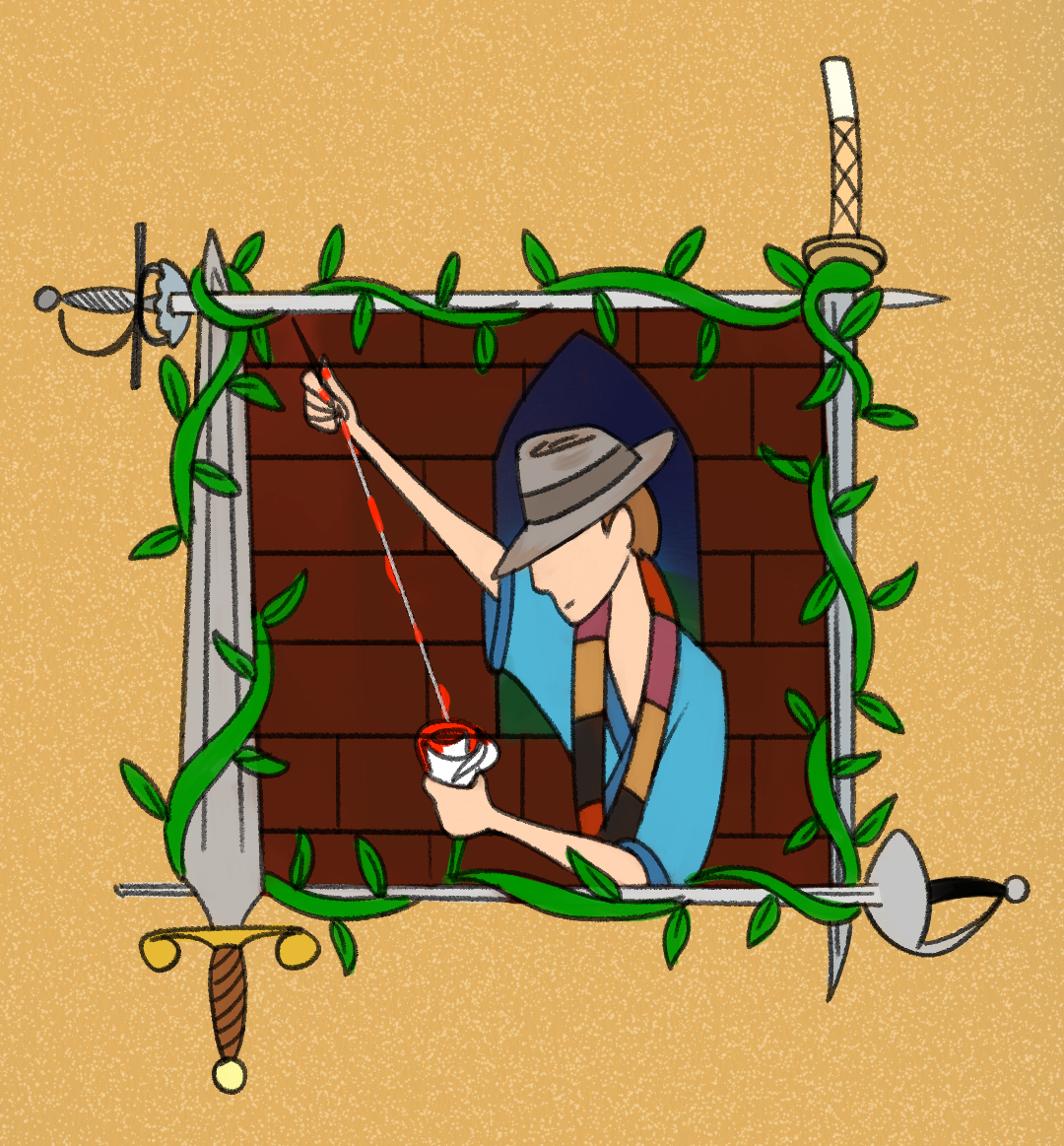
“The Rose Maker” has been with me for a long time. It started as a doodle of a fantasy outfit for myself back when I was a teenager. Somewhat unconsciously, a character in that same get-up became the protagonist in a fairy tale I wrote around the same time. It was part self-therapy for adolescent angst, part an effort to emulate the emotional quality of EDWARD SCISSORHANDS (my favorite movie to this day). Both issues stayed with me well into the college years, so new drafts kept coming. Eventually, “The Rose Maker” morphed from private fable to a capstone project for my undergraduate degree. The resulting student film, and the four years leading up to it, made me seriously doubt I should keep pursuing film or even the arts as a profession. A few years later, at graduate school, going through the footage and re-cutting the film helped build some confidence back.
I like to think I’ve exorcised the mood-demons that sparked the story in the first place over the years. I have, at any rate, long since stopped rewriting and re-editing the story. But between a recent reminder that filming for that student film was ten years ago (ugh) and a springtime prompt for fairy tales, I thought I might dust off the prose version one last time:
Ah, the rose! It’s beautiful, isn’t it? Not a sweeter or fairer flower exists. But how unusual a flower it is! Its velvety petals are as red as blood; the stem is guarded by thorns as sharp as a sword; and the whole of it is rich with a sweet fragrance. How did such a strange and lovely thing come to be?
Years ago – and a long, long time ago it was – there lived an orphan boy who wandered the world wide. This was a pale, long-limbed, gangly fellow, whose eccentric wardrobe - a threadbare blue kimono, a fraying mossy plaid, a richly patterned neck rag, beaten old moccasins, and a tattered grey hat - was ever coated in the dust of travel. The boy understood all manner of tongues and letters, but he never spoke a word and couldn't write a thing. His thoughts he showed through bright and childish paintings, and through his own unique form of sword-dancing, performed with the many blades he had acquired in his travels. As best as anyone could make out from these, this wanderer was a bright and lively character, prone to be friendly (if a little bit shy) and a crack fencer in many schools of sword. Friendliness alone cannot forge lasting bonds, however, and the orphan boy, for one reason or another, could never manage to make roots. Such characters attract many names, but the best authorities have him down as "Tim."
He found himself, our Tim, one day in a small village in the east of Ireland. Up the side of a tall cliff overlooking the sea it was built, split into five walled rings. Behind each wall stood neat round huts, and at the top of the cliff was a great castle unlike any other in the country. Tall walls of black marble, shining green roofs, and bright red pillars capped in gold made the castle a delight to the villagers, and a strong defiance to the English garrison camped outside the woods at the base of the cliff. While the English had never taken castle or village, they had taken the road leading there and cut off all trade and commerce, leaving the village very poor.
But poverty did not make the village any less wonderful to Tim. True, the hut he boarded in was cramped and cold, and set a very meagre table. True as well, the old man and wife who kept the house fought so often that they had put up a wall in the middle of the hut to avoid the sight of one another, but with small slit window so that they could scream at one another. But Tim was seldom in that hut for any but bedtime. He passed his days in the castle, which housed a pristine academy. At this school, all the village children could learn their letters, and something of the great arts and crafts of the world. It was there, behind those fine marble walls, where Tim for the first time in his life seemed truly at home, practicing music, performance, painting, and sculpture alongside the youths of that village. He shared with them his swordplay, and they understood his paintings and dances as well as anyone could. And so they all learned and laughed and played together.
Of all these wonderful friends, Tim was most taken with an absolute klutz of a girl, named "Laura" so far as can be determined. She was a wily and playful sort who kept her pair of sapphire eyes ever covered by purple glasses. No fiddle or bow was safe in her hands. But in that clumsiness, those strange glasses, and her wiles, Tim saw the most beautiful soul he had ever met. He was desperate to let her know this, but when it came to romance, Laura was as clueless as she was clumsy. Tim could make her a painting of a man carving a ham and she would know he wanted a fork, and a twirl of his short sword would let her know to pass the charcoals, but nothing could get across to her that Tim was in love. Whenever he tried to say so, she would just laugh, play with his hat, and dance off, missing the point entirely. At a certain point, Tim faced the plain fact: he needed help.
Deep within the castle was a great library, filled wall to wall and floor to ceiling with books, and lit by special mirrors that caught and magnified the light of sun and moon. Tim stayed up in that library one night, leafing through book after book, searching for some better way to get through to Laura. There was no shortage of tomes filled with suggestions for romantic gifts; silk-screens, poems, jewels. None of it struck Tim as right. Laura would take these as a friendly gift and dance off, likely as not. After eight hours of reading, Tim was tossing books across the room in a tired haze. The last of them in his pile was a well-beaten volume bound in cracking red leather, Of Lost and Extinct Flowers, and as he began to read it, it seemed as if he would be disappointed again. But on the last page, there was an illuminated entry on the rose, a well-loved flower not seen in three hundred years. The entry read:
Soft and light as silk, white as snow, without any scent, this pearl of the garden was too fragile, its numbers too scarce, to survive throughout the eons, and has long since left us.
That was it! thought Tim. He would, for Laura, bring back the rose!
This meant making one, and per the book, that meant silk. With the English blockade, not a scrap of silk had reached the village for some time, but all goods intercepted by the soldiers found their way to the garrison outside the woods. On a full moon night with a thin chilling mist, Tim made his way down the hill and over the bridge and through the forest to the gray slab of a fortress. With two small knives he scaled the high outer walls, slipped inside through the nearest window, and by good fortune found himself in a treasure room filled with plunder. A small chest in the corner held fine white silk. Drawing old scissors and needle, white thread, and Of Lost and Extinct Flowers from his cloak, Tim set to work. By the light of the moon and with the book as a guide, he began to cut and shape the petals of his rose, fitting them onto a vine taken from the castle’s garden. Soon the tight and overlapping bulb of a flower was perfectly realized.
But just as Tim began to sew on the last of the petals, the door to the treasure room burst open. A drunken English soldier stood in the doorway, and Tim was plain to see in the moonlight. He thrust his rose and the book back into his cloak and leapt out the window into the trees below, but the guard was called out after him. Through the woods they pursued the boy, torches burning, black hounds baying, the drunken soldier at the head of the mob. He drew well ahead of his men, until he was right on Tim’s heels. Sword drawn, he caught up with the poor lad and skewered him through the back.
The soldier’s blade failed to pierce the vitals or veins, but it just clipped the top of Tim’s heart and took off a tiny piece of it. That little bit of heart was driven deep into the rose hidden in Tim's cloak, and the rose also soaked up all the blood spilling out of the wound. And so red the rose became, and red it remains to this day.
Tim managed to pull himself off the soldier's sword and draw his own. It wasn’t only for dancing that he used his blades. He met the solider in a duel and swiftly brought him down. Tim then ducked down into a ditch and hid as the guard came across their fallen captain's body and spread out to search. With no voice of his own, Tim had no worry that a cry of pain would betray him, though the wound still seared hot. With his needle and what was left of his thread Tim closed his chest, even as the guard passed by. His cloak he wrapped around himself, tucking the rose and book under his arm.
The morning sun, made gray by the lingering mist, crossed over the horizon when Tim finally pulled himself up from the ditch. He heard the guard returning to the garrison, grumbling over their fruitless chase, and thought himself in the clear. He staggered back through the woods and to the bridge, and it was there he came upon the hound. It was a gnarled and wrathful old creature from the garrison, and at the scent of blood, it lunged. On instinct, Tim readied his two knives, and as the hound came bounding up, he drove them into its coal-black eyes. The dog rolled down the bank, and Tim started across the bride. But the rose slipped out from under his arm and fell onto the planks. The hound, still searching for its prey with its sniffer, caught the scent of Tim's blood on the flower and crawled back onto the bridge, its teeth bared to strike. Tim looked back just in time. As the hound leapt, Tim leapt too, knives drawn, and before they landed, he had carved up the beast.
Tim picked up his little flower. The words from Of Lost and Extinct Flowers came back into his mind: too fragile to survive. And he couldn't stand ever by to slay all things that meant harm to the rose. How to make the plant guard itself? Utterly spent, Tim sat on the forest floor pondering this, his eyes wandering from the fangs of the dead hound to the tips of his knives. And looking at those tips, Tim remembered his great collection of swords.
Tim raced back to the split hut where he lodged and ran up to his room, where the blades lay all over the floor. He broke the tips off of each one and stuck them into the stem of his flower. He rushed through this work and badly cut up his hands, to the point where he could no longer grip the handles of his swords, but soon a line of glittering thorns was in place to protect the rose from harm, and there they have remained to this day.
The night's labor and the pain of his wound fell caught up to Tim then, and great hunger and thirst besides. He gingerly pushed the rose into his left palm and carried it into the kitchen, where he began to prepare his (and Laura’s) favorite drink, a rich tea mixed with lavender and vanilla. The old man and woman of the house were at their places for screaming on either side of the slit window in the wall. Tim was well used to their squabbling and tuned them out as he seeped his leaves. But this particular argument of the couple descended into hurling fruit at one another. Old apples and soggy potatoes at first, but then the old woman put her hands on a ripe, firm pomegranate. Her aim was poor, and a good thing for her husband, but the pomegranate instead shattered the teapot in Tim’s hands. The tea splattered onto the table, and the rose soaked up most of it, gaining the smell of lavender and vanilla. That scent remains on the rose to this day.
Before anything else could go wrong, Tim scooped back up his rose and returned to his room. He sat down on the floor with Of Lost and Extinct Flowers in one hand, open to the page of the rose, and the flower of his own making in the other. Looking from his work to the illuminated page, Tim at first felt quite upset. So much had gone wrong; the color of his rose was ruined, he had added sharp thorns that were not part of the picture, and the smell from the tea was more potent than any flower he knew of. But as he sniffed his newly finished flower, as he felt the thick petals and looked at the blood red shade, and compared it to the illumination, he grew pleased with his rose. It was flawed, but it was his, and his own blood and heart were now a part of it. How pleased Laura would be! And the next day, before music studies began, Tim waited on bobbing feet for her to enter the classroom.
He did not have long to wait. Laura soon came in with a group of chattering friends. The teacher's gong sounded for everyone to take their seats, and Laura broke away to head for hers. Tim moved to meet her there, taking care to keep the rose hidden behind his back until just the right moment. That moment, he hoped, would be when their eyes met, and they very quickly did. Tim began to draw the rose from behind his back. But Laura’s head turned at the sound of the flutes tuning, something Tim missed as he set the rose on her chair.
He turned around just as she looked down and beheld the rose. She adored it! She savored its sweet smell and tenderly caressed the red bulb, and even playfully tapped on the tips of the thorns. But she still didn’t realize what it meant or who it was from!
Tim moved to remedy this situation, but at that moment, a thundering sound rang through the castle, and the doors burst open. The soldiers had at last taken village and castle. What was more, they came now to conscript all the men and lads. No one recognized Tim as the thief from the night before, but that did not save him from their draft. Hands were laid upon him, a rough cloak and arms were shoved into his hands, and with no time given for tears or goodbyes, he and the rest of the village lads were marched down the hill, through the woods, and past the garrison, off to some war in a cold land far away.
All the village went running down the hill after the army, crying for their loved ones and demanding answers that never came. It was late in the evening before they gave up hope, and they walked back up to their village in deep mourning. Laura was among the mourners, and the dear little rose in her hands was a small comfort for her. But as the conscripted lads travelled to their grim fate in a land gripped by winter, Tim's broken heart grew cold. And because a piece of his heart had gone into his gift for Laura, the rose grew cold too, and began to wither and die.
But it did not die completely.
When spring came to Ireland and to the village, so did all the men and lads who had been conscripted. The campaign they had been taken to fight had ended, perhaps, or the climate in that land had turned ill for fighting. Whatever the cause, the men were returning, and so was Tim. As he approached his old home, his heart began to warm. And the rose, which lingered on as a stiff and spiky twig with a few dead black petals clinging to it, began to revive.
The rose Tim had made, awoken by his return in the spring, opened in bloom, and it was full of seeds. Spring storms and summer breezes spread them far over the earth, and they took root and became new roses. As their sire had, they too withered in the winter, when the Tim’s heart had gone cold, and bloomed in spring when his heart warmed again. People the world over could not help but notice the strange and beautiful flower come among them. And perhaps it was fitting that a work of blood and heart should come to be treasured for its value in expressing affairs of the heart.
But what of the affair it was meant for? Tim and Laura are long since passed, and records end at his return. So that’s all I’ll tell you, for that’s all I know.
No posts
Comments
Nothing yet. Say the first thing.
Sign in to join the conversation.