
0:00
-12:37
I don’t watch a lot of television. The only scripted show I’ve followed in the last five years is The Handmaid’s Tale. I will occasionally watch episodes of Law & Order and frequently tease my lawyer friends that I could cover for them in a pinch because I know all of Jack McCoy’s best lines.
But now the Blue Jays are on. World Cup soccer is on. I don’t watch either of those sports, but my family does. I love my family. I love spending time with my family. So, I’m watching television for the first time in ages.
That’s a long way of explaining why I’m a bit late in sharing my fury at those (sorta) new “A Safer Ontario” advertisements put out by the Ontario government.
Presuming most of you do not live in Ontario and may not have seen this particular piece of propaganda, here it is.1
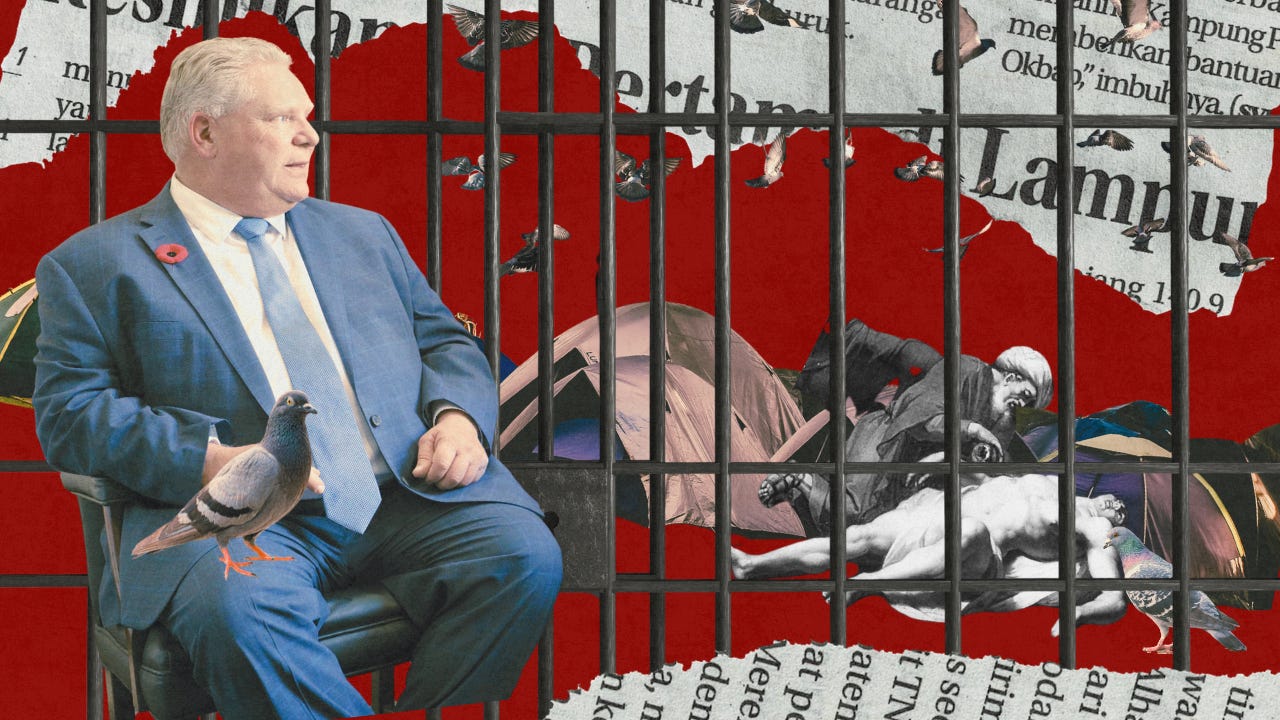
The ad is part of a larger story Doug Ford has been telling about crime, punishment and who should make us afraid, and whose lives are expendable. It’s not a story that is unique to Ontario, but it is the particular version of the story I find myself confronted with right now.
Which brings me to Ford’s recent comments about the new Thunder Bay Correctional Complex.
So, according to Ford, we should be building more jails, but let’s not make them too nice?

Here’s the thing…
(Even aside from the fact that most of the people in Ontario’s carceral facilities haven’t even been convicted…)
You don’t have to be a “bleeding heart” to believe that incarcerated individuals should be treated well and have comfortable lodging. You can be the most self-interested curmudgeon there is and still understand that inmates should have access to mental health supports, addiction services, education and job training.
Why?
Because the overwhelming majority of those who are incarcerated will be released from jail and prison one day. They will reenter communities. They will be your neighbour.
And who would you rather have as your neighbour? Somebody who has been beaten down even more, has received no help or assistance, with no job prospects or means to legally support themselves? Or, would you rather live beside somebody who’s had the time and space to address their trauma, substance use, learned a trade and how to deal with conflict? Which neighbour makes your life better? Which neighbour makes your life safer?
Investigative reporter and author, Keri Blakinger, made this exact point when I spoke with her a few years ago.
Here is an excerpt:
You do not need to believe in redemption to understand this argument (although I hope you do). You do not even need to be particularly merciful (although I think you should, but more about that below).
You only need to understand cause and effect.
When people are placed in violent, overcrowded, degrading institutions, denied meaningful support, and then released with little money and few prospects, the damage travels into communities.
Doug Ford has been doubling down on selling his “tough on crime” platform. He wants his constituents to be afraid. Afraid of criminals. Afraid of those who use illicit substances. Afraid of those who live in encampments. Never, ever, pondering how people arrive at the places from which he tells us to fear them.
Any time a government wants you to be afraid, you should start paying attention. People who are afraid are willing to accept a lot of things they perhaps wouldn’t otherwise. And Doug Ford is attempting to use fear to define who Ontario is, and who Ontario needs to be protected from.
And Jesus really wasn’t into that.

A lawyer (who probably didn’t look or sound at all like Jack McCoy) asks Jesus a question. “Who is my neighbour?”
Who counts? How far does my obligation extend?
Jesus answers, as he often does, with a story:
A man is travelling from Jerusalem to Jericho when he is attacked by robbers.
They strip him and beat him. They leave him half-dead beside the road. Important people—holy people—pass this helpless and broken man by. They know the command to care. They know all the correct words. Still the keep moving. Maybe they thought he had it coming? Maybe they just couldn’t be bothered? Either way, they keep moving.
Then, a Samaritan comes along. For Jesus’ audience, this is exactly the wrong kind of person. Somebody they would have learned to fear and despise. In general, the feeling was mutual.
But this Samaritan is moved by compassion. And the expression of that compassion is very practical. He tends the wounds from the man’s assault. Places him on his own animal and carries him somewhere safe. He pays for his care and promises to return.
Time. Inconvenience. Health care. Housing. Continued support.
The Samaritan does not stand over this bleeding man and deliver a lecture about how dangerous it is to travel on the Jericho road. Nor does he question whether the man made any other poor choices. Nothing in this story suggests the Samaritan thought making the man comfortable and cared for might reward irresponsibility. He doesn’t worry that an inn with clean sheets will feel too much like the Four Seasons.
More on Broadview:
During COVID-19, former prisoners are re-entering a world with fewer supports
Addiction struggles led my nephew to crime and imprisonment. Is there hope for him on the outside?
Prison fails to prepare convicts for life once they’re out of jail
With this story Jesus turns the lawyer’s question around.
The lawyer asked, “Who is my neighbour?”
Jesus asks, in effect, “Who behaved like a neighbour?”
The lawyer wants to know which people qualify for his concern. Jesus asks what kind of person he intends to become.
This is the truth buried beneath all of this “tough on crime” rhetoric.
“A Safer Ontario” presents the people of the province as one group who must be defended from another.
There are the good people. Innocent people. Taxpayers.
The families sitting on their couches watching baseball or soccer.
And then there are the dangerous people from whom the good people must be protected. But it is a false dichotomy.
The people awaiting bail are neighbours.
The people living with untreated mental illness are neigh bours.
The people caught in addiction are neighbours.
The people without homes are neighbours.
(A lot of them watch baseball and soccer too.)
Doug Ford, and those like him, want to decide for us what people are worth. What they deserve.
Those living in encampments don’t simply disappear when told to move on.
The people in our jails will someday come home.
What kind of neighbour do you hope to have? What kind of neighbour would you like to be?
Because safety built on another neighbour’s degradation is not really safety at all. 🐦
Wilderness Times is co-created with Broadview, an award-winning Canadian publication known for thoughtful journalism that attends to spirituality, justice and the questions that tug at our collective conscience.
Broadview is a registered charity and has made this Substack freely available because we believe that thoughtful, justice-seeking journalism should be accessible to everyone. Creating this space — and keeping it free — takes time, skill and resources. If this space nourishes you, please make a tax-deductible donation.
Your support empowers Broadview to tell more courageous stories and helps build a more just and compassionate world.

If this story resonated with you, you might appreciate more like it — and more often.
Broadview’s Best of the Week newsletter delivers a curated selection of award-winning journalism on current events shaped by faith, straight to your inbox every Friday.
Who is easiest for you to exclude from the category of “neighbour”?
Is there a point at which someone forfeits our concern? Why or why not?

I’m sorry I’m sending you to Reddit with a clearly biased comment section. I just couldn’t find the ad in any format I was able to embed.
No posts
Comments
Nothing yet. Say the first thing.
Sign in to join the conversation.