
If you are a churchy kind of person, and if the church where you worship follows the Revised Common Lectionary, a couple of Sundays ago you likely heard Jesus say these words:
If you love me, you will keep my commandments.
Jesus says this during his farewell discourse. It happens right after Jesus and his friends have shared their final meal together. Judas’ seat is still warm. Peter has not yet been confronted with the limits of his bravery.
If you love me, you will keep my commandments.
I think of Jesus speaking to his friends, downloading everything they need to know before he leaves. I hear him less like a stoic professor, as he can sometimes come across in John, and much more like a desperate man who knows everything is about to go violently sideways. This is his last chance for the disciples to get it. And given the amount of facepalming Jesus endures with the disciples so often not getting it, I’m sympathetic.
If you love me, you will keep my commandments.
And what are Jesus’ commandments?
Flipping into the Gospels of Matthew and Mark, we hear a story about the temple leadership attempting to trick Jesus with a test of theological gymnastics. They ask him, “What is the greatest commandment?” Combining elements of Deuteronomy and Leviticus, he replies:
Love God with all your heart and all your soul and all your mind.
And then,
Love your neighbour as yourself.
Not as much as yourself. Love your neighbour as if your fates are entwined. If we can think of salvation as a communal exercise, my neighbour’s well-being is unable to be disentangled from my own. My work toward the wholeness of the world is work toward my own wholeness as well.
This can be a frustrating concept to work through. This kind of enmeshment is a serious rebuke of the kind of individualism that seems only to be gaining strength in our beautiful, aching world. It also means that any of the justice work I engage with is not simply altruistic. I have some skin in the game. My soul is on the line as well.
I think mainline and “progressive” churchy people have done a significant amount of work around seeing the disenfranchised as neighbour. The poor. The hungry. The oppressed. I worry that we talk about those who are experiencing poverty as a mythic “other” kind of neighbour, rather than a neighbour who is one of us, sitting in our sanctuaries. But ask, “Is this person who is experiencing homelessness my neighbour?” and I know my congregation would say, “Yes” — and act accordingly.
But a couple of weekends ago, I experienced something that has left me wondering a lot about both the expansiveness and the limitations of Jesus’ call.
Who is my neighbour?
Who is my enemy?
What does it mean to love them?

I live in the East End of Toronto, in the same neighbourhood as the congregation I serve. There are pluses and minuses to this. Mostly pluses. Walking to work is amazing. Within a ministry that was explicitly created to be community and outreach focused, it is very helpful that my family is part of the neighbourhood.
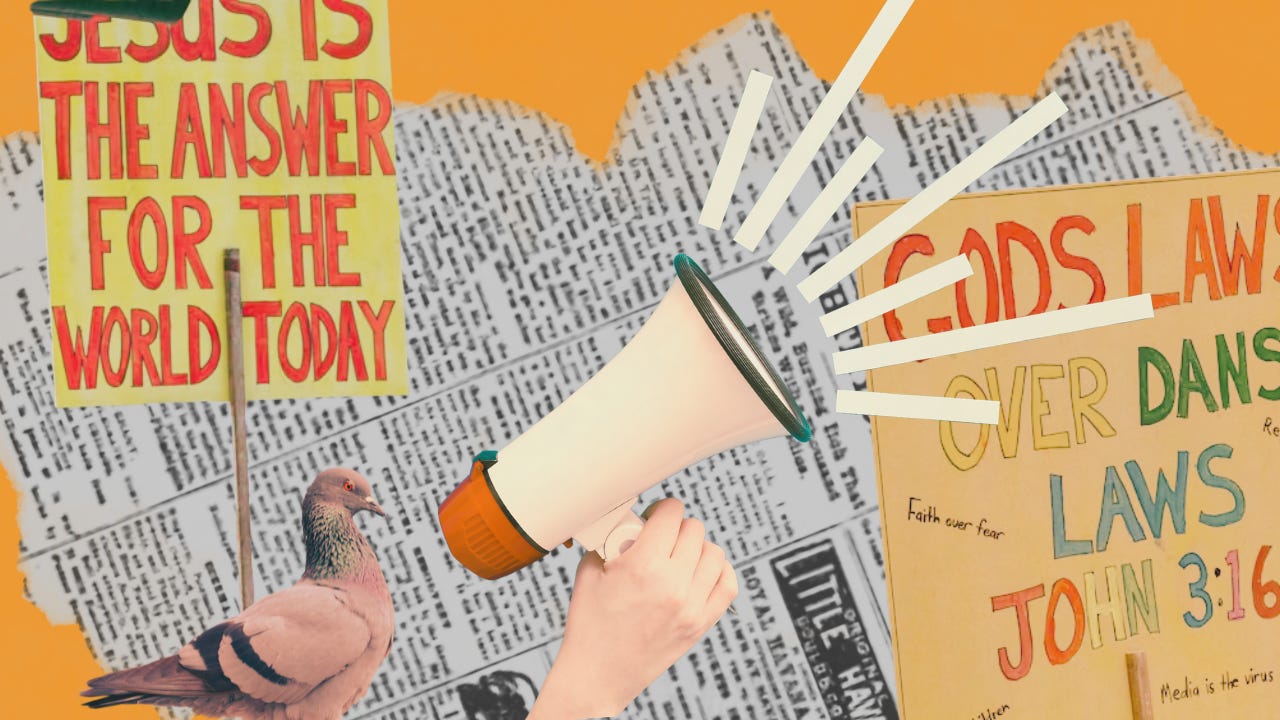
Last week, I was walking along Danforth Avenue, just living my life on a Saturday afternoon, when I came across six men who were demonstrating across the street from our church. When I approached, these men knew exactly who I was, which community of faith I serve, and proceeded to yell to passersby that I am a “Jezebel,” unqualified to be a minister, “The IR-reverend Bri-anne Swan, so-called minister to Eastminster United Church.”
They needed folks on the street to know that I am leading my people into the fiery pits of hell by endorsing people’s “lifestyle choices.” They very clearly targeted that corner because my church and our Anglican friends across the street both have women serving as their clergy. They knew we were an Affirming congregation. They seemed to be under the impression that the louder one proclaims something, the more true it becomes.
For the first time, it felt necessary to have security present at worship the next day.1
And at that service, we heard Jesus reminding his friends:
If you love me, you will keep my commandments.
Which had me pondering about these loud and angry men shouting that my very being was an abomination. How they are also — sigh — my neighbour. They are my neighbour, and if I love Jesus, then presumably I am to love them too.
Well, I don’t really like that at all.
Are there no limits to neighbour? I don’t see where Jesus felt that neighbours need to opt in to one another. Where do boundaries come in? Shielded by many of the unearned markers that can offer protection, I know I have more space to navigate this dilemma than somebody whose safety was more at stake.
Still…
I presume Jesus meant these men are my neighbour. They feel more like an enemy. Can an enemy be a neighbour?
In this context it doesn’t really matter. Neighbour. Enemy. Both. The instruction is the same.
I am commanded to love them.

I have little use for a version of Christian love that asks vulnerable people to become practice dummies for someone else’s violence. I don’t want a theology of neighbour-love that asks women, queer people, trans people, racialized people, poor people, disabled people or anyone else who has had scripture used against them to stand placidly in the way of religious cruelty while the church congratulates itself on its open-heartedness.
That ain’t love.
Love is not pretending harm is not harm.
But I don’t think Jesus gives me permission to respond with hatred either. I don’t get to “other” them.
This is deeply inconvenient.
More on Broadview
These moms chose their LGBTQ2 kids over their conservative churches
Ontario church hit with nasty comments over ICE resistance singing event
Jesus could have made it a lot easier by saying: “Love your neighbour, unless your neighbour is acting like a full-tilt menace outside your place of work.” It would be a huge relief if somewhere in the Gospels there was a foonote that said commandments are suspended when someone shouts about hell in the public square. I would find that pastorally useful.
But Jesus does not seem interested in making this easy.
Love your neighbour.
Love your enemy.
Pray for those who persecute you.
Do good to those who hate you.
It is all very beautiful until someone is actually doing the hating.
And then suddenly I would like to consult the Greek.
I do not know if I love those men. I certainly don’t in any feeling-oriented sense. I do not feel affection for them. I am not interested in pretending otherwise, because I do not think lying is a spiritual practice.
Christian love is not about generating warm feelings toward people who cause harm. Love is, at least in part, the refusal to let hatred determine the terms of the encounter.

Love requires that we take the situation seriously. Love sometimes requires that security be present at worship. Bodies matter. Fear matters. Safety matters. The people entrusted to our care matter.
Love requires protection.
But loving my neighbour also means that I don’t get to pretend that these angry, delusional men are simply monsters. I don’t get to dehumanize them.
The Very Rev. Jordan Cantwell had some very excellent thoughts about this in 2017 as she reflected on the need to love Donald Trump and those who supported him, while also denouncing their words and actions.
We need to not allow that sort of divisiveness, and the fear of difference, and the desire to create an “us group” by creating a “them group.” We need to resist all of those tendencies and practice the discipline of loving our enemies. This is an urgent requirement if we are going to, in fact, create the kind of society that I believe our faith calls us to create.
The Very Rev. Jordan Cantwell
So perhaps loving those men begins here: I will not lie about them.
I will not pretend they are anything other than human beings.
I will not pretend they are harmless.
I will not return their damnation with my own.
I will not let their certainty become more powerful than the tenderness of the people they would exclude.
This is our work towards the wholeness of the world. Which is the work towards our own wholeness as well.
Maybe this is where I am landing, though landing feels too settled a word. Those men are my neighbours. I hate that. They may also be my enemies. Jesus appears maddeningly unconcerned with how I categorize them. The commandment remains.
But love is not surrender. Nor is it silence. Love is not allowing the loudest and most frightened theology on the sidewalk to decide who gets to be called beloved. I have a hope that if these men return with their signs and their blow horns that my congregation (those who feel safe enough) would go outside and surround them, singing hymns of defiant love and compassion.
If I love Jesus, I will keep his commandments.
Which means I will love my neighbour.
And sometimes that means loving one neighbour enough to protect them, and another enough to refuse to meet their hatred with my own.🐦

Wilderness Times is co-created with Broadview, an award-winning Canadian publication known for thoughtful journalism that attends to spirituality, justice and the questions that tug at our collective conscience.
Broadview is a registered charity and has made this Substack freely available because we believe that thoughtful, justice-seeking journalism should be accessible to everyone. Creating this space — and keeping it free — takes time, skill and resources. If this space nourishes you, please make a tax-deductible donation.
Your support empowers Broadview to tell more courageous stories and helps build a more just and compassionate world.
What do you think Christian love requires when someone is actively causing fear or harm?

East End United shares one of its buildings, the Danforth Multifaith Commons, with Neighbourhood Unitarian Universalist Congregation and the Danforth Jewish Circle. As we were coordinating security for worship, I was acutely aware of how this is now just standard practice every time our Jewish friends meet. Many of my American colleagues who serve Open and Affirming congregations also require security at their worship services. There is a whole thread here about how many urban Affirming United Church of Canada congregations are not often confronted with the cost of this stance in the way those in other communities are.
No posts
Comments
Nothing yet. Say the first thing.
Sign in to join the conversation.