
It all begins not with a song, but with a poem. Abel Meeropol, a Jewish English teacher from the Bronx at DeWitt Clinton High School and a leftist close to the Communist Party, was deeply affected by a photograph of the 1930 lynching of two young African American men, Thomas Shipp and Abram Smith, in Marion, Indiana, taken by Lawrence Beitler. Writing under the pseudonym Lewis Allan, he wrote a poem titled “Bitter Fruit,” published in 1937 in The New York Teacher, the magazine of the New York teachers’ union, and later in the left-wing paper New Masses. Only in November 1938, when he set the verses to music himself, did Meeropol change the title to “Strange Fruit”: this sequence is recounted several times, with consistent detail, by his adopted son Robert Meeropol, today the founder of the Rosenberg Fund for Children. It was his wife Anne who first performed the song, accompanying herself on classical guitar at union meetings between late 1938 and early 1939, while singer Laura Duncan also performed it at Madison Square Garden. Meeropol later explained in simple terms what had driven him to write it: he hated lynching, the injustice it represented, and the people who carried it out.
One lesser-known detail: in 1940, just a year after the song’s success, Meeropol was summoned before the Rapp-Coudert Committee, a New York State body tasked with rooting out Communist teachers from public schools, and was asked directly whether the Party had ordered him to write the song. The episode says a great deal about the political climate in which “Strange Fruit” was born: not only a song against racism, but also an object of suspicion during the early years of McCarthyism.
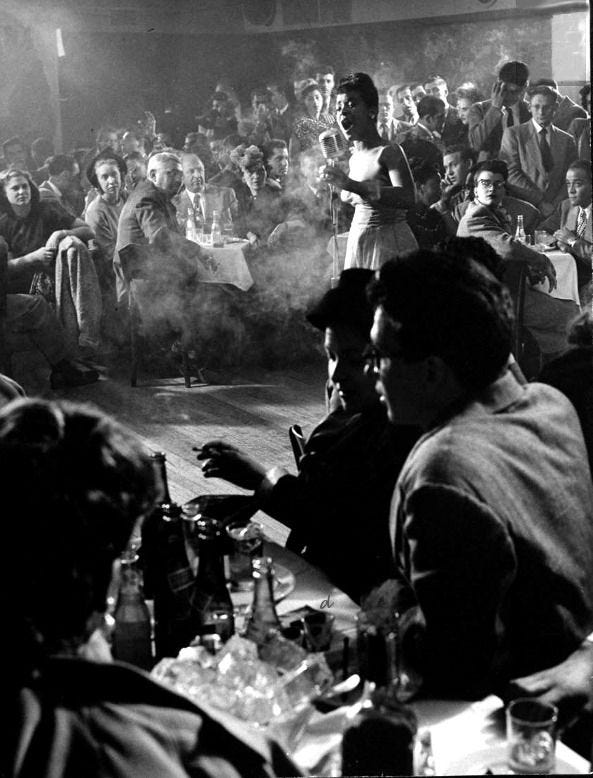
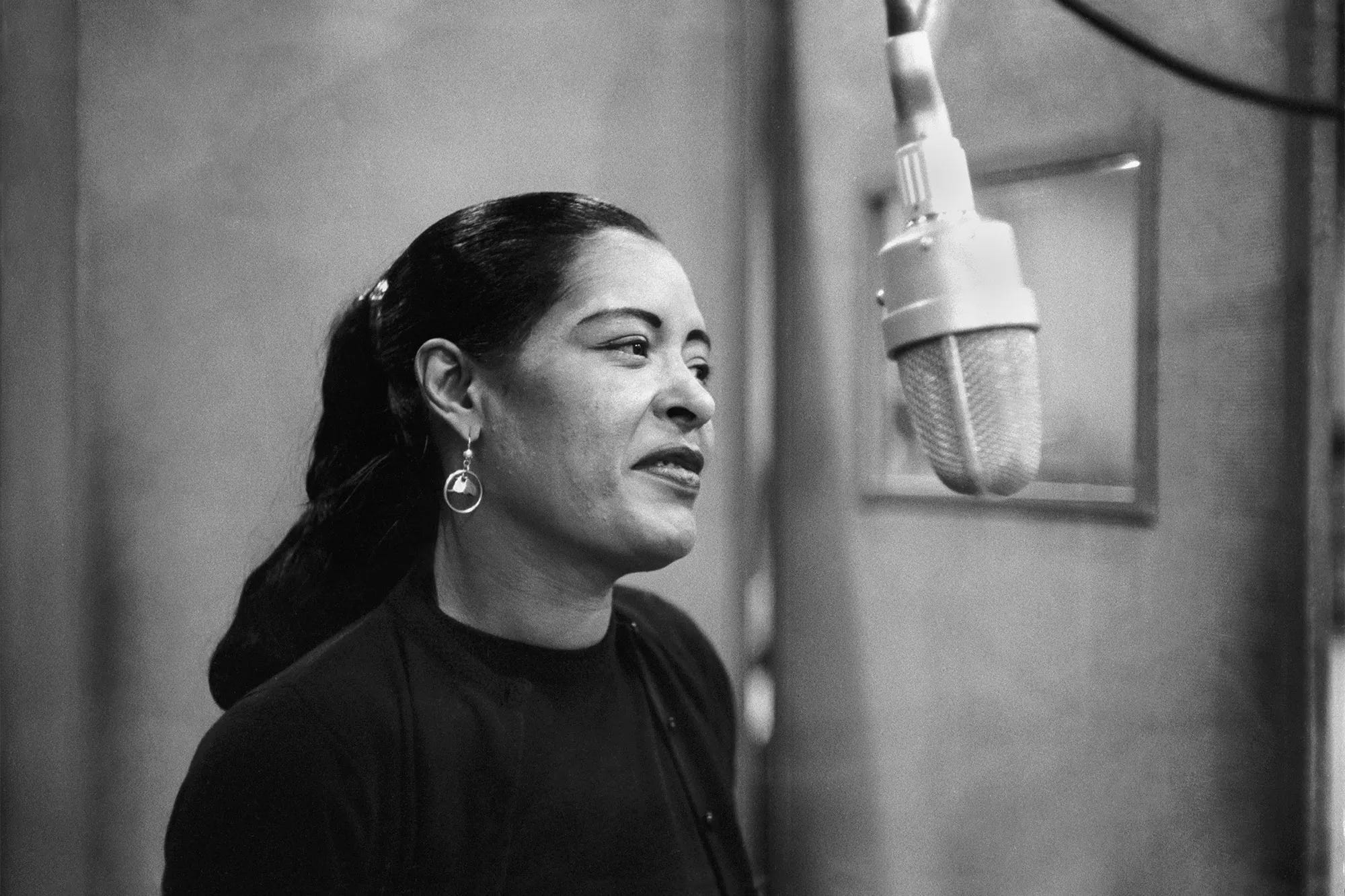
The song reached Billie Holiday through Barney Josephson, owner of Café Society in Greenwich Village, New York’s first truly racially integrated nightclub. Holiday, then twenty-three, was initially reluctant: she feared audiences wouldn’t want to hear a political song, and she feared retaliation. But once she began performing it live in 1939, the audience’s reaction convinced her to keep it in her set for good.
Josephson turned the performance into a genuine ritual: the song always closed the set, waiters stopped all service beforehand, the room went dark except for a single spotlight on Holiday’s face, and there was never an encore. During the instrumental introduction, according to the Wikipedia entry based on Margolick’s research, Holiday stood motionless with her eyes closed, as if in prayer. When the light went out, no matter how loud the applause, she never came back out to take a bow.
When Holiday brought the song to her label, Columbia, the company refused, fearing backlash from record retailers in the South and from affiliates of its co-owned radio network, CBS; her producer John Hammond also declined to record it. She turned instead to her friend Milt Gabler, owner of the small independent label Commodore: she sang the song to him a cappella and moved him to tears. Columbia nonetheless granted Holiday a one-session release from her contract so she could record it elsewhere.
The recording took place on April 20, 1939, with Frankie Newton’s eight-piece band. Worried the song was too short (Commodore charged more than competing labels for its singles, and an overly brief record would have seemed poor value), Gabler asked pianist Sonny White to improvise an introduction: on the record, Holiday doesn’t begin singing until about 70 seconds in. The session also featured Tab Smith on alto sax, Stan Payne and Kenneth Hollon on tenor sax, John Williams on bass, Jimmy McLin on guitar, and Eddie Dougherty on drums.
This is where the story gets complicated. In her 1956 autobiography, “Lady Sings the Blues” (written with ghostwriter William Dufty), Holiday claimed that she herself, along with Meeropol, pianist Sonny White, and arranger Danny Mendelsohn, had set the music together in about three weeks. Biographers David Margolick and Hilton Als, in their study “Strange Fruit: The Biography of a Song,” dismantled this account point by point, describing it as containing more misinformation per column inch than almost anything else in the book. When confronted with these objections, Holiday brushed them off, saying she’d never even read her own book.
Mendelsohn’s role, however, can’t simply be dismissed as invention: according to Arthur Herzog, one of Holiday’s regular songwriters and co-author of “God Bless the Child,” it really was Mendelsohn who reworked the musical arrangement of the melody Meeropol had composed, which he rather uncharitably dismissed as little more than a rough sketch. How much real musical work Mendelsohn did in 1939 remains an open question: a concrete contribution to the arrangement seems likely, while Holiday’s direct role as co-composer was almost certainly exaggerated, and further embellished by Dufty.

New York Post columnist Samuel Grafton described the recording as a work capable of overturning the usual relationship between a Black artist and her white audience: as if, for the first time, it was she asking the audience to listen to her, rather than the other way around. Not everyone received it the same way: some critics of the time dismissed it as little more than propaganda dressed up as music, only for Time to name it song of the century sixty years later.
As for commercial success, some caution is warranted. The figure of “a million copies,” repeated almost everywhere (from Holiday’s official website to the Smithsonian, from Wikipedia to numerous other outlets), isn’t a verifiable certification in the modern sense, since no sales-certification bodies existed in 1939 as they do today. It’s more likely a cumulative figure built up over time. It’s also worth noting that different sources credit different Holiday recordings as her all-time best-seller: sometimes “Strange Fruit,” sometimes “Lover Man” (1945, Decca), sometimes “God Bless the Child” (1941), the latter described as third on Billboard’s year-end chart with over a million copies sold. Without certified data from the era, it isn’t possible to say with certainty which record was truly her best-seller: what is certain is that “Strange Fruit” was a commercial success wildly out of proportion to what anyone could have expected from an independent label like Commodore.
Meeropol was deeply hurt by Holiday’s account in her autobiography, to the point of taking legal action to have the facts corrected in later printings of the book. According to his son Robert, the whole episode cast a shadow over how Abel felt for the rest of his life about what he considered his most important composition. Despite this, according to other family accounts, Meeropol chose never to attack Holiday publicly, so as not to hand ammunition to the racists who were already persecuting her.
The story of Holiday’s persecution at the hands of Harry Anslinger, head of the Federal Bureau of Narcotics, has become central to the song’s public narrative, especially after Johann Hari’s book “Chasing the Scream” and the film it inspired, “The United States vs. Billie Holiday” (2021). In this version, Anslinger saw Holiday as a symbol of everything America needed to fear, and his obsession stemmed directly from her refusal to stop performing “Strange Fruit.” In 1947 Holiday was arrested for drug possession and sentenced to a year and a day in a West Virginia prison; once released, her cabaret card was revoked, the license required to perform in New York clubs serving alcohol, forcing her to move toward theaters and concert halls instead.
It’s worth keeping a note of historiographical caution, though: some historians have pointed out that the source Hari uses to link the persecution directly to the 1939 performance is a 1947 Down Beat interview referring to a later, unrelated episode, repositioned chronologically to strengthen the causal link. What remains established beyond dispute is that Anslinger was an outspoken racist even by the standards of his time, and that his relentless pursuit of Holiday over drug use became entangled, over the years, with her refusal to stop singing the song until the end of her life; she died in 1959 with a federal agent reportedly still stationed at her hospital bed.
The two most celebrated interpretations, Holiday’s from 1939 and Nina Simone’s from 1965 (on the album “Pastel Blues,” later reprised in 1974 on “A Portrait of Nina”), reveal two opposite emotional stances toward the same material. Holiday’s is a composed, almost restrained lament, preceded by seventy seconds of instrumental introduction that prepare the ground for a story to be told calmly before it can be cried out. Simone’s, by contrast, opens with no introduction at all, going straight into the lyrics, and was described by a French critic of the time as an attack rather than a lament. In the closing moments, Simone dramatically extends the final word of the lyric with a vibrato that one critic compared to the sound of a woman exhausted by an industry and a society that didn’t want to see a Black woman at the top of her craft.
The reason “Strange Fruit” resurfaces periodically in American public discourse, from the 1960s to the era of Black Lives Matter, lies in its capacity to remain a benchmark: every time racial violence returns to the headlines, the song gets replayed, resampled, reinterpreted. This happened with Kanye West, who sampled Simone’s voice for “Blood on the Leaves” in 2013, with Rapsody, who used it as the symbolic opening of her album “Eve,” and with soul singer Bettye LaVette, who in 2020, after the murder of George Floyd, moved up the release of her own cover because she felt she was telling the same story, decade after decade.
Holiday’s 1939 recording entered the Grammy Hall of Fame in 1978 and the Library of Congress’s National Recording Registry in 2002–2003, and was voted by Time as the song of the century in 1999.
Thanks for reading! This post is public so feel free to share it.
Comments
Nothing yet. Say the first thing.
Sign in to join the conversation.