
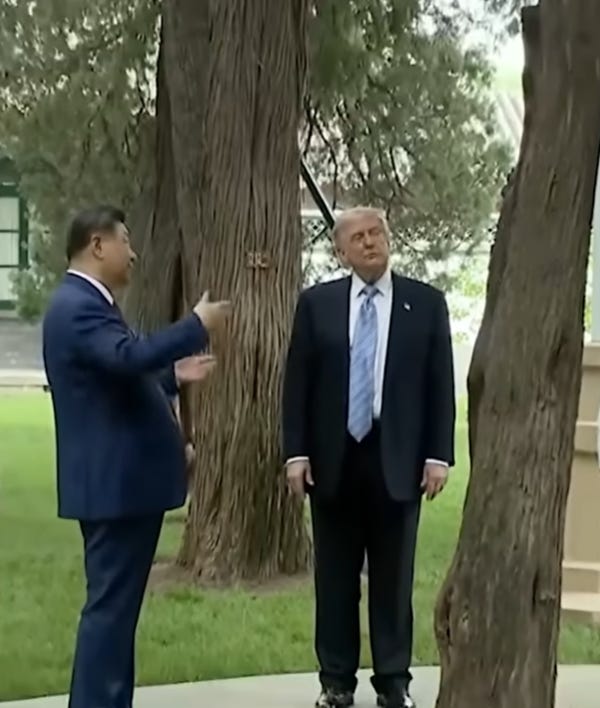
The Trump-Xi Summit in Beijing, from May 13–15, 2026, produced deeply ambiguous, and in several respects disappointing, results. Xi Jinping’s evident urgency in securing the meeting should have been met with maximal U.S. leverage and clear, uncompromising demands, above all the release of Jimmy Lai, Pastor Ezra Jin, the dozen or so Catholic Bishops who were imprisoned, and other political and religious prisoners, numbering in the thousands under Xi’s increasingly repressive system. Instead, President Donald Trump’s failure to capitalize on this moment raises a basic and uncomfortable question: what, concretely, did he extract from Xi Jinping in return for conferring diplomatic legitimacy at a moment of evident Chinese vulnerability?
The steady influx of Western leaders into Beijing over the past half-year is not a sign of Chinese strength, but a deliberate political project aimed at shoring up a leader facing mounting internal strain. Xi Jinping presides over an increasingly brittle system in which elite tensions and institutional pushbacks are becoming harder to conceal. Reports of unease within the Chinese military and political establishment, including within senior PLA structures, point to a leadership under pressure, not one in ascendancy. In this context, Xi’s accelerated diplomatic campaign is less about global leadership and more about regime stabilization through staged displays of international acceptance.
To maintain this façade of legitimacy, Xi has reportedly extended an array of economic incentives to visiting Western leaders. Yet these promises rest on increasingly unstable foundations. After more than a decade of Xi’s economic stewardship, China has shifted from sustained high growth to structural slowdown, rising debt burdens, and deepening demographic headwinds. The idea that Beijing can reliably underwrite broad new external commitments is, at best, doubtful. More importantly, Xi’s track record of selectively honoring agreements should give any counterpart reason for caution rather than accommodation.
Xi Jinping’s invocation of the so-called “Thucydides Trap” in front of President Trump and senior U.S. officials was not an intellectual flourish, it was a strategic framing designed to normalize Chinese ambition and imply inevitable American decline. It should have been met with immediate and forceful rejection. The premise is not only misleading but strategically inverted: it is China, not the United States, that faces the sharper convergence of economic slowdown, political rigidity, and external constraint in mid-2026. That reality should have been asserted plainly and without hesitation.
Equally striking was the missed opportunity on Taiwan. A serious U.S. response would have forcefully highlighted that public opinion in Taiwan remains firmly resistant to Beijing’s coercive unification agenda. That resistance is not accidental; it is the direct consequence of China’s increasingly aggressive posture toward the island. Moreover, any historical narrative that attempts to frame cross-strait relations as naturally converging toward Beijing ignores a more complex reality. Taiwan’s most constructive period of engagement with the mainland coincided with earlier, more pragmatic economic policies associated with China’s Special Economic Zones, initiatives rooted in the reform era associated with Xi Zhongxun, Xi Jinping’s father. That contrast exposes Xi’s Achilles heel in the country, and it should have been used to challenge Xi’s attempt at rhetorical reframing directly and in real time.
No posts
Comments
Nothing yet. Say the first thing.
Sign in to join the conversation.