
The last few days in China have made one thing uncomfortably clear: whatever has been taking place in China over the past few decades is coming to a head. Conflicting signals out of China, the sudden appearance and disappearance of claims, and the silence that follows are not distractions from reality; they are reality. What’s taking place may be less the case of routine housecleaning and more a syndrome of nonlinear warfare turned inward. That is why this series on cyber-scam prison factories in Southeast Asia needs a reset. These operations are not criminal anomalies at the edge of the global economy. They are industrialized expressions of a world where power is exercised through deniability, distance, and disposable human lives.
What if the cyber-crime prison factories in Southeast Asia aren’t criminal flukes, but a deliberate intelligence and revenue-generating strategy?
The Philippine case of Alice Guo exposes a system that is industrialized, politically protected, and embedded in transnational networks.
These are not rogue gang, they are state-adjacent enterprises generating revenue, political leverage, and operational control.
Understanding this model matters because it reframes what analysts, journalists, and policymakers often call “organized crime” in the region.
Rather than isolated operations, these prison factories function like United Front–style ecosystems: integrated into offshore political warfare networks and shielded by elite patrons.
The Philippine case reveals the full architecture of such a system, from detention and coercion to political protection and cross-border financial operations.
Three ways to identify state-protected cyber-crime networks in Southeast Asia:
1. Elite political integration
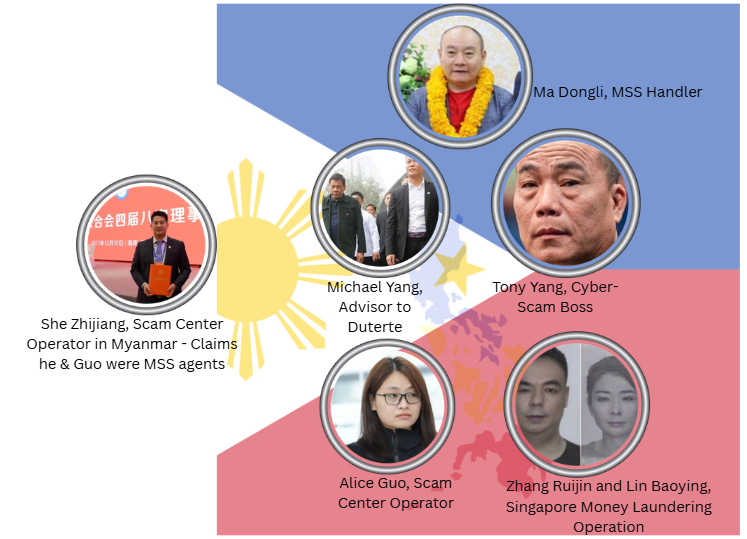
o Michael Yang, a Fujian native and brother of Tony Yang, inserted himself as an economic adviser to former President Rodrigo Duterte.
o His brother, Tony Yang, acted as the operational “godfather” for the Philippine cyber-scam prison factories, controlling coerced labor and scam operations from on high.
o This demonstrates how political insertion protects and legitimizes otherwise illicit operations.
2. Operational continuity across borders
o Alice Guo ran operations at the Zun Yuan Tech compound, where 875 workers were detained and forced to execute online scams generating an estimated $122 million.
o After fleeing the Philippines via Malaysia to Indonesia, she was captured and returned in September 2024; she and her co-conspirators were sentenced to life imprisonment on November 20, 2025.
o The networks extend regionally: She Zhijiang, a prison-factory operator in Myanmar, claimed that Guo and he were Ministry of State Security assets, and that Ma Dongli acted as their handler. While these claims warrant scrutiny, they align with patterns of politically insulated intermediaries.
3. Integrated financial infrastructure
o Offshore money laundering centers, notably in Singapore, were staffed with Chinese nationals from Fujian.
o Leaders of the Singapore operation, Zhang Ruijin and Lin Baoying, also became founders of Alice Guo’s company, linking operational scams, coerced labor, and financial laundering into a single, coordinated ecosystem.
Pattern takeaway:
Elite patrons, transnational operators, and integrated financial networks work in concert.
Enforcement is selective and often absent because the system serves political and intelligence objectives rather than purely financial gain.
When forced labor, illicit finance, and political protection converge across jurisdictions, the key question is no longer whether the state knows, but why it allows these systems to function at scale.
If the Philippine networks are a blueprint, which other Southeast Asian states, or global jurisdictions, might be quietly hosting similar structures?
No posts
Comments
Nothing yet. Say the first thing.
Sign in to join the conversation.