
Hey hey!
Welcome back to Why Join.
So there’s this pattern in tech that keeps repeating. The most exciting new thing and the most dangerous new thing are always the same thing. Every major platform shift starts like this. Useful before it’s secure. Adopted before it’s understood. The people who move first get a massive edge and the people who move first without thinking get wrecked. That’s where we are right now with agents. And if you’ve been building long enough you know the window between “this is a toy” and “this is infrastructure” is when the real companies get built.
Alright let’s get into it.

File crypto taxes in minutes
Easily import your crypto transactions and file your taxes in minutes with TurboTax, H&R Block, or your own tax professional. Save time and maximize your refund using our crypto tax software.
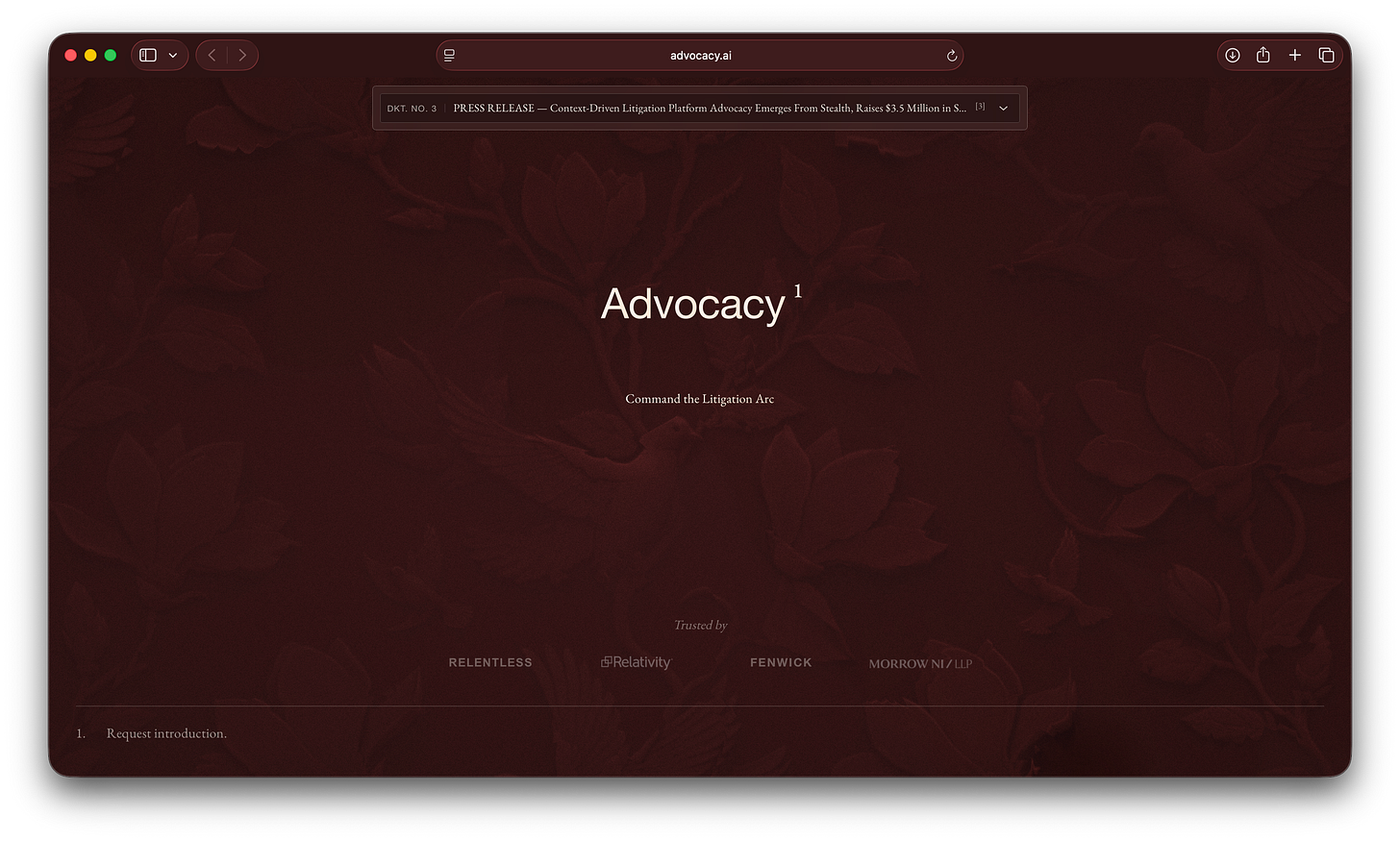
💵 Raised: $3.5M seed, led by Relentless. Relativity (via Rel Labs) and Am Law 100 firm Fenwick & West also in.
One-liner: AI litigation workspace that actually remembers your case.
Why it’s a fave: Most AI legal tools right now do the same thing: draft a motion, summarize a deposition, maybe do some research. But litigation isn’t a series of one-off tasks. It’s a months- or years-long process where context is everything, and right now that context lives scattered across e-discovery platforms, research tools, and... litigators’ heads.
Advocacy built what they call a “case memory” layer. It centralizes all matter-critical intelligence (documents, audio, video evidence, timelines) into one workspace that gets smarter as the case develops. Instead of keyword search, it does context orchestration. So when you’re drafting a brief at month 14 of a case, the AI actually knows the full history, the evidence, the arguments, all of it. They can also ingest raw audio and video and map it into the case timeline automatically.
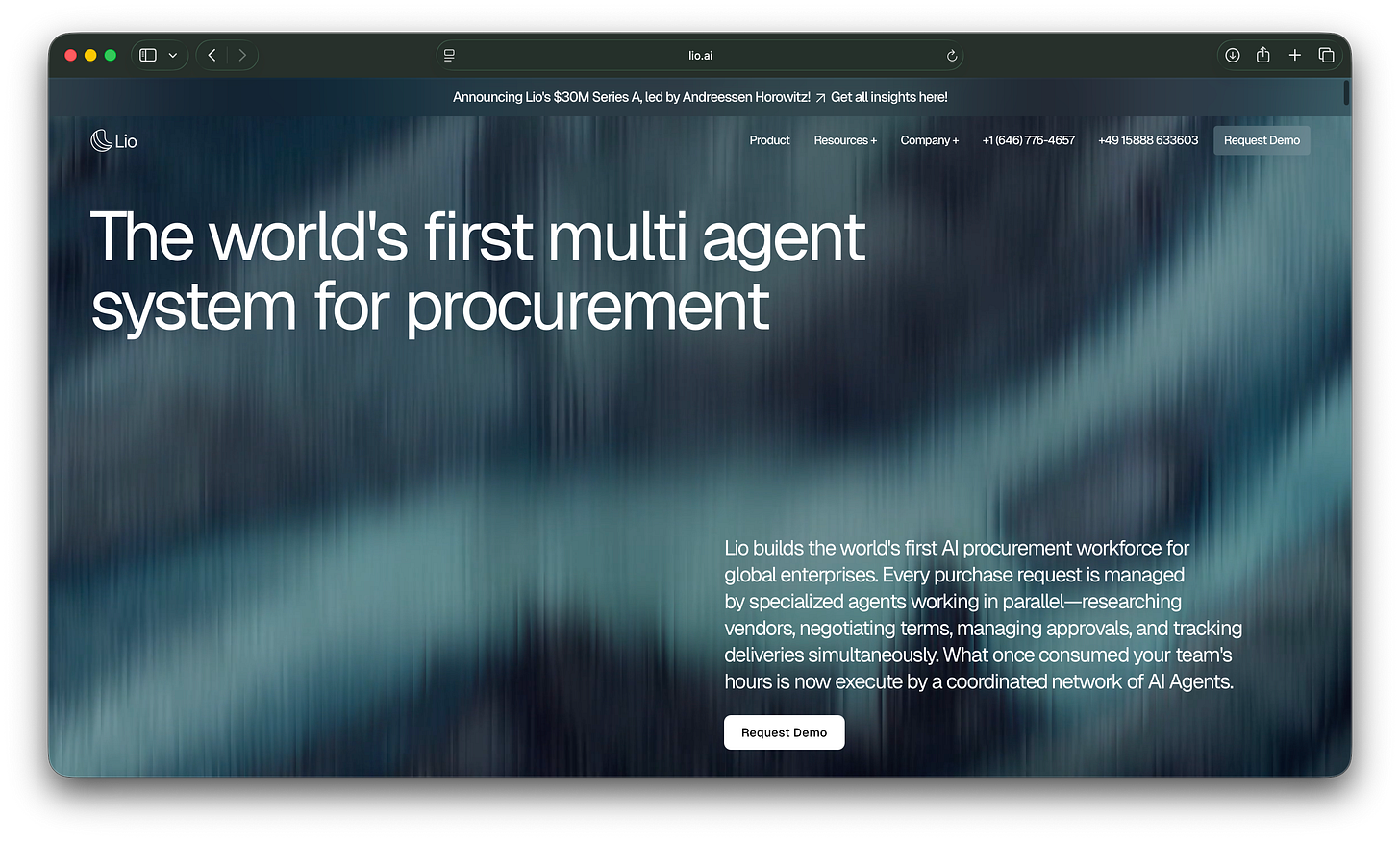
💵 Raised: $30M Series A, led by a16z. SV Angels, Harry Stebbings, and YC also in.
One-liner: Agentic AI workforce that actually does procurement, not just tracks it.
Why it’s a fave: Enterprises spend $180B a year on procurement talent versus $10B on procurement software. That ratio tells you everything. Despite all the eProcurement tools out there, decisions still happen at human speed. Requests move through layers of systems, rules, approvals. Teams scale by adding headcount or outsourcing at up to 20x the cost of software.
Lio’s approach is different from most procurement startups. Instead of building another tool that sits on top of the process, they built AI agents that do the actual work. Triaging requests1, analyzing quotes, comparing suppliers, negotiating, onboarding vendors, executing purchases. End to end across ERPs, inboxes, contracts, the open web. They call it Agent Operating Procedures (AOPs)2, basically teaching AI agents to follow the same playbooks as experienced buyers.
Hiring: Founders Associate - CEO Office, Sales Development Representative, Partnership Manager, Event Marketing Manager, Software Engineer, Account Executive - New York; Munich
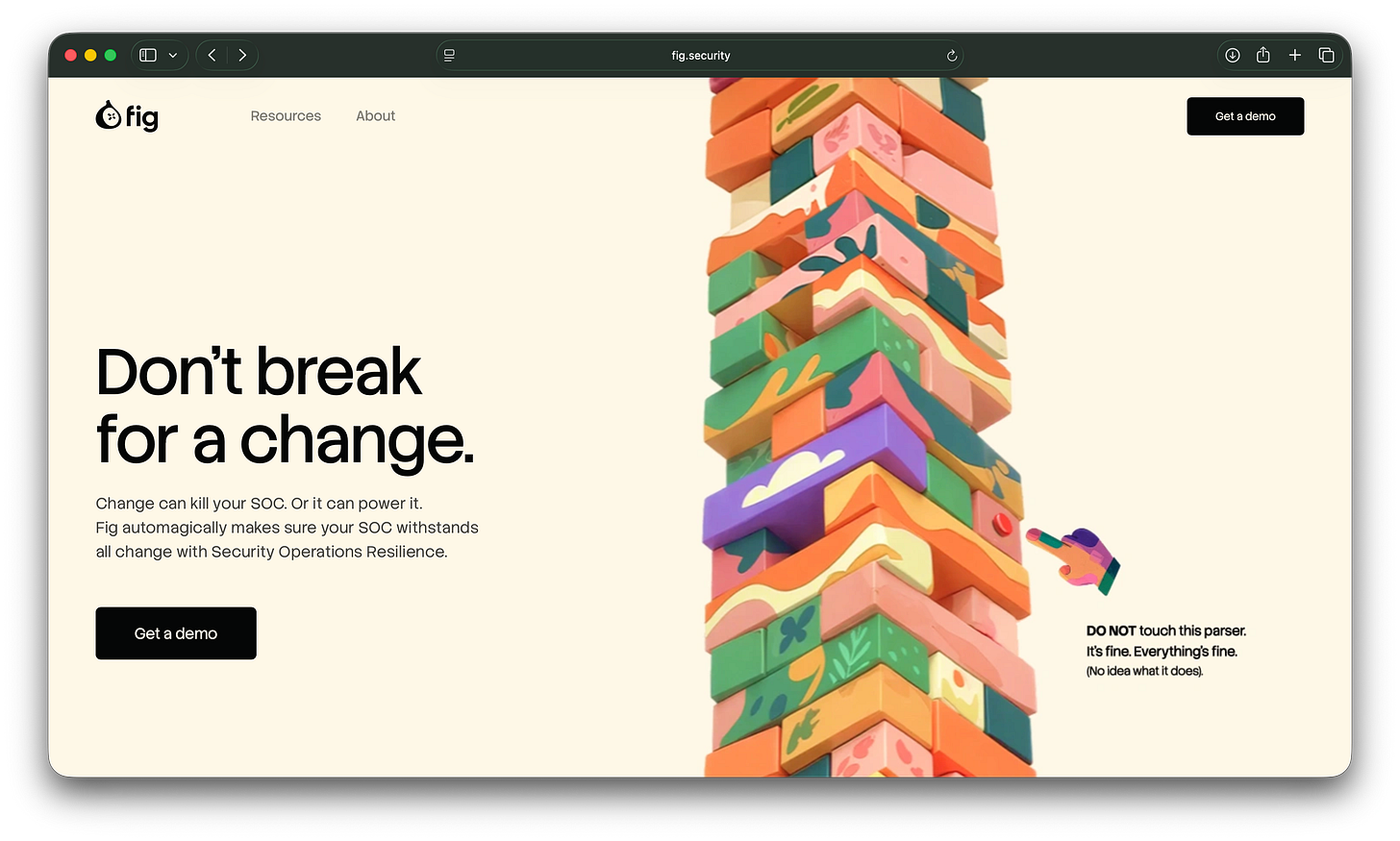
💵 Raised: $38M (seed + Series A). Investors include Team8, Ten Eleven Ventures, plus former Splunk CEO Doug Merritt and former Palo Alto Networks CMO Rene Bonvanie.
One-liner: Monitors your security stack to make sure your defenses actually work.
Why it’s a fave: Modern enterprise security stacks are absurdly complex. Dozens of tools all wired together, and a small change in one can quietly break detection and response somewhere downstream. The scary part is you might not find out until something bad happens. It’s like an alarm you haven’t tested in months... do you actually trust it still works?
Fig traces data flows through the entire security stack, from source through pipelines and data lakes to your SIEM3 and response platforms. But instead of following data forward to see where it goes, they work backwards from your detections4. That’s the thing that needs to work, so they back-trace what has to happen for each detection to fire correctly, then alert you in real time when something breaks the chain. You can also simulate how a new patch5 or change would affect things before you deploy it.
Anthropic sues the Pentagon: The company is taking the Defense Department, Hegseth, and a bunch of other officials to court over the supply-chain risk designation. Anthropic's argument: this was retaliation for a policy disagreement, not an actual security threat. (That designation is usually reserved for adversary-nation entities like Huawei, so yeah.) Trump ordered all federal agencies to stop using Claude with a six-month transition window, which Anthropic points out kind of proves how essential its tools are. The White House called Anthropic a "radical-left, woke company." Microsoft and Google say they'll keep working with Anthropic commercially. The $200M Pentagon contract? In limbo.
Hayden AI sues ex-CEO: The SF startup that builds spatial analytics tools for cities is claiming co-founder and former CEO Chris Carson forged board signatures, sold $1.2M in stock without authorization to buy a home in Boca Raton and a gold Bentley, then had an employee download his entire 41GB email file onto a USB stick on his way out. He’s since started a rival company called EchoTwin AI. Oh, and Hayden AI says his entire CV is fabricated—claims he wasn’t getting a PhD from a Tokyo university in 2007 but was actually running a paintball equipment shop in a Florida strip mall. Hayden is valued at $464M.
Google hands Pichai a $692M pay package: Three-year deal, almost entirely stock-based and performance-tied. Includes PSUs linked to Alphabet’s total shareholder return vs. S&P 100 companies (0-200% payout), plus ~$130M in incentives tied to Waymo’s growth and $45M tied to drone delivery unit Wing. His base salary hasn’t changed since 2020: $2M, no bonus.
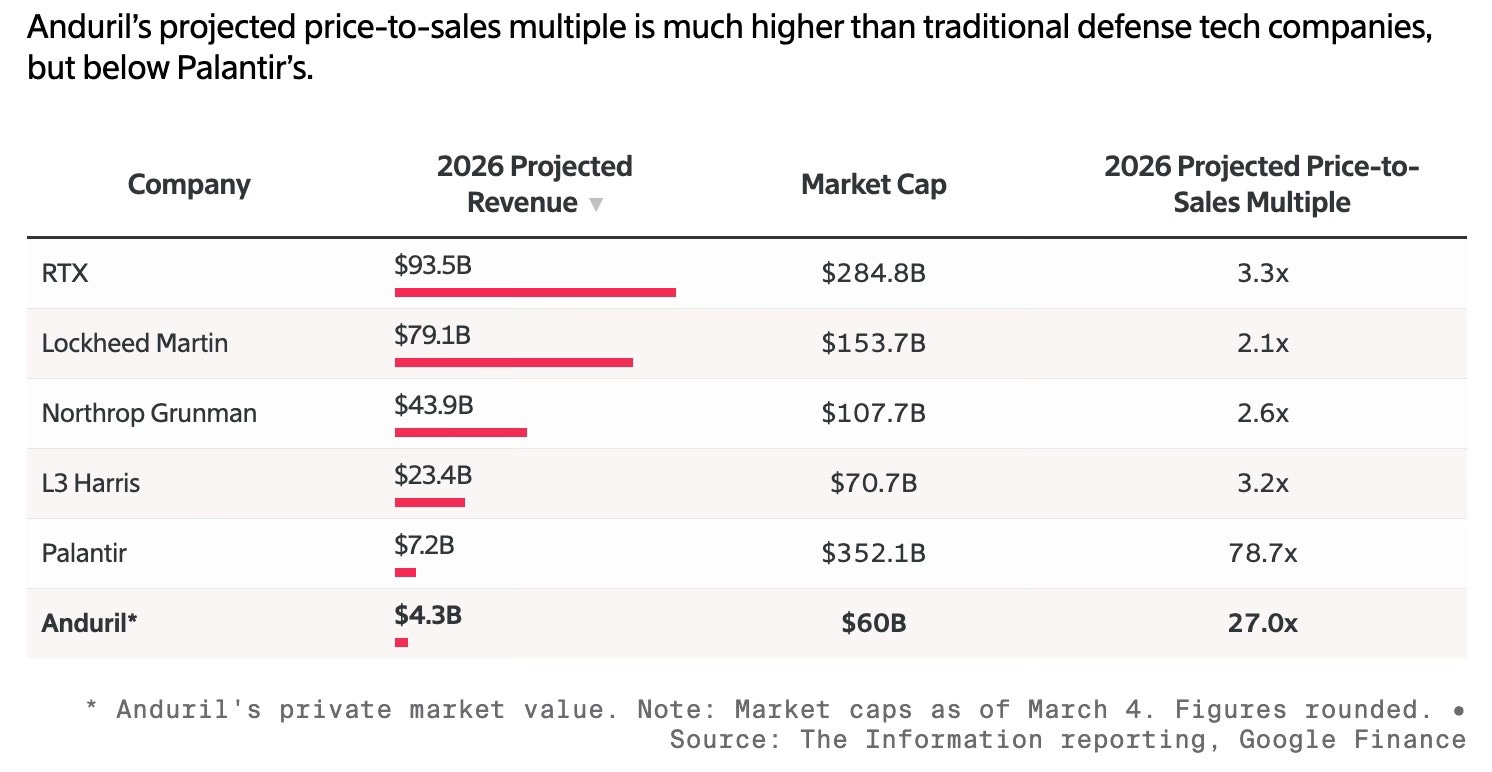
Palmer Luckey’s retro gaming startup wants $1B valuation: ModRetro, Luckey’s side project that makes high-end vintage gaming handhelds, is raising at a billion-dollar valuation per the FT. First product was the Chromatic, a Game Boy-style device that reviewers loved. Now working on an N64-inspired device. (As The Verge put it: “If Lockheed Martin made a Game Boy, would you buy one?”) Meanwhile, his day job is going well too: Anduril is reportedly raising at $60B.
Anduril revenue doubles to ~$4.3B, but losses widen: Defense tech company saw sales double, with its Altius long-range strike drone now the biggest revenue driver. Missiles and fighter jets are expected to take a larger share going forward. The company is spending $900M+ on a factory outside Columbus, Ohio, that should open within months. The catch: $1.2B in operating losses expected this year, up from $800M in 2025, with $1B+ annual losses projected for the next four years. Gross margin dipping to 36% in 2026 before climbing back to ~40% by the end of the decade.
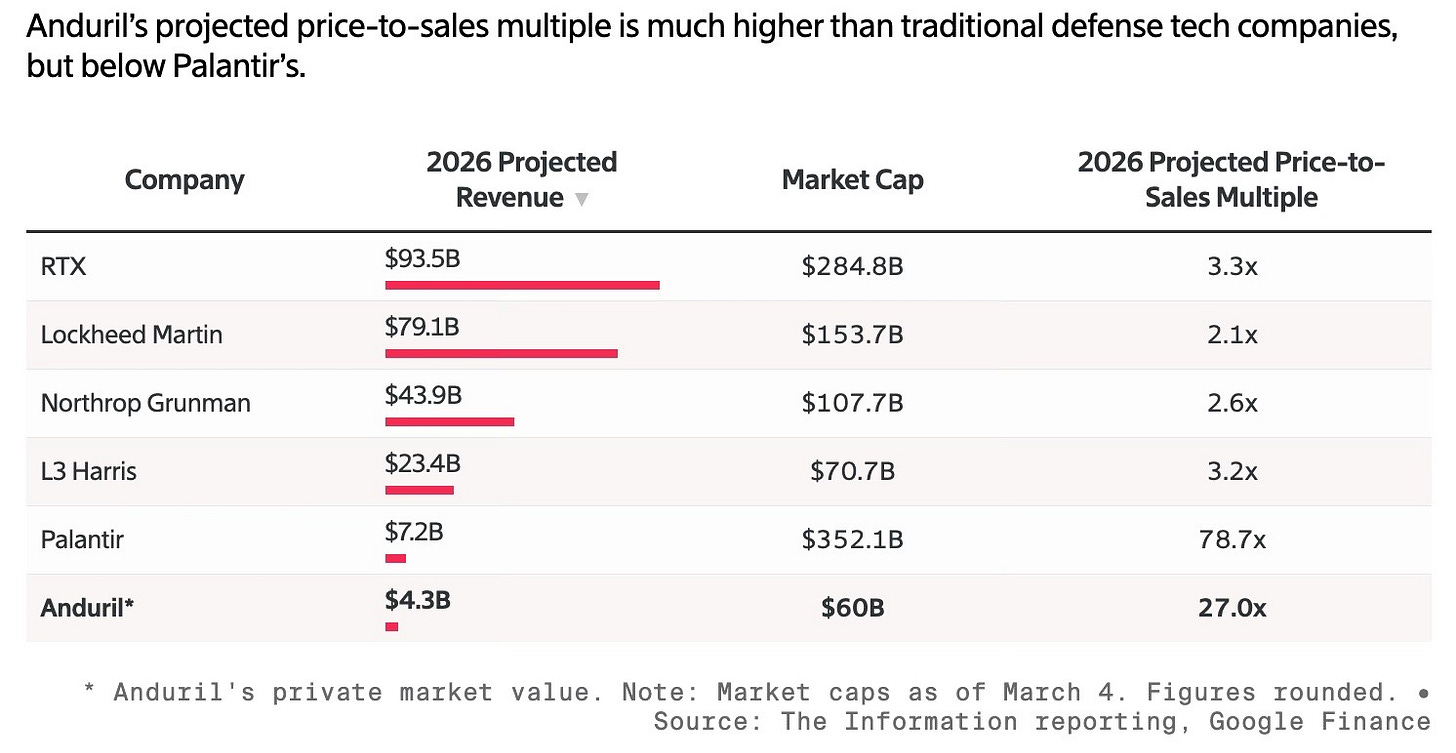
Source: The Information Kalshi and Polymarket both eyeing $20B valuations: Per the WSJ, both prediction market platforms are in early fundraising talks that would roughly double their late-2025 valuations. Kalshi (CFTC-approved, $11B last round) is at ~$1.5B annualized revenue run rate. Polymarket ($9B after Intercontinental Exchange’s $2B investment) is right behind. Both are doing nearly $2B in weekly trading volume. The space is getting crowded though, with Coinbase, Robinhood, and now Nasdaq and Cboe all exploring prediction markets.
OpenAI hardware exec quits over Pentagon deal: Caitlin Kalinowski, who ran OpenAI’s robotics team, resigned over the company’s new DoD agreement, saying surveillance without judicial oversight and lethal autonomy without human control “deserved more deliberation than they got.” OpenAI jumped on the Pentagon deal after talks with Anthropic fell apart over those exact same safeguards. (Trump then ordered all government departments to cut ties with Anthropic and the Pentagon slapped it with a supply-chain risk designation, the kind of thing usually reserved for companies like Huawei.) Even Altman admitted the whole thing looked “opportunistic and sloppy.” The consumer fallout has been something: ChatGPT uninstalls surged 295% and Claude climbed to #1 on the App Store. Anthropic says it’s taking the designation to court.
Flipkart moves HQ back to India, IPO coming: Walmart-owned Indian e-commerce giant relocated from Singapore to India as it targets a domestic IPO by March 2027. GMV hit ~$30B in 2025, up from $23B in 2021, with 500M+ customers and 1.6M sellers. Part of a broader wave of Indian startups redomiciling ahead of listings, following Zepto (filed confidentially for an IPO in December) and Groww (went public last year).
Sage: Sales Development Representative, Client Implementation Specialist - New York; Remote - CST, MST, or PST
Diligent: Full Stack Engineer - London
Cosmon: AI/ML Engineer - Palo Alto
Guided: Founding Product Engineer (full stack, backend), Founding AI Engineer - Paris
Rillet: Founders Associate, Digital Marketing Manager, Content Marketing Manager, ML/AI Engineer, Software Engineer, Accountant - New York City; San Francisco
David: Marketing Designer, Creative Strategist - New York
City Detect: Business Development Representative, AI Engineer, Full Stack Engineer - Remote (US)
Patlytics: Full Stack Engineer - Remote (APAC); Full Stack Engineer, Business Development Representative, IP Attorney / Strategic Business Development Lead - New York
360 Capital: Analyst - Paris
Equal Ventures: Analyst/Associate - New York City
If you haven’t yet, please subscribe, like, leave a comment, and share it! It helps us continue to bring you the most interesting news + nuance in tech and business every week.
See you Wednesday, Ryan
Sponsorships: We are now accepting sponsors for Q2 ‘26. If you are interested in reaching my audience of founders, investors, and tech executives, send me an email at chief@whyjoin.xyz.
sorting and prioritizing purchase requests
structured workflows that tell AI agents how to perform tasks
Security Information and Event Management systems that collect and analyze security logs
the alerts your security tools generate when something suspicious happens
Comments
Nothing yet. Say the first thing.
Sign in to join the conversation.