
Nick Ferrell (NF) is the founder of DC Vintage Watches.
Nick here. Hubris can be incredibly damaging, particularly when it comes to business.
1969 was one of the most significant years in the long history of Seiko, a Japanese watch manufacturer. That year, the brand released the world’s first automatic chronograph, the Calibre 6139, and the V.F.A. (Very Fine Adjusted) movement, the latter of which delivered Seiko’s highest level of precision for a mechanical watch movement yet.
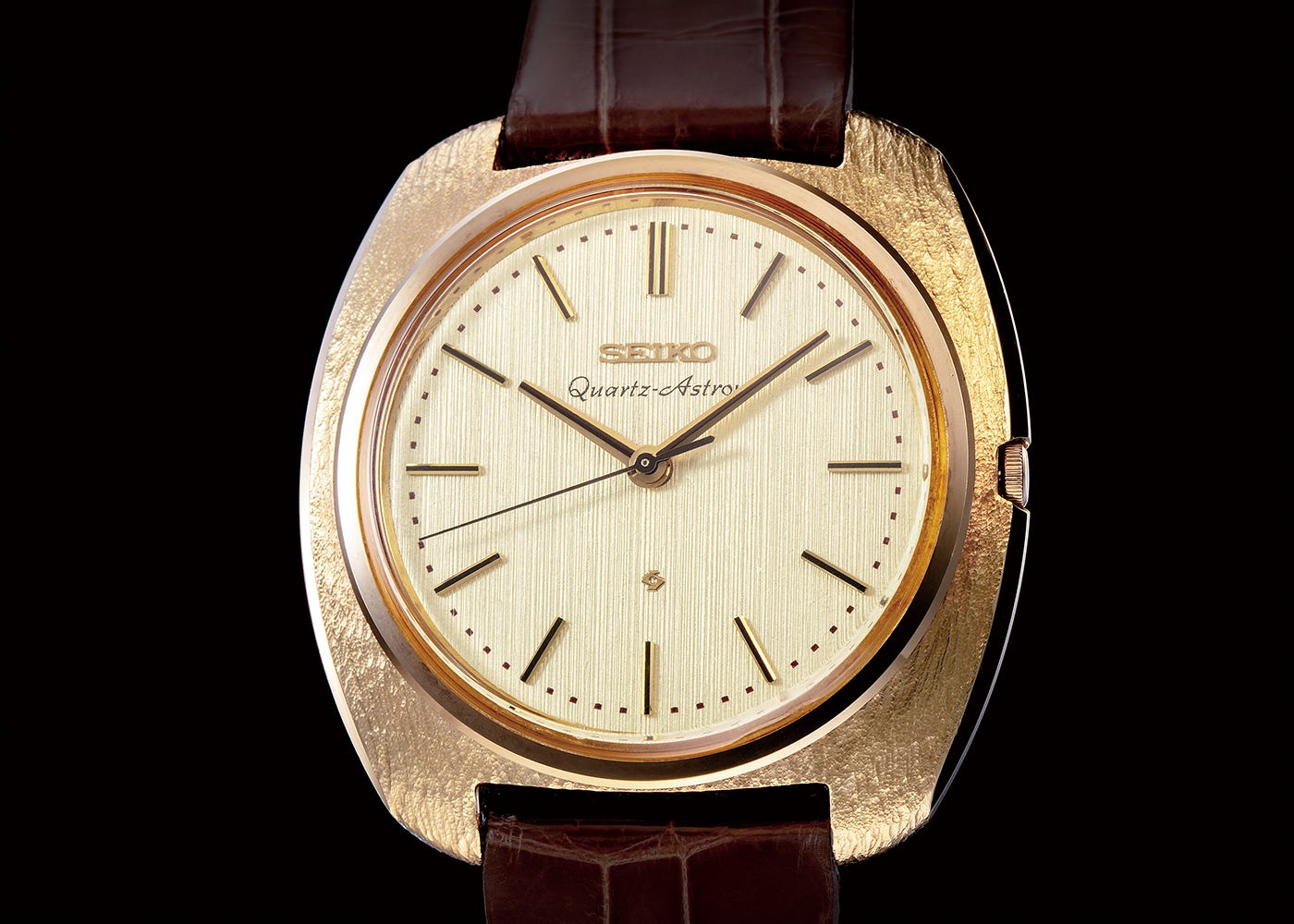
On Christmas Day of the same year, Seiko unleashed another first upon the world: The first commercially-available quartz wristwatch. Seiko’s Quartz Astron watch went on to change the way the world told time, and severely tested the dominance of the Swiss watch industry—a period known as the “Quartz Crisis”—as it brought highly accurate technology to all.
Quartz technology, however, was not without its fair share of problems. The watches were initially expensive (the gold Seiko Astron cost as much as a medium-sized Toyota Corolla at the time), difficult to produce, and also consumed batteries at an alarming rate. Not that the Swiss watch industry took note, instead continuing to live by the “if it’s not broken, don’t fix it” motto, and failing to recognize the true looming threat of quartz as the technology became more economical, and innovation and economies of scale continued.
As such, the Swiss weren’t anywhere near ready with their own quartz watch in 1971, when Seiko drastically reduced the price of its quartz watches after some technological breakthroughs. Switzerland’s reluctance to challenge mechanical watchmaking traditions spelled financial doom—or at least a large decrease in sales.
Why was such a clear challenge ignored by the Swiss until it was nearly too late? The Swiss, suffering from hubris, didn’t appear to realize they were enmeshed in a war with the Japanese at all, even after the Astron debuted. They also seemed to hold Japanese watchmaking in contempt. As one Swiss industrialist said at the time, “[The Japanese] were not even irrelevant, because irrelevant implies that they had been noticed.”
Why is this interesting?
By the 1980s, the Quartz Crisis was in full bloom, and Swiss (and American) watch manufactures were closing their doors at an alarming rate. The Seiko invention of the quartz wristwatch movement was a major paradigm shift for the watch industry, and led to massive increases in quartz watch sales. American watchmaking, hidden behind protective tariffs, which resulted in a failure to innovate, was simply overwhelmed by the sudden change in watch technology and quickly left behind. (American watchmaking has yet to catch up to this day, half a century later.)
Throughout the 1970s, the Japanese watchmaking industry tripled its production numbers, from nearly 24 million to nearly 90 million, surpassing the Swiss by 1980. Worse yet, the Swiss, in an effort to bring down prices by sourcing parts outside of Switzerland, had instead caused a steady “cheapening” of the Swiss-made brand, so much so that the Swiss Government had to re-define what the term itself meant.
Seiko’s quartz advantage took a dire toll on the Swiss watch industry. Between the mid-1960s and 1980, approximately 2,000 watch companies dwindled to less than nine hundred, and Swiss watch employees from 90,000 in 1970 to a little over half that number by 1980. By that year, Japan had surpassed Swiss sales in the industry’s most important market—the United States—with the Japanese widening their lead even further by 1985. And the Swiss watch industry literally paid the price for its hubris during this era vis-à-vis loss of global market share, and entered a period of stagnated sales.
All because the Swiss watch industry, overconfident in its collective dominance, was too comfortable to pay attention to its competition. (NF)
Comments
Nothing yet. Say the first thing.
Sign in to join the conversation.