
0:00
-16:37
Do you remember the first “productivity system” that you genuinely tried to follow? My husband introduced me to David Allen’s GTD or Get Things Done system about fifteen years ago. I honestly thought that it could be life changing. I hoped it would be.
In later years I’d see versions of it turn up in apps like Things, Todoist, and Amazing Marvin. It seemed like such a simple yet usable system, which relies on core pillars of Capture, Clarify, Organise, Reflect, Engage. I was about to find out that I was born for one of those things. And that it would be incredibly unhelpful.
I think you can tell it’s an older system because it doesn’t have a catchy acronym. CCORE. Oh wait, maybe it does. Kuh-core! Sounds like a corvid. Maybe a raven, portending doom.
I loved the Capture, or brain dump part. I have always been excellent at brain wiping eg dumping everything into a to-do list, whether digital or analog. Evacuating the scrolling to-do list in my head and putting it on paper. Phew! So much working memory freed up.
I know I’m not the only one here who’s bought an expensive planner - perhaps multiples, different sizes and types of paper - with the understanding that it’s the even flashier cousin of the crown princess of productivity tools: The New Notebook. With The New Notebook and The Expensive Planner you’re unstoppable, correct?
And yet.
I had all the gear, no idea. Still buying last minute birthday presents for important people in my life, still double booking myself, still having angst over the shared calendar. A new system would surely save me.
It wasn’t long until I detected the flaw in GTD. Seriously, have you seen how many times you have to touch each element? Like Jarndyce and Jarndyce, my brain utterly rebelled at having to keep relitigating the same task over and over. Also, no colour. Unless I spent more time augmenting the list with highlighters than I did working on the tasks. That may have happened.
Next, I have never been great at the Reflect/Review aspect of task management. Understatement of the century there. I want to get things done, gone, and march onwards. This may be the ADHD brain in charge. The ASD side loves nothing better than a routine, but keeping one going is next to impossible.
So I’d make the list, pretty it up, and then what?
Nothing. That’s what.
Gone from my head? Gone from my consciousness. None of those tasks would exist any more. Until I’d come across the list weeks later, experience a moment of stomach-plummeting horror, then bluff through it, telling myself that the sky hadn’t fallen so, hey, onwards. Digging a bigger and bigger grave for myself.
But hey, at least it was only my own stuff, right?
GTD didn’t work for me, because I didn’t get a tangible benefit quickly enough. The unhelpful paradox was that I had a clear enough head to do some work, but I didn’t have an obvious, easy first task. We do not do Eat The Frog here. My head felt clearer, but it didn’t help me to be more productive — it actually had the opposite effect. Out of sight, out of mind.
And categorising, scheduling, reflecting and reviewing tasks? Well my brain blew loud raspberries at that. Shan’t, Won’t, Can’t. Because I was already panicking most of the time about how much I had to do, how I wasn’t keeping up — even when I was. Weirdly, I know that I was perceived as a really organised person but at I also knew what was going on behind the curtain. Bedlam.
It’s not like I hadn’t needed to be organised. For a while I worked as an executive assistant. Invariably those roles expanded, and my favourite thing was spinning lots of different plates, because novelty. Sidenote: I didn’t love not getting paid for all of them. In one job I started as assistant/office manager which eventually also encompassed HR manager and marketing assistant, while the number of staff tripled.
I don’t know anything about HR. I didn’t want to know anything about HR. I did choose the health insurance scheme that meant we all got free gym membership if we all went regularly enough, so at lunchtime there would be an exodus to the gym down the street shouting “Getting healthy” at our manager while we downed tools and walked out.
There was no plan. In hindsight I didn’t spin the plates. I yeeted them into the stratosphere and lunged to catch the one closest to the ground before it fell - that worked most of the time. I also spent a lot of late nights and early mornings in the office, playing catch-up. Of course this was before I was aware of how sensitive I am to environmental sounds, particularly in the modern hellscape that is the open-plan office, and light years before the advent of noise-cancelling headphones as standard. Early mornings and evenings were quiet.
I’m guessing this will be familiar to many late-diagnosed neurodivergent women: we were fuelled by bravado and caffeine and working ourselves into the ground to maintain the ‘normal’ and ‘coping’ and ‘capable’ facade. Would we do it now? Most late dx-women I know don’t work in the typical 9-5 any more, either by choice or necessity.
The free gym membership — if you went regularly enough — worked as a motivator for me, not just because it saved me money but also because it meant (tacitly) legitimate two hour lunch breaks, all in the name of ‘fitness’ which for me was mostly a happy coincidence. The saving was a bonus, but not a motivator.
To be fair, my boss was pretty patient with me (while loading me up with two additional roles, which could have been full time jobs) when I messed up. I think I messed up quite a lot. Arranging meetings but forgetting to put them into his diary. Agreeing to meetings without checking his diary and finding out he was double-booked — because I’d just double-booked him. Failing to notice that some meetings weren’t on site, which would mean he wouldn’t be back in time for in-house meetings I’d set up.
At the same time, as part of both my two official, and two unofficial roles, he’d give me tasks to do. They were not tasks.
They were projects.
Multi-stage, lots of moving parts. I’d either slapdash it off if it was boring, just before the deadline, or bore down so deep into it that he had to explain the sunk cost fallacy to me and unpeel my fingers from my death grip on it. I think that came from another well-meaning (but unhelpful) truism that someone imparted to me when I was young: “if a job’s worth doing, it’s worth doing well.”
I wasn’t doing my job well.
I think he eventually took over his own diary which was a relief but also felt shameful to me. It was literally the core of my job, and something that everyone else seemed to handle with such ease. I’d vow that I couldn’t go on like this, that I would shape up.
Sidenote: sometimes it’s totally ok to half-arse something, it’s just a matter of being able to judge which things. A bit like there are rules for writing, but nobody knows what they are.
My brain wasn’t made for sharing my executive function. I need every single drop of it. And yet even now, even though I know it’s unworkable and why that is, I often battle to keep everything in my head. No wonder my memory is so poor, my brain is totally overtaxed remembering EVERYTHING. Throw in menopause, and it’s a dumpster fire.
Yes, I have tried apps, bullet journalling, Japanese planners (multiple, simultaneously) another go at to-do lists, a scrolling Note on my phone, whiteboards, whiteboard calendars, working with a VA, and all the other things you can think of.
I still struggle with checking my diary, and rely on my smartwatch to ping me about meetings. Let’s hope they are in the right calendar. Whoever thought multiple calendars (that you can toggle on and off!) were a good idea for neurodivergent people. Out of sight, out of mind…yet another productivity switch that’s a good idea for some brains, and terrible for others.
It took me a really long time to find a few things that do work for me.
When I don’t do my Sunday evenings routine, it comes back to bite me in the butt all week. It’s less of a data dump, more of an audit. Working from my Technicolor digital diary that holds everything from school holidays to husband’s band’s gigs, I transcribe any appointments or meetings into my paper planner — which later also serves as a record of what actually has happened. Again, the pitiful memory.
I think this works for me because I can retrieve the image of it on paper, a complete picture of what’s going on. Visual memory, I guess.
I have to feel motivated to take action, something needs to help me flip the switch. I need a reason or a reward. That brought me to a realisation about the beautiful Hobonichi Techo that I love so much. Smooth wafer thin paper, holds fountain pen ink beautifully, so many layouts and boxes, and I’ll stop now because I’m either boring you or enabling you.
For me, they offer cohesion for a whizzy brain, plus separation. An A5 Hobonichi Cousin works well for me because it has so many sections that can be used differently - recording streaks, daily practices, as well as daily planning on the weekly view and detail on the daily page.
Still though, explain to me why I have two. And an A6. Two different Weeks. Ack, it’s probably because of the pretty colours.
That’s novelty in action. A pick and mix selection of planners to choose from.
No matter how much time you spent choosing it and setting it up, inevitably productivity systems and tools overpromise for neurodivergent brains. Once the novelty wears off, the system you spent ages constructing and implementing is at best boring and at worst gives you the ick.
You already spent all your available dopamine on it too. Our brains generate dopamine when we get a surprising or unexpected result from something and you’re not going to get that from a system that you’ve spent ages refining and prepping.
However, when you return to that system in three months time, it’ll be just like finding a tenner in your coat pocket and may well work beautifully for you. Hence why I might have a couple of months blank in my planner followed by a season of using it intensively every day. I’m much more compassionate to myself than I used to be about this which probably helps too.
I have dallied with The Apps.
The one that I’ve returned to again and again is Todoist. I love the fact that now I can ‘ramble’ into it — that’s what they call the AI-driven feature — and reel off the scrolling to do list in my head, and it detects the individual tasks and puts them in my inbox for me.
It also gives me a medal when I tick off five tasks. Yay. But the most consistently reliable system for me? It’s a throwback to gold star stickers at school, and my longing for a library date stamp. (Yes, I was that kid.)
I suspect it works so well because it’s physical and visual.
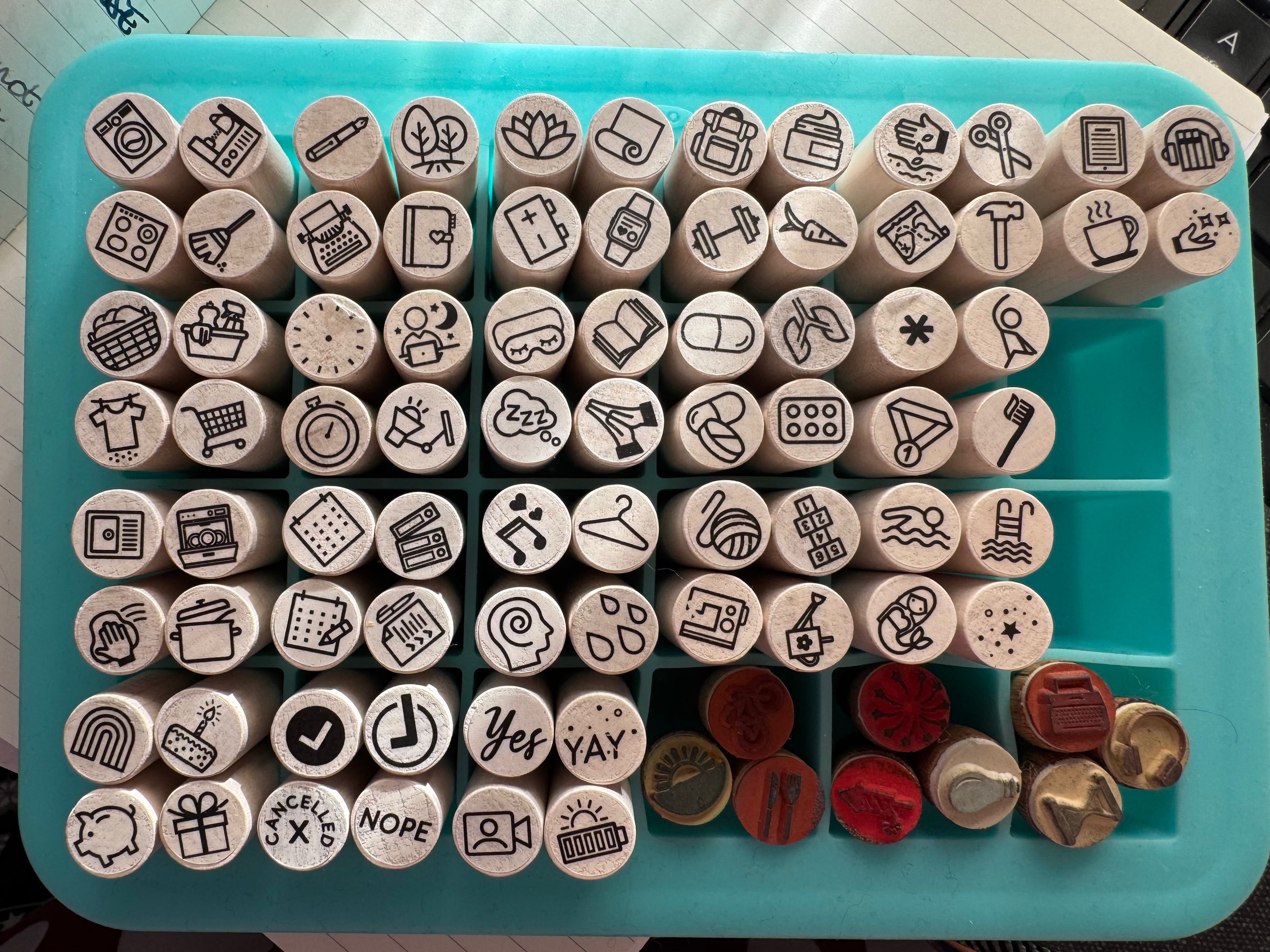
Over the course of years I’ve built up my vault of ministempfel or mini stamps. I get to give myself a visual reward for emptying the dishwasher, or hoovering, or getting to bed on time, or taking all my meds: whichever of the adulting tasks I’m most struggling with. You may notice that there are quite a few of them which relate to writing - that’s not an accident.
Going rogue on my planner helped too.
I am allowed to
decorate
experiment
miss days
And crucially: nobody else ever sees it. It’s just for me. It’s ok if it’s not perfect or Instagrammable. Totally ok to skip days, and I stopped giving myself shit for having blank pages - they invariably get filled in later with notes or overflow writing from another page.
Do you know what happened? Less guilt. More writing. More planning, more recording.
It took me such a long time - while being brutal to myself - to find systems that I can live with, tweak and tolerate.
My brain definitely doesn’t cleave to typical productivity systems but I can find ways to Get Shit Done. My hierarchy of motivators are Novelty, Rewards, Competition and Deadlines. Deadlines are definitely at rock bottom and only work in certain circumstances. Carrot is infinitely preferable to stick.
It’s a plain fact that if you give me free rein I’ll happily organise things like delivery of 10,000 litres (not a typo) of compost for twenty-eight different people to our allotment site. Or obtain a hundred kilos of bread flour in April 2020 to feed neighbourhood sourdough starters. The common factor here is scenarios with people saying “that must have been a nightmare” and me happily replying “actually it was quite fun!” because it’s a puzzle and a challenge, and almost silly. Perfectly novel.
Ironically now I’m managing three people’s calendars plus the family one. And a work diary. It’s all in colour coded, layered Google calendars. That results in much time on colour coding, not enough time on reading the bloody thing. All over again. But the kids are nearly, very nearly old enough to start taking some responsibility for themselves.
Here’s hoping diary management isn’t genetic.
As mentioned above, deadlines don’t do anything to motivate me. That’s okay as I’m not under contract right now, I’m writing for myself at the moment. Future editors will probably have to send me care packages in the post which explode and shower me in confetti.
Competition isn’t a good motivator here either because I don’t believe that writer should be in competition with each other.
Rewards would totally work though. Even tiny ones.
Reading in a sunny window, with chocolate. Infinitely calming for my nervous system.
Buying cute pocket sized notebooks so that I always have one to stick in my pocket for notes on the go.
Time to potter about at the allotment.
A tattoo on my forehead (backwards) that says I’m exactly where I’m supposed to be. Ok maybe not that one. Yet.
Rewards are particularly idiosyncratic and personal, just like our writing processes are completely individual.
Letting my switchboard brain find the connections between all the inputs — films, books, overheard conversations, random news articles — fuels my writing and add another thread to the story.
The trick was always finding what worked for my particular brain. Compassion and self-acceptance are the best motivators. That sounds like a ‘live laugh love’ sign but hey, it’s true. I am over kicking myself over not working, not writing. No penalties for the days that I don’t get to the desk. There’s enough crap in the world at the moment without us all beating ourselves up for how our brains work differently.
I gave up chasing productivity. I choose creativity instead.
I work with late diagnosed neurodivergent writers, helping them regain their trust in their creativity.
Comments
Nothing yet. Say the first thing.
Sign in to join the conversation.