
I have a full shelf of craft books, many with spines uncracked. No, they’re not valuable first editions.
It’s more like: well, I just need to acquire the book, right? Then all its wisdom just magically seeps into my bones via magical osmosis.
Spoiler alert: It does not. It just means I have more to dust.
(I don’t dust either.)
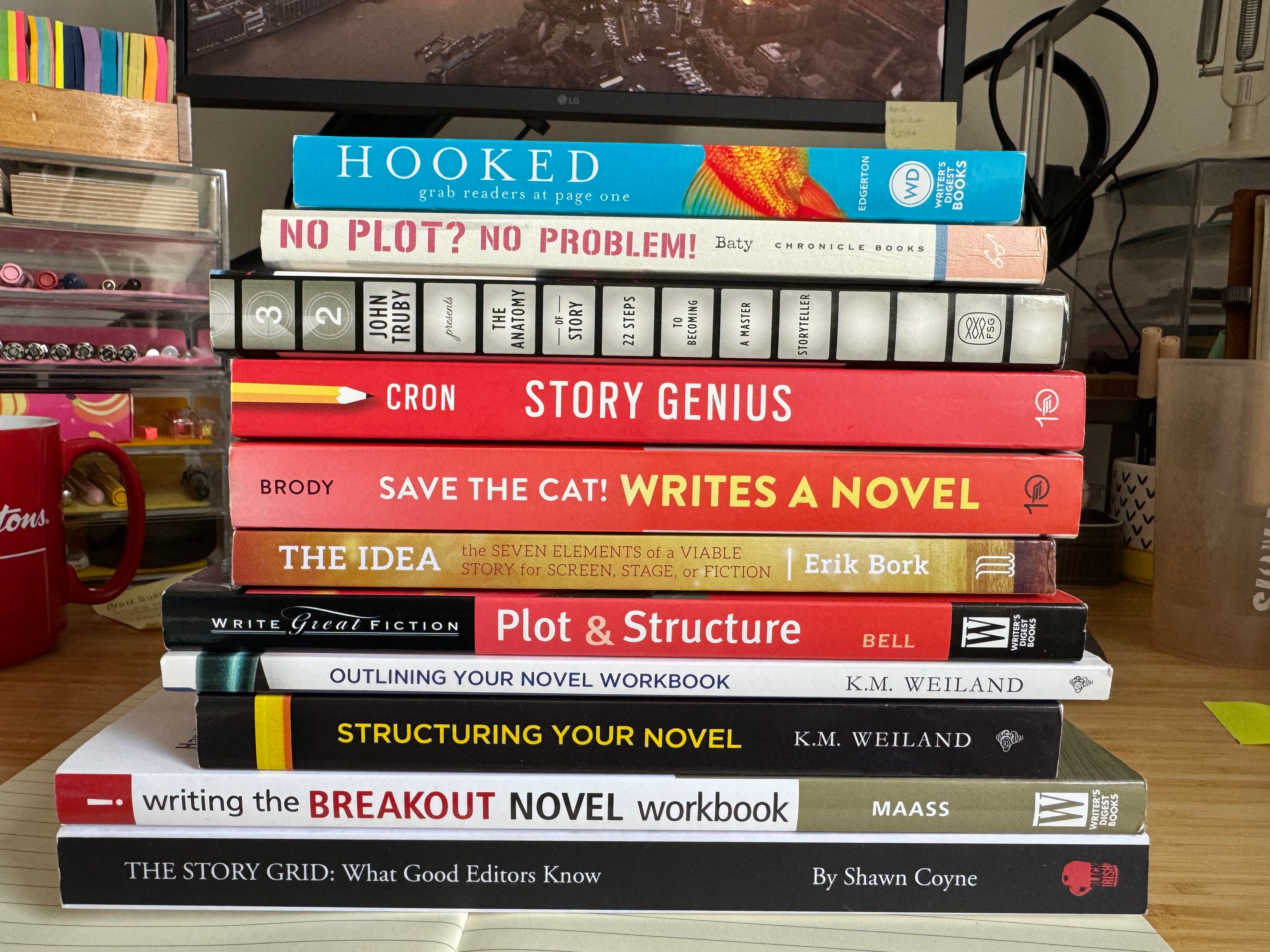
I am semi-obsessed with the BTS of other people’s creative process, learning about the craft, and foraging for inspiration. That’s the official answer. And also true.
Because they’re comforting. They’re company. A little shot of reassurance in paperback form — and, when you’re genuinely stuck, they can be exactly the right tool at exactly the right time.
Also I’m nosy and love all things writing-adjacent and thinking about narrative. And reading is part of writing, right? Well, yes it is. I always recommend reading to clients who feel stuck, because good prose or insightful writing often spurs them back to their own work, after a while. But there can also be a downside to being a perpetual student of writing.
The downside? It’s not actually writing. It’s circling it, thinking about it, not doing it. Julia Cameron calls this being a shadow artist.
For me, it’s down to the two Ps.
Procrastination and Perfectionism: finding lots of ways to make sure that I put off writing as long as possible, in favour of making everything just right.
There is no “just right”. There is only shuffling around of papers, losing notebooks, rearranging furniture, finding the right index cards (yes, I’ve done that). Does it actually affect whether to start writing? Only in that after hauling your ten-ton standing desk into a new position across the room, then realising the office door doesn’t open properly anymore, you have to heave the damn thing back and you’re too frustrated and knackered to write. Also a true story.
Compulsively collecting craft books isn’t necessarily about locating the cheat codes to writing a book. It can be curiosity, comfort, or staying connected to writing while working within your capacity, all of which are resourcing.
It gets trickier when it’s an expression of a lack of confidence. Self-confidence, professional confidence. Believing that the author of one of these books must have an answer, a system that works for me. Is there one on the shelf called “How to just sit your arse down in a chair and write a book”?
If you’re neurodivergent, the answer might be slightly more complex than “butt in chair” for lots of reasons. One is that a lot of systems are linear, and depend heavily on consistency.
I used to be in the ‘write every day’ crew, but in a hyperfocus, forget to wee, write a five-thousand- word scene that doesn’t actually move the plot forward, sort of way.
These days, add in menopause and chronic illness, and I am more Team ‘write 7k words in two days then forget the book exists for a fortnight.’
It’s very tempting to think that there’s a right way to do things, and if only we trap that very special unicorn, we’ll defeat all our obstacles! Honestly, even if there was, it would probably only work on Wednesdays in months with an R in them, and only once.
Ensuring perfect conditions feeds into perfectionism, which is a form of fear. It engenders fearful behaviour - which often shows itself as not wanting to share your work, but can start as far back as putting off starting the work in the first place. The window of tolerance for taking creative risks gets smaller and smaller each time you try, and then decide you’ve failed.
Reading a craft book can let you feel like you’re still “working” when you’re not writing.
So what are craft books to you — tactical tools, resourcing, a decompressing habit… or busy work?
Something that looks and feels like progress, but isn’t quite the action that moves your writing forward?
I don’t think I’ve found a craft book that addresses that feeling — but a few come close.
Maybe Matt Bell’s Refuse To Be Done, which is about revision and iteration as much as writing.
In the introduction, he stresses that you should ‘take only what’s useful’ — and he’s clear the book is shaped by his personal process, preferences and blind spots, which I find incredibly refreshing.
Not writing-related, but another way into this is Tara Brach’s ‘Radical Self-Acceptance’. I think it should be prescribed alongside ADHD meds.
To be clear, I do believe craft books are brilliant - when you use them tactically, at the right time.
If you’re really stuck, a beat sheet approach like ‘Save the Cat writes a Novel’ can help you identify the next big Tentpole event you could jump to, and that’s often enough to get you moving again.
Delving into story mechanics can also be useful, giving your brain some factual, and fascinating information: Will Storr’s The Science of Storytelling investigates how our brains interpret and understand narrative — useful when you’re shaping an arc or major character motivations.
I personally really like to cherry-pick from John Truby’s 22 Steps for fundamentals about story structure and function. It uses cinema for its examples but it’s widely applicable.
When you’re stuck or distracted, craft books can help you make one choice on what to try next. You don’t need a whole new system, just something to spark your curiosity again.
The bad is slavishly following an approach even when it feels icky.
You’re labouring rather than creating — it might even start to feel hard to get to the page, like it did before.
Relying too heavily on anyone else’s approach can actually be stifling, especially if you’re an intuitive writer, which I think is the case for lots of neurodivergent creators. (This can sometimes feed into what I call leggy creativity where you’re working furiously, but not actually making much progress.)
To me, the ugly aspect is the notion craft books is somehow cheating. “You shouldn’t need one of those” is something I’ve heard, and I think at best that’s unhelpful. “Shoulds” usually aren’t in our best interests, I’ve found.
Tools are tools. Are you writing? Good. Are you enjoying it? Excellent! No beating yourself up for using them.
Your work is always going to be your work. Doesn’t matter how you get there. Scaffolding is just something that gets the house built.
Yes, I’d like to read more of my library of craft books, ironically I use them all the time with my clients. Whether it’s Ann Lamott’s one inch picture frame, Will Storr’s filmic word order, or John Truby’s character web, sometimes a craft book can have exactly the right tool to get someone out of a fix. A lifeline.
Deploying a specific tool is especially useful for us writers with world-building brains, who get hobbled when faced with isolating just one story to focus on from an entire universe.
When anxiety means you don’t believe you’ll ever finish, it can help to map your story against a beat sheet and realise that you have most — if not all — of your elements already in place.
You have enough. I promise. If you get stuck, well then you have permission to go pull a book off the shelf. Go write.
On that, want to write with Jennifer Zarin from Journal Your Path and me, on Thursday 11th June at 6pm UK time/ 1pm EDT? Subscribers, check your email for details!
Know someone with a weakness for craft books? Let them know they’re not alone!
Comments
Nothing yet. Say the first thing.
Sign in to join the conversation.