
Welcome to this week’s AI & technology series!
One shift shaping the future of technology, explained before it becomes obvious.
Lately, I’ve been thinking about how agentic layers are reshaping research, especially the shift toward owning the workflow.
Claude for Excel came to the picture. The spreadsheet used to be the final destination after hours of research, analysis, and manual modeling. Now the AI layer is moving inside the spreadsheet itself, helping build the analysis instead of just answering questions about it.
The same pattern is appearing across institutional or industry-specifiy research. Tools are moving closer to the finished deliverable, from finding information to producing the thing you actually need.
For over a decade, research platforms sold a simple promise: help analysts find information faster.
Jack Kokko built AlphaSense after living the pain himself. As an investment banking analyst at Morgan Stanley, he spent hours pressing CTRL+F through thousands of PDFs, hunting for one relevant sentence.
That pain defined the research product for over a decade. Research platforms helped analysts search faster, access more sources, and surface relevant information inside a mountain of documents.
But everything after that stayed manual. Analysts still built models by hand, wrote memos, and stitched together five different tools to move from a question to a finished slide.
Fast forward to today, finding and summarizing information has become way easier.
Tools that help you search no longer enough. It becomes: which platform can take you from question to finished deliverable?
That is why research platforms are expanding beyond search:
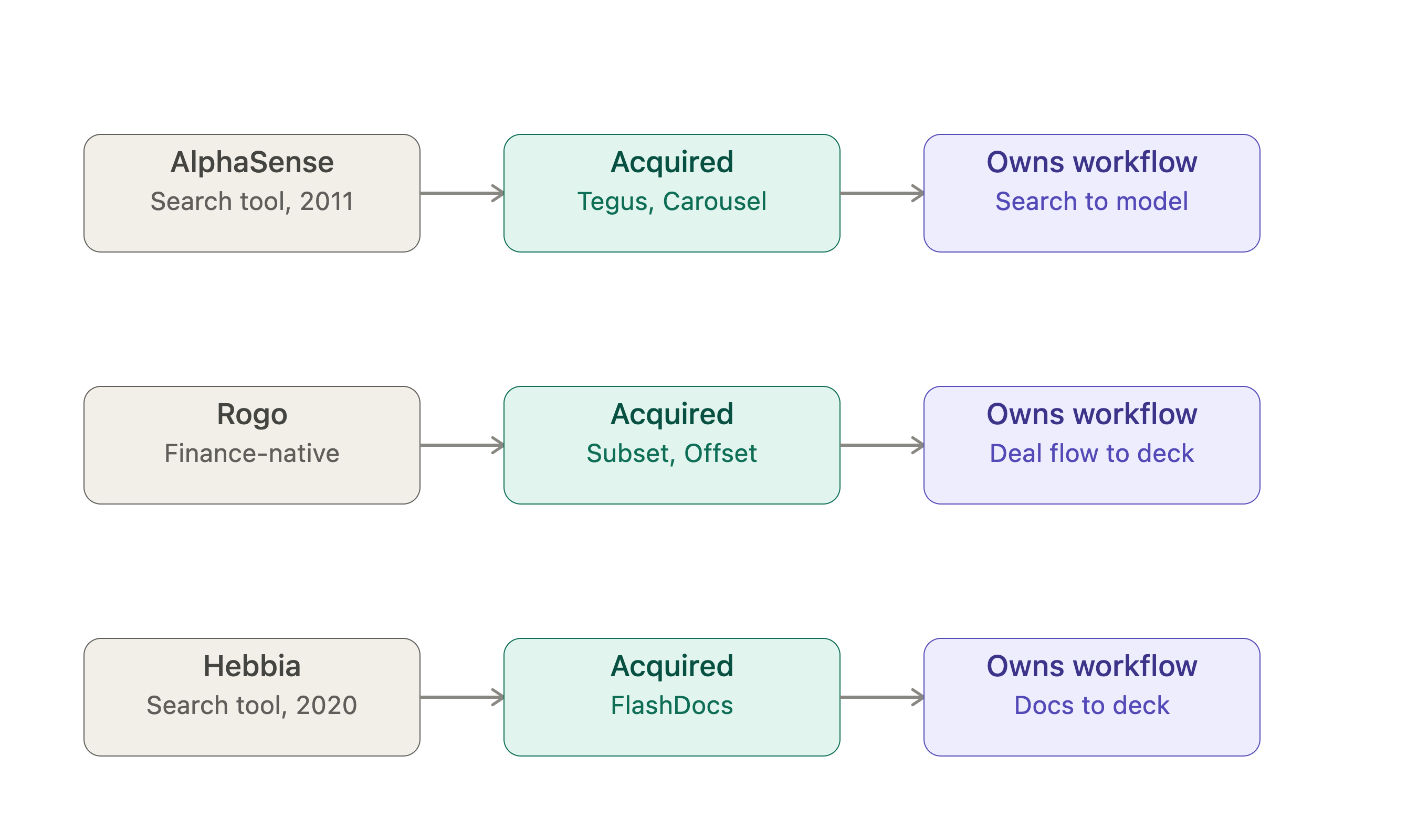
AlphaSense bought Tegus for $930 million in 2024, adding expert interview transcripts. Then in October 2025, it acquired Carousel, a YC-backed startup building AI-powered Excel models.
Rogo followed a similar path. It acquired Subset, an AI spreadsheet company, then later acquired Offset, which automatically updates financial models as new information arrives.
Hebbia acquired FlashDocs, a company focused on automated slide generation.
These companies no longer want to be merely search tools. They are absorbing features that solve the same missing piece: turning an answer into a finished output.
The shift toward owning output is forcing a response. This time from incumbents and horizontal AI labs themselves.
And I don’t think they are moving into this by coincidence.
Bloomberg launched ASKB in February 2026, an agentic AI layer inside its flagship Terminal. The goal was explicit: shift ASKB from a search tool into an embedded intelligence engine, with AI agents integrated directly into existing Terminal workflows.
Around the same time, OpenAI pushed into the same workflow from another angle. It released ChatGPT for Excel, with live data feeds from FactSet, LSEG, S&P Global, and Dow Jones Factiva built in.
Both moves point in the same direction: search less, build more.
By contrast, Rogo was built around automated financial workflows from the start. AlphaSense and Hebbia took a different path. Both began as search tools, then gradually expanded into broader workflow platforms through product evolution and acquisitions.
There's also a second pressure building underneath, coming from the open-source alternatives.
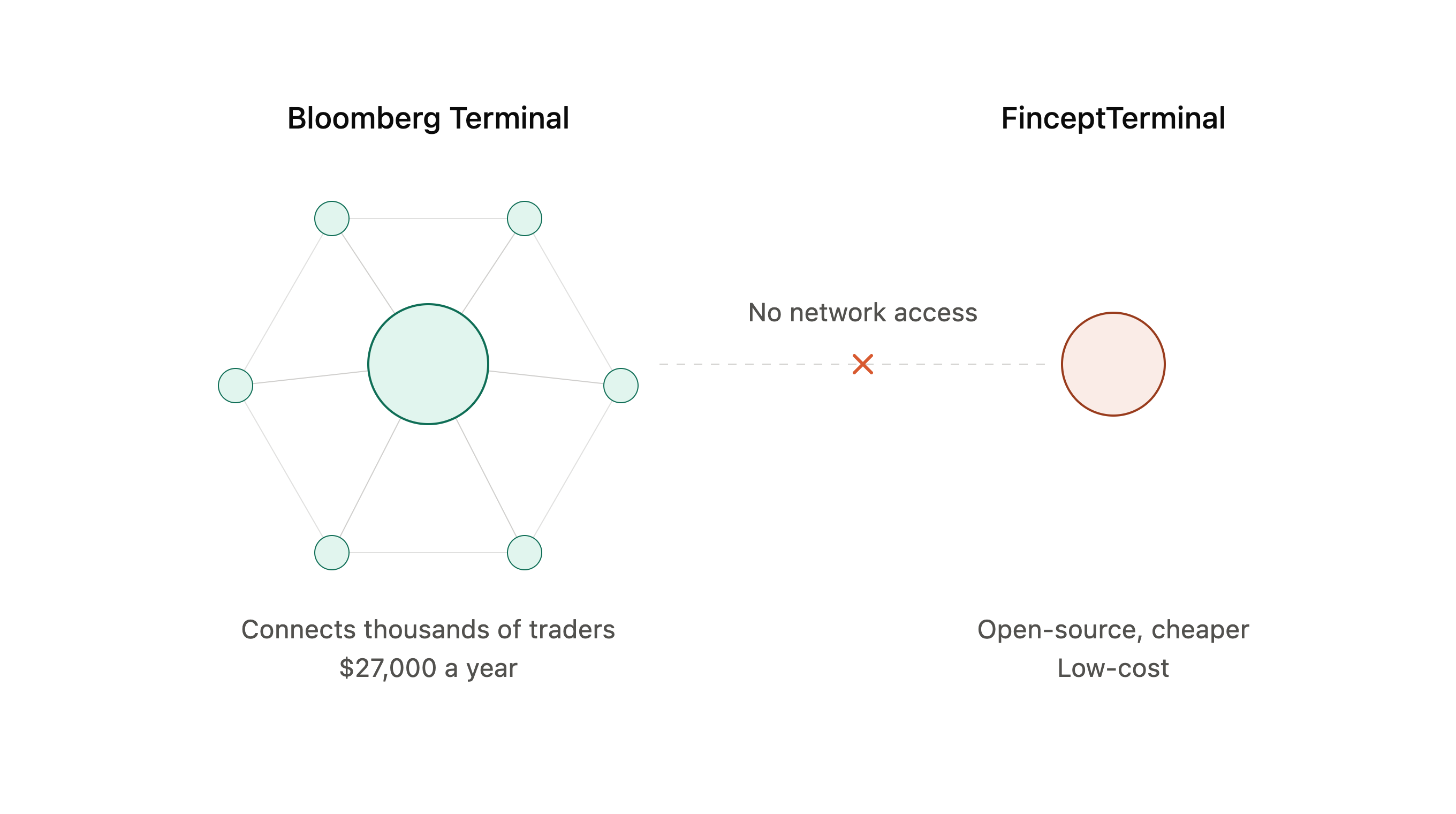
For decades, Bloomberg’s price, widely cited around $27,000 a year, locked out small research teams, independent analysts, and boutique funds.
Now projects like FinceptTerminal are stepping in from below, open-source and far cheaper, trying to close that gap.
But Bloomberg’s moat is deeper than pricing. A $27,000 annual seat buys more than data access. It includes Instant Bloomberg, the communication network traders rely on to reach counterparties directly.
FinceptTerminal can undercut the price but it can't replicate the network.
Before AI, the market rewarded companies that solved one painful step better than anyone else.
In an analyst’s workflow, that could be any step in the chain: find information → analyze → build models → write memos → create slides.
Carousel, Subset, Offset, and FlashDocs were four independent companies before they got acquired. Each solved one real adjacent problem within the researcher and analyst workflow:
Carousel built AI-powered Excel modeling.
Subset focused on AI spreadsheets.
Offset helped update financial models as new information arrived.
FlashDocs automated slide generation.
Within a year or two of proving those workflows mattered, each was acquired into a broader platform like Hebbia, AlphaSense, and Rogo.
Once a feature gets absorbed into a bigger platform, more value moves from the individual tool to the platform that connects the entire workflow.
Now, the workflow is the product. Individual capabilities become the features.
The moat is no longer simply who can create AI-native products. It is how deeply a product can become embedded into someone’s workflow. I explored this concept in my previous post on vertical AI, where the same dynamic appears across different industries:
Looking at these acquisition cases, the pattern becomes clear. These companies started as research platforms, then gradually expanded toward owning more of the analyst’s workflow:
Rogo positions itself around investment banking workflows, where research flows directly into models and deal materials.
Hebbia focuses on large document-heavy workflows across diligence and legal.
AlphaSense is expanding beyond search into a broader system combining research, transcripts, and modeling.
The stack is getting rebuilt around the workflow itself.
Up until this point, the market hasn't abandoned individual features like search, financial modeling, spreadsheets, or slide creation. These capabilities still matter; they aren't fully commoditized.
What has changed, based on the observations I discussed above, is the workflow ownership layer, i.e., who gets to own the entire path from question to finished output, not just one step along the way.

Liked this post? Share it with someone who’s thinking about this space!
All content is provided for educational and informational purposes only. Nothing herein constitutes financial, investment, legal, or tax advice. Always conduct your own due diligence before making financial or business decisions.
Comments
Nothing yet. Say the first thing.
Sign in to join the conversation.