
Sinners is going to win a bunch of its record-breaking 16 Academy Award nominations. Written, directed, and produced by Ryan Coogler, Sinners is an allegorical film about the never-dying threat of racial violence in America.
The much-deserved attention Coogler and Sinners is getting reminds me of another groundbreaking filmmaker, Ava DuVernay, whose films have helped me see America and myself more clearly.
I feel deeply connected to Ava DuVernay. Not just because we’re both storytellers – me for brands like Nike and AND 1, and DuVernay as an Oscar-nominated filmmaker – but because of an experience I had in Selma, Alabama.
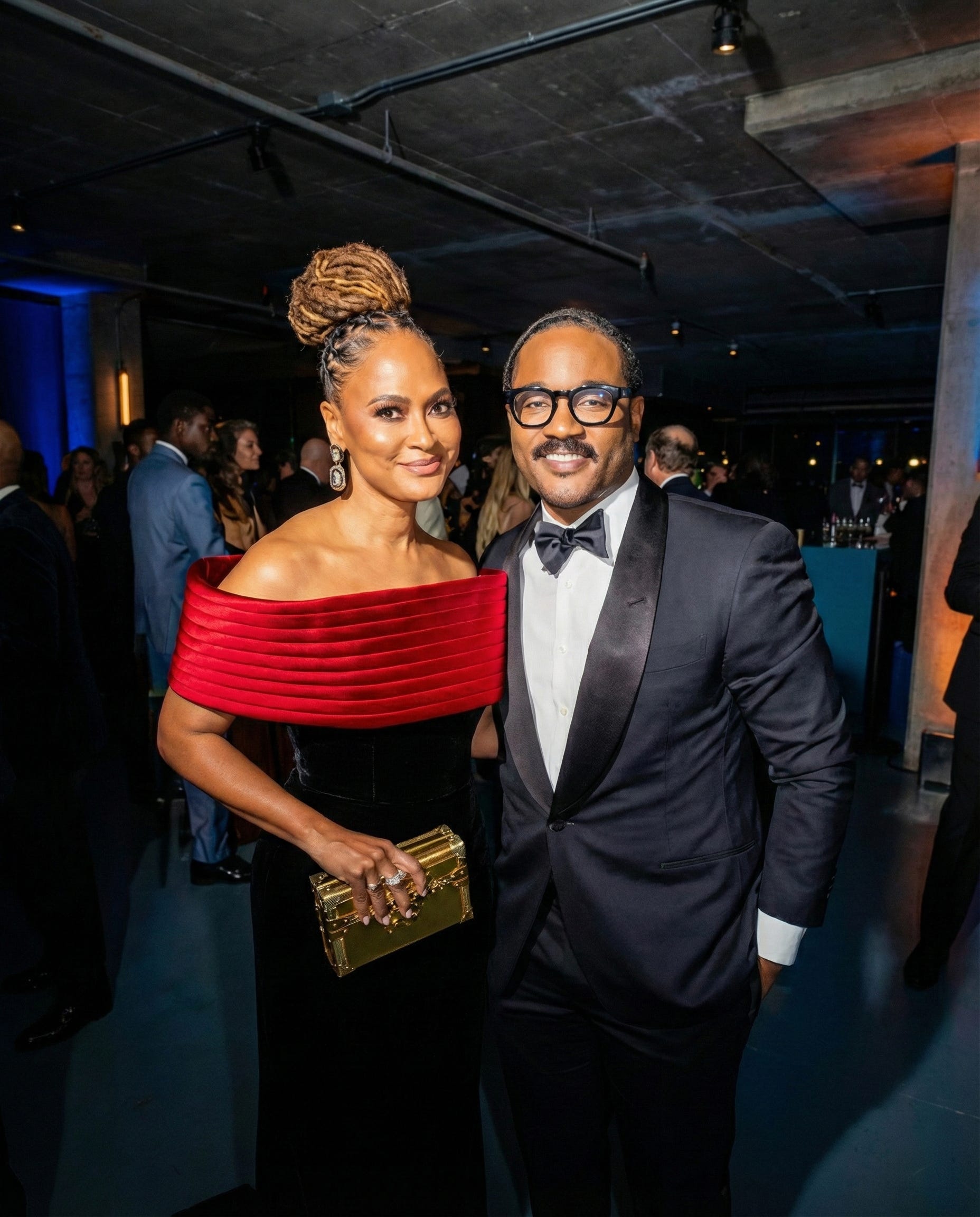
DuVernay may be best known for her 2015 Best Picture Oscar-nominated film Selma, which chronicles the historic Selma to Montgomery civil rights marches in 1965, including the infamous Bloody Sunday march, over the Edmund Pettus Bridge, led by John Lewis.
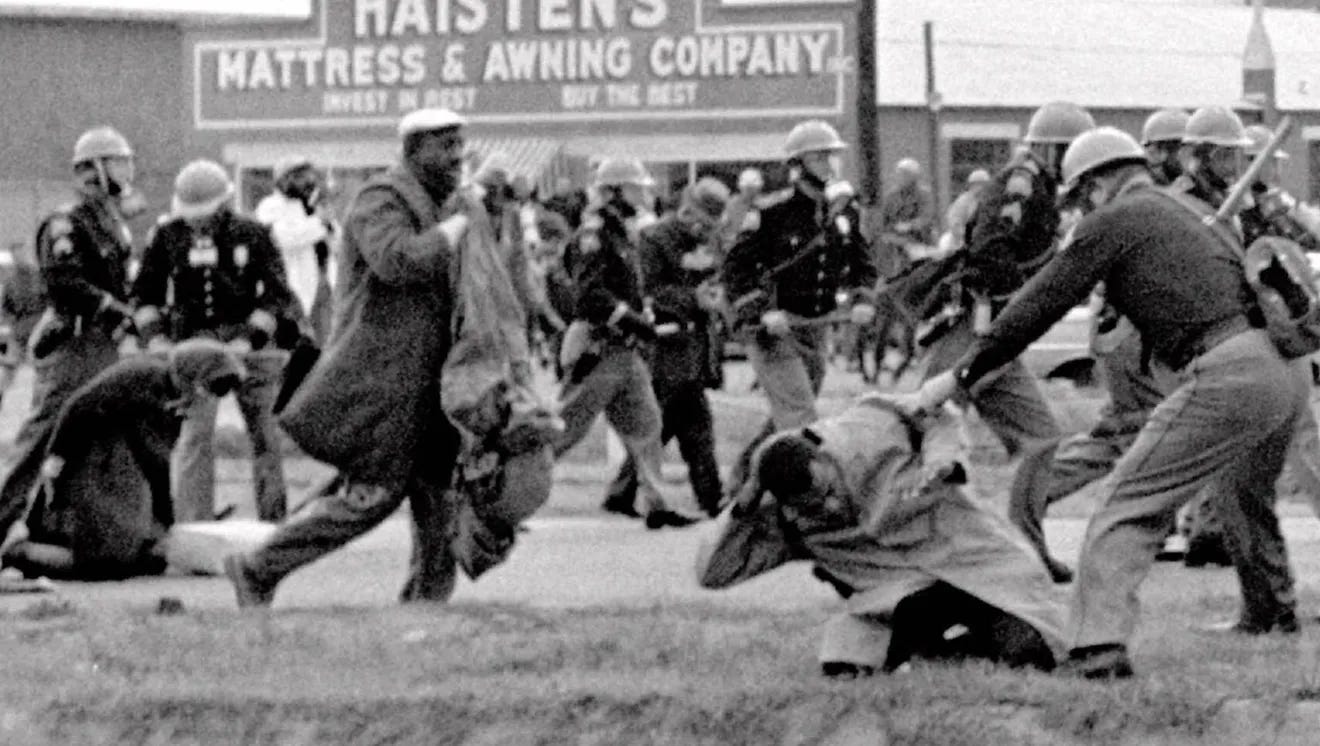
In March 2023, at the annual Bridge Crossing Jubilee, I crossed that same Edmund Pettus Bridge. It is now named the Edmund Pettus-Foot Soldiers Bridge in a compromise presumably to honor both those who fought for freedom of the formerly enslaved and continuously terrorized, alongside the name of a Confederate General and alleged leader of the Klu Klux Klan. I crossed with 5,000-10,000 others, almost all Black, alongside 50 of my brothers from White Men for Racial Justice (WMRJ).
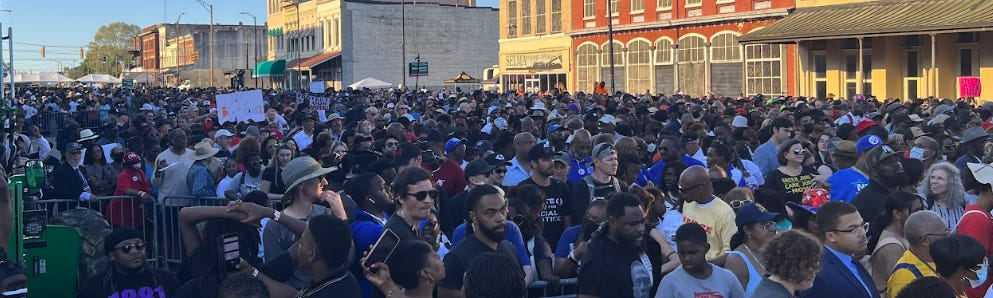
Our day in Selma was memorable for so many reasons – from the spontaneous, tearful, and reverent joy that encircled a wheelchair-bound Jesse Jackson during the annual King Unity Breakfast, to the lifted voices of the choirs in the morning Black church services we were invited to attend before the afternoon crossing. The one reason that stands out the most is the feeling of being welcomed and loved, a feeling of connection and community.
As a group of 50 white guys, I expected that we would be pretty conspicuous. Like most, I was uncertain how we would be received. Like most, I was anxious about the reactions of the overwhelmingly Black crowd to our White Men for Racial Justice t-shirts. All day long, people were checking us out, reading the t-shirts. Often, someone would break from their group of fraternity brothers or sorority sisters, church group, or local union, and come over to ask us, “What’s up with the tee?” One woman, face set to deep skeptic mode, even pointed to her phone and started recording as one of us shared his story of why he was there.
All day, as we fumbled our way through explaining ourselves, if perhaps not for this woman, then for most, we could watch skepticism turn to curiosity and then to interest; sometimes, more often than justified, interest unexpectedly expressed itself as hope and gratitude. On many uncomfortable and kind of embarrassing and then fun occasions, people asked if they could take photos with us to show friends and family back home the not-gonna-believe-this crazy thing they saw in Selma. We were embraced with love we didn’t deserve. It was just a t-shirt. The bar is that low. But for many there was a deeper message in that t-shirt that says White Men for Racial Justice – as we had heard from one Black woman prior, the t-shirt said, ‘It means you know my story.’
Yeah, most of us ask ourselves if wearing this t-shirt is “performative?” Maybe. The truth is this simple t-shirt sets a marker. Black women occasionally give me the “chin lift” that says, without words, welcome to the fight. That non-verbal exchange is also a form of accountability because I feel the added weight of raised expectations that I stay in the fight, even when it’s hard.
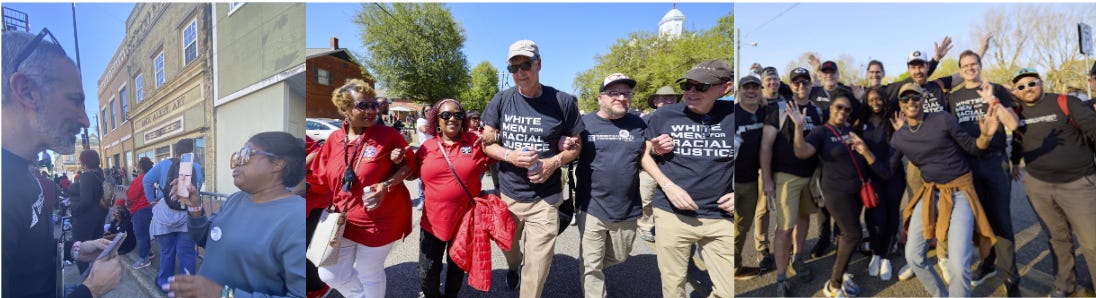
DuVernay once said, “The challenge is not to take the past and romanticize it, but rather to use it to inform the now.”
DuVernay’s Selma was released in 2014 amid escalating racial tensions in the U.S. – just weeks after massive “I Can’t Breathe” protests erupted in New York City because a grand jury failed to indict a New York police officer in the choke hold killing of Eric Garner, and just months after Black Lives Matter burst into the national consciousness during the uprising and riots in Ferguson, Missouri after Michael Brown was killed by a police officer. While the protests in New York and Ferguson were largely peaceful, I was among the majority of White Americans who were uncomfortable with the arson, looting, and violence in Ferguson. Yet, as a preacher’s son and person of deep faith, the words of Rev. Martin Luther King, Jr. resonated: “It is morally irresponsible to condemn riots without condemning the intolerable conditions which cause them.”
DuVernay’s Selma, along with her 2017 Best Documentary Oscar-nominated 13th about mass incarceration, and her 2019 Emmy-nominated miniseries When They See Us about the wrongful conviction of the Central Park Five, helped me to understand our still recent history of racial violence and the current conditions of a racially biased criminal legal system. DuVernay’s storytelling helped me to see the conditions that can lead to uprisings or riots, like when a drought creates the conditions for a forest fire when lightning strikes.
DuVernay’s impact extends beyond her art. What stories get told, and how those stories are told, has a lot to do with who the storytellers are. That’s why DuVernay founded the filmmaking collective Array, which champions diverse storytellers in film, offering resources and support to filmmakers from underrepresented backgrounds. DuVernay also uses her platform to raise awareness on issues such as immigration reform, women’s rights, and environmental justice.
As we approach both the Oscars and the March anniversaries of the Selma to Montgomery marches, and as we live in another moment of mass protest against state-supported violence in our streets and racially biased mass detentions, I invite you to watch Selma, 13th, and When They See Us to better understand our national story – the good, the bad, and the ugly – and its relevance to our lives today.
No posts
Comments
Nothing yet. Say the first thing.
Sign in to join the conversation.