
For the last several years, AI discussions have revolved around increasingly familiar questions:
Which model is best?
How much computational power is required?
Which benchmark matters?
Those questions are important.
But they may no longer be the most interesting ones.
A different constraint is emerging: human feedback.
Every AI System Eventually Needs Human Judgment
Large language models can generate text, write code, summarize documents, and answer questions, but determining whether those outputs are actually good remains surprisingly difficult.
Many of the most important questions in AI cannot be answered by another AI system.
Questions like:
Which response is more helpful?
Which answer is more trustworthy?
Which recommendation is more persuasive?
Which chatbot response feels more natural?
Which shopping recommendation better matches a customer’s needs?
These are fundamentally human questions.
As a result, AI companies increasingly rely on people to evaluate model outputs, rank alternatives, identify failures, and provide preference signals.
The industry has names for these activities:
Reinforcement Learning from Human Feedback (RLHF)
Preference Ranking
Model Evaluation
Trust & Safety Review
Human-in-the-Loop Assessment
But underneath the terminology, the mechanism is surprisingly familiar.
You ask people questions.
Then you analyze their answers.
Sound familiar?
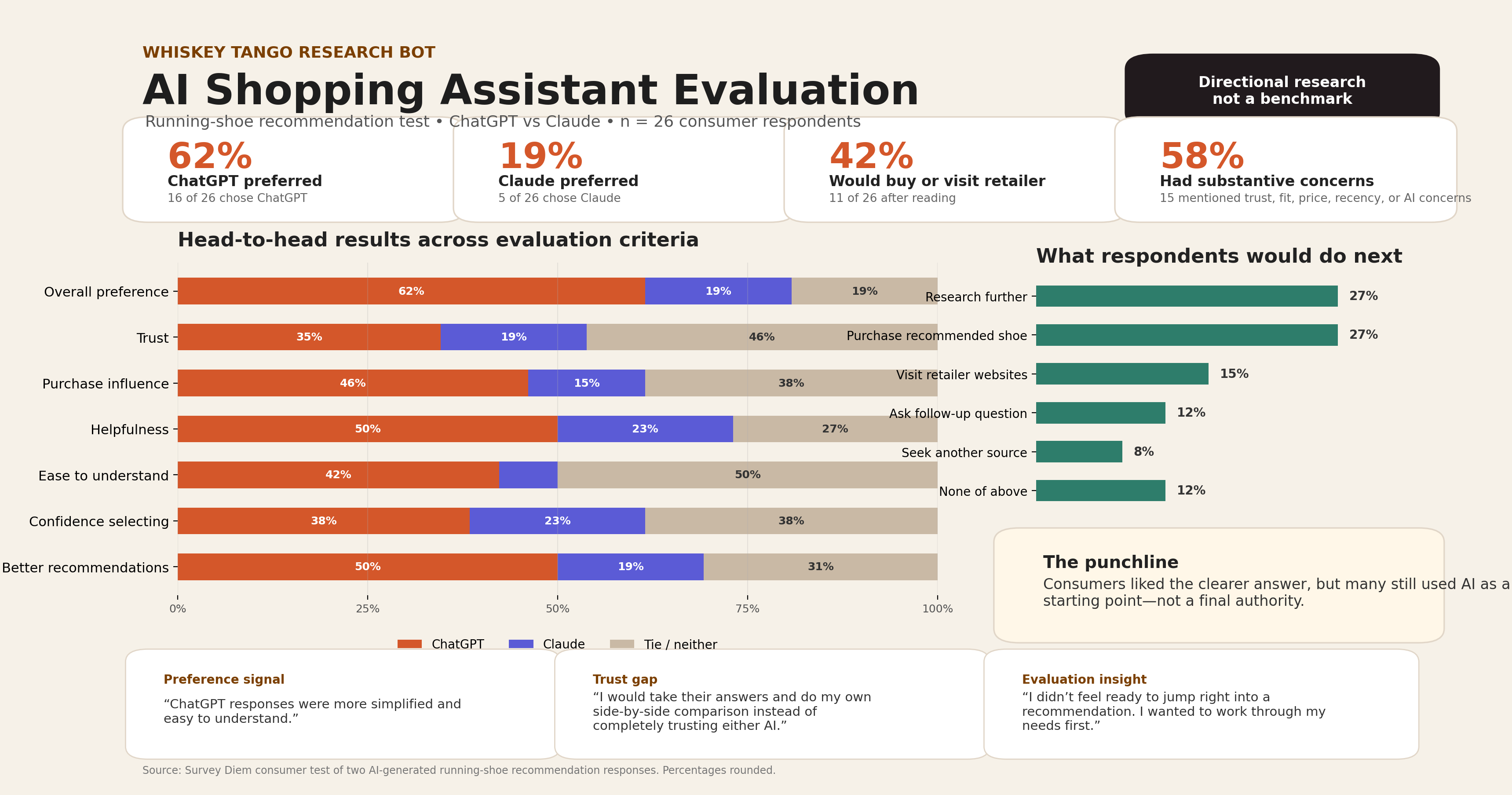
AI Evaluation Looks a Lot Like Survey Research
Survey researchers have spent years building systems for:
Recruiting respondents
Managing incentives
Preventing fraud
Measuring quality
Designing questionnaires
Collecting structured feedback
In other words, they have been solving human-feedback problems all along.
The difference is that traditional survey research asks questions about products, brands, opinions, and behaviors.
AI evaluation asks questions about model outputs.
The underlying mechanics are remarkably similar.
This is one reason why I suspect the boundaries between survey research and AI evaluation will become increasingly blurred over the next few years.
The Hidden Problem: Not All Human Feedback Is Equal
As demand for human evaluation grows, a new challenge is emerging.
How do you know the humans providing feedback are qualified to do so?
This problem is familiar to anyone who has worked in market research.
Bad samples produce bad data.
The same principle applies to AI evaluation.
If an AI company wants to evaluate:
Medical advice
Financial recommendations
Educational content
Shopping assistance
The identity of the evaluator matters.
A panel of random internet users may produce very different results than a panel of verified consumers, subject-matter experts, or carefully targeted audiences.
The quality of the feedback becomes inseparable from the quality of the people providing it.
Much of the AI industry’s attention remains focused on model performance.
But another race is quietly taking shape.
Companies are competing to build better systems for:
Recruiting evaluators
Measuring preferences
Capturing human feedback
Detecting low-quality responses
Creating representative evaluation samples
In short, they are competing for access to trustworthy human judgment.
As models become increasingly capable, the ability to measure quality may become nearly as important as the ability to generate outputs in the first place.
Thanks for reading.
No posts
Comments
Nothing yet. Say the first thing.
Sign in to join the conversation.