
I’m back with my latest idea, PlasCred Circular Innovations, and it fits three themes I’m chasing right now:
an old problem finally solved by advances in material science
a desperately needed green tech that is wildly profitable without government subsidies
good companies with terrible names.
I suspect this may be my most controversial idea yet: mixed plastic recycling with pyrolysis. I hear groans in the back of room. I’ll just wait a second while half of you see yourselves out.
Warning: I am an addled low-IQ bird. You’d be a fool to take anything written here as advice or a recommendation.
Plastic waste is a huge problem: 400 million tonnes of plastic waste is generated each year, and only 9% of that is recycled. Plastic lasts forever, but 40% is single use. This is both a huge problem and a huge opportunity: there is massive value, waiting to be unlocked, in the hydrocarbons tied up in that plastic.
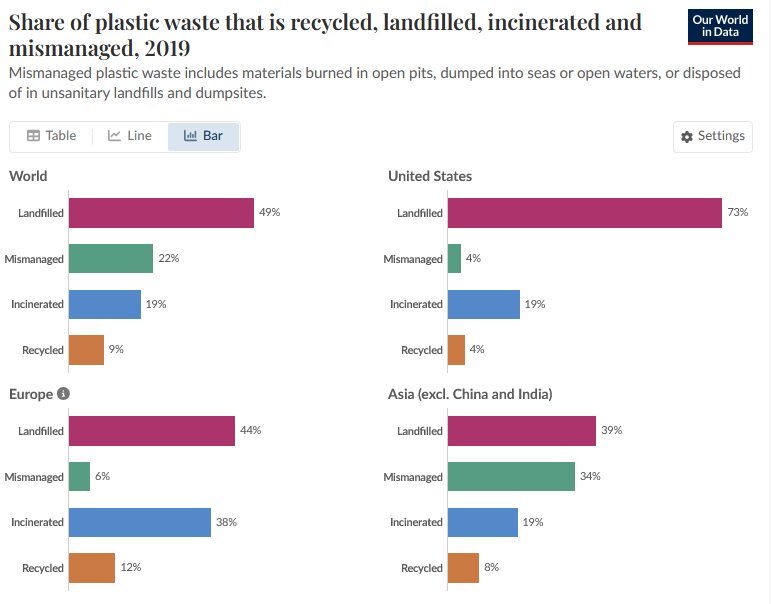
The Holy Grail of plastic recycling is converting mixed plastics (Types 1-7 including PVC and PET) into a petrochem feedstock, i.e. naphtha/condensate. Lots of well funded actors have spent much investors’ money trying, and mostly failing, to do this.
And that’s why pyrolysis has a terrible reputation: a long history of incinerating capital as well as polymers.
So first things first, I will address why PlasCred could succeed where those before have mostly failed.
When you think of plastic recycling, you are probably thinking of what is known as “mechanical recycling”: plastics are sorted by type, and then melted down and turned into ugly patio furniture or long lasting fence posts.
There are three main problems with mechanical recycling:
The feedstock must be a pure, single type of plastic (eg: only HDPE). In practice this is prohibitively expensive on large scales.
Every time the plastic is melted, the polymer chains get shorter and weaker, so the recycled product deteriorates every time it is “recycled”.
Used plastic has contaminants (eg Billy Bob used his milk jug to store used motor oil), and simply melting down the HDPE won’t remove those contaminants.
Mechanical recycling is pretty much a dead end and why so little of the waste plastic stream is currently recycled.
Technically pyrolysis is “the decomposition or transformation of a compound caused by heat”, but in the context of plastic recycling it means heating plastic (typically to 500C+) in the absence of oxygen (so it doesn’t burn) to break down (“crack”) the long plastic polymer molecules into shorter hydrocarbon chains.
Historically plastic recycling with pyrolysis has failed for a few reasons:
Inability to handle mixed plastics: without a pure and consistent feedstock, simply applying high heat to mixed plastics produces an unusable output oil that needs very expensive to post-processing. Even small amounts of PVC produces enough hydrochloric acid to corrode reactors and poison the output oil. Mechanical sorting of mixed plastics, to produce an appropriate feedstock, is not economically feasible. When you see a company reporting experimental results recycling pure polypropylene or polyethylene, you should be very skeptical.
Wax and coke: without precise control, thermal cracking produces an oil with heavy waxes which are no bueno for the oil or the reactor. If the polymers get too hot or spend too much time heated in the liquid phase, they can turn to coke and foul the reactor which necessitates costly downtime. Also, contaminants in the feedstock (eg: aluminium foil) can end up in the output oil or foul the equipment.
Toxic byproducts: without adequate control mechanisms, nasties like dioxins and polycyclic aromatic hydrocarbons get created. No bueno squared.
Poor quality product: pyrolysis oil is often of very poor quality, with the wrong carbon length profile, too many contaminants or aromatics, and/or too many unsaturated molecules (olefins). All of these are, at best, expensive post-processing liabilities.
Energy efficiency and scaling: it is energy intensive to heat plastic to 500°C+, scaling up reactors makes it difficult to maintain an even temperature, and temperature variations leads to the above problems.
When it comes to pyrolysis oil, “presumption of guilt” is the order of the day: assume the technology is doomed until convinced otherwise. To that end the first thing I want to do is point-by-point explain why I think PlasCred has cracked (groan) this problem. But to do so, I first need to describe PlasCred’s process.
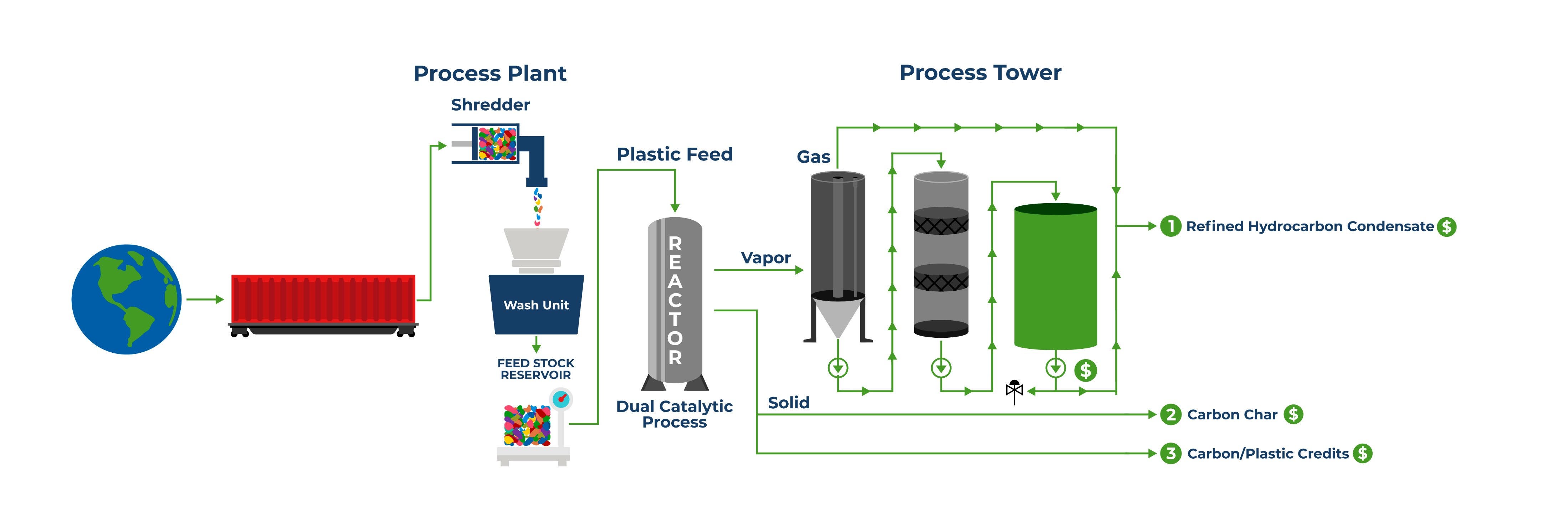
Conceptually, the process is pretty simple, but there is some real magic hiding in the details.
Mixed plastic bundles arrive by railcar and pass through a shredder.
The shredded plastic is washed to remove the bulk of the contaminants. Interestingly, chlorine that is extracted in step 4 below is used in this washing step.
The washed plastic enters the reactor and is heated to 350C at 10 psi with continual mixing. Managing the even heating of a viscous liquid has some crossover with the steam injection of SAGD heavy oil wells in Alberta, and PlasCred’s team has years of experience with that tech. Catalysts are used to crack the liquid plastic into carbon lengths that vapourize at these modest temperatures and low pressure. The low pressure obviously greatly assists in vapourizing the cracked plastic, and makes the industrial process simpler and cheaper.
The cracked and vapourized polymers move into a gaseous phase reactor where more catalysis occurs: long chains are further cracked and undesirable byproducts (eg: chlorines) are removed.
After the ex-situ gas reactor, the gases move to distillation columns, where the molecules are separated into three broad categories:
Process gases: methane (C1) through butane (C4).
Condensate: C5 – ~C20.
Heavier waxes: ~C21 – ~C26.
The three streams out of the distillation column go three ways:
The process gases are burned for the heat the system needs.
The condensate is condensed into the output oil.
The vapourized waxes are piped back to the liquid phase reactor to be run through the process again.
PlasCred’s magic happens via two key processes: in-situ reactor conditions of 350C and 10 psi, and multi-phase processing.
Note: all of this section is based on the results of PlasCred’s pilot Primus plant, which has a nameplate of capacity of 400 kg plastic/day producing 2 bbl condensate/day. It has been operating since May 2023, so PlasCred has 3 years of experience and data from this small scale facility.
Cracking and vapourizing mixed plastic at 350C and 10 psi is a remarkable achievement, and is at least 150C cooler than most historical pyrolysis efforts. These conditions dramatically reduces the risk of coking and creation of nasty byproducts.
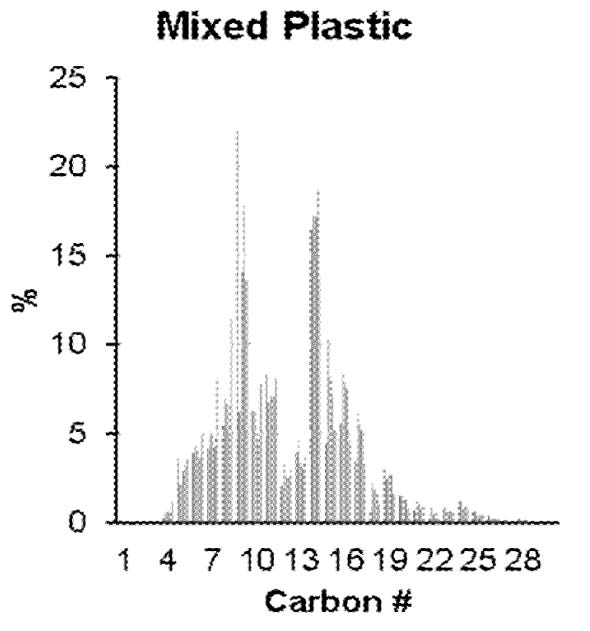
As the liquid plastic is cracked, the PlasCred process continually pulls vapourized molecules into the gaseous reactor. This minimizes residence time in the liquid phase reactor, which minimizes coke production and maximizes the liquid content of the system output. Another benefit is that there is a maximum molecule size that will vapourize at 350 C (C26? C28?), so the introduction of the gas phase reactor automatically terminates the right tail of the carbon number chart, and this is exactly what you want.
One by one, let’s go through the five horsemen of pyrolysis oil:
Mixed plastics: PlasCred’s process, with moderate temperatures, low pressures, two phases, efficient mixing and thermal control, can produce a condensate grade oil from an unsorted mix of plastics Type 1-7. That is their claim, and large industry players have independently verified these claims (more on that later). Subject to #5 horse below, this looks solved.
Wax and coke: Coke production is eliminated by PlasCred’s low temperatures and low liquid phase residence time. Some char (< 5%) is produced and some contaminants pass through the system, but these are collected and removed from the reactor without a system shutdown.
Toxic byproducts: Again, moderate temperatures are key. Nasty byproduct production is virtually eliminated, and the product flow can be effectively and efficiently cleaned in the gaseous phase reactor.
Product quality: PlasCred produces a clean, sulfur-free oil with an ideal carbon number profile that is a condensate/naphtha drop-in replacement with one exception: olefins. The olefin story is surprising. While they are the ultimate petrochem feedstock, they are a moderately reactive molecule, so are generally rejected by the recycled hydrocarbon supply chain. Additionally, the Enbridge condensate spec requires <1% olefins, so high olefin content oils are not eligible for the Enbridge pipelines. PlasCred had expected to hydrotreat their condensate (remove the olefins) in the gaseous phase of their ex-situ reactor (+$5/bbl to production cost), but their customers surprised them with a request to leave the olefins unsaturated. They are valuable to the petrochem industry if transport can be managed, and apparently it can.
Energy efficiency and scaling: With relatively low temperatures, low pressures, economical catalysts, and captured process gases, PlasCred’s processing costs are $34/bbl, making for 72% gross margins with their $120/bbl offtake. Based on the three years of experience with the Primus pilot project, management is very confident in the scale up to Neos. But, yeah, they would be. This appears to me to be the risk. More on this later.
PlasCred has partnered with CN (Canadian National Railway), a C$94B Canadian company with 32,000 km of track stretching from coast to coast in Canada, and south past the Great Lakes to the Gulf of Mexico.

PlasCred is leasing the land for their first commercial scale plant (“Neos”) from CN in Scotsford AB. Getting tied into the CN logistics network is a huge advantage for PlasCred, and will help keep the cost of feedstock, and the cost of shipping the produced oil, as low as possible.
PlasCred’s feedstock will be transported in boxcars, and that is why this is interesting for CN: at least a third of boxcars currently travel empty (“backhaul”) west across Canada to pick up commodities (primarily forest products and pulp/paper) for transport back east. If CN can work towards filling those railcars with bales of waste plastic, it would be valuable economically, as well as scoring green points for free.
The CN network also offers economic access to the plastic waste of eastern North America.
It is probably no coincidence that a past Senior Vice-President, Rail Centric Supply Chain at CN Rail is on PlasCred’s board of directors.
PlasCred has signed a 5-year binding offtake with global commodity trading house Trafigura for 2,000 bbl/d at $120/bbl. That is all of Neos’ production, and most of Maximus Phase 1! This price is for transfer at the CN rail yard, so Trafi is on the hook for all shipping costs. This is a very big deal for a startup like PlasCred: they have a guaranteed price for 100% of their product at a very favourable price. Trafi liked the product so much, they also negotiated a right of first refusal on PlasCred’s next bigger facility.
As part of signing this offtake, Trafigura was on-site at the Primus site for a week performing due diligence on the facilty. They ran the process from inputting mixed plastic to pulling off the condensate at the end. The PlasCred team did not interfere in the process, and Trafi collected their own samples to be sent to their chosen labs for analysis.
Signing a binding offtake at this price tells us they believe the tech works, and the quality of the product meets a very high specification. This is a massive validation of PlasCred’s technology from an industry titan. DD was also conducted by Shell, Exxon, and Dow, and all three offered offtakes at competitive pricing, just not quite as competitive as Trafi’s.
PlasCred has announced a deal with Circular Materials, a industry-funded organization tasked with facilitating the recycling of post-consumer plastic waste. That deal will pay PlasCred to take mixed plastic. This is unsurprising – it is a very similar setup to Comstock Metals charging for the accepting of end-of-life PV panels: both old panels and waste plastic are toxic waste that organizations will happily pay for it to be disposed of in an environmentally friendly way. Plastics are even more compelling as governments worldwide are mandating that plastic be recovered, not buried or burnt.
In a now-deleted interview with ceo.ca, PlasCred’s CEO Troy Lupul talked about this deal, and went so far as to say it could reduce their total opex to near zero. That is quite a statement. By my math, they would need to charge ~$220/ton for mixed plastic delivered to Scotsford. Those don’t sound unreachable numbers to me, but to be conservative, I am going to model a tipping sufficient to cover shipping costs to Scotsford.
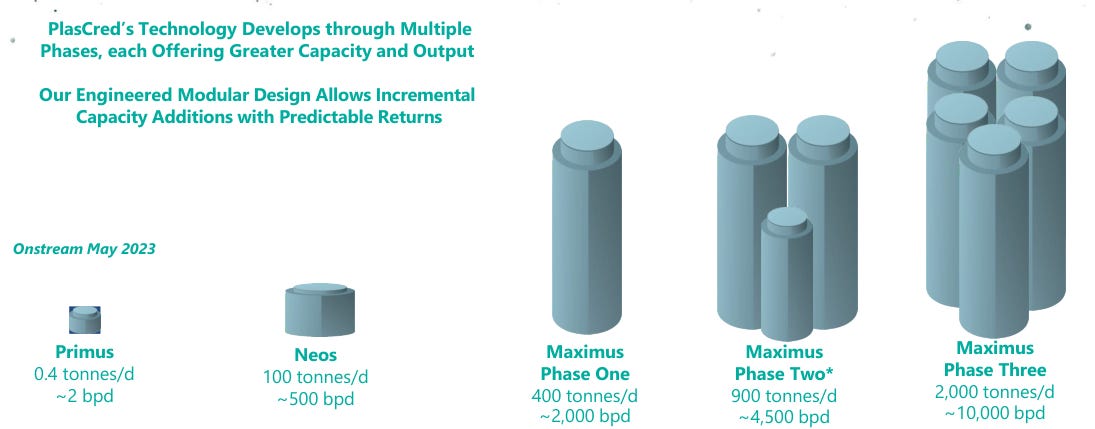
PlasCred have been running Primus (in batch) for three years, and are now doing final engineering on their next facility, dubbed “Neos”. Neos will be small scale commercial: nameplate of 100 tonnes/day of feedstock, producing 500 bbl/d of condensate. I am guessing we get FID in Q4, but deposit will be made on long-lead itmes before then to keep the a schedule of mid-2027 commissioning.
Neos is small for commercial scale. While it will generate ~$11M+ EBITDA on $25M capex, its real purpose is to prove that the technology can scale. Neos will be a single 500 bbl/d reactor, and scaling to 10,000 bbl/d just means more reactors - once Neos is proven, any further scaling risk is minimal.
Once Neos is proven, PlasCred will immediately start work on building the next facility, “Maximus”, that will size up in 3 stages to 2,000 tonnes/d feedstock and 10,000 bbld/d condensate.
The alert reader will have noticed that the capex intensity of Maximus is actually higher than Neos, which initially surprised me. The reason for this is the Maximus design includes a much more sophisticated front-end for sorting and cleaning to handle very dirty feedstocks (think fertilizer bags, oil containers, etc).
That is interesting, and begs for some connecting of breadcrumbs. We know that the Circular Materials will preprocess the mixed plastic before delivering it to PlasCred. My guess is that PlasCred is being careful about the feedstock they are lining up for Neos. Make no mistake, they will be processing Types 1-7 mixed plastic, but I think PlasCred is walking before running, and will be leaving the most difficult feedstocks for later. Sensible risk management.
PlasCred has a patent application filed covering their system. I am not a patent lawyer, but the application reads very broad and non-specific to me, however Gemini tells me it has a couple novel ideas and may have a good chance of receiving a patent.
When I spoke with management, they emphasized that many of their trade secrets, which includes catalyst details, are not published in the patent application for a good reason: their trade secrets would no longer be secret. If the patent application was denied, then they’ve shot themselves in the foot, and even if it was, actors like China are not known for worrying about details like patents.
It is common for microcap tech startups to choose to leave some of their secret sauce out of patent applications, or to just avoid the whole patent process altogether and rely on trade secrets and a head start. LibertyStream and Comstock Metals are two other examples I’ve written about that do not have patent protection.
Maybe the patent will prove valuable, honestly I have no idea. But if it doesn’t, I don’t consider that particularly damaging to the thesis: any competitor would be years behind and would not have such excellent logistics integration.
The originally published economics for Plascred quoted $64/bbl in variable costs, but that included ~$150/tonne in feedstock costs: $100 for the plastic, and $50 for transportation. Just the processing costs amount to ~$34/bbl.
Since then, we’ve had the Circular Materials deal that includes a tipping fee, a real game-changer for the economics. While this could be accretive to earnings, to be conservative, I am going to model a tipping fee of $0/tonne delivered to Scotsford, or $100/ton if not, which would cover shipping, so in both cases I am modeling free feedstock but no tipping fee (deferred) revenue.
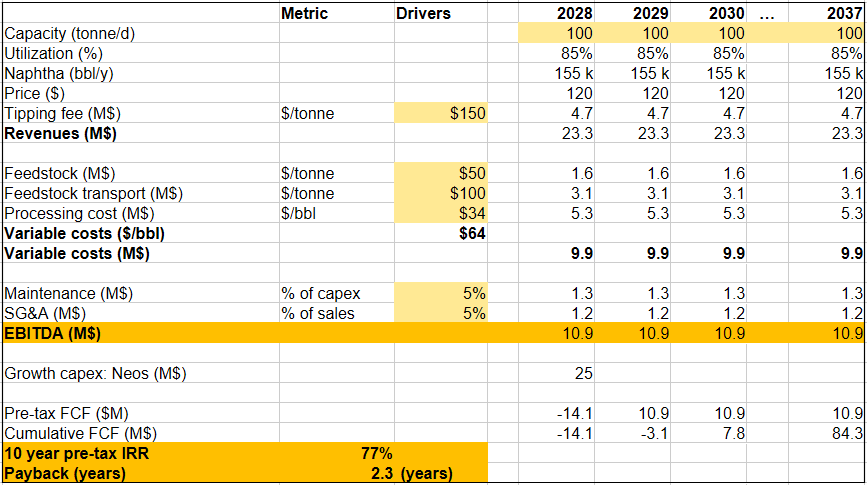
Per plant economics are compelling: 77% pre-tax IRR with a 2.3 year EBITDA payback. Capex efficiency would undoubtedly improve with larger facilities.
By my calculations, after the April/May capital raise PlasCred needs another $6M to bring Neos into production. While Neos should be generating cash by 3Q27, I am looking for funding through 1Q28. My understanding is that sources other than another equity raise are being pursued.
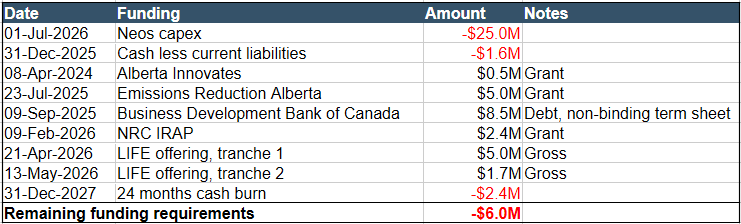
One extra consideration, is that there are ~$9M worth of warrants outstanding that are callable above $0.40, so if the stock were to settle above that level, additional funding would not be required.
Once Neos is proven, financing will become much easier, and PlasCred’s cost of capital will become much cheaper. But having said that, it is too early to speculate on how Maximus will be financed.
I haven’t gone deep on the competition – I don’t think it matters. Nobody is recycling mixed plastics at scale today and the market is enormous, so there is lots of room for multiple players, and PlasCred’s integration with CN is a huge advantage.
PureCycle: a US$1.8B company that doesn’t use pyrolysis, but requires pure polypropylene feedstock. Losing money forever.
Agilyx: a US$250M Norwegian company founded in 2004. Non-pyrolytic recycling of pure polystyrene only. Yup, you guessed it, bleeding money like a stuck pig.
Alterra: A US-based private company that has had a 60 ton/d pilot project in Akron, Ohio running since 2020. This is the closest tech to PlasCred: below 400C, low-pressure catalytic pyrolysis. They are going the licensing route, and have licensed their tech to Neste in Europe, but scale-up challenges continue.
BlueAlp: A private Dutch company with multiple industrial investors like Shell Ventures (21%), Borealis (10%), Mourik, Den Hartog. They have a relatively mature tech, but pretty conventional: 500-600C non-catalytic pyrolysis. They have a 20 kton/year mixed plastic in Belgium that was commissioned in 2020. Despite it being integrated into a large facility that pre-sorts and pre-processes feedstock, they have struggled with both problematic feedstock and sub-standard output oil.
Mura: a large private UK plastic recycler. Uses water at extreme temperatures and pressures to rip the plastic molecules apart. Needs massive facility size. Capex looks 2-3x PlasCred’s on a volume basis, but the projects are massive and have equally massive capex requirements. Opex also looks high due to temperatures and pressures required.
Aduro: a Fintwit favourite. Similar to Mura, but slightly less crazy reactor conditions and uses catalysts to assist in cracking. They do not yet have a proper pilot project, look a couple years behind PlasCred’s schedule, plan to mostly license not build, and are focused on Europe. They do have some patents, but none that apply to plastic. Market cap is US$450M, about 25x PlasCred’s.
Troy Lupul is PlasCred’s CEO. He has a long history of working with water, wastewater, and water treatment in or adjacent to the oil and gas industry in Alberta. And this isn’t his first rodeo: he has build, and sold, two companies (Filterboxx and ClearBakk) that innovated in the water/wastewater sectors.
Troy owns ~22% of the company, or ~14% fully diluted.
We can look at Neos’ economics and see they are very compelling, but we’re not buying $PLAS.CN for a 500 bbl/d plant. Assuming Neos works anywhere near as advertised, it is obvious financing will become easy, and PlasCred will move ahead with Maximus and Colossus (yes, I made that one up) as fast as possible.
Valuing PlasCred is a bit of a challenge, to be charitable. A lot of unknowns and risks lie on the road ahead. What I can do is imagine a modest bull case in an effort to wrap our arms around the opportunity.
My assumptions:
Deposits are placed for long-lead items this summer.
Neos FID is made in 4Q2026.
Neos commissioning is 6 months late, with real ramp in production not happening until 1Q28.
After an average utilization of only 50% in 2028, utilization rises to 85% in following years.
Maximus Phase 1 FID is made mid-2028 after ~6 months of Neos production, with commissioning in mid-2029.
Maximus Phase 2 commissions in 2031, Phase 3 in 2033.
Maximus phases are funded with half debt, half equity. Equity is raised at 15x EV/EBITDA based on the year prior to commissioning.
Keep in mind this is just order of magnitude stuff, but it is a clear path to over $200M in EBITDA by 2033. A game changing tech, with a massive TAM, growing at 50%? What multiple you want to put on that EBITDA? 15x is not ambitious and gives us a market cap over 100x the current fully diluted valuation. But do remember that doesn’t include future dilution, which is inevitable and likely significant.
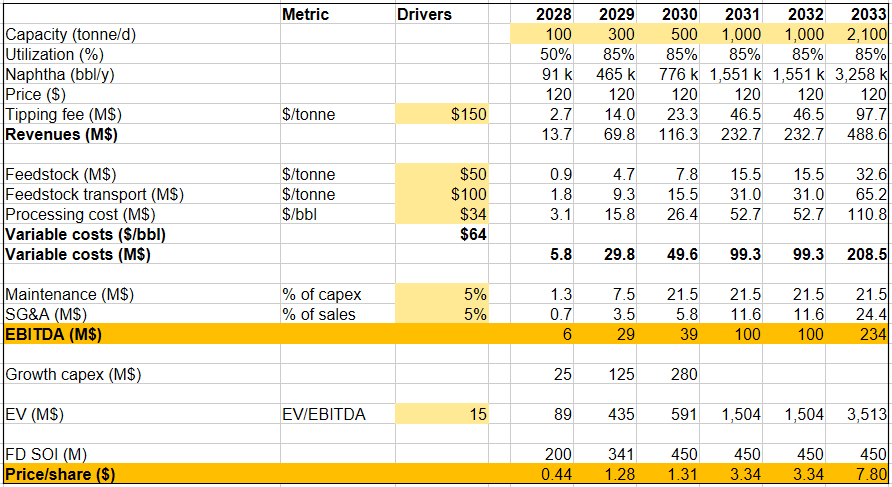
Calculating dilution using 15x the prior year’s EBITDA is very conservative. If Neos works, the market will definitely look forward, and non-dilutive financing options will be plentiful.
The share price has moved over +50% since I started writing this some time ago, and is now $0.24, but the above conservative analysis suggests to me that it is still very cheap.
What I’m not including:
Plastic credits. A legitimate future source of revenue, but not one I can, with any confidence, model right now.
Faster growth. If Neos works, money will be falling out of the sky for PlasCred. Multiple US states are already courting PlasCred, wanting facilities in their states. Growth could easily surprise to the upside.
Tipping fees. Tipping fees could be a material source of revenue.
The obvious comparison people are going to make, and have been making, is PlasCred vs. Aduro. If you don’t know about Aduro, you’ve been living under a rock. FWIW, I think PlasCred compares very favourably.
The PlasCred reactor operates at a similar temperature to Aduro’s, but at a dramatically lower pressure (10 psi vs ~2,500 psi). This makes engineering much simpler and capex and opex much lower. To be fair, I’m guessing on those last two points because Aduro still has not published unit economics.
PlasCred will have its first commercial facility built before Aduro does a proper mixed plastic pilot plant.
PlasCred has signed an offtake with a global commodity trading house at an excellent price. Aduro has not.
PlasCred has signed a feedstock agreement that includes pre-processing of the mixed plastic and a tipping fee. Aduro can only dream of that.
PlasCred has very valuable partnership with CN.
As of time of writing, Aduro is trading at C$676M, vs PlasCred at C$25M fully diluted.
I know Aduro has some enthusiastic and vocal supporters, and I am not here to poke that hornets nest – I just think PlasCred offers a much better risk/reward setup.
Wayne Monnery was PlasCred’s CTO until his resignation in June 2026. In April he held ~1% of PlasCred. The departure of the Chief Technical Officer just as the company is preparing to build their first commercial scale facility is a bit concerning, to say the least. I asked management for the story, and thought I was given a pretty good answer. In a way it is classic tight-ship Troy, and seriously, Troy runs a tight ship with a cash burn of only ~$50k/month the last couple years.
Now that they are in the build phase, there really is no work for a chief chemist, and in fact Monnery hadn’t been drawing a salary since 2024. What they need are project managers (hired) and chemical/process engineers. To have access to senior, highly capable talent, management feels it is better for them to contract them from Grey Owl, Startec, etc. In Alberta, there is a large pool of seasoned, expert talent, sourced from the O&G industry. Monnery apparent left on good terms and may in fact work for them on a contract basis during commissioning of Neos.
By far the most significant risk is the technical risks of scaling from Primus at 2 bbl/d to Neos at 500 bbl/d, a 250x size-up. This is where so many pyrolysis project have come a cropper.
There are also significant risks associated with moving from Primus’s batch processing to Neos’ continuous process.
Real world commercial quantity mixed plastic feedstocks could prove problematic.
Not all Neos financing is locked in, and depending on Neos’ performance and macroeconomic conditions, Maximus financing could prove impossible to secure or ruinous in cost.
PlasCred’s reactors are industrial processes involving 300+ C heat and flammable gases. Post-consumer mixed plastic waste is notoriously contaminated. An industrial accident, while unlikely, is possible.

PlasCred sets a new record, garnering 4.5 out of 5 on the Spicy Rating™.
The company is pre-revenue, with material sales still 18 months away.
Significant tech and execution risks remain. All previous efforts at pyrolysis have failed, and extraordinary claims require extraordinary proof – I don’t think we’re there yet.
Any stumbles in the commissioning or ramp to nameplate capacity will mean the company will need to tap the capital markets for funding.
Lots and lots of capital will need to be raised for Maximus and beyond.
At this point, PlasCred only gets one shot on goal, and Neos is it. If Neos fails, this is a zero. Let me repeat that: there is a real risk this fails and is worth zero. For the love of god, be sensible with position sizing.
I’m long the common and warrants.
For various reasons, this piece has sitting in my drafts, mostly complete, waiting to be published for some time now. The stock has moved significantly in that time, so some of the price/market cap numbers above are already stale. But I do not believe the fundamental valuation picture has significantly changed.
No posts
Comments
Nothing yet. Say the first thing.
Sign in to join the conversation.