
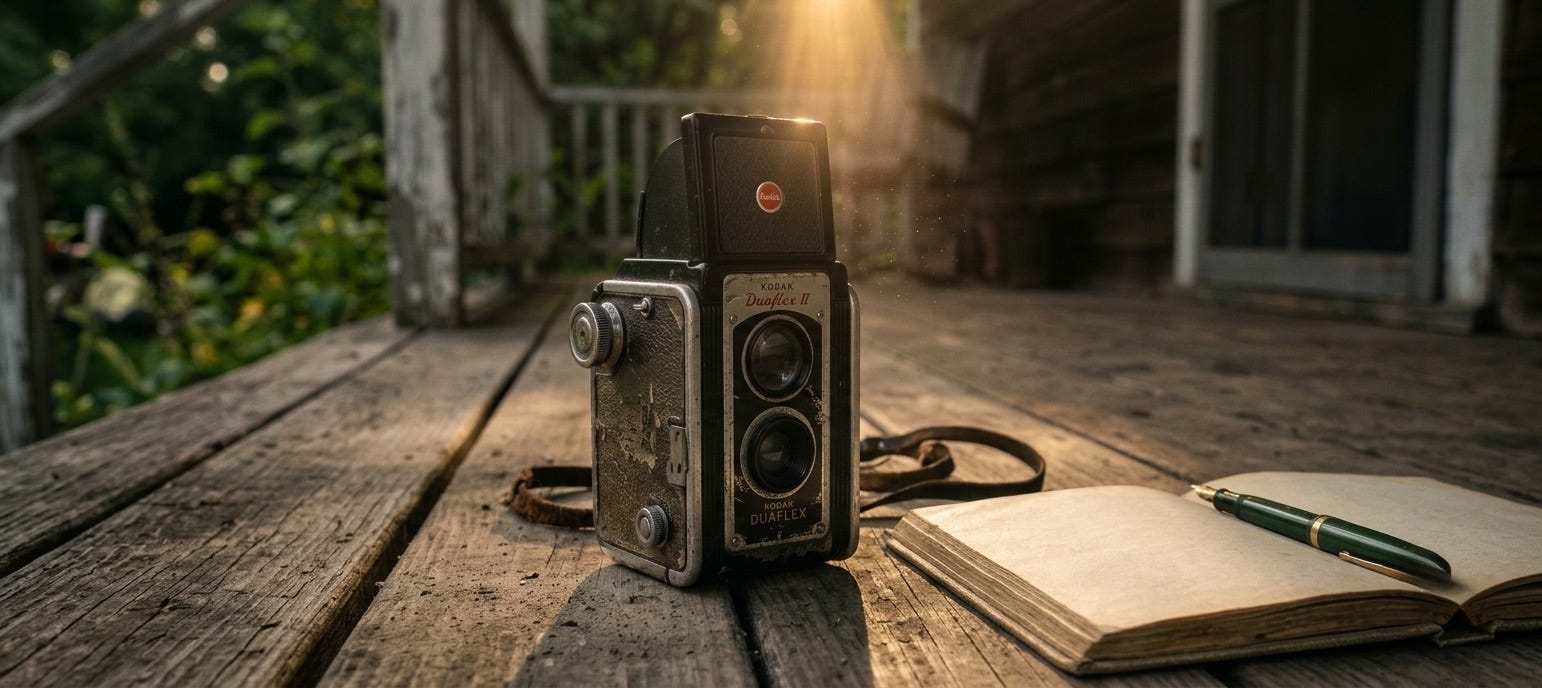
A single speck of Appalachian dust rested on the brilliant glass viewfinder. Clara watched it catch the late afternoon light. It was a tiny and luminous thing; a fragment of the Hocking Valley catching the sun.
She sat on the edge of a warped wooden porch just outside of Athens. The cheap, plastic strap of a Kodak Duaflex rested heavily around the collar of her blouse. Opposite her sat Elias and Martha. They were a landscape of hard years and quiet dignity. Their lives were framed by the peeling paint of a front door that had seen decades of seasons come and go.
“You can put that box away,” Elias said. His voice lacked anger. It possessed only the immovable weight of a mountain stone. “We told the other university people before. No pictures. We may not have much to our name. But we have our pride. We are not a spectacle for your school paper.”
Martha looked down at her hands. They were folded neatly in her lap. She nodded in silent agreement.
Clara did not argue. She offered no defense. Instead, she carefully lifted the strap over her head. She placed the Duaflex gently onto the porch boards. It was a cheerful little machine. It was designed for sunny suburban patios and birthday parties. Sitting here on the edge of genuine poverty, it looked woefully out of place.
She opened her notebook. She capped her pen. She just listened.
For an hour, the camera sat untouched. Elias spoke of the mills slowing down. He spoke of crops that failed to take root. He spoke of a world that seemed to be moving on without them. Clara wrote nothing down. She bore witness to the weight of his words.
Eventually, the silence stretched out. It was filled only with the hum of cicadas in the high summer grass. Elias eyed the notebook. “Must not be a very good story if you are not writing.”
“I am not here for a story about what you lack,” Clara said softly. “I know what that looks like.”
Elias raised an eyebrow. “You are a college girl from the university.”
“I am,” Clara nodded. Her voice was steady. “Because my mother works double shifts at the hospital in Cleveland. Her hands constantly smell of iodine and bleach so she can pay my tuition. She works those shifts because my father left his right leg on a beach in Normandy. The military pension does not cover the rent.”
Elias shifted his gaze. He looked at Clara. He really looked at her. He saw past the pristine notebook and the bright red hair. He saw the familiar and tired set of her shoulders. The invisible weight of a family’s singular hope rested squarely upon them.
Martha reached out. She placed a calloused hand over her husband’s knee. A silent and entire conversation passed between them in a fraction of a second. The walls dismantled themselves. They were walls built thick by years of being overlooked or pitied.
“Your father,” Elias finally said. His voice was softer now. “He was in the Infantry?”
“Sixteenth Infantry Regiment,” Clara replied.
Elias nodded slowly. “I was in the Argonne. A long time ago.” He took a deep breath. The Appalachian air filled his lungs. He patted his wife’s hand. He looked down at the little black and silver camera resting on the porch. Then he looked back at Clara. “If you do not take a picture, your professor is going to give you a poor mark. Is he not?”
“I will manage,” Clara said.
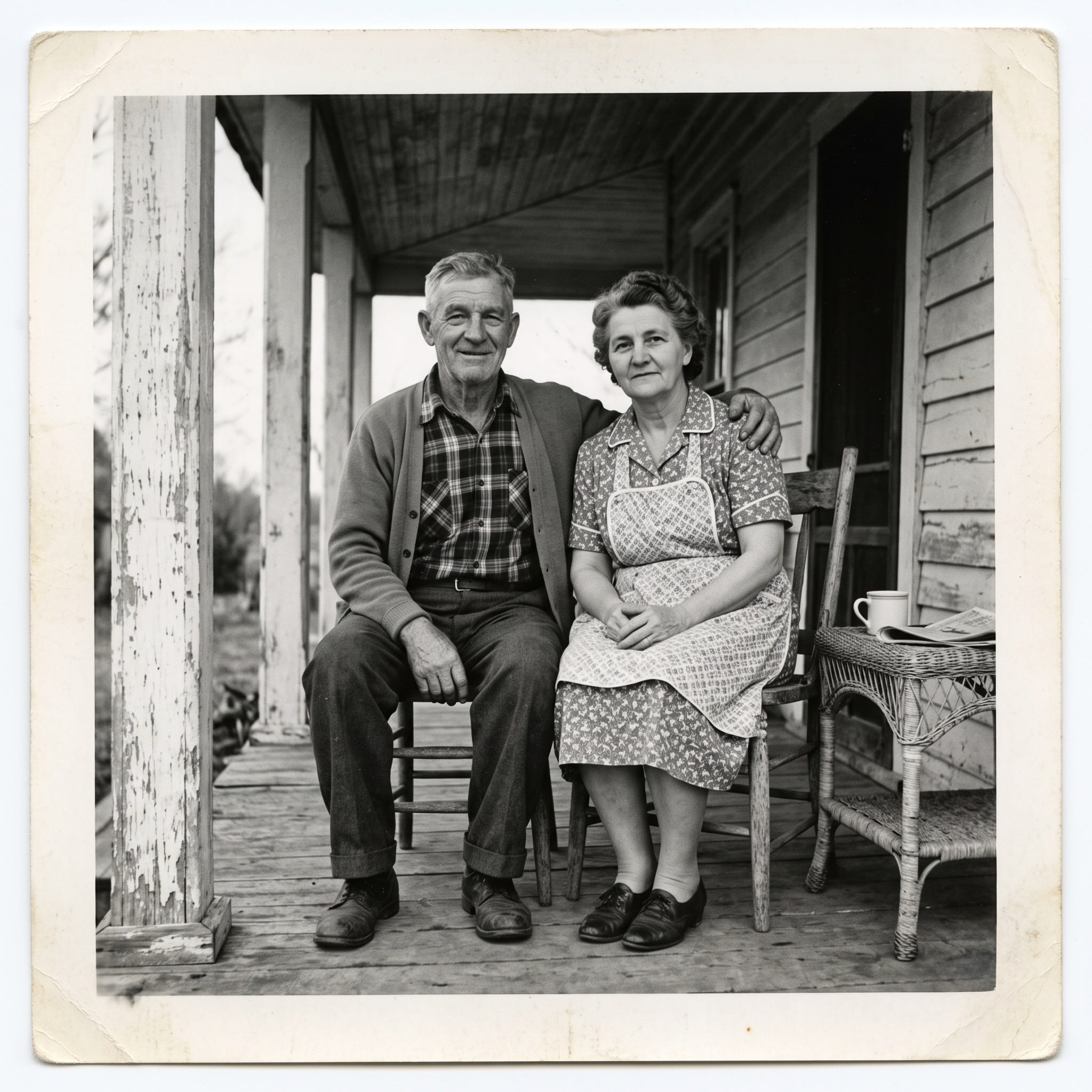
“Pick it up,” Elias instructed. He adjusted his collar and sat up a fraction straighter. Martha smoothed the apron over her dress. “If you are going to put us in your paper, you make sure we look like us. Not like somebody’s pity.”
Clara smiled. It was a genuine expression of profound gratitude. She picked up the Duaflex and slipped the strap back over her neck. The camera had a fixed focal length. She could not zoom. She had to physically step closer. She had to bridge the distance between them.
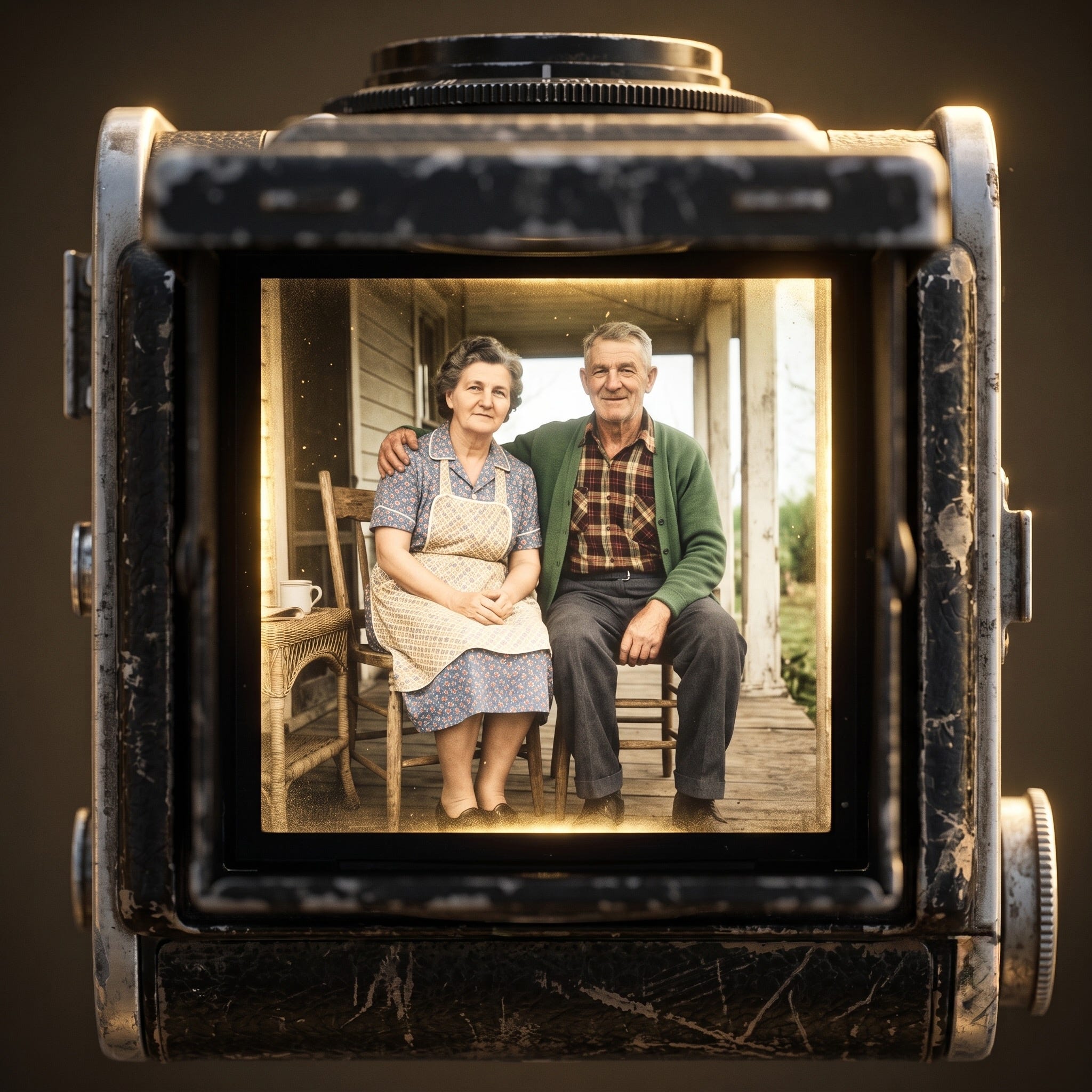
To frame the shot, she did not hide her face behind a piece of intimidating glass. Instead, she looked down into the large and brilliant mirrored viewfinder. In doing so, she bowed her head to them. A posture of reverence.
In the bright reversed glass of the viewfinder, Elias and Martha looked magnificent. Proud. Unbroken. Clara held her breath. She tightened her grip on the plastic body. She pressed the shutter.
Click.
The Camera: Kodak Duaflex. Produced from 1947 to 1960.
The Design: A pseudo-twin-lens reflex camera. It appeared more sophisticated than the rudimentary Kodak Brownie but remained infinitely more accessible and less intimidating than professional Twin Lens Reflex cameras like the German-made Rolleiflex. It democratized photography for the post-war middle class.
The Viewfinder: A brilliant waist-level reflex mirror. It offered a large and bright preview of the image. The view was reversed left to right. This required the photographer to look down into the camera to compose their shot.
The Lens: A simple and fixed-focus Kodet lens. It required the photographer to physically position themselves at least five to seven feet away from their subject. This forced a physical relationship with the scene.
The Film: 620 roll film. This yielded twelve square exposures per roll.
I trace my thumb over a deep scratch on the side of my Kodak Duaflex. The metal underneath the black paint shines through like a tiny sliver of silver. It is a scar. A permanent record of a moment long gone.
I bought this camera because I was looking for something else entirely. I had been on a quest to add a legendary German Rolleiflex to my collection. The staggering price tag quickly brought me back to reality. I wanted that classic waist-level twin-lens reflex experience. I simply could not afford the real deal. So I went looking for what I could afford.
I found this Kodak Duaflex on Facebook Marketplace. I bought it without knowing much about its history or mechanics. I bought it simply because it looked the part. It had the stacked lenses. It had a handsome metal faceplate. It had the top-down viewfinder of a high-end European machine.
When it finally arrived, I realized just how wonderfully simple it truly was. It is a beautiful piece of metal. But it lacks the complex gears and precision engineering of the German masterpieces it was styled after. It is essentially a basic box camera dressed up in a tuxedo.
And yet I absolutely love it.
My specific copy is heavily scratched and visibly used. This fact makes me incredibly happy. A pristine vintage camera is a museum piece. A scratched camera is a storyteller.
Those scuffs on the metal and wear on the edges are evidence of a past life. They are proof that it did not sit safely on a closet shelf. It was carried out into the world. It was held at waist level at birthday parties. It went on a summer vacations. Perhaps it even sat on dusty porches with scrappy young photographers trying to capture the truth of their communities.
The Kodak Duaflex was a brilliant piece of marketing. It was an illusion designed to give everyday Americans the feeling of being a real photographer without the barrier of cost or complexity. But when I hold this scratched and beautiful little machine today, I am not holding an illusion. I look down into that glowing glass viewfinder. The connection it gives me to the past is entirely real.
What does it mean to hold a memory you did not create? Perhaps it is just an invitation. An invitation to slow down. To notice the light. To document our own fleeting seasons before they, too, become history.
Comments
Nothing yet. Say the first thing.
Sign in to join the conversation.