
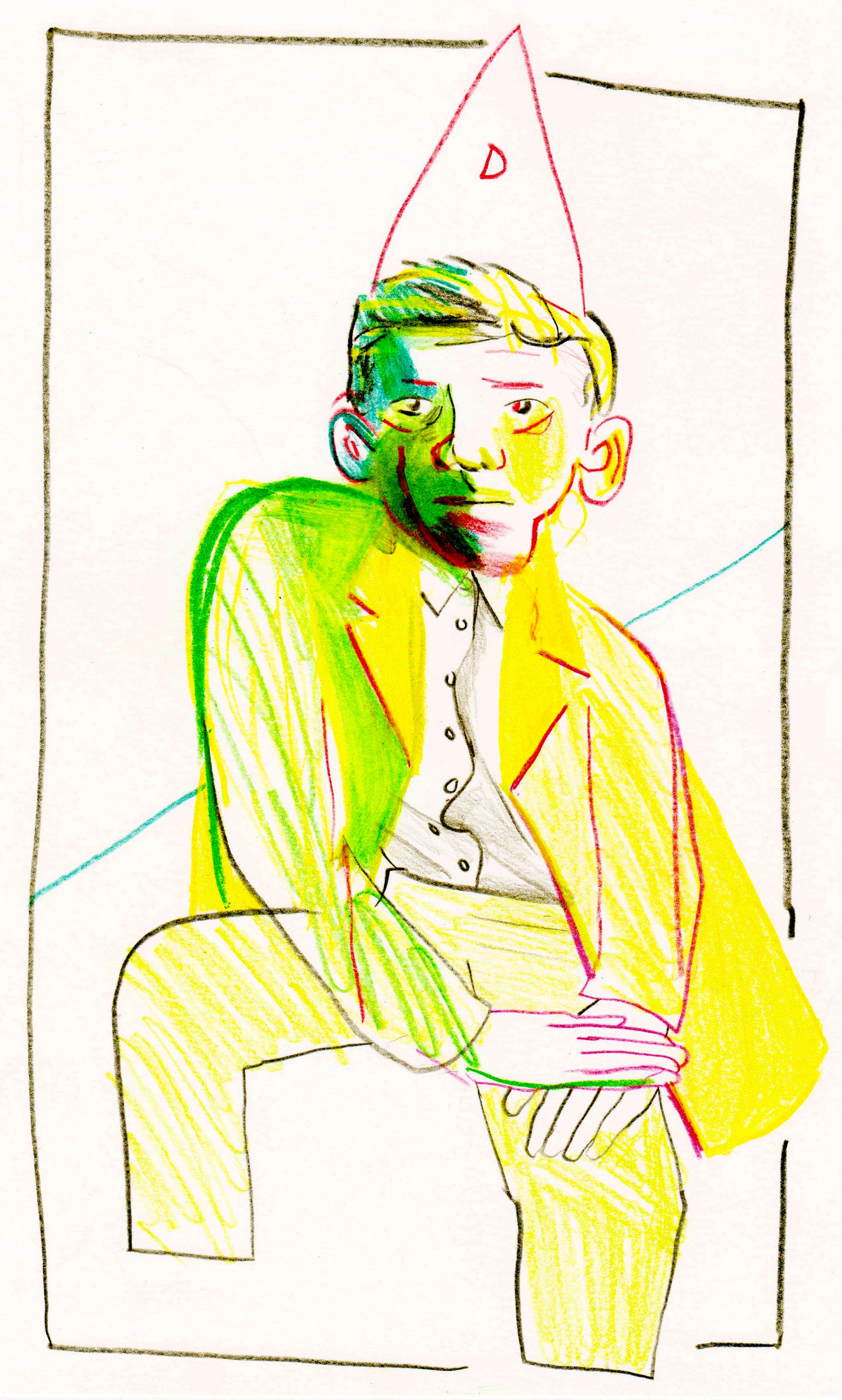
A man wearing a bright yellow suit arrives on the last ferry to a small town in Norway. He’s forgotten something, so immediately travels all the way back. The next day, he takes a carriage to the town instead, books himself into the local hotel, then walks back to the town he just came from. He sends a couple of telegrams to himself, returns to the small town, opens the telegrams and leaves them lying around. They refer to country estates and great sums of money, but the man quickly admits to anyone who asks that he was just trying to make himself seem important.
He wears the yellow suit to funerals and parties, he seems to fall in love with the local beauty queen, but he might just be copying a story he read in the local newspaper. He tries to play one woman off the other, but they mostly seem baffled by his attention, and he only manages to stress himself out. The man in the yellow suit has been carrying a vial of poison in his pocket, and showing it to random strangers. In his despair, the poison seems like a solution. He knocks the vial back and of course, immediately regrets it. He runs through the woods, trying to find a puddle to drink from, maybe he can dilute the poison? He fails and lies down, ready to die. But to his shame, survives unscathed. The vial wasn’t full of poison after all. It was just water. He returns to the town, bullies his maid, sees a vision, and just as both the reader and the townspeople have decided that the man is a worthless idiot, he is reluctantly forced to play the violin.
‘And then he played a few strokes that sounded like a desperate howl, a lament so plaintive, so heart-rending, that the audience was stunned. After three or four strokes he stopped abruptly and removed the violin from under his chin.’
He can’t help ruining the beautiful effect he has created.
‘“Why on earth did you end your performance with those discordant notes?” Miss Anderson asked.
“I don’t know,” said Nagel, “It just happened.”’
The man’s name is Johan Nagel, his confessions and visions only go so far, he never admits to being the protagonist of Knut Hamsun’s Mysteries, but then, it is only 1892. Modernism hasn’t arrived yet, let alone post-modernism. The playful idiots of Thomas Pynchon, and the romantic idiots of Roberto Bolaño are still to come. Johan Nagel is tortured by his idiocy. Along to the East, in more or less a straight line, Dostoevsky wrote of a similarly tortured idiot. Unable to follow the cruel conventions of his society, unable to choose a life which accords to his principles, Prince Myshkin is placed in a sanitorium.
Unfortunately for Johan Nagel, protestant Norway has no tradition of the Holy Fool. While Dostoevsky allows his Idiot to mirror Christ and point to higher sanity beyond the insanity of this world, Nagel’s revelations are more or less meaningless. He mocks and questions both Christianity, and the liberalism and socialism which lie historically downstream. But beyond them, sees only a dreamlike collage of the culture he has rejected.
Byung-Chul Han’s book Pyschopolitics: Neoliberalism and New Technologies of Power rounds out the last of its bleak philosophizing with a cheerful chapter titled Idiotism. By this point in the book, you’ve read that ‘Disciplinary society’s ‘concerted orphoapedy’ seeks to make a shapeless mass of dough into an unfeeling machine.’ You now know that, ‘the neoliberal subject is running aground on the imperative of self-optimization’, and you’re well aware that ‘the imperative of boundless optimization even manages to exploit pain.’ What can I do about it? The reader thinks.
Well … a possible etymology of the word idiot, is the Greek idios, a private person, someone who ignores the political. From here, comes our word idiosyncratic.
‘The idiot does not ‘communicate’. Instead, he communicates with the Incommunicable.’
The reader writes in his notebook – must communicate with incommunicable.
‘The idiot savant lives from the faraway – like a stylite. Vertical tension enables him to find higher agreement.’
The reader scribbles down, live faraway … in vertical agreement? By the last sentence (‘The idiot does not exist as a subject – he is more like a flower: an existence simply open to light’,) the readers notebook is useless. Should I become more like a flower? He wonders. The thought is tough to sustain. Insufficiently idiosyncratic, the readers thoughts immediately collapse from the personal back to the political. What would it look like if everyone was an idiot? What does an idiotic society look like? An idiotic industrial policy? An idiotic foreign policy?
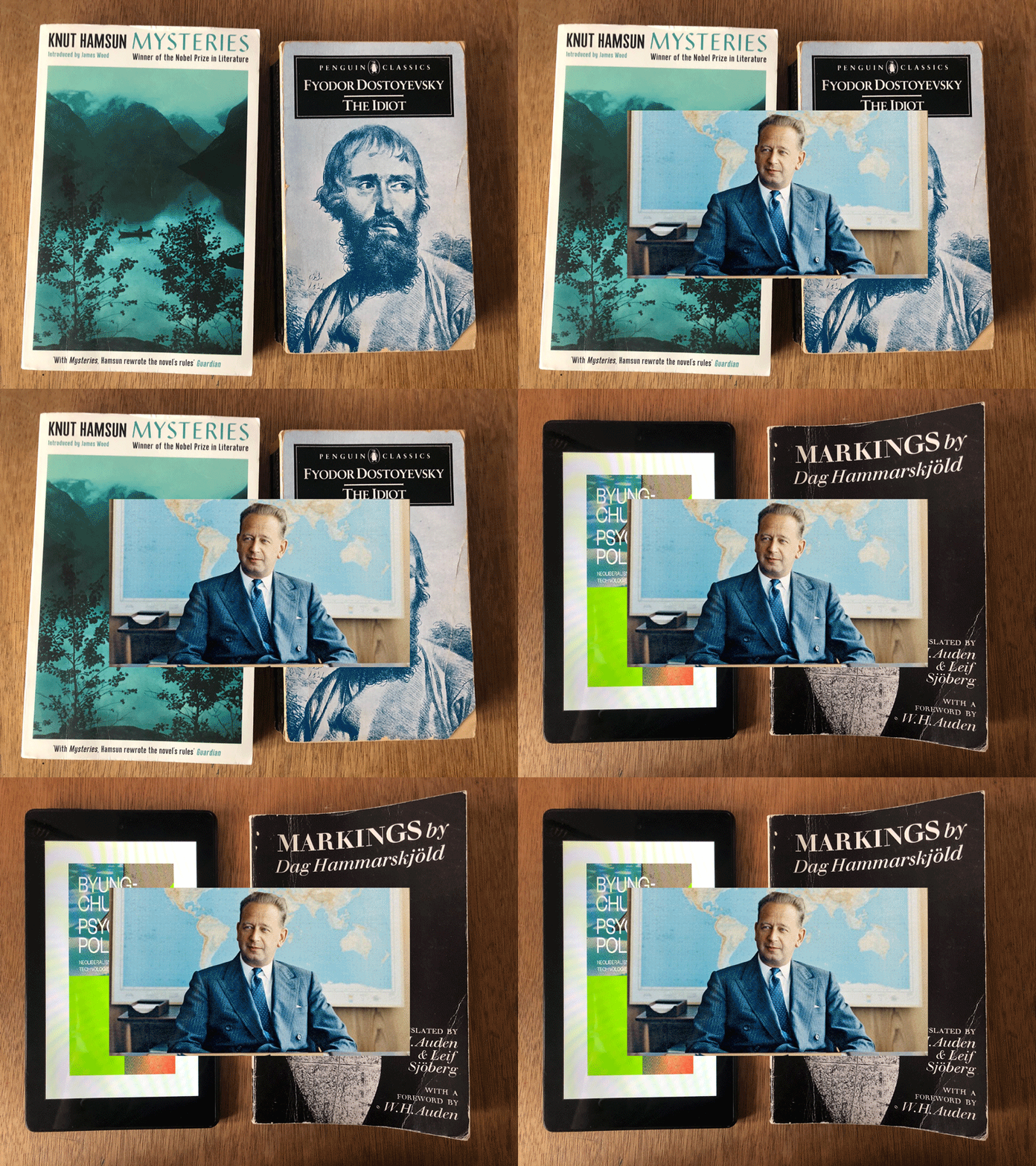
The reader looks through his bookshelf and sees Dag Hammarskjöld’s Markings. Just like Johann Nagel’s sudden mastery of the violin, the key to being idiotic, might be to secretly, not actually be an idiot.
Dag Hammarskjöld was elected Secretary General of the UN in 1953, after months of gridlock between the US and USSR. Having nominated and rejected a dozen previous candidates, Hammarskjöld was selected almost at random, included on a list of possible candidates by the French representative, because they had met at a conference the previous year. Seen as ‘harmless’, by the USSR and completely unknown by the US, when Hammarskjöld was nominated, he refused to believe it. He stated, ‘Nobody is crazy enough to propose me—and I would be crazy to accept’. But, after several phone calls reassuring him that it wasn’t an April Fool’s, Hammarskjöld devoted himself to the job despite his feelings of personal inadequacy. In 1960, due to his attempts to intervene in the proxy war being conducted in the Congo, the USSR demanded Hammarskjöld’s resignation. In 1961, he suffered the closest thing we have to secular canonization, (alleged assassination by the CIA.)
While it might seem difficult to describe the head of the UN as insufficiently political, Hammarskjöld proceeded in the manner of Dostoevsky’s rather than Hamsun’s Idiot. Hamsun’s Johann Nagel, while being insufficiently public, is also insufficiently private. He has little to no inner life. The ideas which he expresses, are passionate whims, immediately forgotten, leaving no trace in a non-existent interior. In contrast, Dostoevsky’s Myshkin has an elaborate and overabundant inner life, whose strictures often prevent him from acting, paralyzing him between contrasting goods and possible evils.
Hammarskjöld’s short book Markings is possibly the most idiotic book our time can imagine. A politician who keeps a diary of incredibly earnest poetry, prayer and aphorism.
‘Forward! Thy orders are given in secret. May I always hear them – and obey.’
‘Like the bee, we distil poison from honey for our self-defence – what happens to the bee if it uses its sting is well known.’
Imagine the laughter which would follow the discovery of a leaked email from Number 10, containing this …
‘In our age, the road to holiness necessarily passes through the world of action.’
But without the earnest prayer and poetry, would Hammarskjöld have been able to stand up to both the US and USSR? Without the romanticism and self-seriousness? Without notebooks and diaries, we are left with bright yellow suits and empty vials of poison, performative idiocy in place of the only thing which is truly idiotic, an inner life.
No posts
Comments
Nothing yet. Say the first thing.
Sign in to join the conversation.