
As I was getting ready to write this, I realized how short the last few posts have actually been, and that probably should have been a signal I needed to take a break. So I did, last week, though I didn’t do a great job of letting any of you know until the last minute (or really, after, since I didn’t send anything until after the episode was supposed to be out). I apologize for not being more on top of things.
Well, “took a break” isn’t quite right either. I spent the week on a lot of behind-the-scenes things and doing more calls. The biggest challenge right now is trying to plan as many special calls as I can before we hit the big milestone, which is tricky when all I’ve got to go on is a sentence or two from someone’s application.
I’ll spare you the logistics. But it was really interesting to sit down this past week and look back. My focus the past few months has been so much on the future: 100 calls, the 2-year anniversary of the podcast, the 3-year anniversary of the project. Looking at all of that, I ended up spending a good chunk of time looking backward instead, and it’s wild to see what we’ve built here. I know I’m biased, but it’s really impressive.
It’s a reminder of how easy it is to lock onto something that isn’t now. We do it all the time, looking toward the future for milestones or events that feel like they carry all this meaning. It’s just as easy to do with the past, a lot of who we’ve become is built from stories we’ve latched onto back there. It’s easy to get locked onto just one of those things. But so much of what I’m learning right now is about balance, not extremes.
WATCH
When the caller mentioned this, I said it sounded familiar. Turns out I had no real memory of it, because when I looked it up after the call, I had no idea what I was about to find. The caller described it as close to a visual for what they picture an afterlife could actually look like.
WORD
Apoptosis · noun · /ˌæp.əpˈtoʊ.sɪs/ (also /ˌæp.əpˈtoʊ.zɪs/)
Programmed cell death; the process by which cells in a living organism are systematically destroyed as a normal part of growth or aging. From the Greek apoptosis, meaning “falling off,” as leaves fall from a tree.
READING
That last time one of these came out I had hit a TOTAL reading rut. I was picking up books, getting 20-30 pages in, and then putting them down. Ultimately what helped was going back to what got me into reading in the first place. Mystery/Thriller type books no matter how good or bad just seem to make it so easy to enjoy reading. I picked up Riley Sager’s new book and it was like jumpstarting my reading engine (I hate myself so much for writing that…). I’ve clipped through a few books since then and still not entirely sure where I’m headed next but there’s a lot of possibilities!
Just finished: Whistler by Ann Patchett (53)
Currently: Steppenwolf by Hermann Hesse, The Five Invitations by Frank Ostaseski
On deck: The Tibetan Book of the Dead, The Snow Leopard by Peter Matthiessen, The Master and Margarita by Mikhail Bulgakov
(And if you are really curious you can always check out what I’ve read recently here)
QUESTION
I’m not going to be very creative here because this week’s question isn’t far off from this week’s episode title, and that’s because I think it’s a really important one. It’s a question that’s come up in a couple different ways on some of the more emotional episodes of the podcast.
If you lost someone so close to you, is it possible to change your beliefs on what you think happens when we die?
THIS WEEK’S CALL
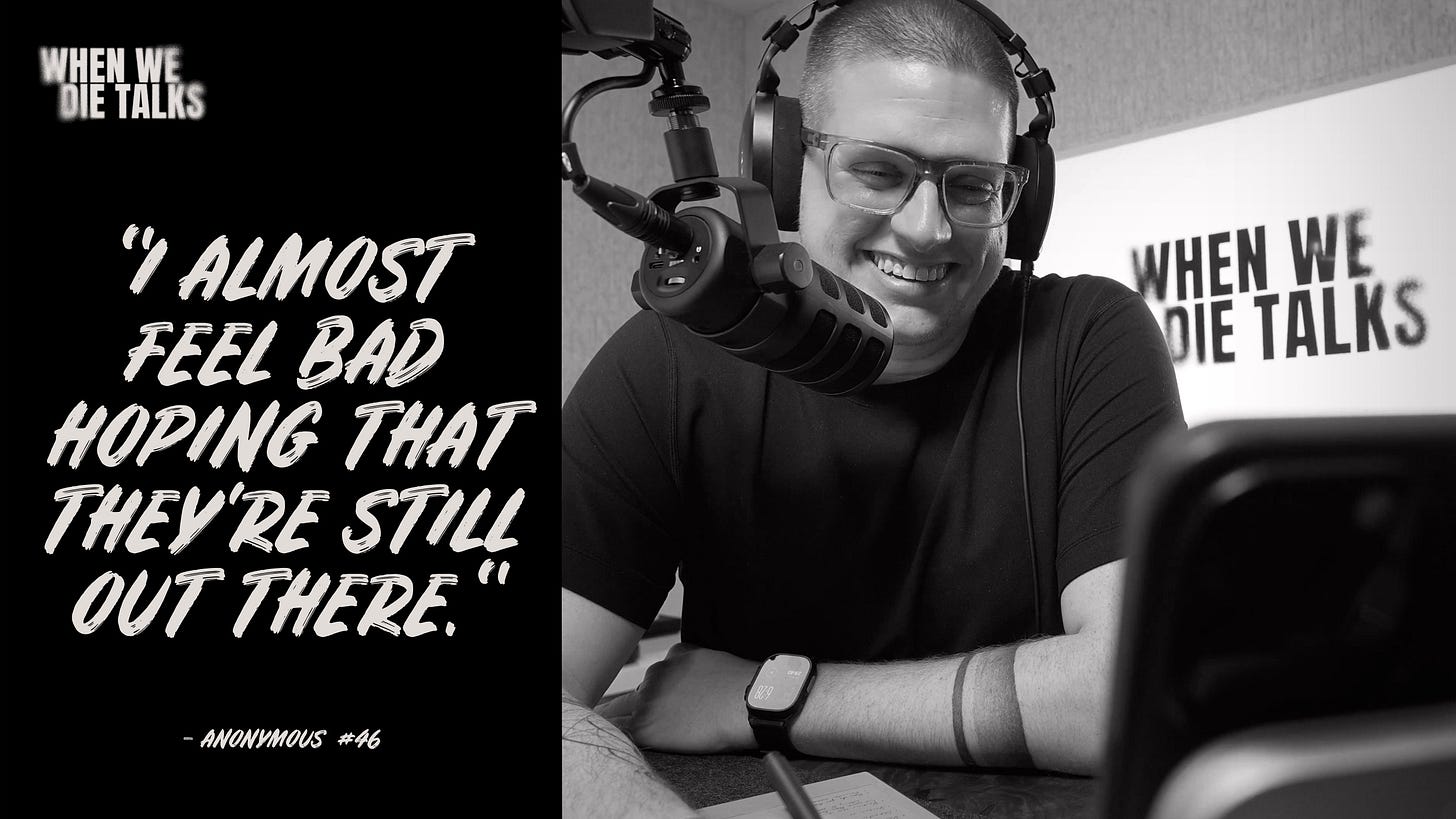
Anonymous #46 — Can You Hope for an Afterlife That Was Your Partner’s Worst Nightmare? (Listen Here)
Episode Type: Living with Loss. For more info about what this means check out the Episode Guide.
Content Note: This episode includes discussion of suicide, physician-assisted death, psychosis, and serious illness.
RESOURCE
Here’s a little resource that might help your listening experience if you stick through the very end to hear an extra little story from our caller (it’ll make so much more sense when you listen).
SMILE
I know I've mentioned it numerous times, but making anything in this world today can feel like shouting into the void. I never realized how apt that description might actually be for this project. There's just so much in front of all of us, every moment, every day, and you never really know how things are being received. This week, as I let the caller know their episode was coming out, they sent this back, and it's messages like this that keep me going:
thanks so much and for this show in general. its such a gift. i have a lot of friends who are really going through it this past year w respect to grief and loss and listening to these conversations has been really helpful in combatting the isolation of grief and death
Have a good life.
— Z
ARCHIVE
2014 // 2013 // 2012 // 2011 // 2010 // 2009 // 2008 // 2007 // 2006 // 2005
No posts
Comments
Nothing yet. Say the first thing.
Sign in to join the conversation.