
New here?
A quick note: if you found me through my writing on Israel or antisemitism, that’s still a core part of this publication. Echoes is the more personal lane, where those public themes meet memory, family, identity, and the book I’m writing.
The sharper commentary is still on the main feed, and it remains free.
The first time I was near a suicide bombing, I had my hand on the metal push bar of a door at a bar I was working at on Allenby Street across from a coffee shop. The explosion happened across the street. I felt the concussion before I heard it.
The second time, I was late to Mike’s Place because I got pulled over. The bomb went off at the entrance. Three people were killed. More than fifty were wounded.
Both times, I was near the center but not in it. Both times, the geometry of the moment had placed me just outside the blast radius by minutes, meters, the specific accident of timing that survival sometimes is.
In the days after October 7th, 2023, I walked into the center deliberately.
The school is not visible from the street.
It sits in a small, quiet neighborhood in North Carolina, tucked behind trees, accessible only through two or three turns that you have to know to make. Of course, Waze and Apple Maps will get you there, but you get the point.
It’s small enough that we know every car in the parking lot, every parent, every administrator. Anything unfamiliar sticks out immediately, which is either the comfort of a tight community or the particular vigilance of people who have learned to read parking lots the hard way.
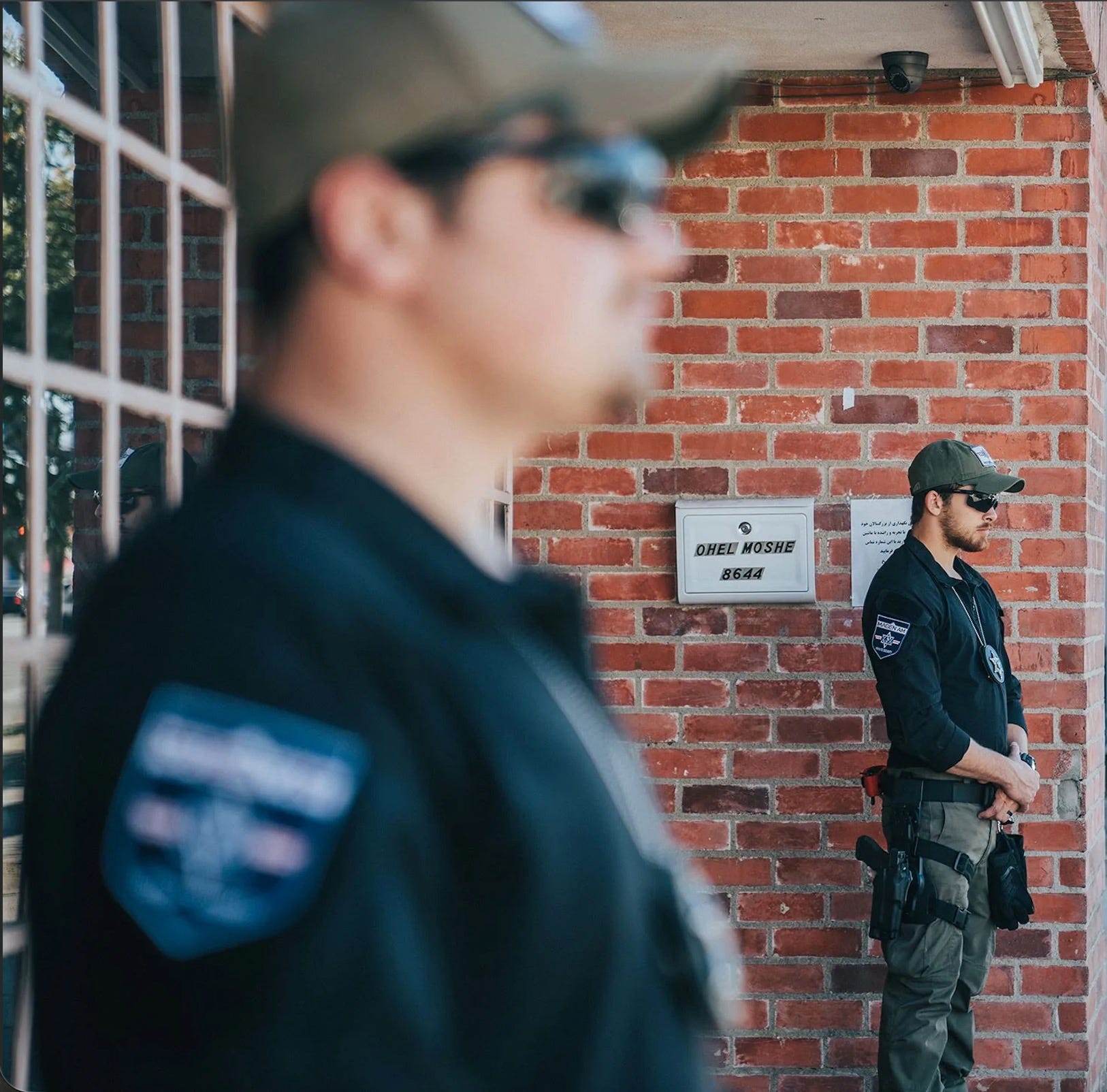
The school had brought in a police officer for the entrance and had their regular security doing rounds, moving through the building and around the perimeter without stopping.
I was additional. Unarmed.
No one asked me to come. I just did, because that’s what you do when your people are being attacked across the world.
All three of children were inside, in class, shielded from the aftermath of October 7th, as children ought to be.
My wife was there, too, teaching.
My entire world was in that small building. Where else would I be?
You show up where you can. In whatever way you can.
Because it matters.
Standing at the edge of the lot with another Israeli father who also had three kids at the same school, watching the cars come in, doing the thing my body has been doing since I was eight years old and the world started teaching me to watch.
My friend had served in Flotilla 13. The naval commando unit. The Israeli Navy SEALs. He had been seriously injured during the Second Lebanon War and had made a full recovery. He was not standing in that parking lot by accident.
Neither was I.
We were talking about how crazy it all was.
Not the school, specifically. All of it. This week. The world. The specific and nauseating experience of watching October 7th happen and then watching the global response unfold, which was not the response either of us had expected and which both of us understood immediately, in our bodies, before we had words for it.
Protests breaking out on university campuses celebrating the attack. People who had never been to Israel and had no stake in the region suddenly possessing strong opinions about whether Jewish people deserved what had just happened to them. The reframing, within hours of the massacre, of the victims as the aggressors. The specific vertigo of watching this happen in real time while you were trying to process what you had just seen.
We were talking about what it meant that we were standing in this parking lot. Two Israeli men in our forties, both of us with children inside a Jewish school in America, scanning the entrance to make sure nobody was coming for them.
Why would anybody want to come for them?
Eighty-plus years after my father had to flee Poland and hide under a false name because the world had decided that Jews didn’t have the right to exist, here we were in suburban North Carolina doing the math again.
Not because of anything we had done. Because of what we were.
For what? we were saying. For existing? For being the victims of an invasion of our sovereign homeland? How is it possible that this is still the sentence, still the condition, still the reason a man has to stand in a school parking lot and watch the entrance?
Then the car came in.
Black. Beat up. Old civic or something close to it. Tinted windows. Music blasting loud enough to hear from across the lot.
It came in fast, then slowed down, then sped up a bit again, the way a car moves when the driver is looking for something. Not the way a parent drives in. Not the way anyone who had been to this school before drives in.
No parent had that car. No administrator had that car. I knew every car in that lot and I did not know that one.
I said something, I don’t remember exactly what. My friend moved to the side. And I ran at the car and put myself in front of it.
I had no weapon. I had no authority. I was a forty-four-year-old man in a school parking lot in North Carolina with nothing between me and that car except the decision that it was not going to move another inch closer to the building where my children were.
The car stopped.
I told the driver to roll down the window.
She rolled it down. She was a woman, alone in the car, and she said “I’m sorry, I’m DoorDash, I’m delivering breakfast to someone here.”
I saw the bag. I saw the food.
Behind me, one of the teachers was already walking out of the school. The police officer was watching closely at this point. “I think that’s my DoorDash,” she said.
The driver delivered the food and left.
My friend and I stood there for a moment.
I had been near two suicide bombings and survived by the grace of proximity. My Coffee Shop. Mike’s Place. Each time the specific accident of where I was standing (or not) had kept me outside the thing.
Standing in that parking lot, I understood that I was done waiting to find out whether geography would save me again. I had three children inside that building. My wife was in there. I was not going to stand at the edge of the lot and watch to see what happened.
That was not a decision I made in the moment. The moment was too fast for decisions. I saw the car and my body was already moving, the way a body moves when it has been paying attention for over forty years and finally has something important to do again.
The instincts I learned growing up under terrorism in Tel Aviv did not leave me when I left Tel Aviv. They came with me to San Diego and then to New York, and Boston, and North Carolina and they have been waiting in my body ever since, patient, ready, looking for a parking lot where they might be useful.
October 7th woke them up.
I think about that a lot. The specific usefulness of knowing how to be afraid efficiently. The men I grew up around who could scan a room and do the math in under a second. The particular education that terror provides, not just in fear but in the management of it. What to do with the information your body is giving you. How to act when the window is two seconds wide.
The raining I’ve received in not being concerned with feelings, profiling, kindness, or any other noise, because those are privileges you don’t have when you need to make a life or death decision.
They don’t matter. Only action matters.
My children do lockdown drills at that school. Not for fire, or active shooter, like most schools do.
For people who want to kill Jews.
They come home and ask me why people hate us.
I don’t have a good answer. There has never been a good answer to that question.
But at 47 years old I can stand in the parking lot to try and protect them from that answer.
That is the only thing I know how to do.
So that is what I do.
This is one of many Echoes from the book I’m writing.
Fragments of a larger story about survival, inheritance, and identity.
If you want to be among the first to know when it’s ready, you can join the early reader list.
If you want to simply follow along it as it comes together, you can subscribe.
Everything I’m writing lives on the feed.
Most readers find me through my Notes.
This is where the Notes find their roots.
No posts
Comments
Nothing yet. Say the first thing.
Sign in to join the conversation.