
New here?
A quick note: if you found me through my writing on Israel or antisemitism, that’s still a core part of this publication. Echoes is the more personal lane, where those public themes meet memory, family, identity, and the book I’m writing.
The sharper commentary is still on the main feed, and it remains free.
Early 2024.
The war in Gaza was raging. There was a man at my gym who wore a kaffiyeh around his neck. White guy. Pale. Culturally appropriating the cause of the season with the commitment of someone who had found a new personality and was not yet ready to give it up.
We crossed paths many times. He never said a word to me. I never said a word to him.
I was wearing a Star of David.
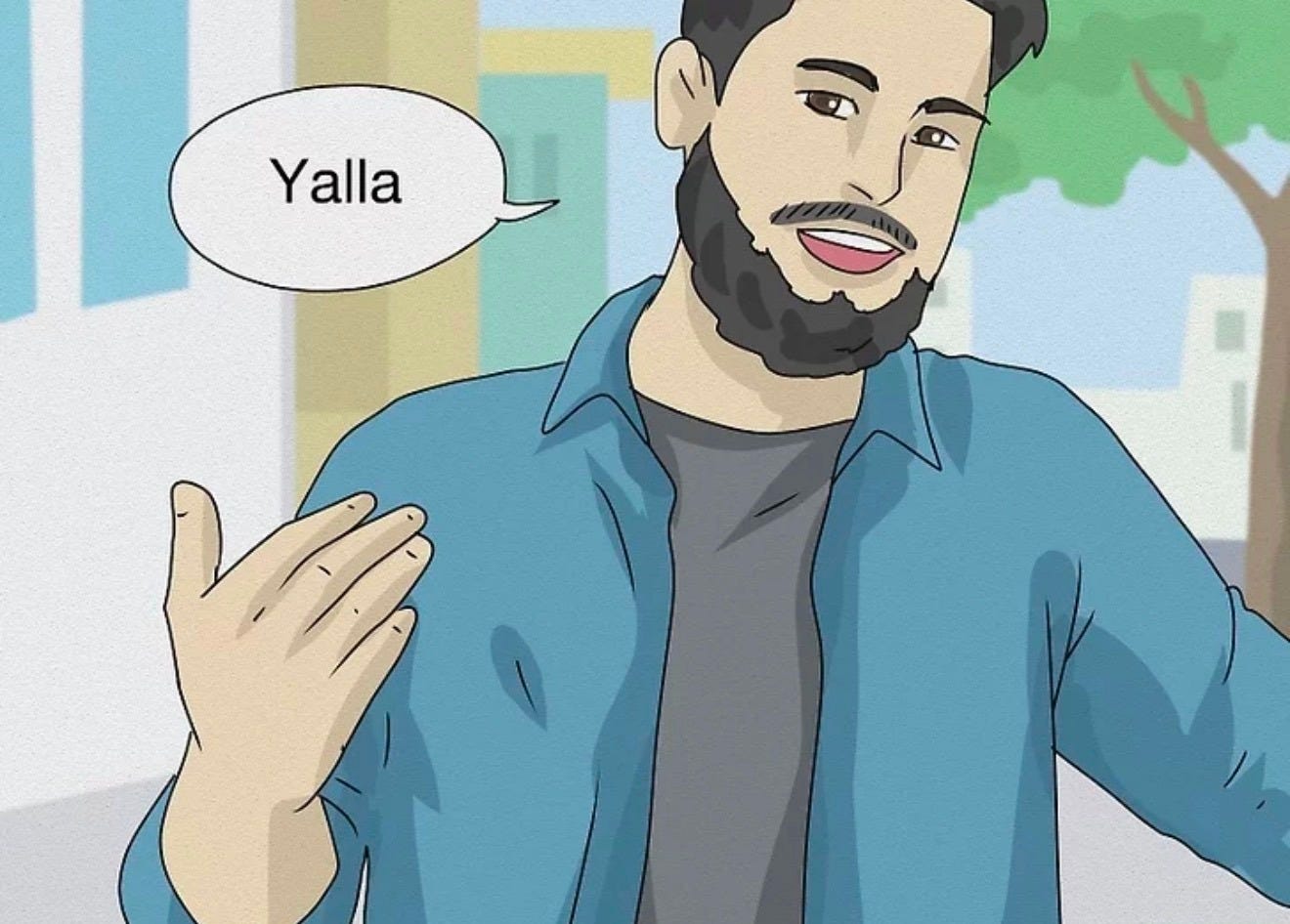
Yalla.
One of the most used words in Israel. We borrowed it from Arabic. That happens when two cultures spend a significant amount of time next to one another.
It means many things. Motivational: “let’s go, come on!” Dismissive: “get out of here, get to the point.” If you break it apart, “Ya Allah,” it is pure awe and surprise.
It is everything I was excited to leave behind when I moved from Israel to San Diego, California in 2003, at almost twenty-four years old.
That word was a microcosm of Israeli culture to me. Harsh. Abrupt. Dismissive. Cold. I felt I was above it. That I would thrive in an environment that allowed people to wax poetically, dive deeper philosophically, and take the roundabout way to arrive at a destination.
I was wrong.
The Second Intifada had just torn through my early adulthood. I had narrowly missed the bombing at My Coffee Shop on Allenby Street, watching from across the street as it happened. I was not at Mike’s Place on the Tel Aviv beachfront on the night of April 30, 2003. A Wednesday. A place I went every week. A suicide bomber walked in and killed three people. One of them, the bouncer, I knew.
I had grown up watching Iraqi missiles pass over my neighborhood during the Gulf War. Standing on a balcony at twelve years old, watching a shadow the length of what felt like a football field glide overhead while the ground shook.
I needed to walk into a room without scanning it first.
I needed to stop doing the math.
What I found in San Diego felt, at first, like interacting with people from another planet.
No wars. No real threats.
September 11 had happened two years earlier. But there was nothing imminent. Nothing that required exit-route calculations or profiling the person near the door with the heavy bag. It felt like I was moving among people who had lost contact with reality. Because insecurity, and preparing for the worst, is what most of humanity has managed throughout history. Not San Diego in 2003.
I went shark hunting with my bank manager.
I remember sitting in that boat thinking: this is insane. Not the sharks. The fact that in Israel, my bank manager had never once seemed to have a life outside the branch. Dull. Institutional. Contained. This man was taking his customer into the ocean to hunt apex predators on a Tuesday afternoon.
The contrast was stark. And for a while, I mistook it for a superior way of living.
The San Diego bank manager was not more evolved. He was less burdened. His lightness was not wisdom. It was the absence of weight.
I envied it anyway. For a long time, I envied it.
So I did what made sense at the time. I disappeared.
My name, Ido, was going to start a lot of conversations I did not want to have. I was not going to change it. But I built a quick pivot: “Yeah, I’m originally from Israel. Where are you from?”
I did not want to be the Israeli guy. I wanted to just be Ido.
I dove headfirst. College life in San Diego. The nightlife scene in New York, where I lived for seven years after. All American friends. Barely one or two Israelis anywhere I lived. I married an American Jewish girl. The first Jewish girl I had seriously dated since arriving. We had three kids. Beautiful American kids of Jewish heritage.
I never really spoke Hebrew to them at home. Something I regret. My mother kept reminding me. I was always too busy. Too tired. Too something.
Life goes by you when you have more excuses than conviction.
For years, when I heard Hebrew spoken in public, in New York or anywhere outside Israel, I would not respond. I would not acknowledge it. I would not “out” myself.
I was proud of my country. I have always been proud of my country.
But I did not want to be its spokesperson. I did not want to explain or defend the abrasiveness, the bluntness, the urgency I had spent years trying to leave behind. The Israeli identity felt, in certain rooms, like a liability I was not ready to carry in public. I had made a life in America. I was building something here.
So I hid it. Not the pride. The visibility.
There is a difference, and I told myself that difference mattered. I was proud on the inside. I was quiet on the outside. I was done with the math.
I never lost the vigilance. The scanning of rooms. The reading of exits. That never left. But I allowed myself to believe that distance meant safety.
I made it out. Nothing could touch me here.
I wanted to own the lived experience without living the living experience itself. Existing as an Israeli Jew in America, not an American Israeli.
I lost perspective.
That distinction held up until October 7, 2023.
Then it collapsed entirely.
I wanted to run back into the fire. Not metaphorically. I wanted to be in Israel, in person, doing something that mattered instead of watching app notifications about missile alerts from American safety. My sister was still carrying the uneven load while I watched from the wrong side of an ocean.
The guilt was real.
I knew what I had left. I knew what it cost to maintain the thing I left. And I understood, finally, that the hiding was a form of running I had not fully named until that afternoon in October when the notifications started coming in.
There is no outside. There is no room where the math is permanently quiet. There is only the question of whether you carry the weight visibly or keep it private and tell yourself that it’s the same thing.
It is not the same thing.
For twenty years I told myself the hiding was about not wanting to be reduced.
I did not want to be just the Israeli in the room.
But there is a difference between refusing a label and letting someone else fill it.
When the world started insisting on defining what Zionism is, what Israeli means, what Jewish identity stands for, and getting it so criminally wrong, the silence stopped being neutral.
Staying quiet was not modesty. It was concession.
I spent my whole life rotating between atheist and agnostic. Nobody who knows me would have predicted what happened next.
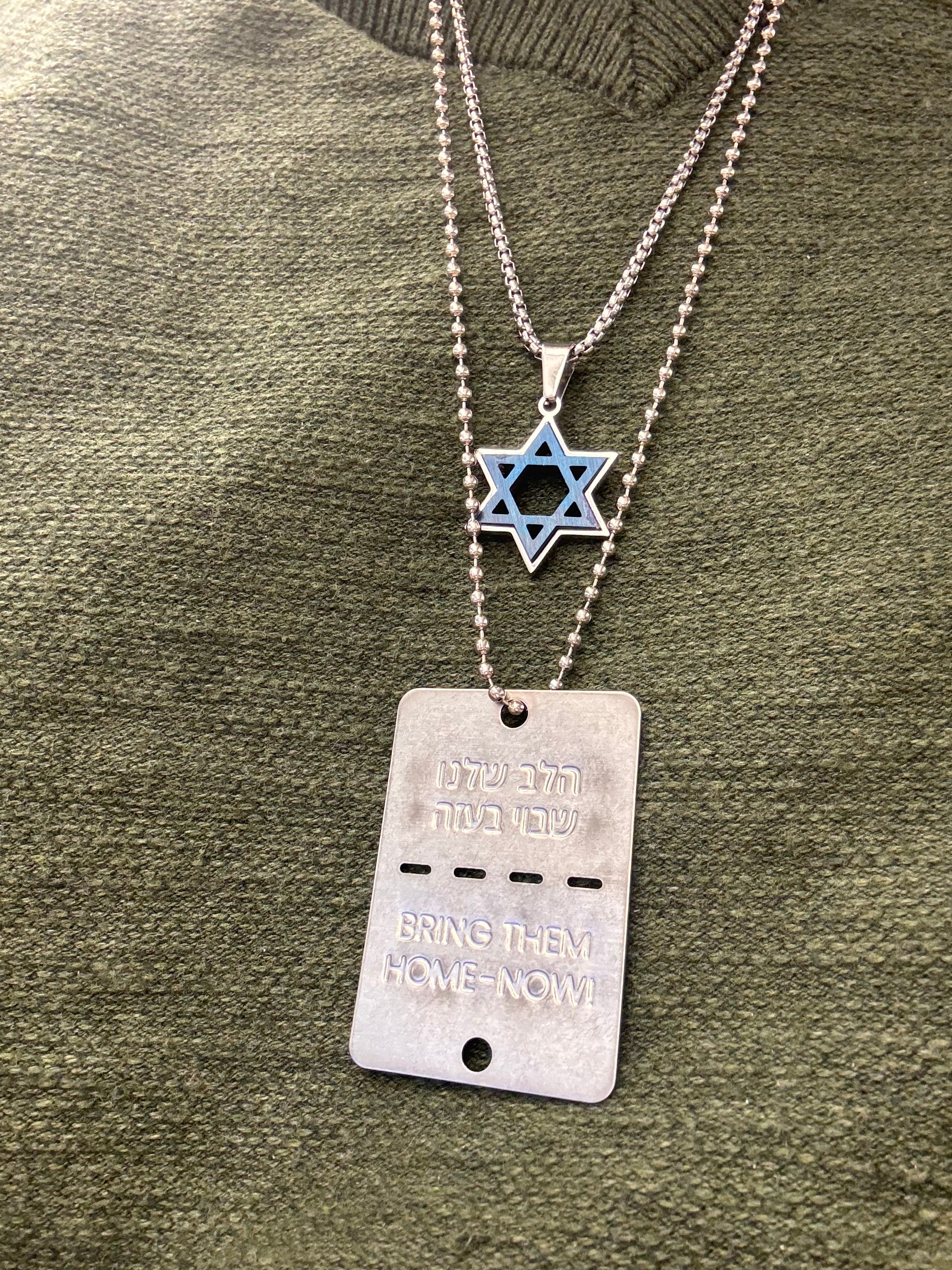
I put on a Star of David.
My wife grew up in Massachusetts as one of the only Jewish kids in her school. She heard the comments. She knew what it cost to be visibly Jewish in a room that was not built for you. I had never experienced that. In Israel, being Jewish is not visible because it is universal. It is the air. You do not notice the air until you leave it.
I put the necklace on in front of a mirror. It felt completely out of place. Like a costume from someone else’s life. I walked into the other room without saying a word.
It stopped my wife cold.
I wore it to the gym. I was nervous. No reactions that day. Some since. I kept wearing it.
Not because God told me to. I am still not sure what I believe about God.
I wore it because my people were under attack and I needed the world to know whose side I was on.
There was a Groucho Marx line I used to hide behind. “I don’t want to belong to any club that would accept me as a member.” It turned out to be the operating system of an entire generation of Westerners who have been taught, from the classroom up, that pride in their own civilization is evidence of its worst impulses. They do not want to belong to the club of Western culture because Western culture, they have been told, is the villain of every story.
A generation that belongs to nothing, stands for nothing, and falls for anything.
A generation that reaches for the nearest available identity. A kaffiyeh. A cause. A hashtag. Whatever the algorithm is currently rewarding.
They do not hate Zionism because they understand it.
They hate it because it reminds them of everything they were told to abandon and cannot get back.
Zionism is not a theology. It is a declaration. It says: we are here, we belong here, we are not disappearing, and we are not ashamed.
About a year ago, the kaffiyeh disappeared.
He had moved on. The algorithm had moved on. The fad had run its cycle and he had found something new to wear around his neck, or perhaps nothing at all, which is the natural resting state of a person with no particular reason to stand for anything.
My Star of David is still on.
That is the difference between a fad and a principle. Between a cause you adopt because it is available and an identity you carry because it is yours. Between people who perform belonging and people who have it.
I spent twenty years hiding the Hebrew. I ran from the abrasiveness, the bluntness, the urgency. I built a life in America and envied the lightness of people who had never been asked to carry what we carry. And then I put on a Star of David and walked into a gym in North Carolina, and understood, finally, what I had been running from and why it had followed me across an ocean and would follow me for the rest of my life.
Not because I can’t escape it.
Because I don’t want to.
The yalla was never what I was running from.
It was what I was made of.
Yalla.
This is one of many Echoes from the book I’m writing.
Fragments of a larger story about survival, inheritance, and identity.
If you want to be among the first to know when it’s ready, you can join the early reader list.
If you want to simply follow along it as it comes together, you can subscribe. Everything I’m writing lives on the feed.
Most readers find me through my Notes.
This is where the Notes find their roots.
No posts
Comments
Nothing yet. Say the first thing.
Sign in to join the conversation.